SUSTAINING YOUR PRACTICE: ASSIGNMENT 5 ARTIST TALKS

MOTIVATION, EXECUTION and EVALUATION

(Evaluation details below in Part 3)
Part 1: MOTIVATION

At the outset of the project (Project Proposal draft Assignment 2) I was adamant that wanted to attract limited local attention, due to local sensitivities. My Tutor challenged this as did my peers as my work began to take shape. I revised my intention a few months later as feedback told that the narrative was common to many localities, and decided to offer artist talks to a range of local people, to engage with an audience and offer the opportunity for them to reflect on the nature of community

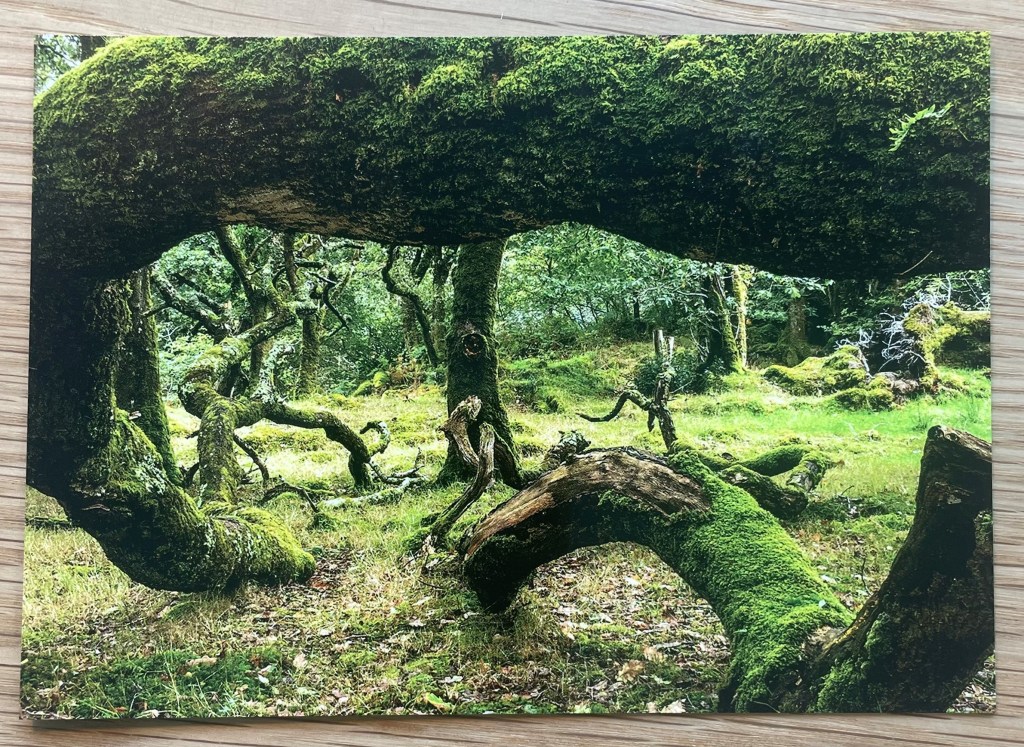
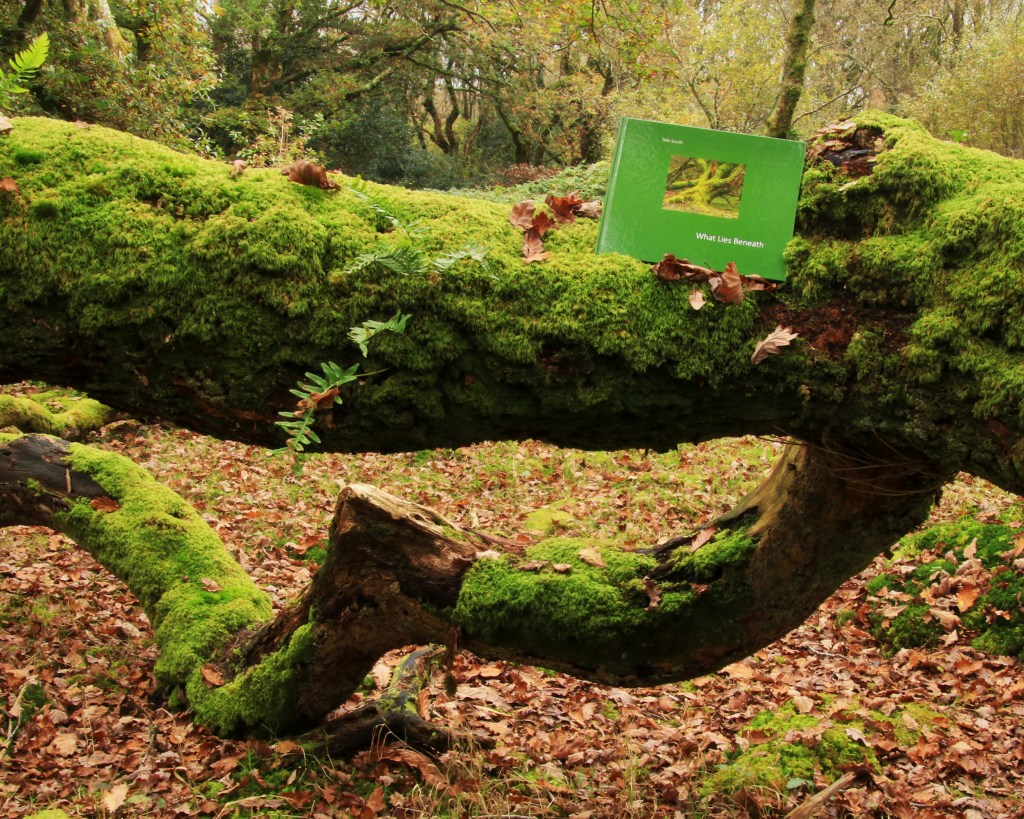
I chose initially to do these 1:1 as I thought this would be more likely to give frank responses. I invited people via promotional postcards and offered another of their choice to takeaway and as potential promotional material:

As I gave publicity postcards away, word got around and I had locals ask me if they could see my book

Part 2. EXECUTION

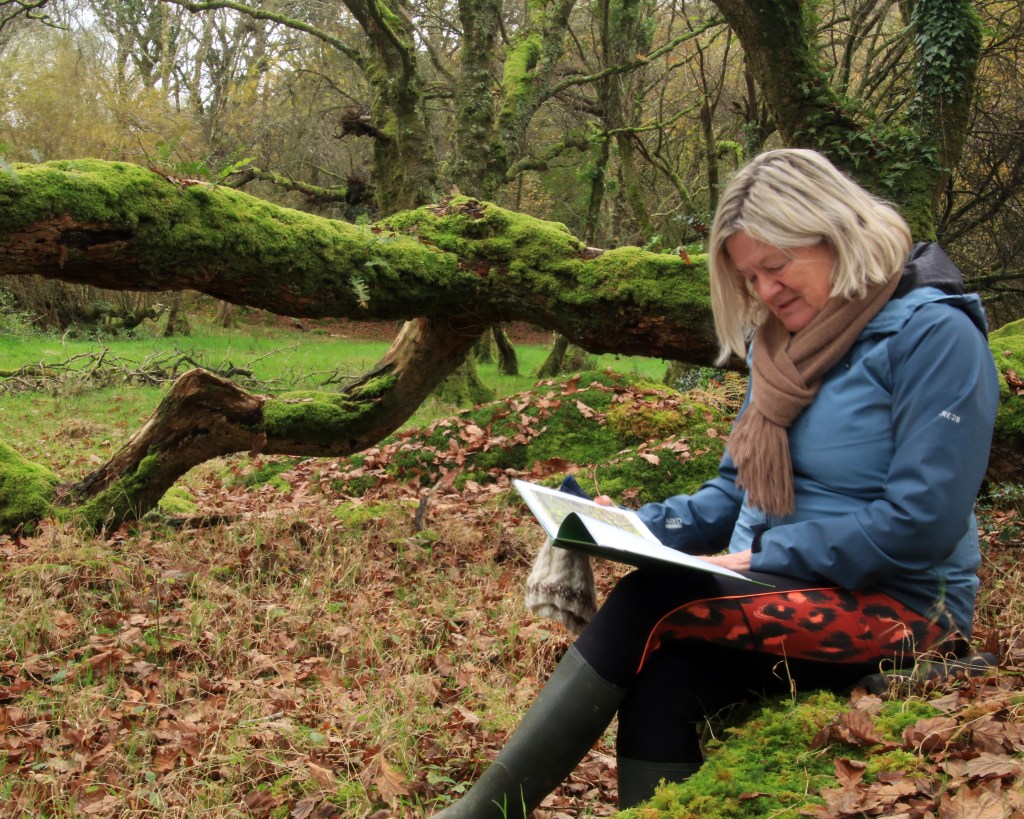
Artist talks in the woodland where the images were photographed

21.10.24 with Kathryn

She said that the preface prepared her for the upcoming content well – the what and the why.

As she viewed the main images and couplets, she said “it made me reflect on my previous experience of human relationships, in fact ones away from this locality”. She spoke of her experience of others often not being generous, and how a lot of social etiquette is in fact ‘bollocks’. She liked many of the word choices such as ’festering’ which she called evocative. Kathryn said that the images and words relating to the woodlands conveyed a softness and peacefulness which is what she experienced in the woods at that moment, and of a sadness that is evident in the work. She particularly like the ‘residents’ images and definitions, saying it brought it home that diversity in a community can be quite simple.

She offered an interesting suggestion that the ‘residents’ images would be good behind ’flaps’ as readers may expect to see human portraits next to the definitions, and then be surprised.

My learning from this first artist talk was that the 1:1 talks are an effective method for sharing and gaining personal feedback on the work. It seems to create a mirror for a reader to reflect on human relationships in a fruitful way as well as offering an opportunity to enjoy the woodland community featured in it.

A big learning point was that the work is not obviously about one particular place (e.g. This local community) as the experience described in the work is very generic and applicable to most locations and networks; she believes I am reading too much into it with my fear of discovery.

Kathryn also said that the work doesn’t come across as harmful in any way, as it is sensitive, and not at all negative; it just has a feeling that it was made by someone who has experienced sadness and wishes for better relationships. She actually said I had “boiled the pettiness out of it”. I was able to explain about ethics in photography and how this project meets my aims.

She said she was very ‘affected’ by the photography, and enjoyed the self-reflection it provoked.

23.10.23 with Marianne

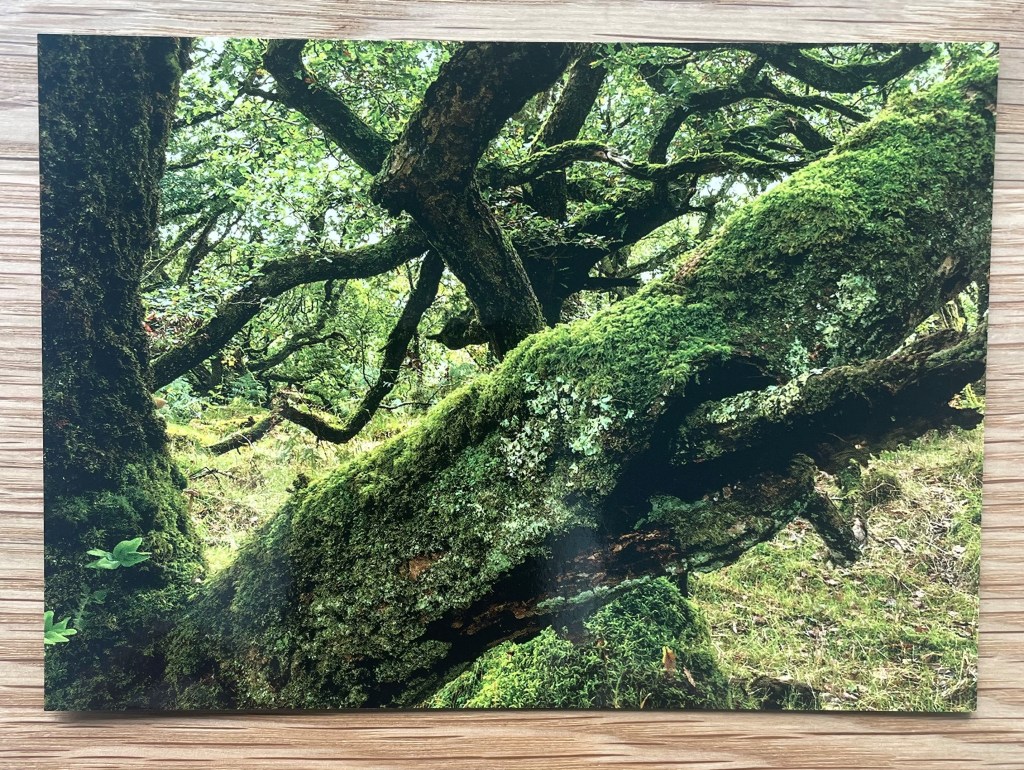
Beginning with the preface she immediately recalled a conversation with some tourists she bumped into recently and a conversation shared about locals an incomers. They related that where they have lived for 30 years they will never be considered local. Marianne referred to herself a ‘blown in’ though she’s lived here for years. She concurred with a line in the preface that incomers contribution to communities are rarely acknowledged.

Viewing the 1st image, and looking around herself at the woodland, she reflected how diverse the woodland is and it yet adapts over time; conversely that humans seem resistant to change. Reading on she commented on the layering there is in the words and how it draws her into the images.

When musing on the ‘residents’ section of the book, she reflected on how in small human communities there can be a lack of perspective as they lack context, and the feeling that you can’t sneeze without someone knowing. This led her on the recount an experience she’d had with a local neighbour.

Marianne said that she found the book very honest and that I had done well to share my thoughts in a way that isn’t harmful to others but causes you to reflect and respond.

We discussed how I could share with a broader audience locally as she thought it could be shared more widely and that it could be beneficial for others. I said I should be conscious not to restrict my sharing to certain sectors. She commented that we have a very eclectic mix of people living here and that actually to tick all bases would be impossible.

29.1.24 with Jane

She remarked straight away on the quality of the book and paper. Then the strength of the images.

She pointed out that you could construct the same work and point to a different view of human community. Also, that those with less friendly behaviours are just an element of the community and that it is possible that thier expressions are simply their way of functioning in a community – you get gossipers in every community.

She went on to say “the work is very thought provoking as I don’t normally dwell on community behaviours”. She has lived here for 30 years and said she is aware of conflict in the community, but tries to insulated herself from it, by not dwelling on it.

We talked at the end about how the woodland might respond if it had ‘incomers’, aka invasive species; this was a reflection point for myself.
2.11.24 with Rachel

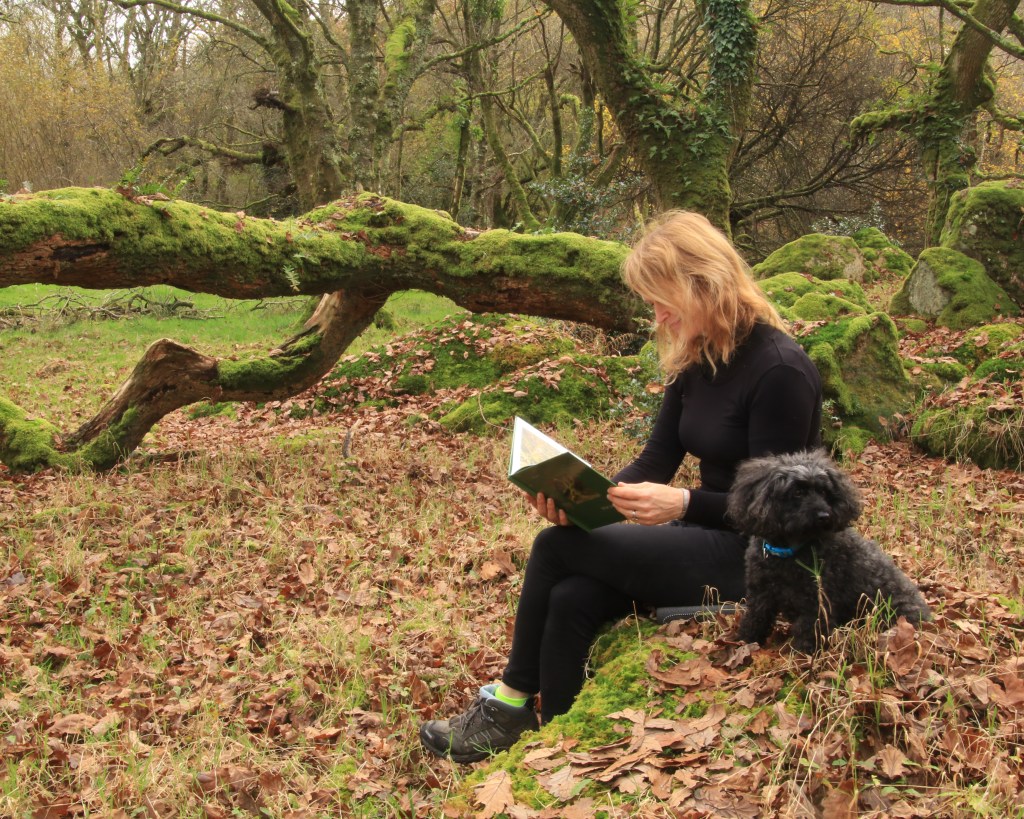
As sat in the woodland the leaves fell around us. Rachel read the book to the end of the ‘community’ section before asking me the background. She then commented that the poetry made her feel sad.

She queried that all is harmonious in the woodland if you widen out from the flora I focused on, for instance the elements and the fauna (food chain) but agreed that for such a diverse community it is relatively harmonious.

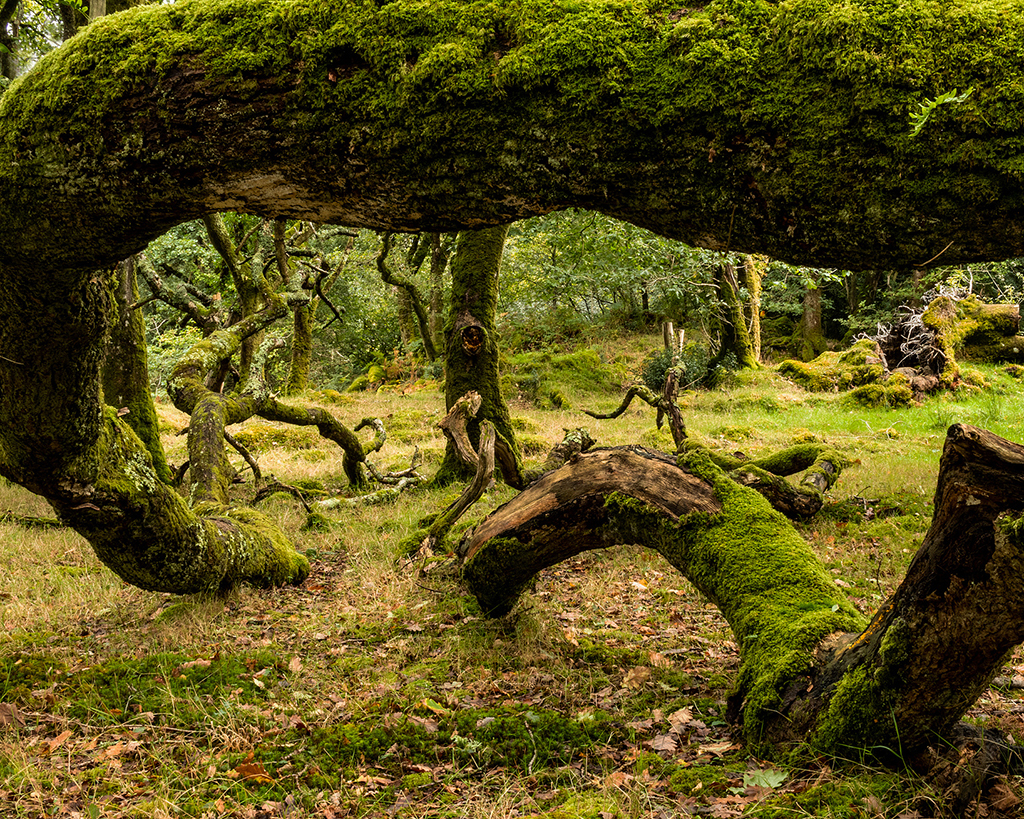
She then focused on the images and said the 1st image conjured up a feeling of protection. and spotted that main images 2 & 5 appear chaotic on the surface, though they were ordered underneath. She also commented that image 6 seemed hopeful and spring like. I shared that she was perceptive as images 2 & 5 were taken when I photographed elements that appear chaotic and image 6 for a subset I called rebirth.

She noted how the top and bottom couplet lines are the extremes of positive and negative, and the language used evocative, e.g. Contentedly and festering. She shared her own always positive attitude to human community, saying it made her consider that all may not be as it appears on the surface and there be other that have different views.

She continued with the ‘resident’ section of the book and enjoyed the close-up images. Her observation was that they could just carry a headline title each, like nourish, and not have the definition as well, leaving more to the viewers imagination.

Overall, apart from loving the images, she commented “the book has made me reflect on the nature of community and consider how others might feel about it”. She read the book quietly several times and said she would like to reread again, saying she enjoyed the layers in it and the reflection it was provoking.

6.11.24 with Sharon

She initially commented that the woodland ‘just is’, whereas words like prejudice and ….are labels that we have in human communities, as humans seem to need to put limits/labels on things. She said that the images made her realise how nature coexists naturally whilst humans need to work hard to come together/ be together.

She said the images showed the diversity and richness of the woodland community.

I asked if she thought my signposting text was harsh on humans, and she replied that no she thinks it’s a reality in communities generally, and agreed that the contrasting words chosen for the poetry was completely appropriate.
  • I will continue with and expand my artist talks to local audiences
  • Experiment with Artist talks outside of the woodland, where and will be open to holding group sessions
  • Capture feedback.
  • I have been asked to present my work to a group audience, at a County organisation, and will look for similar opportunities.

Had I not disseminated my work through Artist talks I would not know that I’d met my project intentions, nor would have evidence of this:

” The book has made me reflect on the nature of community and consider how others might feel about it” (Rachel at artist talk)

LO5 confidently engage a public audience with your practice and analyse, review and evaluate information relevant to your practice, identifying opportunities for professional development

MY ETHICAL CODE

Whilst developing and resolving my project ‘What Lies Beneath’ I have been aware at all times of ethics in photography and my ethical code. See my previous post:

Ethical code – Niki South

Principle: My photography maintains my freedom of thought and expression, whilst not harming others.

Enacting: I will be aware of the possible impact of my images and accompanying text and recognise other’s perspectives. I will be honest in my representations. If I wish to publish or exhibit my work I will seek permissions from any individuals represented.  If my work does not represent individuals but does points to generic groups/sets, it will retain anonymity to any particular locations or groups of people.

Principle: I support the protection of sensitive environmental locations.

Enacting: I will be cognizant of whether there is a need to protect a habitat or location, if so I may choose to keep it anonymous, by not sharing with others where my work was photographed.

Principle: Whilst working I do not spoil enjoyment of others in the same location or setting.

Enacting: When photographing I am conscious of others around me. I am careful not to impede their access, and don’t act in any way that would impair their experience of the place. I will be discrete and respect others privacy.

Principle: I am considerate of the environment.

Enacting: When working in the landscape I will leave no trace behind. I will be aware of how the landscape is when I enter, then tread carefully and leave everything as I find it.

Principle: My photography represents subjects with integrity.

Enacting: When photographing, editing and presenting my images, I try to give as much context as is necessary, and do not change or manipulate the context of a subject if it misrepresents or harms another.

How this relates to my SYP project

As I choose what I photograph and how I present it, I know I am responsible for being critically, situationally and culturally aware. I self-reflected throughout the process asking:

Who am I in relation to the story I am telling? I am both an incomer and a local resident, but not a born and bred ‘local’. I have spoken with a broad range of community members and researched economic, social and political facts.

What assumptions do I carry? What biases do I carry? I can appreciate the position of incomers who suffer disadvantages locally as well as the benefits of enjoying the area. I can also understand the viewpoints of locals who sometimes embrace the benefits of incomers and visitors and sometimes bemoan them. I can see the benefits and the economic need for seasonal tourism but share the discomfort of ‘locals’ in season when the population swells.

What are my motivations, reasons for documenting the story? Though I can understand the various perspectives, I am saddened by the behaviours and the lack of understanding that this diversity provokes.

Is the language that I’m using honest? I believe so.

Consider the impact the work may have make careful decisions about where work is shared – how to share my work without upsetting others – minimising harm – recognising other’s perspectives. I am mindful that my representation should not cause harm to others. This is why I have reservations about sharing my work widely locally. I have learnt that to be accepted in the community it is best to keep your opinions and feelings hidden. This particularly when you are not a ‘local’ here. Most are quite gentle here apart from their tongues; however there have been times when ‘outsiders’ property has been damaged as well as their reputations in response to locals feeling threatened in some way.

This is why I am not exhibiting locally, I have not named the Town I live in, or the location of the woodland.

I have also protected the location of the woodland, a rare temperate rainforest, and acted environmentally responsibly when photographing.

SUSTAINING YOUR PRACTICE: ETHICS IN PHOTOGRAPHY

ETHICS IN PHOTOGRAPHY

Ethical literacy is about having the skills to make sound ethical decisions. These skills include things like critical thinking, situational awareness, and cultural sensitivity. In June 2023 I attended an understanding ethics study day with the photo ethics centre, to develop skills to think critically about ethics in their work.

My notes:

We make ethical decisions at every stage of photographing. Ethics are the principles that guide a person’s behaviour.

  • Ethics can be: Subjective, contextual (geographic/cultural – where & why), genre & institutions/guidelines/policies
  • Fluidity is important, interpretations are different – principles-based approach to ethics gives us rules to navigate and adapt.

We have the power to select what and how is photographed & power to determine how it is pictured.

Bias- we all have our own assumptions and need to be aware of them –

Be aware how our aesthetic choices are going to involve: stereotypes, top down or on a level

We viewed a Ted Talk on The Danger of a Single Story (Chimamanda Ngozi Adichie, 2009): This presents a picture of people as 1 thing & 1 thing only and this is what they become. People are defined by the power of another person but to make it the definitive of the person.

Q: What kinds of ethical principles are important in photography?

  • Facts don’t mispresent.
  • Give context /don’t not give context or change.
  • Don’t change facts postproduction.
  • Don’t share unless permission – consent? A human right to make decisions about yourself/autonomy.
  • Terminology – don’t use ‘shooting/capturing’
  • Ask, should I photograph or intervene, or not?
  • Caption carefully

A STATEMENT OF ETHICS is a declaration of your ethical principles and a description of how you enact those principles in your photography practice. To make a statement it was suggested:

  1. Self-reflect:
  2. Why do you do the work that you do? What drives you?
  3. What ethical principles guide you in your life and your work?
  4. What photographers do you admire? What do you admire about them?
  5. What people or ideas have shaped how you think about photography or about your role as a photographer?
  6. What do you want to work toward or improve about your practice?
  7. Begin with principles, then identify actions. For example, it is good to say that you value dignity, but it is far better to explain what dignity means to you, whose dignity you are talking about, and how you will uphold dignity in your practice.
  8. Select the key ethical principles which you feel are central to your work.
  9. Craft a definition for each principle you have selected.
  10. Identify tangible actions for each principle that can help you to enact it within your photographic practice.

I have subsequently revisited the website of the Ethics centre and note:

  1. Visual story telling is a collaboration. Collaboration is a kind of insurance policy against the reproduction of stereotypes, by inviting others’ views ‘photographers are less likely to reproduce their own assumptions about a community, place, or person’ in the images: Listening sessions  are opportunities to  integrate opportunities for feedback. Sharing images with community members to listen to their reflections.
  2. A photographer’s positionality shapes the stories they tell. Practice reflexivity, what assumptions do I carry? What biases do I have? Who am I in relation to the story I want to tell? Am I the right person to tell this story? ‘you need to be conscious of your unconscious bias’. ‘Traditionally documentary photography has been concerned with photographing disadvantaged, underprivileged, exploited communities’ J(ustin Carey cited in Dodd, 2009:5)
  3. The language we use matters: Verbal and visual language.eg misuse of shooting/capturing.
  4. Consent is a dialogue that takes time. Full consent is a long/ongoing conversation.
  5. Transparency is key for building trust. Trust at all times, including between and following photographing.
  6. Photography is powerful. It is universal. It can be used to enforce or challenge stereotypes. Let go if you have a power position.
  7. Good intentions are important, but they are not always enough. Look at the objective and your own reasons for documenting a subject. Understanding your motivation is important self-reflection. Understanding your motivation and where the roots of the work will help you to understand the impact the work is likely to have in the world.  P15
  8. Photography ethics change. New knowledge and understanding, changes in society, technology and practices means that our responses to ethical decisions may change.

References:

Chimamanda Ngozi Adichie (2009) The danger of a single story Directed by Adichie, C.N. At: https://www.ted.com/talks/chimamanda_ngozi_adichie_the_danger_of_a_single_story (Accessed  19/10/2024).

Dodd, S. (2024) Eight lessons from the photography ethics podcast. Photography Ethics centre. At: https://nkssite6.photo.blog/wp-content/uploads/2024/10/2237e-eightlessons-english.pdf

Dodd, S. (2020) On self-reflection and vulnerability in photography. At: https://www.photoethics.org/content/2020/7/14/on-self-reflection-and-vulnerability-in-photography (Accessed 19/10/2024).

Resources:

Principle: My work will maintain my freedom of thought and expression, whilst not harming others

Enacting: I will be mindful of the possible impact of my images and words on others and recognise other’s perspectives. Then I will consider whether I should exhibit or publish.

Principle: I support the protection of sensitive environmental locations

Enacting: With an awareness of whether there is a need to protect a habitat or location, I may choose to keep it anonymous, by not sharing with others where my work was captured

Principle: Whilst working I will not restrict anyone else’s access or enjoyment of the location

Enacting: When in a location I am mindful of others in a location and don’t restrict their access or enjoyment of it.

Principle: I am considerate of the environment

Enacting: When working in the landscape I will leave no trace behind. I will be aware of how the landscape is I enter, tread carefully, and leave everything as I find it.

Principle: I try to give as much context as is necessary and do not change or manipulate the context of a subject, if it misrepresents or harms another.

Enacting: When shooting and editing I am mindful that my representation should not cause harm to others.

Drafted June 2023 and revisited August 2024

COMPETITION ENTRY: LIGHTREADINGS

Open Call for online exhibition and print issue

 https://lightreadingsmag.com/open-call-enigma-of-life/ lightreadingsmag@gmail.com

Submission deadline: 31 July 2024

You will need to submit to lightreadingsmag@gmail.com the following:

  1. 5 – 10 images of your work (no signatures, watermarks or writing), attached to your email.
    Please do not insert the images on the email body.
    All images must be submitted as JPEGs (size 1500px on the longest side, 72dpi). The file name of your image must begin with the sequence number for the image followed by your full name. For example:  01_John Smith.jpeg.
  2. Two to five lines of text to explain your approach. (Please, no artist statements.)
  3. Inform us if you wish to participate in the printed edition of the magazine. We will contact you with further details if selected.
  4. Your Instagram name so we can tag you.

The deadline to submit your entry is 31 July 2024 at 11.00 pm CEST. Participants names will be announced on 12 August 2024.

“Enigma of Life”

We welcome photographers who depict in their visual investigations many unknown aspects of life, such as subculture – images that makes us conscious of our own human existence, our ways of living and that of nature’s as well, through compelling visual stories. Two to five lines of text to explain your approach

My Submission

Dear Light Readings

Please find my images above for the open call’ The Enigma of Life’, and my text below:

This work, ‘What Lies Beneath’, reflects on community using the landscape of an ancient woodland as a visual model where things coexist and support each other – a contrast to the local community which is often disharmonious and driven by difference, sadly a global issue. Here I point to the inclusive, characteristics of these diverse woodland societies, which would benefit many human communities:

What here lies beneath the emerald wrapping, embracing their collective realm?

What lies elsewhere beneath man’s disguised demeanour, civil but sometimes deliberately divisive?

I would love to participate in the printed edition of the magazine if selected.

My Instagram is: https://www.instagram.com/nikiks_photography/

Many Thanks

Niki South

COMPETITION ENTRY: WHAT YOU SEE IS WHAT YOU GET?

Ffotogallery is excited to present Ffoto Cymru – Wales International Festival of Photography.

Debuting in venues across the country in October 2024. Building on the successes of five editions of Diffusion Festival, audiences are invited to engage with photography in new and meaningful ways through a programme of exhibitions, commissions, conversations, public installations and events.

Our Open Call invites photographers to submit an existing body of work for consideration to feature as part of this year’s festival responding to the theme What You See is What You Get?

Theme: What You See is What You Get? is intended as a provocation, an invitation to question the literal translation of visual information. Do we really get what we see? Or is it more complicated than that? What You See Is What You Get? explores how we see, understand and use images, how

This opportunity is open to all artists inside and outside of Wales, but must respond to the theme of this year’s festival, “What You See Is What You Get?”. Up to four selected artists will receive a £400 artist fee, with all print and production costs covered by Ffotogallery as part of Ffoto Cymru 2024.

Selection:

  • The initial selection of digital submissions will be made by Ffotogallery. This decision is final.
  • Key dates: Submission deadline closes at 23:59 BST Tuesday 30th July 2024
  • Successful Artists will be informed w/c 5th August 2024
  • Digital print files of selected works to be delivered to Ffotogallery by Friday 16th August 2024

Exhibition Dates run 1st October 2024 – 31st October 2024

How to Enter: Complete the online submission form at the bottom of this page and submit. There is no limit to how many times you submit bodies of work for consideration but we will not display more than one series by any one artist as part of this year’s festival.

My submission

This work transforms subconscious thoughts, into the visually concrete. Though humans provoked the work, they are not evident in the images.

‘What Lies Beneath’ expresses my reflections on community using the landscape of an ancient woodland as a visual model where things coexist and support each other.

Conversely my local community is often disharmonious and driven by difference. The inclusive, characteristics of these diverse woodland societies, would benefit human communities where sadly ‘incomers’ like me, are never accepted as local, no matter how long passes, or what they contribute to the neighbourhood – a story common to settings globally.

In this work, combining the world in my head, with the one in front of me, has helped to heal some of the wounds that inspired the story’s beginning.

What here lies beneath the emerald wrapping, embracing their collective realm?

What lies elsewhere beneath man’s disguised demeanour, civil but deliberately divisive? 150

Please share a brief biography or artist statement (max 150 words)
Niki South is a visual artist born in England, now living in Pembrokeshire Wales. Visiting Pembrokeshire she found a hiraeth (deep longing for the place), and after spending years living a ‘dual centre’ life between the two places, is now located there permanently. She is currently finishing her BA (Hons) Photography degree with the Open College of the Arts.

She uses photography as a medium for expressing her reflections, photographing in a metaphorical manner. Her work is shaped by research on ‘affect,’ expressing what is in a photographer’s mind, versus ‘effect,’ realism. Previous works have focused on ‘Layers of Truth,’ whilst others are visual metaphors on issues of the moment.

Niki’s photography is a personal response to dynamic landscapes both internally and externally. She finds combining the world within her head with the one in front of her cathartic – a way to filter and express her subconscious thoughts. (149)

Please submit up to three images that you are submitting for this application, or that best represent your project. (2MB file size each-verbal Bob 10 mb altogether) check submission detail on return to email

Ts & Cs iv: All works must be clearly labelled with the name of the artist, title of work and its orientation (landscape or portrait).

Community

Harmony

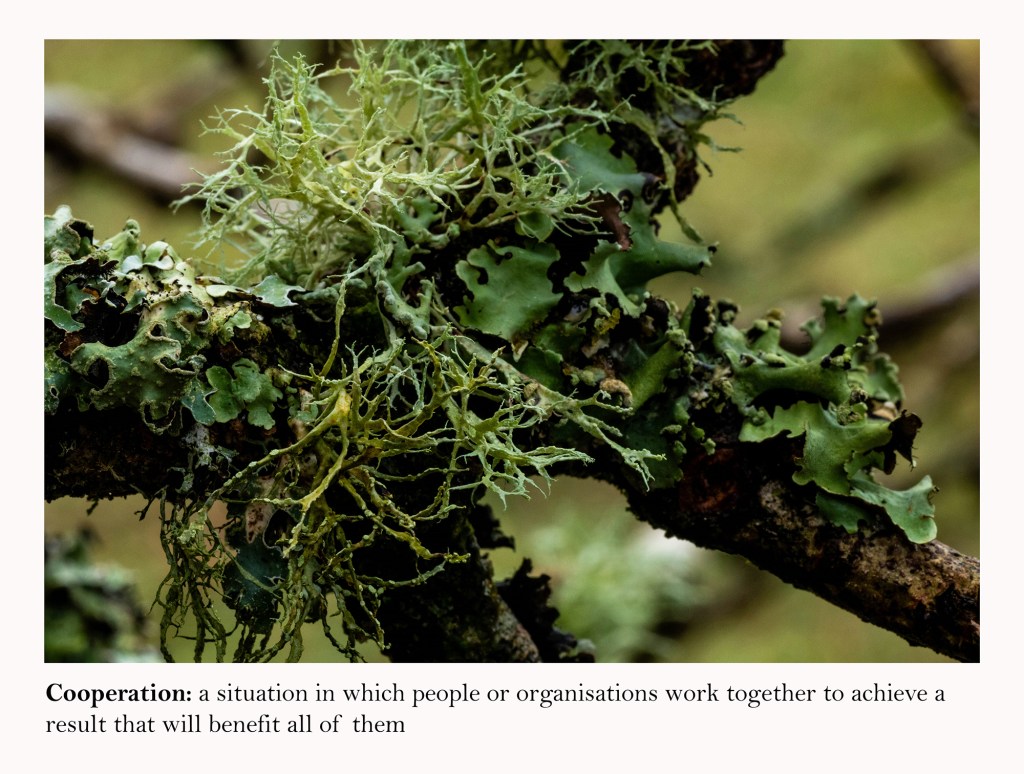
Cooperation

I wasn’t selected for this open call, which was a shame as I felt that my work fitted the brief well. It will be interesting to see what was selected.

PORTFOLIO REVIEW

LENS CULTURE CRITICS CHOICE: I paid for written review when I entered the competition deadline 17.4.24

Portfolio review

  • Be concise when explaining my concept & I edited my artist statement for my next submission
  • Consider where I place the definitions with the footnote images

MY SUBMISSION IMAGES AND STATEMENTS: My submission: https://www.lensculture.com/submission-reviews/107428

See written review at bottom of post:

I submitted 10 images, to be judged as a series, that works as a group, thematically or aesthetically:

WHAT LIES BENEATH

Statement for Lens culture

What Lies Within, is a series of images taken in an ancient woodland. A conceptual project, it uses the landscape as a medium to express my thoughts on community. The photography transforms abstract ideas in my head, into something concrete, positioning the ancient woodland as a visual metaphor for community.

Though humans provoked the concept of the work, they are not evident in the images. The local community, often disharmonious and driven by difference, is in stark contrast with the harmonious characteristics of the woodland society. Footnote images signpost inherent qualities like cooperation, support, diversity, resilience, inclusion, networking, mutual exchange, and adaptation, which could be beneficially adopted in many human communities.

Known and accepted for some years, like other incomers in my neighbourhood, we are never adopted as local, no matter how long passes or the contribution to the community – a story common to settings across the globe.

Combining the world in my head with the one in front of me, through an internal and external passage through the landscape, has helped to heal some of the wounds that inspired the story’s beginning.

Niki South

ARTIST BIO for Lens culture

Niki South was born and grew up in England. From 1995 she began holidaying in Wales; this culminated in buying a second home there in 2009 and transitioning to a ‘dual centre’ life between the two places. In 2019 she relocated to Wales permanently.

Currently completing her BA (Hons) Photography degree with the Open University, she has a particular interest in community. Her previous documentary work ‘Layers of Truth’ was informed by her ‘insider/outsider’ position where she highlighted issues arising during Covid 19 from ‘incomers’ trying to integrate into a small traditional community.

Additional info I gave to the reviewer:

1. What is the single most important question/concern you have about your project that you wish to have answered here in this review? Do the footnotes combined with the artist statement adequately signpost the story behind the series? Can a viewer understand the concept of the woods as a visual metaphor?

2. What do you hope to accomplish with your photography in the next few years? To finish my degree, now 95% complete, to be able to move on and follow my inclination for combining narratives from my subconscious with images from the conscious world. I would like to publish other visual stories.

3. Is this an ongoing or completed project? It will be completed soon when I publish a book with the images and accompanying poetry that I have written, that completes the signposting for the narrative.

4. Do you consider yourself a ? photographer? advanced

5. What genres of photography do you work in (mark all that apply): fine art, documentary, imaginative storytelling

The review:

https://www.lensculture.com/submission-reviews/107428  26.4.24

Hi Niki,
 
You can view your completed Submission Review here»
 
Thank you for trying out our Submission Review service. We hope it helps you refine your future competition entries! And we’d love to hear what you think. Please email us with any comments or suggestions. Thanks again!
 
Cheers- 
The LensCulture Team

It isn’t happenstance that you are using a forest as a metaphor for community. Fungi, aspen groves and many tree species are known to have elaborate networks of communication that bind them together. Not to mention all the other small organisms that make up the ecosystem that sustains the life of what we are seeing in your photographs. You pull any single member of the community out, and the whole forest suffers. Despite that the knowledge is out there for humans to make sense of it all, we continue to make the same, irreversible mistakes, over and over. And this project brings these questions, and more, to my mind. 

In response to your request for feedback, I am still a little confused by the overarching idea that you are going for. If what I have said above rings with you, I think it would be helpful to state it somewhat directly and concisely. For example, instead of saying “The photography transforms abstract ideas in my head, into something concrete,” and defining your work as a “conceptual project,” I would simply say “”What Lies Within” uses the forest landscape of [name the forest] as a metaphor for human communities and civilization.” Or something like that. 

That being said, I still want to understand how you see human communities as stark contrasts to this forest communities, but are using the forests as a metaphor for the human communities. Perhaps they are not a “metaphor” but a “model?” In other words, are you suggesting that these woodland spaces are a model for what it means to be a part of a community and to live in an ecosystem where all things must coexist and support each other’s life processes? Again, I am very interested in the ideas. I just think it’s a question of being clear and concise: especially when submitting to a contest like this where jurors have so little time to spend with each submission/statement. 

I also don’t know if you need to include the words with their definitions beneath the photographs. I think you can say everything in the statement and then rely on the viewer’s intellect to realize that what they are seeing are prime examples of what those words represent. Perhaps you can include those exact words in your statement and then give an example of how that plays out in the woodland environments. But my sense is that this project could exist as two separate entities: image and text. 

Otherwise, I haven’t talked about the images themselves. And I personally find myself getting lost in the beautiful, dense and elaborate spaces you are creating/seeing. The compositions are complex, often surprising and always seductive. These are hard landscapes to render and it feels like you have an eye for figuring them out. 

It’s a pleasure to discover this series, Niki. Wishing you the best of luck. 

Regarding the introduction:

“What Lies Beneath’ expresses my thoughts on community, using landscape of an ancient woodland to create a visual model where things coexist and support each other. Footnote images signpost its inherent qualities like diversity and cooperation. My experience of local human communities provokes the project’s concept, where conversely they are often disharmonious and driven by difference. Sadly, incomers are never accepted as local, no matter how long passes or what they contribute to their neighbourhood – a story common to settings across the globe. This work has helped to heal some of the wounds that inspired the story’s beginning.

What lies beneath the emerald wrapping, embracing their collective realm? What lies elsewhere beneath man’s disguised demeanour, civil but deliberately divisive? “

I replied to the reviewer:

Thanks for the review. It comes at the beginning of my journey to ‘put my work out there’, so is very timely.

I understand your message to be more explicit and concise when conveying my ideas to viewers/reviewers and thank you for the practical ideas that you have given that I can consider in a reformatting of the project.

It was a very thoughtful, useful review.

Thank you!

LO4: independently disseminate your body of work by establishing relationships and networks with audiences, clients and markets

PORTFOLIO REVIEW

FOLLOWING THE TREES PHOTO COMPETITION ENTRY, March 2024

Trees (2024) At: https://asmithgallery.com/exhibitions/trees-5/ (Accessed 10/04/2024). I paid for a portfolio review with the gallery owners, amanda@asmithgallery.com

The Juror for “trees” had been Wendi Schneider, Denver based photographer, and artist widely known for her luminous gold leafed influenced by a background in painting and art history, and layers oils on her photographs to manipulate the boundaries between the real and the imagined. I realised the importance of researching the jurors after the competition was judged, as all images chosen were akin to her artistic style.

I selected 5 images, for the competition that could stand alone, and then for the review they asked for a further 5 images. See below:

I sent extra images sent for the review including some SYP edited out images, as I felt that they sat on their own well:

Reviewers: Amanda Smith is the founder and co-director of A Smith Gallery in Johnson City, Texas, and a photographer for over thirty years. Amanda’s personal photographic work has been selected for numerous juried and group exhibitions and is included in several private collections. 

Kevin Tully is co-director of the Gallery, an artist, photographer, and woodworker. Kevin has juried numerous exhibitions for the gallery and other organizations over the past nine years. Kevin also does portfolio reviews and mentors individual photographers as well as writing about photography and art.

South tree review Time: Apr 4, 2024 10:00 AM Central Time (US and Canada)

They asked for my questions:

  • I asked if Jurors see titles. They said in their case no they number them, but that where are used titles work well. I think if I was submitting with no context in future I would add a signposting title.
  • I asked what genre they see my work as. They replied fine art, though they said that increasingly fine art photography is defined by post production changes…

I asked for advice on how to gain feedback and of course they said by portfoilio reviews. They suggested I might try:

  • The Los ángeles Centre for Photography
  • The Carmel Center for Photographic Art – Anne Jastrab
  • The Griffin Museum
  • Photo fest
  • Atlanta photography group.

My concern remains how to do this with minimal financial investment as I am not aiming to take the work forwards.

I asked about how to contact other photographers who submitted for feedback/support. They advised that some have websites, or to google, or to use Instagram. They will add the contact details/websites to the winning gallery images, so I will contact one or two of those whose work I like, as a way of networking. Those I thought would be of interest were David Lang, Leslie Giem and Ann Milne. However having researched their work it isn’t relevant to my project, concept or style.

  • Ann Milne / Oasis in the Redwood Forest, Rotorua, New Zealand, annwebbphotography.com, though after research she is a straightforward landscape photographer from New Zealand. Her competition image is unlike any of her other work.
  • David Lang / Spreading Wings / the 27 / davidglangphotography.com Some tree images, though all I phone work
  • Leslie Gleim / New Life, Ohia Tree / lesliegleim.com- Beautiful work but not relevant to my work

ASSIGNMENT ONE Part 2: PUBLICITY PDF REVIEW

Having taken your tutor’s comments on board, use your PDF document (or, if applicable, a hard copy portfolio) to get some feedback from a professional photographer or another professional from within the industry. This could be done via a portfolio review or by a contact you already have.                                     (Boothroyd, S. and Alexander, J; 30, 2020)

ReferenceBoothroyd, S. and Alexander, J. (2020Sustaining Your Practice Course Manual. Barnsley, UK: Open College of the Arts.

PDF review with Ann Sellen OCA Post graduate photographer

I asked Anna , who I had not had contact with previously if she would review my portfolio PDF. I chose Anna, a UK based artist, living only an hour away from myself, as she graduated in 2023 and yet has successfully put her work out there and has had her work featured in many exhibitions and won several awards, for instance work featured at New Blood Art Emerging  art prize 2023 at Saatchi Gallery, Open Walls Arles Vol.4 2022/23 in France, FORMAT International Photography Festival 2023, Earth Photo International Photography exhibition 2023, the Royal Photographic Society International Photography Exhibition 2022, Photoworks UK Graduate Showcase 2022 and other events. Her work won awards, including Earth Photo Sidney Nolan Trust Prize, RBSA Photography Prize 2023, Single Image Award at OpenWalls Arles and FORMAT Shutter Hub portfolio award 2021. 

Also, as her projects often start autobiographically and evolve through extensive research. Transition and migration is a common thread in her work, as is belonging, so I believe that she would be interested in my work, and be able to offer me some useful advice on dissemination it.

This was my contact email to her:

Anna replied saying that she was happy to help, but that I’d have to wait a few weeks. We met by video call 17th June.

This was the draft PDF that I sent Anna:

From our discussion:

  • She understood the concept/intention of my work easily.
  • Said the images strong and particularly like them when presented largest. Many reviewers never read the text so the images must stand out.
  • Thinks the ‘footnotes’ are confusing in the context of the publicity pdf as the images are so different they jar with the rest.
  • Suggested that I shorten the introduction, explaining that reviewers want their attention grabbed quickly or they just move on.
  • Suggested renaming the ‘introduction’ as ‘project statement’
  • Liked my poetry and thinks it sits well with the images.

My learning and action points for the PDF:

  • Shorten the introduction and rename it as project statement.
  • See if I can enlarge slightly the images that sit with the poetry, and/or add a separate page for the text as I will in my book.
  • Omit the footnotes from the publicity pdf but include at the end of the book as I intended and at the end of any portfolio review.
  • Have some extra images available for any portfolio review

We also had a free ranging conversation about the rest of my SYP and our photography futures.

Anna suggested look at: WORK Grow show: an online art education platform: https://www.workshowgrow.com/aboutWork Grow Show (2024) At: https://www.workshowgrow.com/about (Accessed 29/06/2024).

What’s included

  • Bi-Monthly group mentorship session with Natasha Caruana 
  • Monthly workshop covering professional and personal development
  • Monthly crit give and receive feedback on your work
  • 24/7 support from a members only co-working space
  • Special Projects real opportunities to network and get your work out there

It is very expensive: monthly: £59 per month, quarterly £162. annually: £612 charged once a year.

I might consider joining if I can get a reduced rate for a couple of months to access past and upcoming workshops (Feb 11th Finding and engaging your audience, March 25th getting published and commissioned, April 29th funding an artist book, Jun 10th Crowd funding, Aug 26th Project planning, Aug 19th Submitting for open calls, Jul 22nd Writing a book.

28.6.24 I wrote:

COMPETITION ENTRY

7. Loosenart: SOMEWHERE Online Exhibition │ Paper Catalog Release. Deadline 12.6.24

for August publication: https://www.loosenart.com/pages/calls

Call for Online Exhibition / Paper Exhibition Catalog Release

FREE ENTRY

The call is aimed to artists, photographers, video makers and visual digital designers, open to any style, genre and subject. invited to submit 1 up to 3 works addressing the theme.

SUBMIT 1 TO 3 WORKS 5mb each max

The theme of our online exhibition – and for which it sees the paper release of its catalog – refers to those indefinite places and contexts, fantastic places in which to get lost, places of escape from reality where freedom is experienced by rediscovering that sense of union and harmonious cohesion with the environment. Places that reveal the personal perception of the world and the authentic emotional experience, where the “self” is transported by osmosis into a timeless and “placeless” space.

Statement Max 80 words: No statement will be published if exceeded

MY SUBMISSION

Name and Surname:       Niki South

Email Address: niki.south@hotmail.com

Website:             https://nikisouth.myportfolio.com/home

Instagram:          nikiks_photography

80 word statements – images under 5mb

TITLE WORK#1   What Lies Beneath: Community

    Media: Photograph

    Year of realization: 2024

    The image is from my series ‘What Lies Beneath’, which expresses my thoughts on community. Here the ancient woodland landscape provides a visual model of an environment where diverse beings coexist supportively; the perfect antidote to my own often disharmonious local community. This photograph is a portal to a cohesive peaceful community.

    What lies here beneath the willing emerald wrapping, accepting their collective realm?

    What lies elsewhere beneath man’s disguised demeanour, civil but deliberately divisive?

    TITLE WORK#2   What Lies Beneath: Harmony

    Media: Photograph

    Year of realization: 2024

    This is the second image in my series ‘What Lies Beneath’, expressing my thoughts on community. Here the landscape of an ancient woodland creates a visual model of living harmoniously, a contrast to my local human community. Though the environment may initially appear chaotic, on closer sight it shows that freedom of individual parts can also bring strong unity.

    What lies here beneath the luminescent selfless sheaths, accepting mutual benefit?

    What lies elsewhere beneath undesired need, acknowledged but resented?

    TITLE WORK#3   What Lies Beneath: Reciprocity

    Media: Photograph

    Year of realization: 2024

    This is the last in my series of images ‘What Lies Beneath’, expressing my thoughts on community. Here the landscape of an ancient woodland creates a visual model where things adapt empathetically, in contrast to the local human community. This photograph offers an escape to a welcoming environment delighting in the reciprocity that is possible in a community.

    What lies here beneath the softest downy dress, sharing nourishment contentedly?

    What lies elsewhere beneath community spirit, concealed but festering? 79

    Confirmation email 9.6.24

    COMPETITION ENTRY

    Suboart Magazine entry for July 24  – Deadline 29th May

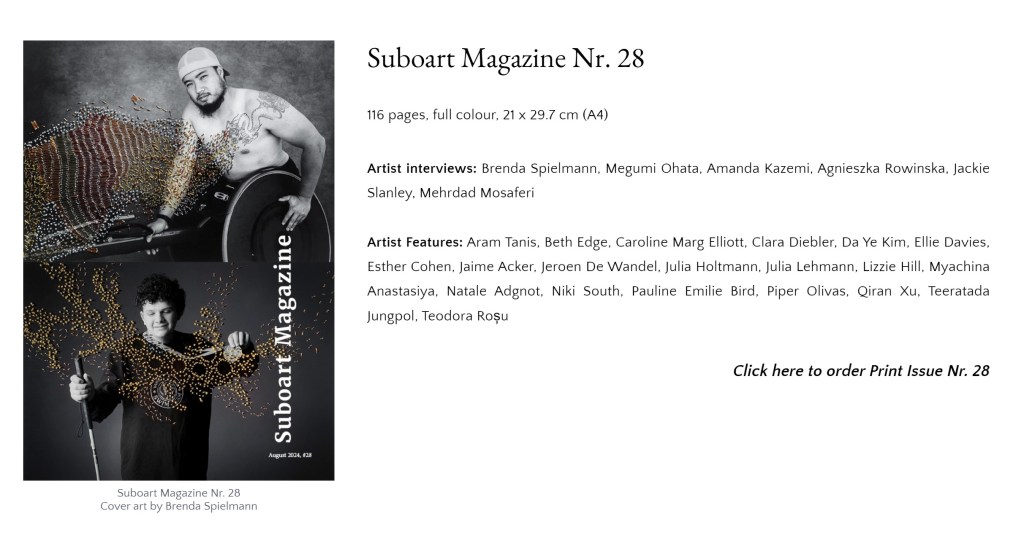
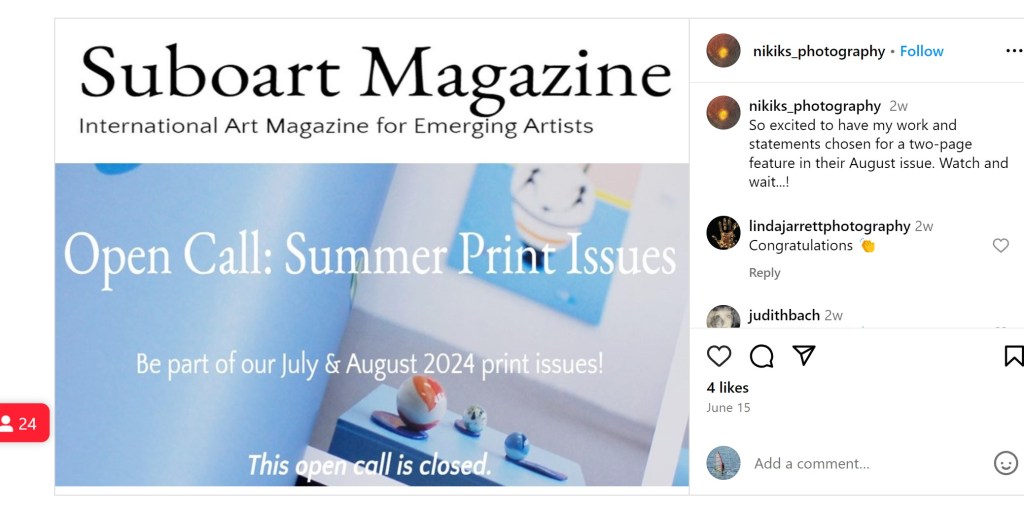
    Success – two page feature in August magazine:

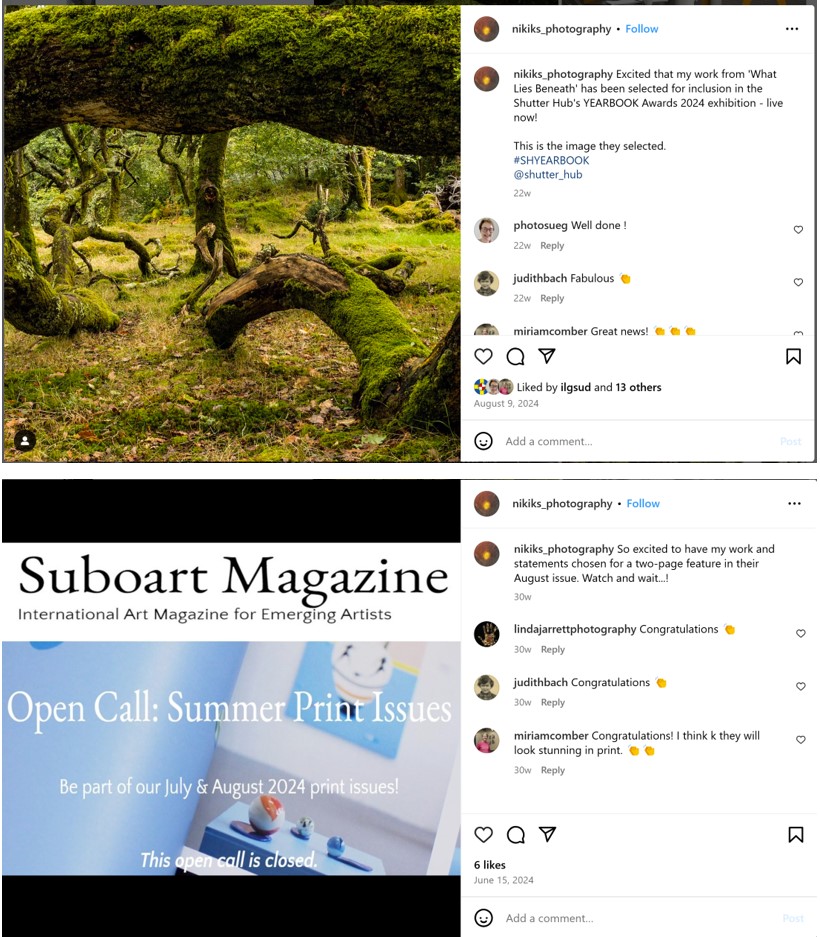
    This was my first successful Magazine submission and success was based not just on the images I submitted but the Bio, artist/project statements submitted. I had learnt to adapt my artist statement and bio for specific audiences and specifications (this entry was my 7th adaptation). It seems I’m getting better at matching pitches to audiences.

    It was also the 1st time that I had to approve a proof copy of my work.

    I share the news and promoted my work on instagram:

    The submission process:

    What? Get your work published in our beautifully designed & carefully curated July and August 2024 print issues!

    • Features are in between 2 and 4 pages long and include in between 1 and 6 of your works, accompanied by your artist bio & statement, website & social media handles
    • Interviews are in between 4 and 12 pages long and give you the chance to speak about your path towards becoming an artist, your practice & specific projects you’d like to highlight, your creative process, upcoming projects, and more.
    • Q&As are in between 4 and 6 pages long and are a shorter version of our interviews that allow artists to speak about their work, inspiration, projects, and themselves.
    • All artists will receive photos of their physical pages that they are free to use on their social media accounts & website
    • All artists will be featured on our Instagram account
    • Print issues will be available for purchase internationally through print on demand

    How to submit? Fill out the form below and – send a maximum of 6 works to submissions@suboartmagazine.com, subject: JULY 2024. Pictures can be sent through WeTransfer (preferred), Google Drive, Dropbox, attached to email

    Pictures requirements

    • JPG or PNG (no .heic or tiff)
    • named: First Name_Last Name_Title_Year_Technique_Size
    • high resolution (preferably 300 dpi & 31 cm on the longer side, but other resolutions/ sizes are okay, too)

    Information requirements

    • Biography (150 words max. Please do not just copy your CV or exhibition list)
    • Artist or Project Statement (150 max. 1st or 3rd person) 
    • After submitting, please don’t forget to send up to 6 pictures to submissions@suboartmagazine.com, Subject: JULY 2024. All submitted pictures must be high resolution, ideally 300 dpi.

    Fees: To be as inclusive as possible, there is no submission fee to apply to this open call. Upon selection, there is a non-refundable participation fee of 30€ (33$ USD) that allows us to keep on doing what we’re doing. The fee includes a free digital copy of the magazine (PDF) and photos of the physical pages that artists are free to use on their media channels and website. The publication fee doesn’t include a free printed copy of the magazine.

    What else?

    • Print issues will be available for purchase internationally* via print on demand through a link on our website (printed by our partner Peecho), and digital copies of the magazine will be for sale on http://www.suboart.com/shop
    • All artists will get photos of their physical pages and will be featured on our Instagram account
    • It’s not a problem for us if the works have been published in other publications before.
    • Deadline: Wednesday May 29, 2024 11:59 p.m. EST
    • All artists will receive feedback until June 12. In case you don’t hear from us by mid June, please do reach out to us.

    The publication fee includes a picture of the physical pages that the artist is featured on. Artists have permission to use these photographs on their websites, newsletter and social media channels, always crediting Suboart Magazine as the copyright owner of the images.

    The Print Issues will be available for purchase through our website via print on demand.

    Digital issues will be available for purchase on our websites (www.suboartmagazine.com & http://www.suboart.com).

    The July 2024 print issue is scheduled to be released in July 2024 and the August 2024 print issue is scheduled to be released in August 2024.

    MY SUBMISSION

    Artist Bio

    Niki South is a visual artist born in England, now living in Pembrokeshire Wales. Visiting Pembrokeshire she found a hiraeth (deep longing for the place) and spent many years living a a ‘dual centre’ life, between the two places, until relocating there permanently. She is currently completing her BA (Hons) Photography degree with the Open University.

    Niki uses landscape photography as a medium for expressing her particualar reflections, photographing in a metaphorical manner. Her work is shaped by research on ‘affect’, expressing what is in a photographer’s mind, versus ‘effect’, realism. Her previous work ‘Brexit’ expressed her reflections on an issue of that moment.

    Her photography is a personal response to dynamic landscapes both internally and externally. She finds combining the world within her head with the one in front of her cathartic. (133 words)

    Artist Statement

    These images from my series ‘What Lies Beneath’, express my reflections on community using the landscape of an ancient woodland to create a visual model where things coexist and support each other. Here I transform abstract ideas in my head into something concrete.

    My experience of local community provokes the work, where conversely humans are often disharmonious and driven by difference. The harmonious, inclusive characteristics of primeval woodland societies, such as cooperation, support, and adaptation, would benefit human communities where sadly ‘incomers’ like myself, are never accepted as local, no matter how long passes – a story common to settings across the globe.

    Combining the world in my head with the one in front of me, has helped to heal some of the wounds that inspired the story’s beginning.   

    What lies beneath the emerald wrapping, embracing their collective realm?

    What lies elsewhere beneath man’s disguised demeanour, civil but deliberately divisive?                                                                                             (150 words)

    • A beautifully designed two-page feature that will showcase in between one and 4 of your photos and will include your biography, artist statement, website and social media account
    • A photograph of the pages that you’ll be free to use on your website, socials & newsletter
    • A digital PDF copy of the magazine & promotion on our Instagram page through posts or reels or stories
    • Time to proofread your feature before publication to make sure everything turns out perfectly

      If you’d like to see pictures of former magazines, please click here and here.

    They replied with further details 15.6.24:

    22.7.24

    I was sent a draft proof copy to approve – which I did.

    18.8.24 Suboart Magazine no 28 published

    LO4: independently disseminate your body of work by establishing relationships and networks with audiences, clients and markets