I have been involved with regular student hangouts for several years and have found them invaluable. If I’m honest, I have not been contributing so actively the past few months, though attending, and need to find the space to give more to peers in between times, this will in turn help me.
The level 2/3 student group that I participate in has been very supporting as we have progressed through from level 2 together. We meet approximately 3 weekly. This seems to focus more on BOW that CS.
As this has recently grown in numbers, I have found lately that I need something a more focused on level 3 and have been accepted to an OCA Level 3 closed group hangout with 6 members. I am just getting started in this group.
I am also participating it Ariadne Xenou’s Contextual Studies online groups monthly, and though based around contextual studies, we do also touch on BOW.
L2/3 group takeaways to March 2022:
24.2.22
Shared my work. Presented my close-up work and discussed my ideas for signposting. Others suggested collaging with humans, and we discussed other possibilities, even jokingly the work of someone who dressed as moss in the woodland! Using druid symbols was also suggested.
6.1.22
A reminder to watch surrealism BBC 4 program
9.12.21
Sharing of others work
25.11.21
Fed back to group on Bristol photo fair.
L3 closed group take aways
23.2.22
A general catch up and motivation session
1.12.21
Lynda suggested the book landscape and memory by Simon Schama
Interesting to hear about those working on SYP
CS group BOW relevant discussions:
28.2.22
Ways to move your work forwards when blocked were shared: break things down into bite sized chunks, use a 15 minute (pomodoro rule), start somewhere else, getting photographing for pleasure without a purpose, divert gaze…
31.1.22
Read widely – tease ideas out
29.11.21
When writing think about visual work and when reading think about your CS.
These sessions are written up in more detail for CS.
I viewed these works at the exhibition in progress at the RPS when I visited the Bristol Book Fair:
Laia Abril’s photography series Menstruation Myths
is part of In Progress on display at Royal Photographic Society during Bristol Photo Festival 24th October 2021.
This work, forms part of her larger body of work, A History of Misogyny, which includes topics such as rape, abortion, mass hysteria and femicide. The gallery text describes the work as an “unfixed and open ended narrative…weaving together both research and visual metaphors” to give an understanding of the politics and miseducation surrounding menstruation. She is known for her multidisciplinary work which is what particularly attracted me this work. Displayed on the wall below her photography were a variety of texts on the theme of menstruation:
Gallery view (24.12.21)
Though I can’t clearly see the sources of her text, the variety that she has used has given me some further ideas on sources I could collect text about community from:
Dictionary definitions
Thesaurus synonyms
Newspaper articles
Italian artist Alba Zari’s ongoing work Occult
reflects her search for an understanding of the Christian fundamentalist sect into which she was born, The Children of God. What interested me about the work was the mixed media that she used to present her work, The work draws on her family archive, other member archive images, texts, propaganda, and videos.
Occult (Winterthur, 2022)
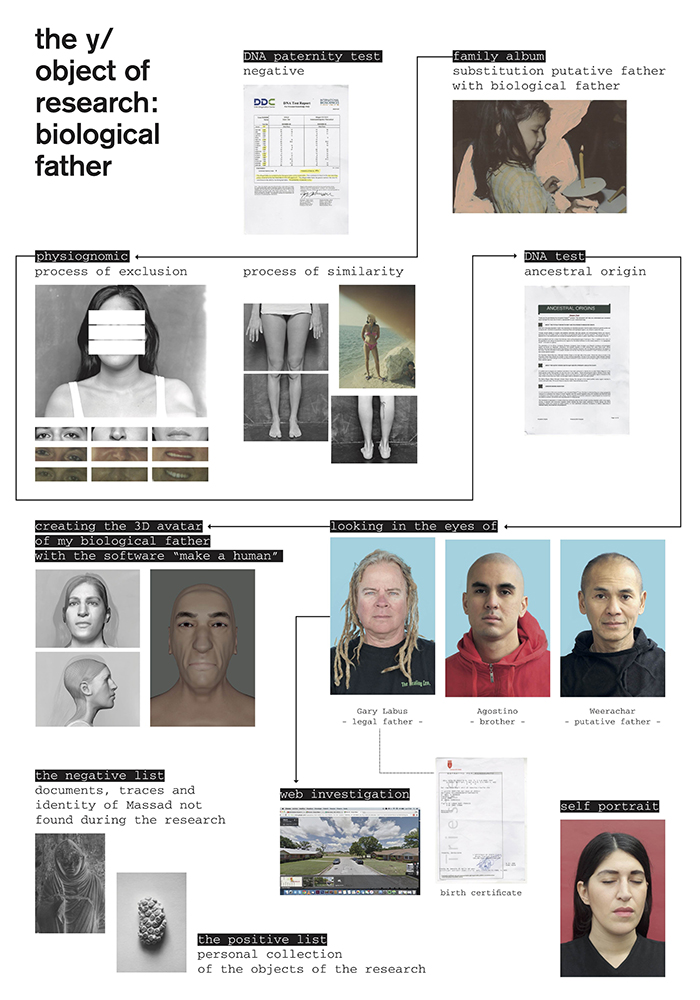
Her previous work “The Y- Research of Biological Father” (2019), her search for her biological father, similarly includes media such as paternity tests, created avatars, web documents, and self-portraits.
Alba Zari – page spread from the RPS, (Royal Photographic Society, 2021)
Zari shows how we can make our own pictures, with mind maps, diagrams, drawings, photographs, saying that there isn’t just one way to do research and even that making photographs is a kind of research in itself. Photography-based research might also include exploring archival material, from family albums, news pictures or historical images. However, she says that as photographers investigate, explore, compile, map, question, connect, interpret, gather, organise, interrogate, construct etc. and that making photographs becomes part of an extended process of discovery. Even that photographers make images to fill the void if information is missing, to help them imagine what does not already exist. She realises that how that research is presented can be very influential and may even disrupt normal expectations. (Royal Photographic Society, 2021).
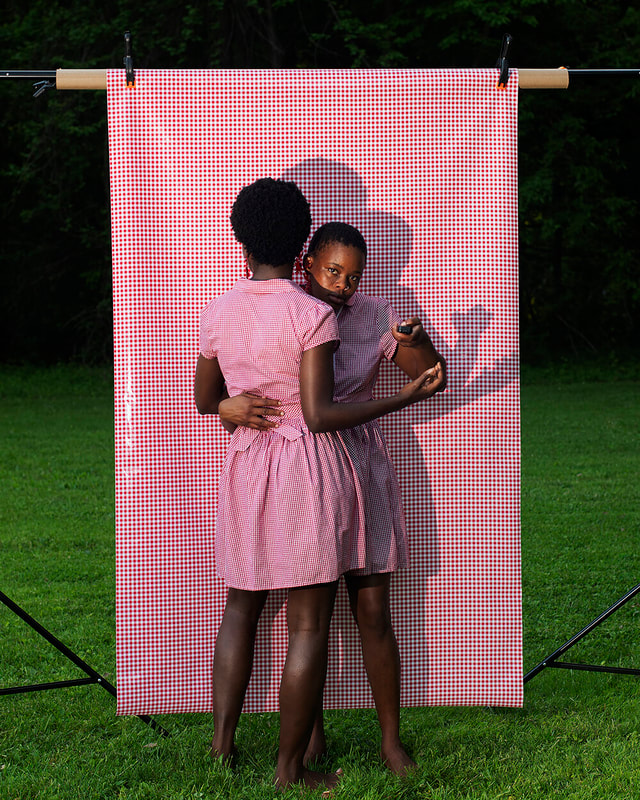
explores cultural identity, race, memory and immigration through photography, video, and installation with a series of self-portraits, featuring herself and friend posing as her with abstract landscapes constructed backgrounds.
(Royal Photographic Society, 2021)
What particularly interested me was the way that she presented her research:
Tillmans uses observation of his surroundings in an ongoing investigation of the photographic medium. He engages in this way to transform the world and so uses exhibition space for performing. Tillmans looks at the world with both curious and playful eyes and with his work gives new ways of viewing the world to viewers.
Studying truth with Wolfgang Tillmans
This installation includes Tillman sharing his views on the subject of truth and was on view at the Tate in 2017. Here he shares his reaction to the Iraq War and the presidency of George Bush, using various textual information, political texts, clippings, and erroneous everyday photographs. He was driven by the opinion that many global problems have been driven by false presentations of truth. “By combining a wide variety of mediums, he constructs a scenario that depicts and analyzes this tendency, while also, by extension, diagnoses it” (The Art Story, 2021).
It showcases Tilman’s work using tabletops as an alternative way to examine the present day. He was interested in statements made by people and groups worldwide that their viewpoint was only the truth. This work Truth Study center project where photographs, and clippings from documents are displayed in deliberate, and possibly provocative juxtapositions, reflects the way they come to viewers in print and online. The articles also bring attention to gaps in knowledge, or doubtful areas.
Below is an example of his project truth study center (2005–ongoing), which displays photographs, articles, objects, and drawings that present differing versions of ‘truth’.
(Tate, 2022).
It is an innovative way to question what is real. The installation also shares a brief audio clip of his views on truth. He has previously exhibited installations of taped prints and pinned magazine spreads. His mixture of mediums is interesting. Does this enlarge opportunities for viewers to participate and form their own conclusions, I wonder?
His photography does increase our attentiveness of the world around us, so that we see things differently and take less for granted.
“that my images are random and everyday when they are actually neither. They are, in fact, the opposite. They are calls to attentiveness.” This image reminds us to be present in our relationship with the world; the strongest moments are actually a strange mix of the sensual and the surreal, and often subtly political.
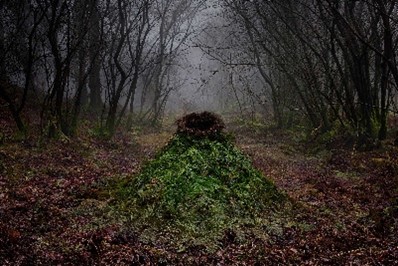
Ellie Davies works with UK forests, particularly in the south of England, exploring the relationship between the landscape and individuals. She talks of the cultural backdrop of human processes in the woodlands, symbols of folklore, fairy tale, magic, and myth, as well as psychological states such as the unconscious. She engages in the landscape with a variety of strategies:
“making and building using found materials, creating pools of light on the forest floor, using craft materials such as paint and wool, introducing starscapes taken by the Hubble Telescope or glittering light from the surface of the sea.”
Her final images are the outcome of these interventions and alterations to the landscape, and she says reflects her personal relationship with the forest, she says she, “walks, thinks, sits, listens then creates.” I can identify with this. These outcomes are she says a reflection of her relationship with the forest, her meditations on what she calls universal themes and the concept of landscape as a social and cultural construct – a visual experience.
Another Green world 2013
Come with me 2011
Knit one pearl one 2011
Davies mentions that she was inspired by the Twilight photography in the Magic Hour (2006), which explored twilight and I can see the influence in her work. In a Lens culture video (2015) she explains how in her photography she tries to explain the atmosphere in the woods, and the effect on you, to give the viewer a fresh look at landscapes, and enable them to interact with the landscape. She puts something of herself in the space, with the woodland as a backdrop, with a “light touch.” The landscape is the subject, and the intervention mustn’t take over, or leave an impact on the woodland.
Reflection
This research underlines my feelings about using photography the landscape to share the sensations and the effect on myself. But also, my search to try to ensure that what I want to say can be seen in my images. I could experiment with some construction in the landscape with, wool, flour, or organic paints but at this stage I would hope not to.
AMONG THE TREES EXHIBITION AT THE HAYWARD GALLERY (2020)
This exhibition showed how artists over the last 50 years have made works relating to trees. As trees live much longer than us, we can see our impact on them and how they act on us and our imaginations. The exhibition shows how entwined human culture is with tree culture. It brought together artworks that encourage us to think about trees and forests in diverse ways:
“Trees are stunningly complex and often visually confounding” (Hayward, 2020) and the artists in this exhibition highlight this to engage us in an exploratory process of looking. By subverting traditional images of the natural world helps us to see afresh. This is a multimedia exhibition, and the modern work helps to avoid the way traditional images may invite us “to get lost, and to experience – on some level – that uncanny thrill of momentarily losing our way in a forest and seeing our surroundings with fresh eyes” (Hayward, 2020).
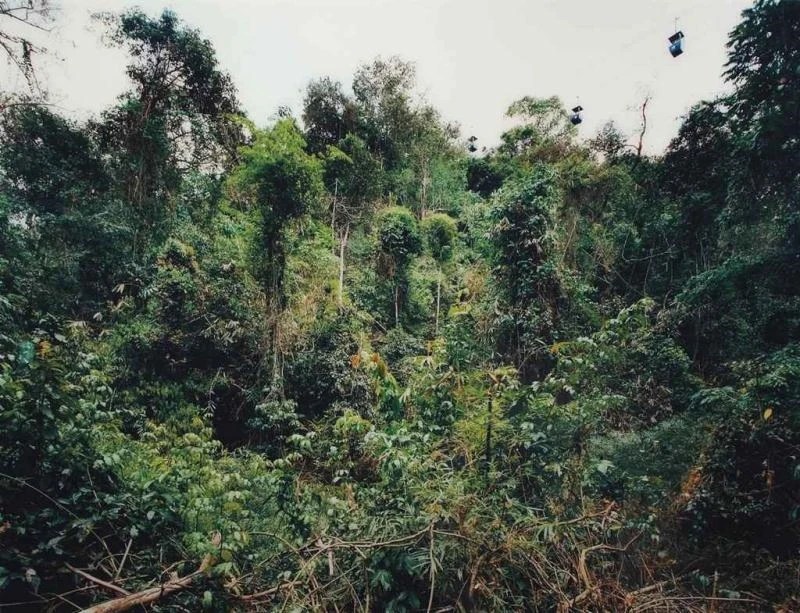
Thomas Struth has photographed forests and jungles around the world. He made this series after observing the trees in the garden of his Düsseldorf flat, after seeing the dense network of branches he thought to make pictures so full of information that they might encourage us to abandon our analytical tools, and ‘surrender to just looking.’ The images in this series, New Pictures from Paradise (1998–2007) all have a decentralised composition, with no single focus point, and no clearly defined foreground or background encouraging our eyes to wander across the image to both take in and get lost in the amount of detail.
(Struth, Paradise 11, 1999)
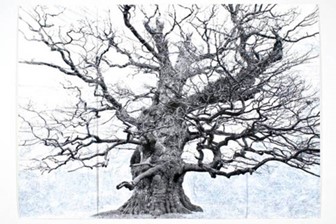
Tacita Dean’s, Majesty (2006) Crowhurst II, is one of a series of ‘painted trees’ that the artist began in 2005. It was made from a black and white photograph that Dean took of one of the oldest complete oak trees in England, which she greatly enlarged and printed on four overlapping sections of fibre-based paper. She then overlay the area surrounding the image with a gouache brushwork that partially obscures the surrounding wood to isolate the structure and form; this draws your eye to the silhouette, the tree, and its personality. Some of the branches of this tree have been propped up with crutch-like supports. Dean combines ideas driven by research with chance, accident, and coincidence.
(Westall, 2010)
Dean created also made a series of Deformed Trees (2005) by painting over the background, and sometimes also the foreground, of old black and white postcards depicting trees.
Rodney Graham began his series of ‘inverted tree’ photographs in the late 1980s. This photograph of a ‘Garry oak’ (native to the Pacific Northwest), was taken in British Columbia, Canada. The series grew from his earlier project, where he used a camera obscura opposite a lone tree where visitors encountered the inverted image of the tree projected on a far wall. Graham describes this as a way to talk about ‘man’s skewed experience of nature.’ In a different way to Ellie Davies Graham is again giving us a way to look again at something familiar – this time by turning it upside down. He says, ‘It’s always disturbing to look at something upside down,’ (Hayward gallery, artist notes (2020). Rodney was influenced by the artist’s work below.
(Artsy Net, 2022)
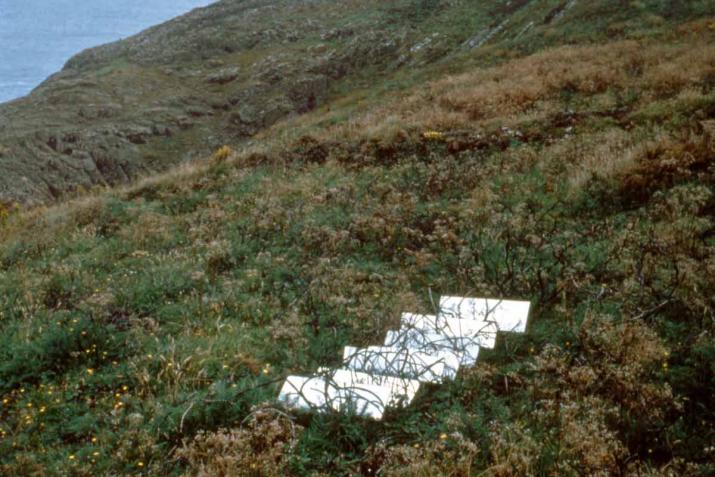
Robert Smithson photographed an upside tree in a different manner, in reality the tree was upside down. He photographed a series of three Upside Down Trees as he travelled from New York to the Yucatán peninsula (Mexico) via Florida; one in in Alfred, New York; the second in Captiva Island, Florida, and the third in Yucatán, Mexico. Each time he removed the branches from a young tree, and replanted it, root-side up. By doing this he has drawn attention to the structural similarity of a tree’s branch and root system. Smithson’s action “challenges our anthropomorphic tendency to identify with the vertical stature of trees” (Hayward, 2020). Alongside Davies and Graham, Smithson calls for an examination of what is.
Upside Down Captiva Island, Florida, USA 1969 (Holt Smithson Foundation, 2022)
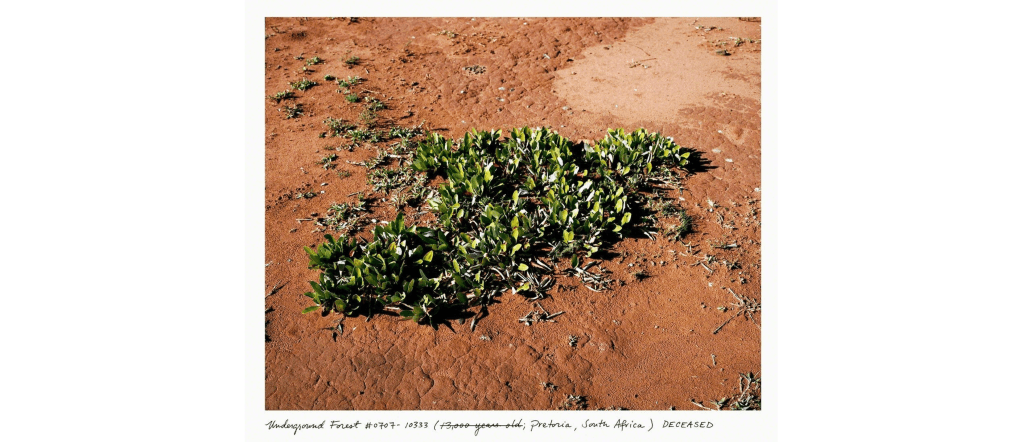
I came across the work of Rachel Sussman when I saw her photograph Underground Forest #0707-1333. This is actually the top of a tree that is 13,000 years old, growing underground in South Africa. These trees have possibly migrated underground to escape forest fires.
(Artsy.net, 2022)
My research led me to discover that Sussman has written a book The oldest living things in the world. She focuses on organisms over two thousand years old such as this llereta a distant relative of carrots and this slow growing lichen (1 cm per one hundred years). It is the oddity of these organisms rather than her photography that is arresting, it’s the subjects themselves that are captivating; that said there is still a familiar theme here, that of focusing on something natural that stops you and makes you look hard. There is a poignant quote by Susan Sontag in Sussman’s book “All photographs are memento mori. To take a photograph is to participate in another person’s (or thing’s) mortality, vulnerability, mutability. Precisely by slicing out this moment and freezing it, all photographs testify to time’s relentless melt”
(Design Observer, 2022)
In the exhibition some artists like Sussman explore the relationship between trees and time passing, seasonal changes, rings, as Sontag says “memento mori.” I would like to explore how trees might teach us some ways forwards; how I have yet to discover.
What I take away from this exhibition’s treatment of trees is the value of finding ways to encourage viewers to look hard or differently at the subject.
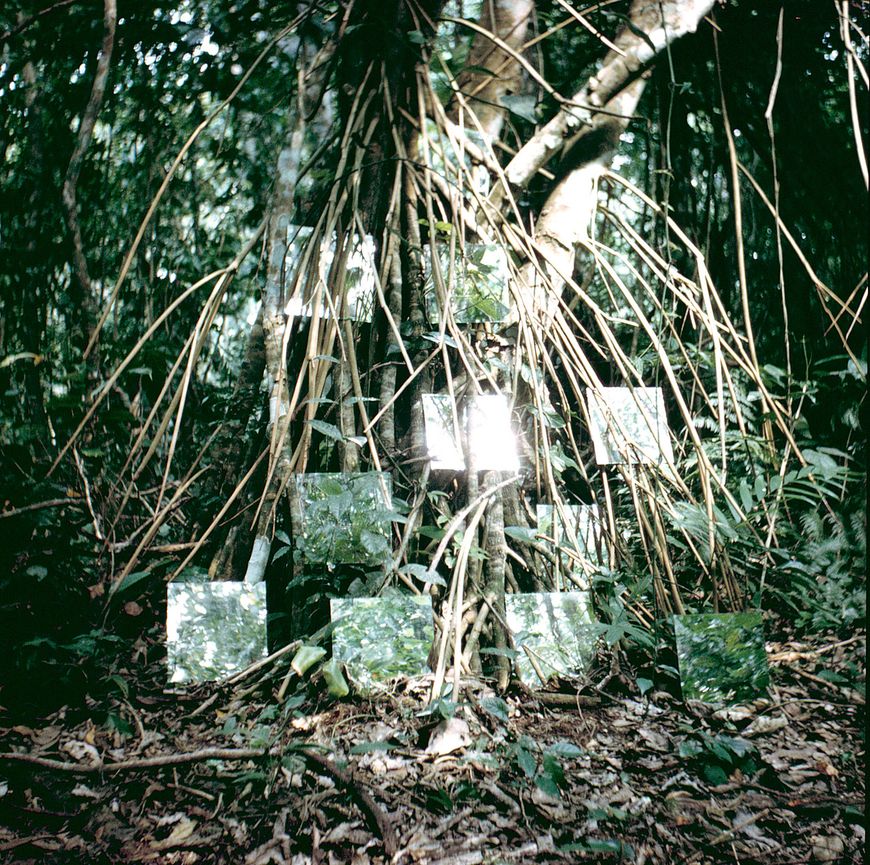
Robert Smithson’s Yucatan Mirror displacements (1-9) 1969.
I have mentioned Smithson’s work “Upside down” previously. He is best known for his earthworks and yet his interests were broad. He produced paintings, drawings, sculptures, architectural schemes, films, photographs, writings, as well as earthworks. He explored the conceptual and physical boundaries of landscape and his work encouraged viewers to ask questions.
In this work he installed 12-inch square mirrors on dispersed sites, resulting in nine photographs. The mirrors refracted as well as reflected their environments, “displacing the solidarity of the landscape and shattering its forms” (Guggenheim, 2022). It has been suggested that the mirror records the passage of time, though that I don’t understand, and the photograph suspends time, this I do understand.
(Guggenheim, 2022)
(Holt Smithson Foundation, 2022)
Noemie Goudal’s
photograph Les Amants (Cascade, 2009),depicts a waterfall made from plastic draped through a woodland setting, the natural and the manmade placed together, organic and synthetic which are generally in opposition. Nature is important I her work and here she is playing with our visual senses and ability to process, which Alexander describes as “a parody of what we would expect in a landscape” (Alexander, 2015:58). Goudal is subverting the picturesque but showing that in postmodern work nature and culture need not be in opposition to each other. This image sits easier with me that Smithson’s Mirror displacements,
(Saatchi Gallery, 2022)
I don’t feel that constructed work is for me right now, but I will reconsider it if necessary to share my message.
References:
Alexander, J. P. (2015) Perspectives on Place: Theory and Practice in Landscape Photography. London: Bloomsbury Publishing.
Are composite organisms made up of fungus and algae living together in the lichen body. The algal partner produces by photosynthesis nutrients (simple sugars) for the fungus and the fungus the body for the algae to live in protected from extreme conditions of heat or drought– a symbiotic partnership.
Lichens are extremely sensitive to environmental changes and are natural indicators of the health of our environment. They are affected by pollutants such as sulphur dioxide from coal burning and industry, as well as nitrogen compounds from intensive farming activities.
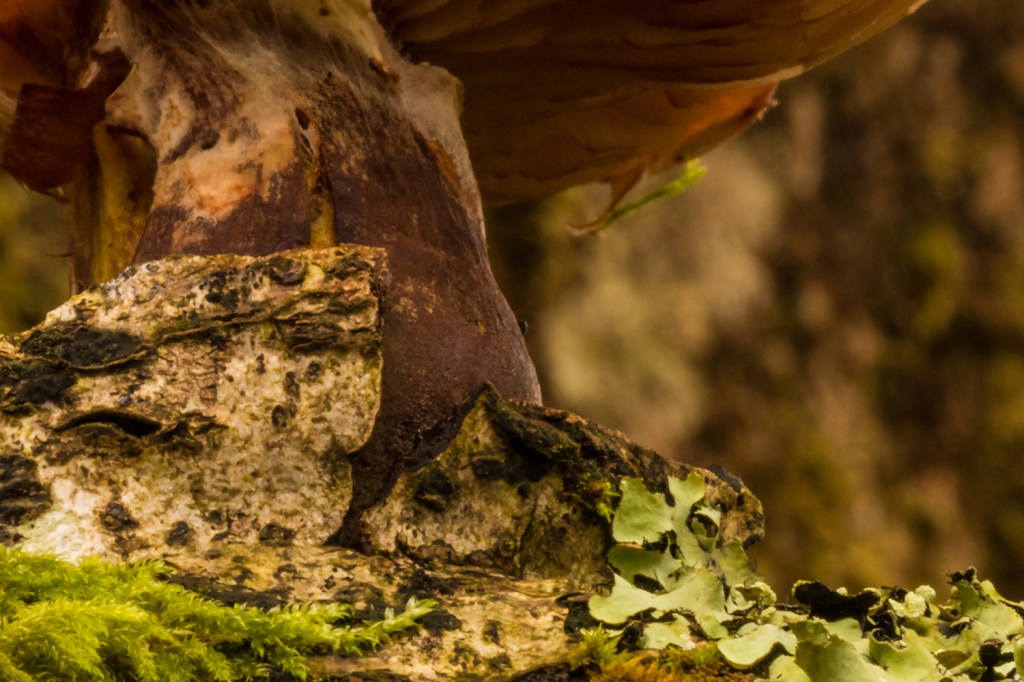
They form numerous shapes, sizes and structures ranging from tiny ‘pinheads’ to porridge-like crusts, to large leafy structures. They colonise most habitats on earth, even your car, but are very evident in ancient woodlands, where the levels of sunlight and moisture are ideal for lichens.
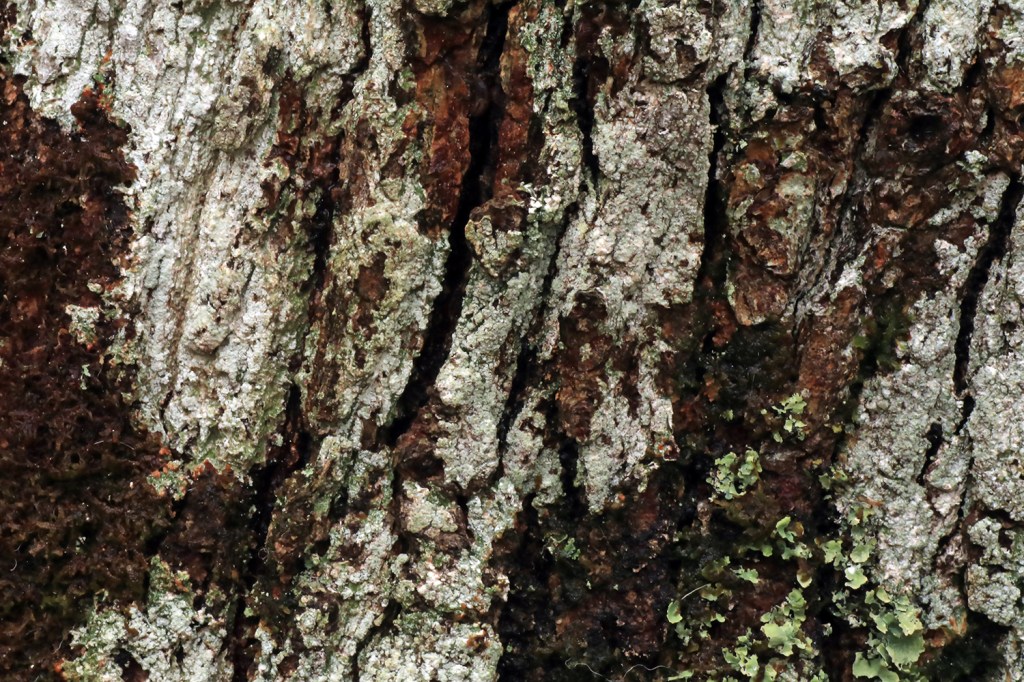
On twigs epiphytic lichens will quickly colonise new growth on branches but must compete with mosses and algae. There are three types of lichen, Crustose which looks like a crust on a bark, such as this one on a deciduous tree:
(South, own collection 2022)
Foliose which attaches like a leaf and Fruticose that attaches to twigs with a sucker like stem and grows like a mini shrub, both can be seen here:
(South, own collection, 2021)
Merlin Sheldrake, author of “Entangled Life: How Fungi Make Our Worlds, Change Our Minds and Shape Our Futures”, gives a good description of lichens saying:
“They flicker between “wholes” and “collections of parts.” Shuttling between the two perspectives can feel strange. The word individual comes from the Latin meaning “undividable.” Is the whole lichen the individual? Or are its constituent members, the parts, the individuals? This confusion is healthy.” (Look at a lichen, 2021).
Also known as Bryophytes, there are 20,000 species around the world which may be microscopic or over a metre in size. They grow in many climates and environments. Tiny, non-flowering mosses are one of the oldest land plants known to Earth, believed to have first appeared around 350 million years ago, long before dinosaurs, and even though they grow slowly, about ¼ inch per century, they are virtually unchanged. In ancient woodlands they grow as green carpet-like mats across forest floors or covering tree trunks. Instead of seeds, mosses have evolved spores to give rise to new plants. They have no vascular system to move substances up through their roots, or move liquid around the plant, and depend on obtaining their water and nutrients by directly absorbing the resources into their leaves while using threadlike rhizoids instead of roots to anchor themselves into the ground. This means that in they need to be almost completely saturated with water. Moss leaves are only one cell thick so have complex leaf structures to maximize photosynthesis.
When in unfavourable, hot conditions: they can almost completely halt their metabolism when stressed. By slowing their biological processes, they just wait until water is available again. As mossy mats can help to prevent soil erosion and increase soil enrichment.
(South, own collection, 2021)
Uses of moss
Moss has been used for drinking water, decoration, food, fuel, and shelter over the years. In World War I, Sphagnum mosses (the most widespread moss) were used to dress wounds and stem bleeding from injuries. It is the major constituent in peat, a slowly renewable fossil fuel, though emitting more carbon dioxide than coal or natural gas.
Ferns are common in woodlands as most are shade tolerant and can grow all year round.
Hard fern is common in the wet conditions of west and north of Britain, preferring acidic rocks and walls, and are found growing amongst other plant species in ancient woodlands.
(South, own collection 2022)
The epiphyte fern grows on trees and are very common in ancient woodlands. This fern lives half its life cycle on another plant such as a tree, usually the bark and the other rooted in the soil. These ferns start as epiphytes, low on the trunk of a tree, and later grow a single root down to the soil. Though rooted in the soil the fern continues to grow up the tree. Interestingly these ferns cannot live on the bark or on the soil alone and are an exception to the general rule that plants are adapted to live in just one habitat. In this case the fern must cope with living with both water poverty, on the bark, and water excess in the soil. Also, there are less nutrients that the fern needs to survive on the bark, so it must be very efficient at nutrient uptake before its root reaches the soil. What an amazing plant!
Mushrooms: The Art, Design and Future of Fungi (2020) Exhibition Somerset House
I visited this exhibition in 2020. In just a small couple of rooms the works of over 40 artists, musicians and designers inspired by fungi were brought together, collages, watercolours, recipes, illustrations as well as new ways of using mushroom materials especially mycelium.
According to the exhibition catalogue fungi having been objects of witchcraft and decay, became prevalent in art and design in the 1960s, especially after their appearance in children’s literature and botany and recently even more so
Background:
Fungi are closer to animals than plants. There are 2 types, those that carry water and those that break down organic matter. The mushroom that we see are the fruiting bodies of mycelium. Mycelium is the thread like underground root network of fungi, sometimes called the wood wide web. It passes nutrients and messages between plants. Chemically the substance that mycelium uses is similar to the neurotransmitters in our brain.
Plants, animals, humans, bacteria, and mushrooms live symbiotically, and such an “entanglement” are necessary for life. Fungi are needed also for creating products such as cheese, bread, penicillin, and vaccines. Mushrooms are also known for their psychedelic qualities and ritualistic and medicinal uses. Fungi are even used for cleaning oil spills and rehabilitating radioactive sites.
Mycelium can also be nurtured in laboratories by mycelium engineering as a biodegradable alternative to plastic and can be used to make shoes, clothing furniture and so on.
Notable mushroom artists:
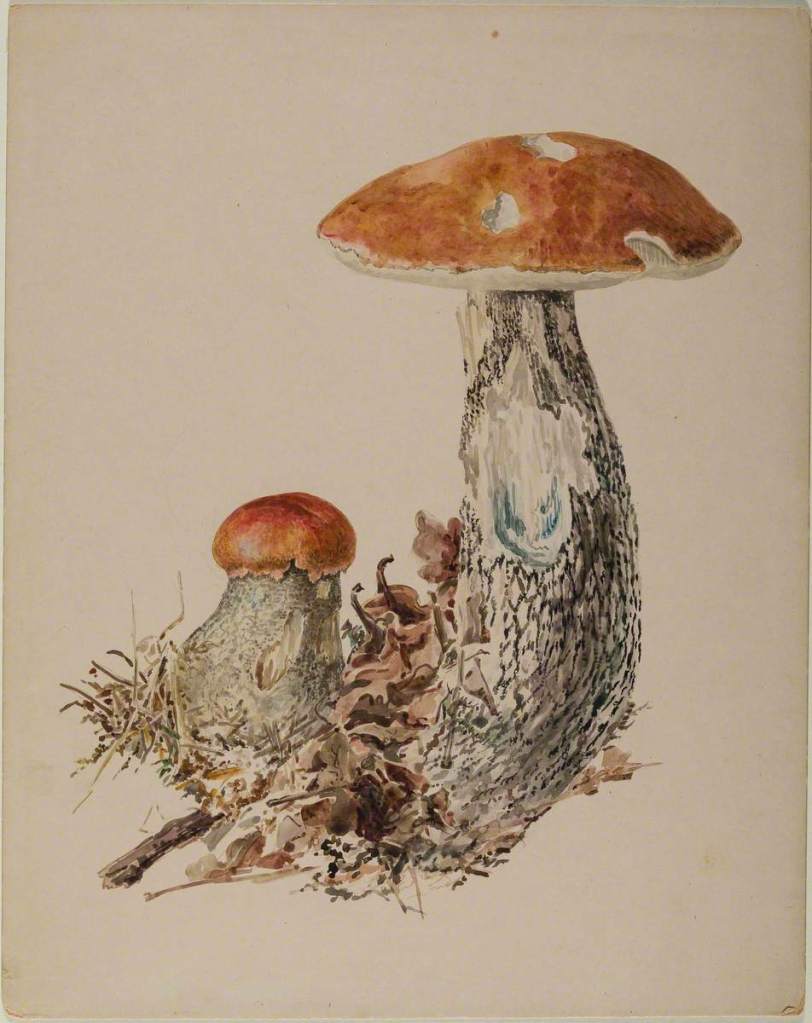
Beatrix Potter had a fascination with mushrooms and painted over 300 water colours of them; her detailed analysis of them was a starting point for her illustrations of nature and landscape in her books. It is suggested that interest in them is partly due to out of interest in the fragility of the natural world and wanting to connect ourselves to nature.
Potter, (Leccinum versipelle, 2022)
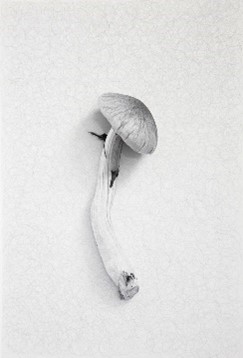
Annie Ratti’s series of overdrawn photographs are part of a larger body of work on psilocybe mushrooms, where she uses photography, drawing, installation, and text to explore their significance and how they grow in a rhizomatic way.
Psilocybin mushroom (The shroom project, 2022)
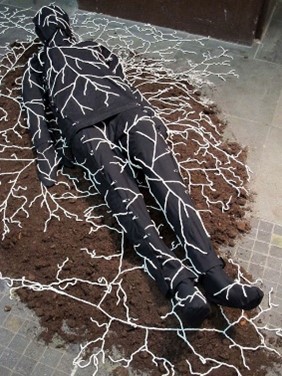
Jae Rhim Lee a Korean American artist, has designed an organic cotton, wood, and biomaterial burial suit, where she has sewn in mushroom spores to help a body decompose and deliver nutrients but not toxins to the environment.
Psilocybin mushroom (The shroom project, 2022)
The exhibition made me look at mushrooms in different ways as well as rethink their potential in areas from art to industry. It illustrates that the mushroom has become a figure of resilience, and points to new ways of living as humans become more disconnected from the natural world.
References:
Catterall, C. and Gavin, F. (2019) Mushrooms: The Art, Design and Future of Funghi. (s.l.): Somerset House Trust.
Ancient woodlands are woods that have been continuously wooded for a minimum of 3-400 years (AD 1600 in England and Wales) and this is just half the lifespan of a large oak tree. Britain has lost almost half its ancient woodland since the 1930s, and it makes up only 2 % of British woodland. Ancient trees are recognised as exceptionally valuable, which may be due to their: size, age, condition, or biodiversity.
Ancient woodlands are temperate, not tropical rainforests but their biodiversity is as rich and there are less of them. These old trees provide great micro habits for other species, and the absence of disturbance here provides good habitats for rarer species. Ferns and mosses, species that need damp conditions can thrive on the woodland floor and on the bark of trees. Lichens are a good indicator of ancient woodlands due to their extremely slow growth and need for unpolluted environments. Fungi, usually invisible unless in fruit penetrate and then decompose rotting trees, whether standing or fallen, though mostly hidden are essential to the success and maintenance of ancient woodlands.
Podcast: The hidden language of trees with Suzanne Simard 14.5.21
Simard is a scientist, Professor of Forest Ecology at University of British Columbia. She wrote a PhD thesis and as researched tree connectivity and communication, and its impact on the health and biodiversity of forests (1997), written about in her book: Finding the Mother tree: uncovering the wisdom and intelligence of the forest (Simard, 2021).
Forests are not just natural resources, or commodity based, they have memories, wisdom, complex communities, web of fungi through the mother tree. A mother tree is the biggest oldest in the forest. They have vast root systems with old fungi networks which nurture the new seedlings and enhance their defence chemistry, which gets passed onto multiple generations- this is teaching the next generation how to survive.
Forests are complex systems showing, interconnectivity, diversity, clean air, hold water, resilient, transport systems.
Value the non-resource elements: Carbon, water biodiversity, rather than as a commodity.
There are parallels with the brain an example of a not a neurological network, but a biological neural network with conduits for transporting resources, glutamate, serotonin, synapses. When you map the networks in the forests they are constructed like neural networks with interlinked nodes and synapses (where exchanges happen), with glutamate moving throughout the network, these are highly evolved, resilient, efficient networks.
There is a symbiotic mutual relationship between fungi and trees mycorrhizal (which means fungal root) below ground network, trees provide the photosynthesis, the fungi provide nutrients from the soil – a physical connection. All trees form these relationships as they are essential for their fitness, whilst fungi rely on trees as they collect nutrients and water from the soil for the trees who provide the fungi with energy from photosynthesis.
Trees have a way of communicating, for instance communicating against threat with biological neural network.
Trees are also conduits for transporting resources. E.g., Douglas firs have been found to warn ponderous pine about injury and herbivores in the environment that are causing them to die back.
Climate change is adapted to and recorded in their seeds, if you destroy trees, you lose this adaptability record.
Don’t short circuit natural selection, as when planting conifer forests. Single species ae not resilience. Don’t isolate trees, use the connections between species, collaboration is important. Birch and Fir transport carbon back and forwards between themselves, the community is helping the individual – arboreal socialism? They compete but collaborate, are diverse and resilient forming productive community. Other species don’t grow in isolation, a society with dominant individuals would not succeed. Diversity is strength, and with this tree’s productivity and resilience increases. Single species are more open to destruction by disease, as you often get in cities.
Trees in old growth forests hold carbon that have accumulated for centuries. When cut two-thirds disappears into the atmosphere fairly immediately, not to mention the system below ground. This can’t be recaptured within the time we have left to change the course of climate change.
Need to increase old woodlands, rather than replant trees. Challenge consciousness and business models. In Monkswood in East Anglia, Wilderness plots were established (1960s), where a barley field was left next to ancient woodland and now has a variety of ancient species growing there – natural regeneration. Stop cutting down old growth forests. If encouraging recovery of old forest, leave oldest trees in place, take out smaller trees to boot strap the natural regeneration to make a healthy diverse eco system. As climate changes more rapidly than trees can adapt, evolve, and migrate, if they can’t achieve this they’ll die, so to help them to survive and hold carbon, we need to enable a mix of naturally regenerated seedlings to support migration by scaffolding to create a viable ecosystem. Naturally, regenerated trees are more successful than planted forests, they hold adaptations in their seeds.
Consumption: use alternatives or less. At least, use only second growth forest where losses have already been made and enhance them by leaving any older trees.
My reflections:
Forests are about connections, resilience.
Species don’t grow in isolation diversity is important for the strength of both individuals and communities, they compete but they collaborate, and resilience and productivity increases.
We should value forests by their true impact on our lives, for example producing water, carbon, clean air. Convert and preserve what we have left.
Simard, S. (2021) Finding the Mother Tree: Discovering the Wisdom of the Forest. (s.l.): Penguin Books, Limited.
Other books that I will write about later:
Beresford-Kroeger, D. (2019) To Speak for the Trees: My Life’s Journey from Ancient Celtic Wisdom to a Healing Vision of the Forest. (s.l.): Random House of Canada.
Deacon, A., and V. D. A. (2020) For the Love of Trees. (s.l.): Black and White Publishing Limited.
Deakin, R. (2008) Wildwood: A Journey Through Trees. (s.l.): Penguin UK.
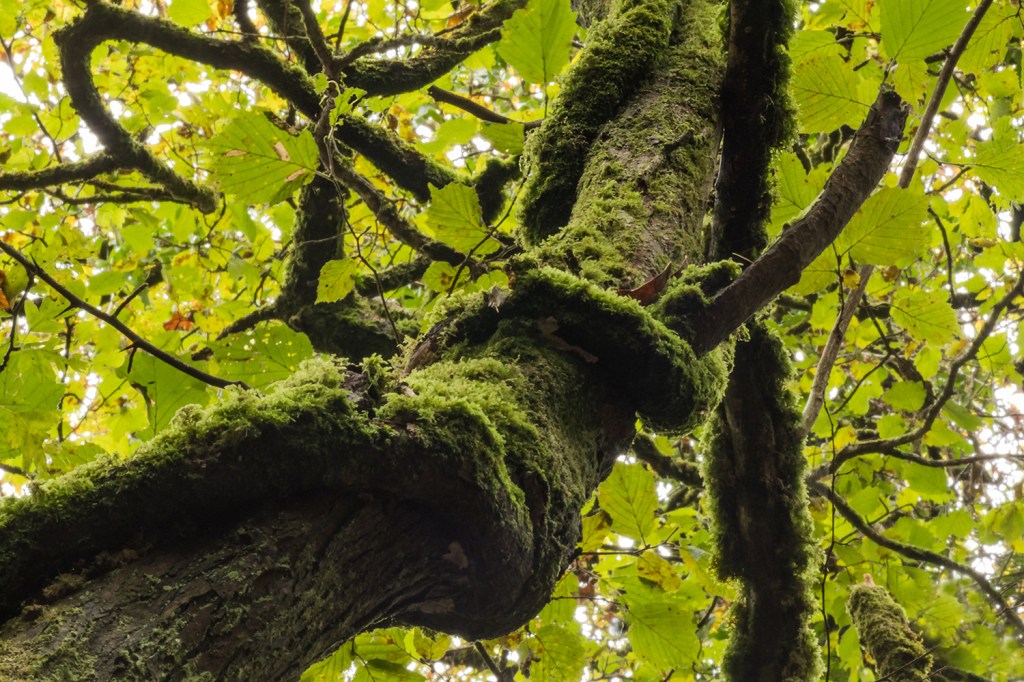
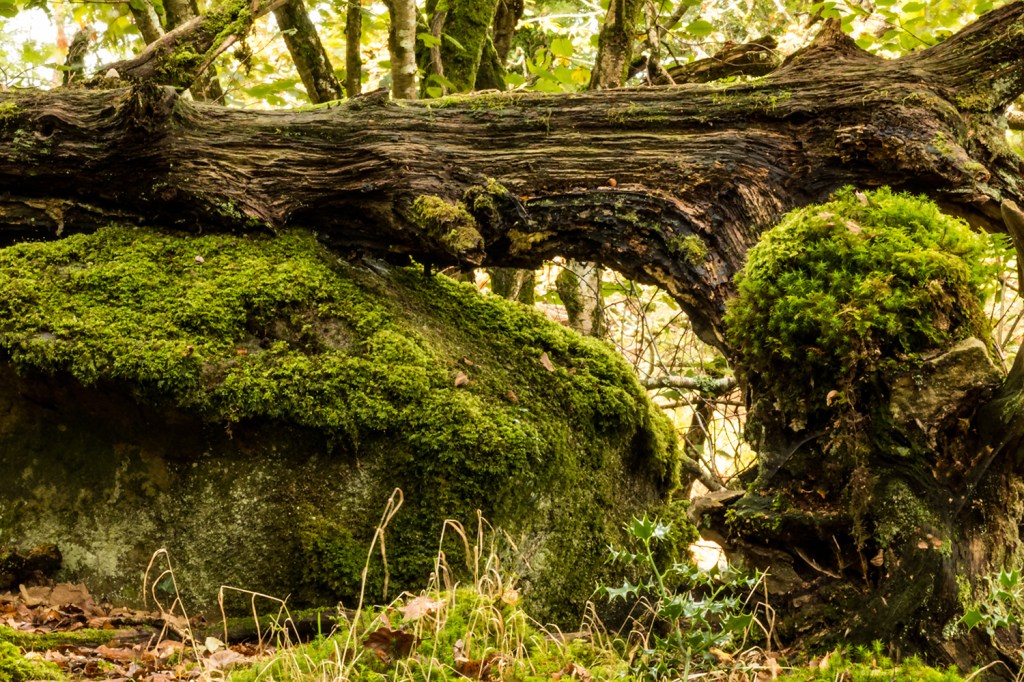
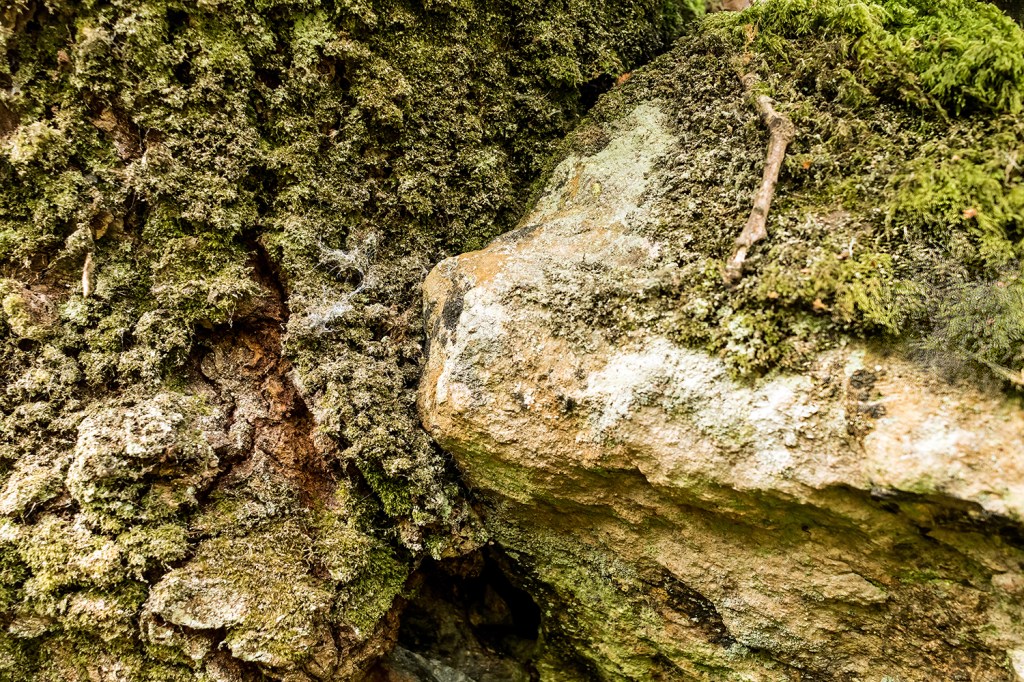
These images are first explorations of my subject ancient woodlands as a visual metaphor for my theme of community.
I began shooting with the genre of psychogeography, photographing my longer/wider viewpoint unfocused whilst moving, and stopping to shoot still and with clarity and in detail subjects that caught my eye. In this way I emulated my external and internal passage through the place. I photographed as I saw, in colour. My later shoots continued with a psychogeography backbone but certainly with an increasing less objective sight as I worked into my topic, and I began to genre hop. I was aware that I was also thinking conceptually as I looked.
I was influenced in my way of seeing by practitioners such as Minor White and Stieglitz who used the landscape to express ideas and emotions in a representational way. Contemporary landscape photographers such as Rob Hudson, Stephen Segasby, Guy Dickenson, Tom Wilkinson and JM Golding of the Inside Out collective gave me further inspiration to explore space as an internal and external passage. As I shot, I increasingly found ways to enhance the aspect of community that the subject before me spoke to me of and shot as much what was in my sight as what was in my head.
The images I share here can fall into 3 groups (there are some that overlap):
Psychogeography/drifting
General landscape representation
Abstract representation
Close up representation
From these I can reflect further about my next steps, but at this moment I feel it is towards a mixture of landscape, abstract and close up. I may dabble with constructivism and conceptualism which I will do more research into, but I’m not convinced that I need to go down these routes to say what I want to in my work. I feel I need to work more into photographic styles that I have begun to develop so far in particular, landscape in abstract and close up, and use my absorption and new perspectives to share what I am seeing and feeling.
ASSIGNMENT ONE IMAGES
Psychogeography:
______
Landscape representation:
Abstract:
Close up:
No changes were suggested by my tutor so this as posted as was my original draft, but see previous post on my reflections on the formative feedback:
Tutor report: This was a video feedback session followed up with written feedback:
MY REFLECTIONS:
It was an extremely useful session. We looked at work on my blog. I went through the photos and explained my work, as set out in my learning log and my reflections on my images. Jayne responded and posed questions to enable me to reflect further.
I was pleased that my Tutor could sense in my images the positive and nurturing environment of the ancient woodlands. We discussed the concept behind my using the woodlands as a visual metaphor for community and I explained that I am interested in representation, different ways of seeing.
The strand that wove throughout for me was the need to get to the essence of my message/ meaning of my work, and the need to provide an entry point for my viewers so that they can access this.
ACTION POINTS:
Form a working title to focus my photographing
Work on clarifying the why and how of my concept
Consider methods I could use to signpost my concept and meaning- and entry point for viewers to my implicit meaning (with or without text).
Collect found text, academic and other on community.
Try photographing in sets: Fungi, lichen, ferns
Try increasingly using perspective or sense of scale to distort.
Research the way these subjects have been represented by others
Research Wolfgang Tillmans, Edward Weston (Images and writings)
Clarify whether I should be reflecting against the learning objectives or the assessment criteria and which is the correct assessment criteria (Contact Dan Robinson)
I’m now feeling inspired and ready to photograph and research again.
I have applied my knowledge of various theories such as semiotics, and Rose’s methods for interpreting visual images. I have also applied aspects of visual culture such equivalence and metaphor that emerged in the 20th century to the work of photographers in the 21st century.
I have shown my knowledge and understanding of some specific aspects of visual culture, such as poststructuralism and ontology.
Demonstration of research skills
Capacity for critical, effective, and verifiable information retrieval and organisation using primary and secondary resources.
I have researched and used both primary and secondary sources, including some relevant photographers, writers, educators, and theorists/philosophers.
Demonstration of critical and evaluation skills
Critically review, consolidate, and extend a systematic and coherent body of knowledge, with specialised skills. Critically evaluate concepts and evidence from a range of sources; transfer and apply diagnostic and creative skills and exercise significant judgement in a range of situations.
This is a difficult area for me to assess, I am not sure what is meant by specialised skills.
To present my proposal I have critically evaluated concepts and evidence from a range of sources, however they are not critically reviewed in depth, just enough for me to begin the process.
Communication
Well-structured and relevant arguments supported with evidence, engage critically with established ideas. Balance and present alternative points of view, use unfamiliar arguments constructively.
I think I have set out a proposal rather than an argument but believe that the proposal was well structured and given with some evidence.
To set out my early experimentation for my body of work I have engaged with established ideas, such as postmodernism and post structuralism.
Whilst I have presented different views on theory, they are all fairly aligned rather than alternative points of view. However, I have tried to use them to extend my ideas.
I was unfamiliar with many of these ideas before I began my research and have tried to use them effectively.
Reference:
Alexander, J. et al. (2020) Contextual Studies. Barnsley: Open College of the Arts.
The purpose of this assignment is to enable you to explore and develop initial ideas and research as part of a dissertation scoping and planning process. It is a key moment to reflect on possible relations between your ongoing research of visual culture with ideas relating to your photographic practice. The assignment requires you to reflect on how visual culture research and practice can weave together and support each other. Write a 1000-word essay (+/- 10%) (or 5 minute equivalent presentation) that relates your Body of Work to an aspect of visual culture, discussed in Part One. (Alexander, 2020:37)
Alexander, J. et al. (2020) Contextual Studies. Barnsley: Open College of the Arts.
I have removed my essay as it has been made available to my tutor:



















 NIKI SOUTH