Sustainable Book / Art Fair Ffotogallery Cardiff 13.7.24
The book/art fair will be focused on similar themes to their current exhibition (Sustainable Vision: Arts and Culture Confronting Climate Change), They invited book makers, book publishers, writers, artists, photographers and crafters influenced by the climate emergency, environmental issues and sustainability.
I visited looking for:
Further in-depth knowledge of a publishing and how the role fits into the broader economy and/or arts community.
Self publishing V publishing.
Inspiration/angles on an essay on publishing: are there any publishers working with students at an affordable level? Current developments in publishing?).
Michal Iwanowski: Go Home Polish project and book production.
Yellow Back books:https://arcade-campfa.org/yellow-back-books ArcadeCampfa, Braeval Street Studios, 11 – 13 Braeval Street, Cardiff, Wales CF24 4SJ Digital residencies I’ve subscribed to the newsletter
Shelf Life Books & Zines: https://www.shelflifebookshop.com/ A not-for-profit radical bookshop in Cardiff working with independent publishers and DIY zine-makers to make space for marginalised and under-represented voices.
I also networked with other photographers visiting and exhibiting at the fair:
Had a long conversation with David Maynea self publishing photographer and contributor/writer for offline journal He said ask yourself why you’re publishing? Who’s it for? He suggested self-publishing gives you control.
Walter Waygood: Art lecturer and self publishing photographer. We had a long and interesting discussion about publishing versus self- publishing, and how he funds his many projects/photo books. He works with various grant issuers and arts councils. Prefers to self-publish, not just from a cost perspective but also to retain control and enjoys having the creative design input, in fact the whole book making process. He said of publishers “you do all the work and they take all the profits”. Said I could email him. https://walterwaygood.com/
Brian Carroll- Offline Journal a bi annual self published journal (1 issue contains an essay and one an exhibition booklet. Offline Journal documents the development of contemporary photography in, from and of Wales – a country rich in photographic history and talent. Established in 2018, Offline Journal exists in parallel but away from the distraction and noise of online platforms and, instead, is printed as limited edition issues published April & October each year. Offline Journal is edited and published in Wales by Brian Carroll. He likes the control of self-publishing.I asked him where he gets his inspiration for his journals, he replied mainly from exhibitions. He mentioned that funding for arts has been cut and this has driven more photgraphers into self publishing. He publishes only welsh based photographers. It made me think that I could focus my work on Welsh photographers trying to publish, and welsh independent publishers.Offline journal free newsletter is at: https://www.offline.wales/substack.com . I purchased some of his journals and published essays by photographers as a stimulus for my writing/publishing.
Shaun Lowde a post graduate photographer now teaching at Carmarthen University, an old friend offered help with printing/publishing if I needed, and is starting up a photography magazine in the Autumn. I was heartend that my work had been accepted in some places that his work hadn’t been!
Photographer talk: Michal Iwanowski (https://www.michaliwanowski.com/) talked about his book ‘Go Home Polish’ with designer Olga Lacna. I was interested to hear about as a freelance photographer with no money, he brought his book to the published stage. Sadly, the sound quality was almost unintelligible and I was unable to glean much from it. He did say that the designer made him change his ideas and use more practically achievable formats. He talked about the anxiety it caused publishing essentially parts of himself.
It was a useful networking and fact-finding visit. It consolidated what I knew about how to self publish and clarified its benefits. It was a very useful professional network building afternoon.
For me to follow up:
Use adobe Idesign or Affinity (USA software) also recommended by OCA student have used there is a free trial) as software.
Publishers for self publishing, Mixam or Youloveprint.co.uk (they put how to do in a PDF). Exwhyzed have also been recommended.
Issuu -Can make a book or zine and if set to PDF can create a dummy
I attended this seminar to increase my knowledge of working in the photographic industry
Nick Dunmur, Commercial Photographer, Advisor to the Association of Photographers (AOP), and chair of the British Photographic Council.
“The Business of Being a Creative’ deals with the nuts and bolts of getting started as a creative business. In this Creative Conversations session, Nick Dunmur walks us through the foundations of getting set up properly, such as business structures, insurance, tax and probably most importantly, knowing how to set your rate properly, to make sure you make money and start a business which not only survives but thrives”. (At: https://learn.oca.ac.uk/mod/book/view.php?id=27053&chapterid=10018 (Accessed 29/06/2024).
My Learning:
This was an excellent seminar, where I learnt much about the business elements of operating as a commercial photographer. I gained detailed knowledge of professional contexts, such as my collective responsibility as well as own (fee setting, use of AI).
This learning supports my own practice as I disseminate my work and operate in the professional dimensions of the photographic industry. It is also timely as the knowledge I have gained will support the writing of my project resolution plan (assignment 2).
I made detailed notes, further down, which I will return to for specific information as needed but here is my top line learning:
If developing a commercial practice:
Consider how you could carve out a niche for your photography?
I have a responsibility to myself and to others, and to the industry. When quoting if you pitch yourself too cheap you won’t have a long career for very long and it lowers cost expectations for other professionals.
Set a creative fee not a day rate (see below)
Consider funding sources
MY NOTES:
Best practice in business basics – Its ‘commercial’ if you’re making a living from it.
AOP promotes connections between organisations and photographers.
Reminder that my AOP membership gives me a 3 years access membership for £40. This keeps me in touch.
Importance of collective responsibility (eg. AI).
Useful information:
Clients often want a day rate. He suggests you pitch as a creative fee so not specifying a length of time but to an outcome, which can’t be compared to other’s day rate, and can be increased as your work becomes well known.
How to fund your life if regular income is needed? This requires setting a day rate, :
Do you need to make money from it?
Are you wedding, portrait editorial photographer, Fine art photographer?
My reasonable requirement + costs of doing business (office costs: Insurance, rent) he suggested 12k office costs 48K as reasonable salary.
Allow for holidays (30 days) illness 4 days, maybe allow 200 days for editorial work which with 60K income needed, divided = £300 a day, apparently this is the going rate today.
Consider the number of shooting days available to me/Number of bookings I’ll get = number of opportunities. Divide what I need annually by this for each event.
Some market sectors you can charge more such as advertising, but the expectation of the value that the photographer can bring is high, as can stress levels.
Consider overheads for your business:
Equipment: Buy hire lease?
Insurance: these define professional photographers, esp first two. Tell your clients that you are properly insured.
Public liability? Covers you against causing injury (say a trip) to others and being sued against their loss of earnings. Cheap approx. £100 a yr.
Professional indemnity (PI) (AOP): covers against infringing someone else’s copyright, but can be messy, against your own mistakes like loss of images/data when you have to reshoot. Can get it through AOP if associate (£160 pa )/accredited member then they provide a blanket group professional indemnity cover (would probably cost £200 pa)
I won’t need employer liability
Portfolio (can be expensive to produce and insure), goods in trust (eg goods photographing), hired in kit & accident and health.
Can get insurance on a shot by shoot basis. Good insurance brokers: Williams and Carson, Glover and Howe, Hancella Canworth….
Cyber and data (data protection cover/breaches, hacking, ransoms eg. Instagram). Office/studio
Doing workshops – overhead CPD
Business plan: needed if making a funding bid eg arts council. Templates for these in the AOP member dashboard. Also consider:
Profit and loss outline
Cash flow forecast – when’s your money coming in?
1/3/5/yr plan
Raising funds: long term/short term
Think how you will fund your own bodies of work – how many average pa, where do the sales come from are they through book sales or gallery, online print sales
The paperwork trail:
Own Terms and conditions (AOP 5 pages long bullet proof T&C that covers most eventualities -geared to business to business, rather than business to consumer, which are less contract heavy)
Estimate (general overview of expectations and outcome: encouraged as give wriggle room) or quotation (avoid as can be legally binding) include terms of use.
Confirmation of commission: to get in writing what has been verbally agreed, as recollections can vary .
Their purchase order
Model release/property release form –if photographing people or on location. (there is an app called ‘easy release’ if want to do on your phone)
Third party/crew agreements- if working with others, assistants, lighting etc.
Issue your invoice and licence to shoot (aka usage agreement or terms of use of your work). You are not handing out your intellectual property/copyright you are renting the use of it out. Eg exclusive licence only they can use this work, cheaper is an non exclusive licence where you can sell the work to others.
Other tips:
Check AOP resources of documents
Artists network £36 pa lots of information and resources on funding opportunities esp useful for fine art practice.
Plus see beyond the lens resource
LO1 demonstrate comprehensive knowledge of the professional context(s) relevant to your practice and have an understanding of the professional dimensions that underpin a successful photographic practice.
I shared my success with the Glasgow Gallery of Photography and August Suboart magazine. I learnt that Suboart will tag me in their Instagram posts and then I can follow others who have been published – and they will publish me.
Join shutter hub and they share your good news and include your work in their yearbook
Miriam shared that here A3 assignment was role related to the photographic industry
During our discussions I thought for Assignment 3 using the question, why are you doing a photography degree? What were your intentions? Or did you intend to take your work beyond graduation? Or how are you taking your work forwards?
Lynda suggested as contacts Rob Townsend, Sarah Jane field?
We discussed assignment 2 for which its just theoretical how I’m going to publicise
For Assignment 3 Michelle suggested a zine would be cheaper maybe combined with a virtual exhibition -Kunstmatrix
Matt suggested use Art rabbit to publicise
Leaflets: Mixam printing use for quotes, or local printers?
We discussed how on or own we feel during SYP, in terms of little OCA support; we wondered if this is intentional as we should be almost independent now and how valuable our peer support is now.
This was a video feedback session. It was the first meeting that we had since beginning SYP, so it was useful to have my Tutor’s feedback and advice at this point.
The details of the feedback session are in the Formative feedback document below:
1. Prepare a PDF document with the intention of showing it to an industry professional and asking them politely for a short piece of feedback. This should contain an edit of the work you produced for Body of Work. You may wish to include an overarching artist’s statement as well as the introduction you wrote in Body of Work. In the first instance, you’ll use this to introduce your work and your ideas to your tutor who will give you suggestions on the submission itself and how to enhance the PDF before sending it out. Please tell your tutor who the PDF is intended for and include some background information on how you’ll contact them. Make sure that you’ve researched the form your submission should take; some organisations still ask for a CD/DVD, for example, which you should prepare in advance.
2. Having taken your tutor’s comments on board, use your PDF document (or, if applicable, a hard copy portfolio) to get some feedback from a professional photographer or another professional from within the industry. This could be done via a portfolio review or by a contact you already have.(Boothroyd, S. and Alexander, J; 56, 2020)
Reference: Boothroyd, S. and Alexander, J. (2020) Sustaining Your Practice Course Manual. Barnsley, UK: Open College of the Arts.
REFLECTIONS AGAINST LEARNING OUTCOMES:
This assignment formed the beginning of establishing new relationships in the industry.
LO1 demonstrate comprehensive knowledge of the professional context(s) relevant to your practice and have an understanding of the professional dimensions that underpin a successful photographic practice
I also built a website using adobe portfolio and a professional Instagram accounts so that I could include links to them in my publicity PDF.
LO2 coherently present a body of work, making creative presentation decisions that complement your subject and/or your artistic strategies.
I prepared an edit of my work for my publicity PDF. I first developed my body of work; editing my images to the final selection for SYP. I also reconsidered the placement and presentation of these images for both my publicity PDF and my book for the resolution of my project. See padlets on this editing process:
LO3 operate in complex commercial contexts requiring the application of specific interpersonal, professional and business skills within an ethical framework.
I also used much of my publicity DF for a portfolio review with Lens Culture. Whilst my Publicity PDF has an Introduction, Artist Statement and Bio, Lens Culture asked for a statement about the work and a bio of under 2000 characters, so I used the bio that forms part of my publicity PDF, and to conform to their word count I combined elements of my Publicity Introduction (80%) and Artist statement (20%). The reviewer’s feedback below was very useful, against parts of my Publicity PDF, and I took this advice into account with Anna Sellen’s when I revised my publicity PDF. See blog post: https://nkssite6.photo.blog/category/sustaining-your-practice/putting-myself-out-there/portfolio-reviews/lens-culture-critics-choice-review-april-24/
LO4 independently disseminate your body of work by establishing relationships and networks with audiences, clients and markets.
LENS CULTURE CRITICS CHOICE: I paid for written review when I entered the competition deadline 17.4.24
Portfolio review
I learnt from my previous review A smith gallery that I should be focused in what I want to get out of it. This time I submitted images, artist statement, Artist bio, and additional questions from the reviewer.
See detailed learning at bottom of this post, but in short:
Be concise when explaining my concept & I edited my artist statement for my next submission
Consider where I place the definitions with the footnote images
I submitted 10 images, to be judged as a series, that works as a group, thematically or aesthetically:
WHAT LIES BENEATH
Statement for Lens culture
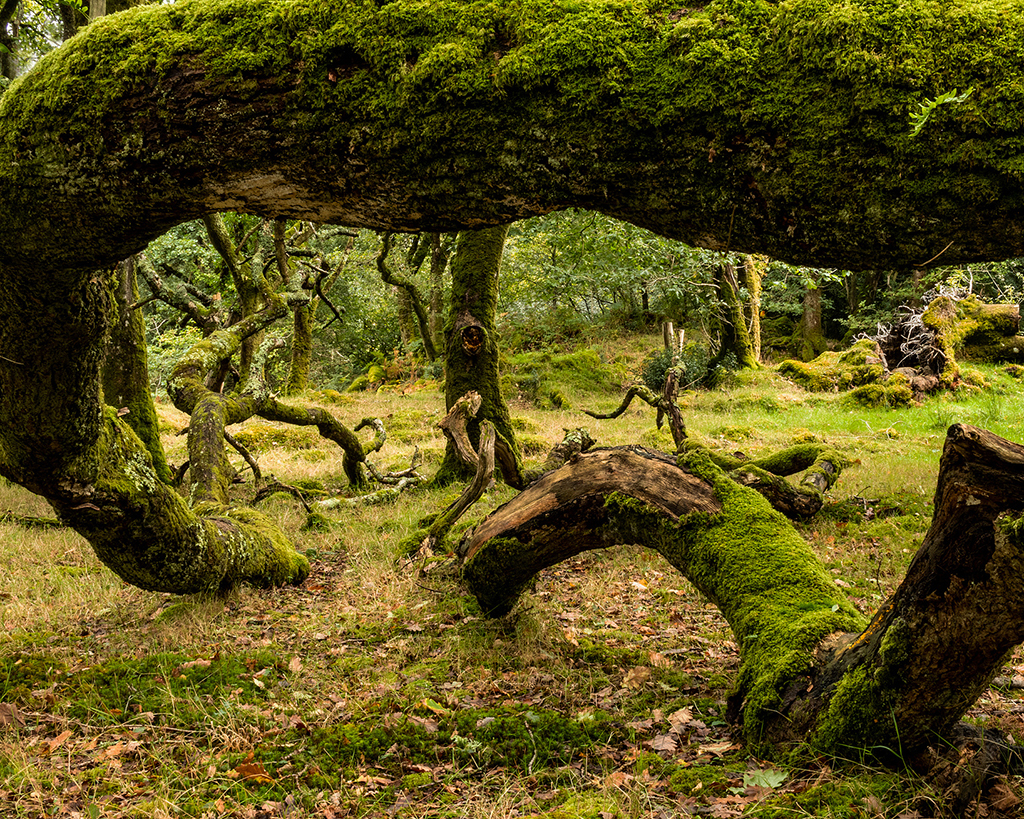
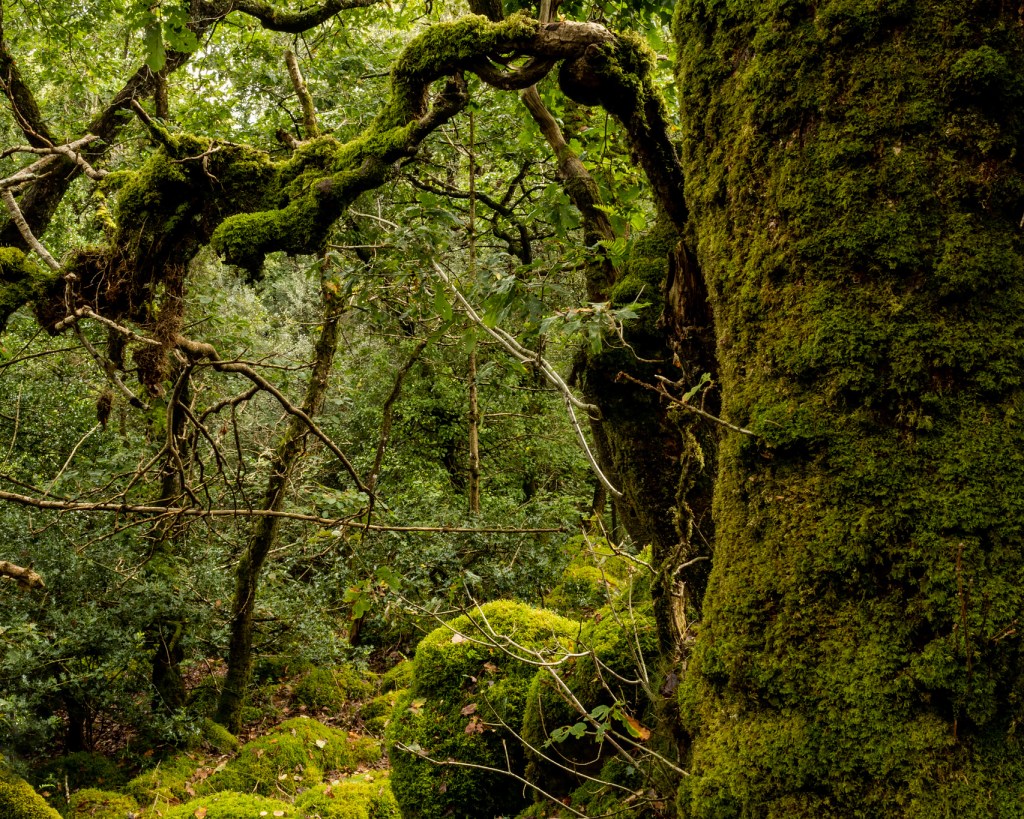
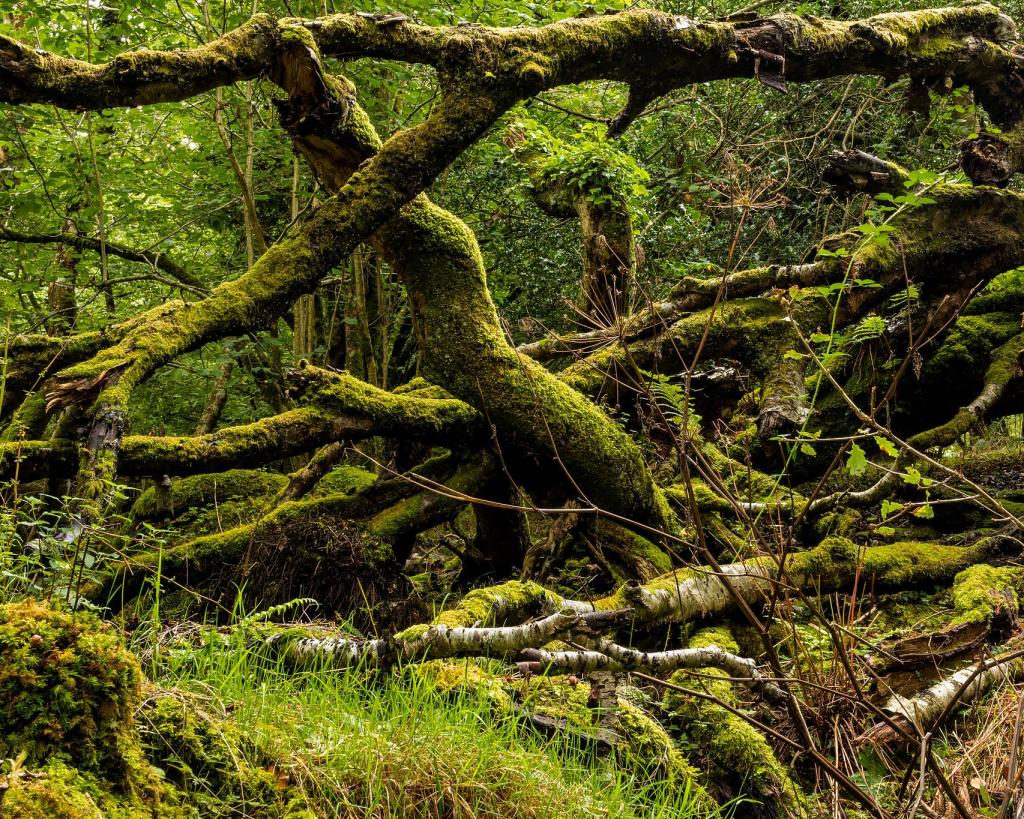
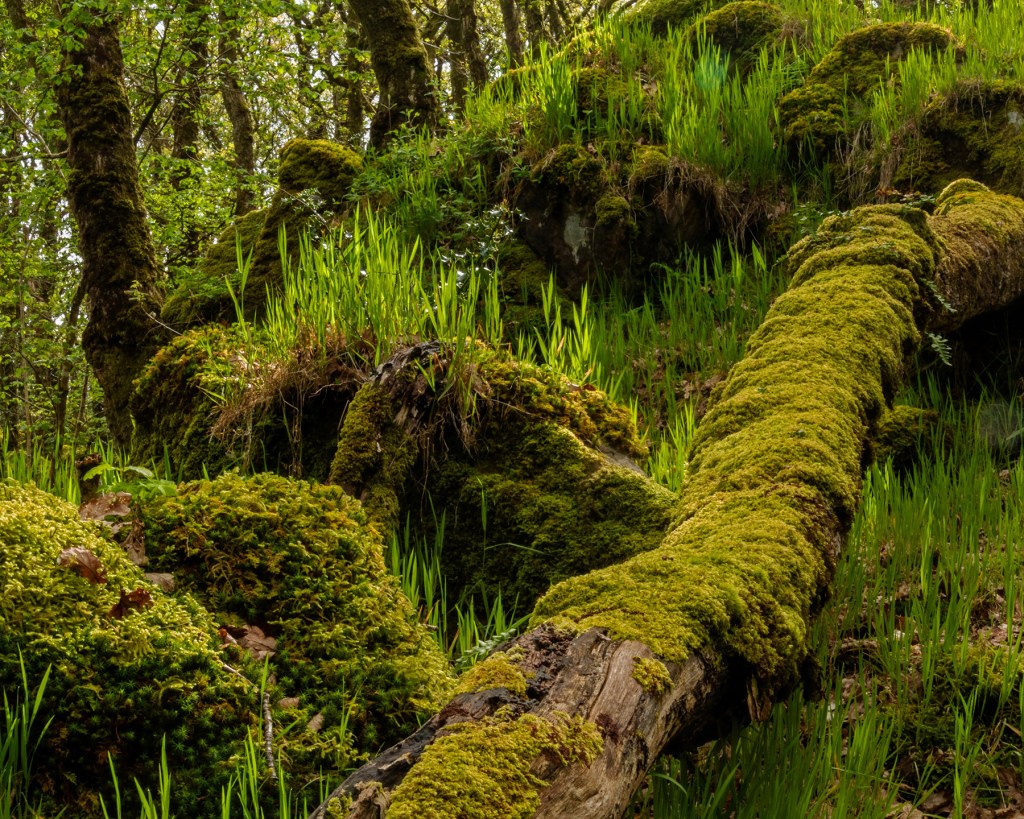
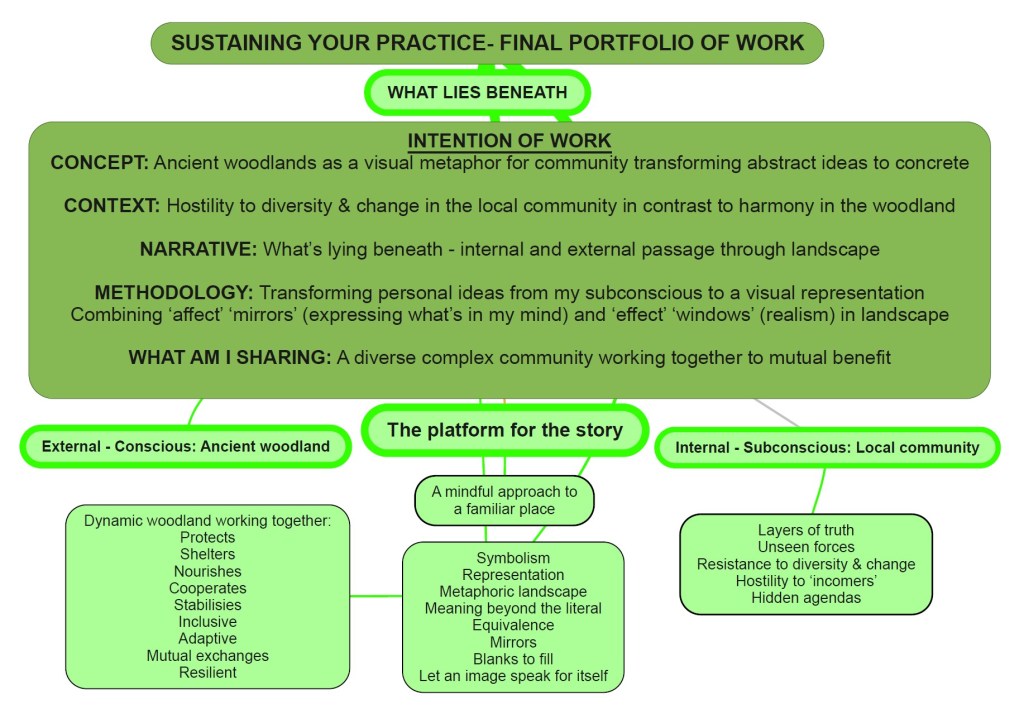
What Lies Within, is a series of images taken in an ancient woodland. A conceptual project, it uses the landscape as a medium to express my thoughts on community. The photography transforms abstract ideas in my head, into something concrete, positioning the ancient woodland as a visual metaphor for community.
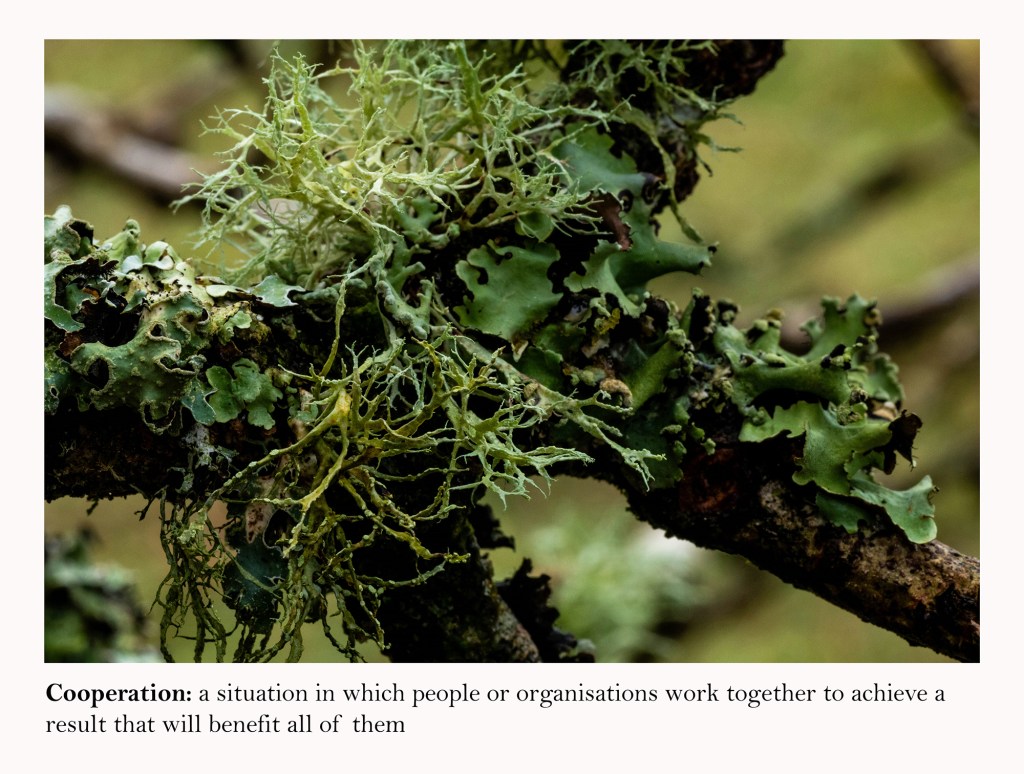
Though humans provoked the concept of the work, they are not evident in the images. The local community, often disharmonious and driven by difference, is in stark contrast with the harmonious characteristics of the woodland society. Footnote images signpost inherent qualities like cooperation, support, diversity, resilience, inclusion, networking, mutual exchange, and adaptation, which could be beneficially adopted in many human communities.
Known and accepted for some years, like other incomers in my neighbourhood, we are never adopted as local, no matter how long passes or the contribution to the community – a story common to settings across the globe.
Combining the world in my head with the one in front of me, through an internal and external passage through the landscape, has helped to heal some of the wounds that inspired the story’s beginning.
Niki South
ARTIST BIO for Lens culture
Niki South was born and grew up in England. From 1995 she began holidaying in Wales; this culminated in buying a second home there in 2009 and transitioning to a ‘dual centre’ life between the two places. In 2019 she relocated to Wales permanently.
Currently completing her BA (Hons) Photography degree with the Open University, she has a particular interest in community. Her previous documentary work ‘Layers of Truth’ was informed by her ‘insider/outsider’ position where she highlighted issues arising during Covid 19 from ‘incomers’ trying to integrate into a small traditional community.
Additional info I gave to the reviewer:
1. What is the single most important question/concern you have about your project that you wish to have answered here in this review? Do the footnotes combined with the artist statement adequately signpost the story behind the series? Can a viewer understand the concept of the woods as a visual metaphor?
2. What do you hope to accomplish with your photography in the next few years? To finish my degree, now 95% complete, to be able to move on and follow my inclination for combining narratives from my subconscious with images from the conscious world. I would like to publish other visual stories.
3. Is this an ongoing or completed project? It will be completed soon when I publish a book with the images and accompanying poetry that I have written, that completes the signposting for the narrative.
4. Do you consider yourself a ? photographer? advanced
5. What genres of photography do you work in (mark all that apply): fine art, documentary, imaginative storytelling
You can view your completed Submission Review here»
Thank you for trying out our Submission Review service. We hope it helps you refine your future competition entries! And we’d love to hear what you think. Please email us with any comments or suggestions. Thanks again!
Cheers- The LensCulture Team
Reviewer Portfolio Feedback:
Hi Niki-
It isn’t happenstance that you are using a forest as a metaphor for community. Fungi, aspen groves and many tree species are known to have elaborate networks of communication that bind them together. Not to mention all the other small organisms that make up the ecosystem that sustains the life of what we are seeing in your photographs. You pull any single member of the community out, and the whole forest suffers. Despite that the knowledge is out there for humans to make sense of it all, we continue to make the same, irreversible mistakes, over and over. And this project brings these questions, and more, to my mind.
In response to your request for feedback, I am still a little confused by the overarching idea that you are going for. If what I have said above rings with you, I think it would be helpful to state it somewhat directly and concisely. For example, instead of saying “The photography transforms abstract ideas in my head, into something concrete,” and defining your work as a “conceptual project,” I would simply say “”What Lies Within” uses the forest landscape of [name the forest] as a metaphor for human communities and civilization.” Or something like that.
That being said, I still want to understand how you see human communities as stark contrasts to this forest communities, but are using the forests as a metaphor for the human communities. Perhaps they are not a “metaphor” but a “model?” In other words, are you suggesting that these woodland spaces are a model for what it means to be a part of a community and to live in an ecosystem where all things must coexist and support each other’s life processes? Again, I am very interested in the ideas. I just think it’s a question of being clear and concise: especially when submitting to a contest like this where jurors have so little time to spend with each submission/statement.
I also don’t know if you need to include the words with their definitions beneath the photographs. I think you can say everything in the statement and then rely on the viewer’s intellect to realize that what they are seeing are prime examples of what those words represent. Perhaps you can include those exact words in your statement and then give an example of how that plays out in the woodland environments. But my sense is that this project could exist as two separate entities: image and text.
Otherwise, I haven’t talked about the images themselves. And I personally find myself getting lost in the beautiful, dense and elaborate spaces you are creating/seeing. The compositions are complex, often surprising and always seductive. These are hard landscapes to render and it feels like you have an eye for figuring them out.
It’s a pleasure to discover this series, Niki. Wishing you the best of luck.
My learning:
I have taken away from this review in terms of my publicity PDF:
Regarding the introduction:
Be concise/direct with my overarching idea – E.g. revisit my wording “The photography transforms abstract ideas in my head, into something concrete,” and defining my work as a “conceptual project,”
Consider if I mean that the woodland is a model for an effective community rather than a metaphor – calling it a model makes sense to me and I think it is more explicit.
Consider how I might use my footnote images and whether I should include the words with their definitions beneath the photographs.
I used this advice to edit some of my statement info when entering my next competition:
“What Lies Beneath’ expresses my thoughts on community, using landscape of an ancient woodland to create a visual model where things coexist and support each other. Footnote images signpost its inherent qualities like diversity and cooperation. My experience of local human communities provokes the project’s concept, where conversely they are often disharmonious and driven by difference. Sadly, incomers are never accepted as local, no matter how long passes or what they contribute to their neighbourhood – a story common to settings across the globe. This work has helped to heal some of the wounds that inspired the story’s beginning.
What lies beneath the emerald wrapping, embracing their collective realm? What lies elsewhere beneath man’s disguised demeanour, civil but deliberately divisive? “
I replied to the reviewer:
Thanks for the review. It comes at the beginning of my journey to ‘put my work out there’, so is very timely.
I understand your message to be more explicit and concise when conveying my ideas to viewers/reviewers and thank you for the practical ideas that you have given that I can consider in a reformatting of the project.
It was a very thoughtful, useful review.
Thank you!
LO4: independently disseminate your body of work by establishing relationships and networks with audiences, clients and markets
The Juror for “trees” had been Wendi Schneider, Denver based photographer, and artist widely known for her luminous gold leafed influenced by a background in painting and art history, and layers oils on her photographs to manipulate the boundaries between the real and the imagined. I realised the importance of researching the jurors after the competition was judged, as all images chosen were akin to her artistic style.
I selected 5 images, for the competition that could stand alone, and then for the review they asked for a further 5 images. See below:
I sent extra images sent for the review including some SYP edited out images, as I felt that they sat on their own well:
Reviewers: Amanda Smith is the founder and co-director of A Smith Gallery in Johnson City, Texas, and a photographer for over thirty years. Amanda’s personal photographic work has been selected for numerous juried and group exhibitions and is included in several private collections.
Kevin Tully is co-director of the Gallery, an artist, photographer, and woodworker. Kevin has juried numerous exhibitions for the gallery and other organizations over the past nine years. Kevin also does portfolio reviews and mentors individual photographers as well as writing about photography and art.
South tree review Time: Apr 4, 2024 10:00 AM Central Time (US and Canada)
My notes from the Feedback:
Images submitted all strong, quality excellent
They awaken your senses
They asked for my questions:
I asked how to submit when you are working from a body of Work and yet only single images are asked for with no opportunity for context.
They suggested look carefully at the jurors, but admitted that that you can’t always tell from this what might be chosen. Apparently this juror always selects work of her own type, but this is not always the case. Sometimes jurors will select work different to their own as a change.
I asked if Jurors see titles. They said in their case no they number them, but that where are used titles work well. I think if I was submitting with no context in future I would add a signposting title.
I asked what genre they see my work as. They replied fine art, though they said that increasingly fine art photography is defined by post production changes…
They suggested to look to enter competitions which call for Bodies of work, or at least those that ask for artist statements as my story is strong and important.
They also advised that I shouldn’t be put off putting my work out there for the same reason. I discussed my concern that because of the sensitive nature of my work, I don’t want to share my work locally, so maybe I should share away from here in some way.
I asked for advice on how to gain feedback and of course they said by portfoilio reviews. They suggested I might try:
The Los ángeles Centre for Photography
The Carmel Center for Photographic Art – Anne Jastrab
The Griffin Museum
Photo fest
Atlanta photography group.
My concern remains how to do this with minimal financial investment as I am not aiming to take the work forwards.
I asked about how to contact other photographers who submitted for feedback/support. They advised that some have websites, or to google, or to use Instagram. They will add the contact details/websites to the winning gallery images, so I will contact one or two of those whose work I like, as a way of networking. Those I thought would be of interest were David Lang, Leslie Giem and Ann Milne. However having researched their work it isn’t relevant to my project, concept or style.
Ann Milne / Oasis in the Redwood Forest, Rotorua, New Zealand, annwebbphotography.com, though after research she is a straightforward landscape photographer from New Zealand. Her competition image is unlike any of her other work.
David Lang / Spreading Wings / the 27 / davidglangphotography.com Some tree images, though all I phone work
Leslie Gleim / New Life, Ohia Tree / lesliegleim.com- Beautiful work but not relevant to my work
Although I thought the gallery owners reviewing was weak, I did gain some insights into how to choose what to submit to and how.
I prepared a PDF document with the intention of showing it to an industry professional and asking them for a short piece of feedback. This included: edited work from BOW, Artist statement, and introduction.
Part 1 : Share with tutor. Part 2 send to industry professional for review
Outcome: Revised Publicity PDF:
Decisions taken to revise drafts to this output shown in red text below
Feedback: My tutor suggested that the footnotes seem rather crowded and to consider omitting these, or perhaps include a question asking specifically asking for feedback on this element when sending out?
Part 2. Sent the same to a professional photographer
They commented:
Understood the concept/intention of my work easily.
Images strong and particularly like them when presented largest.
Many reviewers never read the text so the images must stand out.
Thinks the ‘footnotes’ are confusing in the context of the publicity pdf as the images are so different they jar with the rest, but keep them in the project/final book
Suggested that I shorten the introduction, explaining that reviewers want their attention grabbed quickly or they just move on.
Suggested renaming the ‘introduction’ as ‘project statement’.
Liked my poetry and thinks it sits well with the images.
Shortened the introduction and renamed it as project statement.
Omitted the footnotes from the publicity pdf but included in my final outcome book as I intended
Enlarged slightly the images that sit with the poetry
Have some extra images available for any portfolio review
In addition to the feedback that I relieved from the professional photographer and my Tutor I used parts of the 1st draft PDF as my submission to the Lens culture critic’s choice Global Call 2024, and paid for a written portfolio review, which was a very useful critique of elements of my PDF as well as my work.
2nd paragraph: In response to your request for feedback, I am still a little confused by the overarching idea that you are going for. If what I have said above rings with you, I think it would be helpful to state it somewhat directly and concisely. For example, instead of saying “The photography transforms abstract ideas in my head, into something concrete,” and defining your work as a “conceptual project,” I would simply say “What Lies Within” uses the forest landscape of [name the forest] as a metaphor for human communities and civilization.” Or something like that.
3rd paragraph: That being said, I still want to understand how you see human communities as stark contrasts to this forest communities but are using the forests as a metaphor for the human communities. Perhaps they are not a “metaphor” but a “model?” In other words, are you suggesting that these woodland spaces are a model for what it means to be a part of a community and to live in an ecosystem where all things must coexist and support each other’s life processes? Again, I am very interested in the ideas. I just think it’s a question of being clear and concise: especially when submitting to a contest like this where jurors have so little time to spend with each submission/statement.
I also don’t know if you need to include the words with their definitions beneath the photographs. I think you can say everything in the statement and then rely on the viewer’s intellect to realize that what they are seeing are prime examples of what those words represent. Perhaps you can include those exact words in your statement and then give an example of how that plays out in the woodland environments. But my sense is that this project could exist as two separate entities: image and text.
I learnt from this review in terms of my publicity PDF, for introduction:
Be concise/direct with my overarching idea – E.g. revisit my wording “The photography transforms abstract ideas in my head, into something concrete,” and defining my work as a “conceptual project,”
Refer to the woodland as a model rather than a metaphor, for an effective community.
I combined this with the suggestions from the Lens Culture reviewer and my Tutorfor my 3rd draft of my Publicity PDF (top of post):
I reduced and revised my Introduction/preface, Artist statement and Bio as below:
Original introduction:
Ancient woodlands are complex communities, with trees at their heart; they envelop your senses, encouraging you to slowly absorb what you see and feel, wake your subconscious, and inspire reflection. This body of work is a personal response to a dynamic landscape, both internally and externally.
The photography transforms abstract ideas in the photographer’s subconscious into something concrete, via a visual representation of another subject, positing an ancient woodland as a visual metaphor for community.
Though humans provoked the concept of the work, they are not evident in the images. The Photographer’s local community often disharmonious and driven by difference, contrasts with harmonious characteristics of these woodland societies. Inherent qualities like cooperation, support, diversity, resilience, inclusion, networking, mutual exchange, and adaptation, could be beneficially adopted in many human communities.
As an observer of her neighbourhood, well known and accepted for numerous years, the photographer finds in common with others that incomers here are never adopted as local, no matter how long passes or their contribution to the community. This story is common to settings across the world.(177 words)
Project Statement
‘What Lies Beneath’ expresses my reflections on community using the landscape of an ancient woodland to create a visual model where things coexist and support each other. Here I transform my subconscious thoughts into something concrete.
Though humans provoked the concept of the work, they are not evident in the images. Unlike woodland communities, the local community is often disharmonious and driven by difference. The woodland’s harmonious, inclusive characteristics would benefit human communities where sadly ‘incomers’ like me, are never accepted as local, no matter how long passes, or what they contribute to society – a story common to settings across the world.
In this work combining the world in my head with the one in front of me, has helped to heal some of the wounds that inspired the story’s beginning. (132 words)
Original Artist Statement
I use landscape and documentary photography as mediums for expressing my observations and reflections on communities. ‘What Lies Beneath,’ a conceptual landscape photographic project, builds on my previous documentary work ‘Layers of Truth,’ where in my insider-outsider position, I highlighted the issues and various truths arising from ‘incomers’ relocating and trying to integrate into a small traditional community.
My photographic style is shaped by research on ‘affect’ (expressing what is in a photographer’s mind) versus ‘effect’(realism); I photograph in a metaphorical manner. Artistically I am influenced by photographers who create images as metaphors for something beyond the subject photographed, such as Minor White and Alfred Stieglitz; and by writers like John Szarkowski who explore the differences between photographs as mirrors for expression, beside images as windows that share reality.
I find combining the world within my head, with the one in front of me, cathartic. This internal and external passage through the landscape, has helped me to accept and heal some of the wounds that inspired it’s beginning. (168 words)
New Artist Statement
I use landscape and documentary photography as mediums for expressing my observations and reflections on communities.
My photographic style is shaped by research on ‘affect’ (expressing what is in a photographer’s mind) versus ‘effect’(realism); I photograph in a metaphorical manner.
Artistically I am influenced by photographers who create images as metaphors for something beyond the subject photographed, such as Minor White and Alfred Stieglitz; and by writers like John Szarkowski who explore the differences between photographs as mirrors for expression, beside images as windows that share reality.
I find combining the world within my head, with the one in front of me, cathartic. This internal and external passage through the landscape, has helped me to accept and heal some of the wounds that inspired it’s beginning. (126 words)
Original Artist Bio
Niki South was born and grew up in Surrey in England. From 1995 she began holidaying in Pembrokeshire in Wales with her husband and two children; this culminated in buying a second home there in 2009 and transitioning to a ‘dual centre’ life, between the two places.
She is currently completing her BA (Hons) Photography degree with the Open University. Her previous documentary work ‘Layers of Truth’ was informed by her life as a ‘second homer,’ observing local issues from afar, when unable to travel to her favourite home by the Covid 19 safety enforcements. In 2019 she relocated there permanently. (101 words)
New Bio
Niki South is a visual artist born in England, now living in Pembrokeshire Wales. Visiting Pembrokeshire she found a hiraeth (deep longing for the place) and spent many years living a ‘dual centre’ life, between the two places, until relocating there permanently. She is currently completing her BA (Hons) Photography degree with the Open University.
Her previous documentary work ‘Layers of Truth’ was informed by her ‘insider/outsider’ position where she highlighted issues arising during Covid 19 from ‘incomers’ trying to integrate into a small traditional community. (86 words)
LO2 coherently present a body of work, making creative presentation decisions that complement your subject and/or your artistic strategies.
1. Prepare a PDF document with the intention of showing it to an industry professional and asking them politely for a short piece of feedback. This should contain an edit of the work you produced for Body of Work. You may wish to include an overarching artist’s statement as well as the introduction you wrote in Body of Work. In the first instance, you’ll use this to introduce your work and your ideas to your tutor who will give you suggestions on the submission itself and how to enhance the PDF before sending it out. Please tell your tutor who the PDF is intended for and include some background information on how you’ll contact them. Make sure that you’ve researched the form your submission should take; some organisations still ask for a CD/DVD, for example, which you should prepare in advance.
2. Having taken your tutor’s comments on board, use your PDF document (or, if applicable, a hard copy portfolio) to get some feedback from a professional photographer or another professional from within the industry. This could be done via a portfolio review or by a contact you already have. (Boothroyd, S. and Alexander, J; 30, 2020)
Reflections on formative feedback from assessment BOW
Positives:
It was recognised that I have transformed the abstract concept of social disharmony into a visual narrative using the woodland as a visual metaphor.
My intertextual couplets are important in bridging the ideas.
Peer group participation.
Areas to develop:
Develop/research my ideas psychosocially /anecdotally on the unseen ‘hostile forces’ in the local community. This will help with my audience presentation through my artist statement. See development point 2.
Consider again the final set of main images – possible edit.
Re edit my woodland images for a final selection.
Consider the placement and presentation of the woodland images.
I revisited my BOW intentions:
Editing my BOW images
First I revisited the work on the various ways that I presented it for assessment making notes of any thoughts/observations – it has been some time since I visited this, which is helpful as I may be able to view it more objectively now.
Before I started I brainstormed my editing process:
I gave context for my work by sharing the power point I submitted for BOW. Then shared my editing board for SYP, as above.
We looked first at my main images. After some discussion there was a consensus that if I was looking for images to drop, it should be images 5 (5279), as the lighting is different, and possibly 6 (5607), as I thought. It was mentioned there could be some benefit in adding an image or two that offers different aspects of the woodland as image 3 does currently.
The group found it hard to decide on which to swap in but eventually agreed that images that showed extra aspects to the woodland would be good. Therefore, I have decided to add in possibility images 2 (5640) and 3 (5900) The group felt that these images added some extra woodland context to the other tree images.
I edited the woodland images, by reworking images 1.2.3.4.and 6. I added 3 new images 5.7. and 8. After reviewing I have eliminated original images 4 and 8 and have inserted new images 8 and 5. The peer group confirmed my choices.
Having edited my bow images for SYP, I then wrote a new Artist statement, bio, and introduction to go with the work. I did this with support from the course book and my peers in hangouts, I also studied these on photographer’s websites.
To accompany the PDF I built a website, using adobe portfolio, and an Instagram account; so, I could include links to them on my publicity PDF. These were all big learning curves for me.
Having reviewed my PDF my peers approved of the format and layout, though gave further advice on the artist statement, introduction, and bio. I subsequently altered these to be more explicit about the work, remembering earlier advice that viewers will be coming to my work cold.
I sent the PDF to my tutor on 8th April and had a reply from her on 22nd April advising me to go ahead and send out, taking into accounts her comments below:
Consider whether I should include the ‘footnote’ images as in her opinion they ‘crowd’ the document. I’ll take her suggestion to ask for feedback on this element.
She reminded me to make a bespoke approach to each addressee, explaining why I’m contacting them, encouraging them to respond by a certain date.
I now need to finish the draft above and send it out, then scheduled a tutorial to discuss responses.
Assignment 1 part 2:
I contacted a past OCA photography Graduate Anna Sellen to ask her if she would review my portfolio PDF. Anna is working as a professional photographer both individually and as a part of a collective of 6 photographers, I had not had any contact with her before.
I chose Anna, a UK based artist, living only an hour away from myself, as she graduated in 2023 and yet has successfully put her work out there and has had her work featured in many exhibitions and won several awards, for instance:
Work featured: at New Blood Art Emerging art prize 2023 at Saatchi Gallery, Open Walls Arles Vol.4 2022/23 in France, FORMAT International Photography Festival 2023, Earth Photo International Photography exhibition 2023, the Royal Photographic Society International Photography Exhibition 2022, Photoworks UK Graduate Showcase 2022, and other events.
Won awards, including: Earth Photo Sidney Nolan Trust Prize, RBSA Photography Prize 2023, Single Image Award at OpenWalls Arles and FORMAT Shutter Hub portfolio award 2021.
Also, as her projects often start autobiographically and evolve through extensive research. Transition and migration are a common thread in her work, as is belonging, so I believe that she would be interested in my work and be able to offer me some useful advice on dissemination it.
This was my contact email to her:
Hi Anna
I am in the final part of my Photography degree with the Open College of the Arts, Sustaining Your Practice, which you are familiar with. Incidentally, I am based in Newport Pembrokeshire, not far down the coast from you!
I am currently completing an assignment, which asks me to seek feedback from someone in the photography industry on a PDF preview of my work and the introduction to it. I would really value your feedback as a recent photography graduate and a visual artist, who I know sometimes works autobiographically and with transitions, and has been so successful in having work featured and awarded in events.
Any comments or suggestions you have will be gratefully received. My final product will be a book in which I intend to end with ‘footnote’ images with accompanying definitions, four of which I include in this PDF. I wonder if these samples should be included in a preview of my work, or possibly only two of them, and if you have any comments on this ‘signposting’ element of the work? I know that you will also understand the sensitivity of such work, so any suggestions on the line I am trying to tread between ambiguity and yet honesty would be helpful.
Thank you so much in advance, any insights you can give me will be really appreciated.
Anna indicated that she could respond to me after early June.
In the meantime, I used parts of the PDF as my submission to the Lens culture critic’s choice Global Call 2024—Deadline: April 17, 2024.
I paid for a written portfolio review:
This as it happened was a very useful critique of elements of my PDF as well as my work. Whilst my Publicity PDF has an Introduction, Artist Statement and Bio, Lens Culture asked for a statement about the work and a bio of under 2000 characters.
I used the bio that forms part of my publicity PDF, and to conform to their word count I combined elements of my Publicity Introduction (80%) and Artist statement (20%).
I asked the following specific questions of the reviewer:
Do the footnotes combined with the artist statement adequately signpost the story behind the series?
Can a viewer understand the concept of the woods as a visual metaphor?
The reviewer’s feedback below was very useful, especially reference parts of my Publicity PDF:
Reviewer Portfolio Feedback 26.4.24
Hi Niki-
It isn’t happenstance that you are using a forest as a metaphor for community. Fungi, aspen groves and many tree species are known to have elaborate networks of communication that bind them together. Not to mention all the other small organisms that make up the ecosystem that sustains the life of what we are seeing in your photographs. You pull any single member of the community out, and the whole forest suffers. Despite that the knowledge is out there for humans to make sense of it all, we continue to make the same, irreversible mistakes, over and over. And this project brings these questions, and more, to my mind.
In response to your request for feedback, I am still a little confused by the overarching idea that you are going for. If what I have said above rings with you, I think it would be helpful to state it somewhat directly and concisely. For example, instead of saying “The photography transforms abstract ideas in my head, into something concrete,” and defining your work as a “conceptual project,” I would simply say “What Lies Within” uses the forest landscape of [name the forest] as a metaphor for human communities and civilization.” Or something like that.
That being said, I still want to understand how you see human communities as stark contrasts to this forest communities but are using the forests as a metaphor for the human communities. Perhaps they are not a “metaphor” but a “model?” In other words, are you suggesting that these woodland spaces are a model for what it means to be a part of a community and to live in an ecosystem where all things must coexist and support each other’s life processes? Again, I am very interested in the ideas. I just think it’s a question of being clear and concise: especially when submitting to a contest like this where jurors have so little time to spend with each submission/statement.
I also don’t know if you need to include the words with their definitions beneath the photographs. I think you can say everything in the statement and then rely on the viewer’s intellect to realize that what they are seeing are prime examples of what those words represent. Perhaps you can include those exact words in your statement and then give an example of how that plays out in the woodland environments. But my sense is that this project could exist as two separate entities: image and text.
Otherwise, I haven’t talked about the images themselves. And I personally find myself getting lost in the beautiful, dense, and elaborate spaces you are creating/seeing. The compositions are complex, often surprising, and always seductive. These are hard landscapes to render, and it feels like you have an eye for figuring them out.
It’s a pleasure to discover this series, Niki. Wishing you the best of luck.
I have taken away from this review in terms of my publicity PDF:
Intro:
Be concise/direct with my overarching idea – E.g. revisit my wording “The photography transforms abstract ideas in my head, into something concrete,” and defining my work as a “conceptual project,”
Consider if I mean that the woodland is a model for an effective community rather than a metaphor – calling it a model makes sense to me and I think it is more explicit.
I used this advice to edit some of my statement info when entering my next competition:
“What Lies Beneath’ expresses my thoughts on community, using landscape of an ancient woodland to create a visual model where things coexist and support each other. Footnote images signpost its inherent qualities like diversity and cooperation. My experience of local human communities provokes the project’s concept, where conversely they are often disharmonious and driven by difference. Sadly, incomers are never accepted as local, no matter how long passes or what they contribute to their neighbourhood – a story common to settings across the globe. This work has helped to heal some of the wounds that inspired the story’s beginning.
What lies beneath the emerald wrapping, embracing their collective realm?
What lies elsewhere beneath man’s disguised demeanour, civil but deliberately divisive?
I replied to the reviewer:
Thanks for the review. It comes at the beginning of my journey to ‘put my work out there’, so is very timely.
I understand your message to be more explicit and concise when conveying my ideas to viewers/reviewers and thank you for the practical ideas that you have given that I can consider in a reformatting of the project.
It was a very thoughtful, useful review.
Thank you!
Ann Sellen OCA Post graduate photographer, met with me by video call 17th June to review my portfoilio PDF. These were the main points of her review:
She understood the concept/intention of my work easily.
Said the images strong and particularly like them when presented largest. Many reviewers never read the text so the images must stand out.
Thinks the ‘footnotes’ are confusing in the context of the publicity pdf as the images are so different they jar with the rest.
Suggested that I shorten the introduction, explaining that reviewers want their attention grabbed quickly or they just move on.
Suggested renaming the ‘introduction’ as ‘project statement’
Liked my poetry and thinks it sits well with the images.
My learning and action points for the PDF:
Shorten the introduction and rename it as project statement.
Omit the footnotes from the publicity pdf but include at the end of the book as I intended and at the end of any portfolio review.See if I can enlarge slightly the images that sit with the poetry, and/or add a separate page for the text as I will in my book.
Have some extra images available for any portfolio review
I will combine this with the suggestions from the Lens Culture reviewer and my Tutor:
• Be concise/direct with my overarching idea – E.g. revisit my wording “The photography transforms abstract ideas in my head, into something concrete,” and defining my work as a “conceptual project,”
• Refer to the woodland as a model, rather than a metaphor, for an effective community.
In this I reduced and revised my introduction, Artist statement and Bio as below:
Original introduction
Ancient woodlands are complex communities, with trees at their heart; they envelop your senses, encouraging you to slowly absorb what you see and feel, wake your subconscious, and inspire reflection. This body of work is a personal response to a dynamic landscape, both internally and externally.
The photography transforms abstract ideas in the photographer’s subconscious into something concrete, via a visual representation of another subject, positing an ancient woodland as a visual metaphor for community.
Though humans provoked the concept of the work, they are not evident in the images. The Photographer’s local community often disharmonious and driven by difference, contrasts with harmonious characteristics of these woodland societies. Inherent qualities like cooperation, support, diversity, resilience, inclusion, networking, mutual exchange, and adaptation, could be beneficially adopted in many human communities.
As an observer of her neighbourhood, well known and accepted for numerous years, the photographer finds in common with others that incomers here are never adopted as local, no matter how long passes or their contribution to the community. This story is common to settings across the world.(177 words)
Project Statement
‘What Lies Beneath’ expresses my reflections on community using the landscape of an ancient woodland to create a visual model where things coexist and support each other. Here I transform my subconscious thoughts into something concrete.
Though humans provoked the concept of the work, they are not evident in the images. Unlike woodland communities, the local community is often disharmonious and driven by difference. The woodland’s harmonious, inclusive characteristics would benefit human communities where sadly ‘incomers’ like me, are never accepted as local, no matter how long passes, or what they contribute to society – a story common to settings across the world.
In this work combining the world in my head with the one in front of me, has helped to heal some of the wounds that inspired the story’s beginning. (132 words)
Original Artist Statement
I use landscape and documentary photography as mediums for expressing my observations and reflections on communities. ‘What Lies Beneath,’ a conceptual landscape photographic project, builds on my previous documentary work ‘Layers of Truth,’ where in my insider-outsider position, I highlighted the issues and various truths arising from ‘incomers’ relocating and trying to integrate into a small traditional community.
My photographic style is shaped by research on ‘affect’ (expressing what is in a photographer’s mind) versus ‘effect’(realism); I photograph in a metaphorical manner. Artistically I am influenced by photographers who create images as metaphors for something beyond the subject photographed, such as Minor White and Alfred Stieglitz; and by writers like John Szarkowski who explore the differences between photographs as mirrors for expression, beside images as windows that share reality.
I find combining the world within my head, with the one in front of me, cathartic. This internal and external passage through the landscape, has helped me to accept and heal some of the wounds that inspired it’s beginning. (168 words)
New Artist Statement
I use landscape and documentary photography as mediums for expressing my observations and reflections on communities.
My photographic style is shaped by research on ‘affect’ (expressing what is in a photographer’s mind) versus ‘effect’(realism); I photograph in a metaphorical manner. Artistically I am influenced by photographers who create images as metaphors for something beyond the subject photographed, such as Minor White and Alfred Stieglitz; and by writers like John Szarkowski who explore the differences between photographs as mirrors for expression, beside images as windows that share reality.
I find combining the world within my head, with the one in front of me, cathartic. This internal and external passage through the landscape, has helped me to accept and heal some of the wounds that inspired it’s beginning. (126 words)
Original Artist Bio
Niki South was born and grew up in Surrey in England. From 1995 she began holidaying in Pembrokeshire in Wales with her husband and two children; this culminated in buying a second home there in 2009 and transitioning to a ‘dual centre’ life, between the two places.
She is currently completing her BA (Hons) Photography degree with the Open University. Her previous documentary work ‘Layers of Truth’ was informed by her life as a ‘second homer,’ observing local issues from afar, when unable to travel to her favourite home by the Covid 19 safety enforcements. In 2019 she relocated there permanently. (101 words)
New Bio
Niki South is a visual artist born in England, now living in Pembrokeshire Wales. Visiting Pembrokeshire she found a hiraeth (deep longing for the place) and spent many years living a ‘dual centre’ life, between the two places, until relocating there permanently. She is currently completing her BA (Hons) Photography degree with the Open University.
Her previous documentary work ‘Layers of Truth’ was informed by her ‘insider/outsider’ position where she highlighted issues arising during Covid 19 from ‘incomers’ trying to integrate into a small traditional community. (86 words)










 NIKI SOUTH