Research task: Reading an Archive: Photography between Labour and Capital (Sekula, 1999).
Read Allan Sekula’s essay ‘Reading an Archive: Photography between Labour and Capital’ in Evans & Hall (1999) Visual Culture: The Reader. In your learning log note down your response to this essay – and your thoughts on the discussion of globalisation above. (Boothroyd, 2020:36)
Here are my further thoughts on the globalisation discussion:
I’d not thought about the work such as Martin Parr’s tourism-based projects as globalism projects. Nor had it occurred to me to think of globalisation in terms of exchange of knowledge, or the role of art in this process.
Art is nowadays available across boundaries, physically and virtually. Ritchen suggests that sharing photography globally encourages visual similarities and strategies (Marien,2014:51), which it does. However, it has not resulted in homogenisation of cultural values across the world, despite much consumerism becoming international along with corporate identities and logos (Marien,2014 :395). In fact, globalisation has in some ways heightened awareness of local cultures.
Marien usefully suggests that in Art and photography, globalization is being differentiated from globalism (2014:503). Having sought definitions, it seems that globalisation is defined as a process by which businesses influence or operate on an international scale, whilst globalism is planning on a global basis.
This however didn’t give me clarity, so on further probing I now understand that globalism is an ideology of sharing across borders, whilst globalisation is the actual spreading of ideas, goods and services. Marian describes globalisation in art as a return to Modernism and its desire for universal values. It is possible though that after initial influences, some artists return to their original practices possibly defined by their cultures, whilst others might choose to move outside of this. The good thing undoubtedly is that we can share ideas and artwork globally and that it has the opportunity impact more widely.
The question is posed in the course material in relation to globalisation “who is really your audience? To whom do you want your work to speak?” (Boothroyd, 2020:36).
This is not an issue just of globalisation, but I think the starting point of any work. But I should also remember to ask myself particularly if my audience is not an exclusively local one, would my work be viewed differently in different parts of the world? There may be parallels with my work and another’s work from a completely different part of the world. I should also be aware whether my work might cause offensive to other of a different culture, but again this is not just an issue of globalisation but a general issue.
The idea of considering globalisation is interesting to me, as my work is based on observations of local community, and the above highlights to me the need for awareness that others may not be able to access ideas that I represent, though once again this is always a dilemma withing photographic work.
References:
Boothroyd, S (2020) Photography 3: Body of work coursebook. Open College of the Arts. Barnsley.
Marien, M. W. (2014) Photography: A Cultural History. (s.l.): Laurence King Publishing.
Sekula, A. (1999) ‘ Reading an Archive: Photography between Labour and Capital ‘ In: Evans, J.H. (ed.) Visual culture: The Reader. London: SAGE. pp.181–192. Marien, M. W. (2014) Photography: A Cultural History. (s.l.): Laurence King Publishing
Read ‘Photography’ (Chapter 2) in Howells, R. (2012) Visual Culture on the OCA student website. Note down your own response to Howells’ arguments. (Boothroyd, 2020:35)
Howells considers the relationship between photography and reality and how it can represent the world in its 2-D form. To this he sets out a brief history of photography, and its uses. But he then poses several questions:
-Due to ease of mechanical reproduction, can photography be considered an artist medium?
-Does authorship give this artistic creative achievement?
-Does subjectivity in photography and the creative potential of form over content render photography artistic?
My notes and responses:
– Howells considers the viewpoint set out by Roger Scruton, writer and philosopher that photography is simply a mechanical representation of a subject and can’t transcend that. He points out that there is more to a photograph than its subject matter as this is only conveyed by a photographer by using a number of creative and technical choices-firstly the aesthetic potential of a subject needs recognising, then in the developing and printing there are further choices made. Howell objects to the assertion that photography is only about subject matter choices.
– He asserts that we respond not to what a photograph shows, but to how it shows it,
“A photograph, after all, has formal properties that transcend its subject matter” (Howells, 2012:194), as photographers turn subjects into compositions.
– Howells gives examples of photographers who were photographing where form was more important than the subject matter, often everyday objects photographed in unusual ways, and the image is the focus not the subject, such as Paul Strand, Siskind and Edward Weston. He cites that Siskind believed that “the meaning should be in the photograph and not the subject photographed (Lyons, 1965:6-7). Howells points out that artists such as these transformed the ugly into the artistic, so it is untenable to suggest that photographs are not art.
– Howells does agree that Documentary photography is more likely to be a representation of how something looks, but caveats this with how you may still choose what’s in the frame. He goes on to show that a photographer is even making choices when he decides to photograph something – this is subjective, as is the intent of the documents.
– Howells discusses the theories of Andre Bazin and the ontology “essence” of photography. The acknowledgement of the physical relationship between the object photographed and the photograph, but the understanding that the photograph in turn frees the subject from this relationship of time and space. Bazin believed that photography could be greater that creative power, even surreal as the distinction between the imaginary and the real disappears (Howells, 2012:199).
– Howells concludes that photography is a medium that is neither wholly or imaginary, and that this is its strength.
– On the semiotics of photography, he notes that the literal meaning of an image may not be its complete meaning.
– He covers the key debates of Scruton previously mentioned, as well as William King’s challenge to these views that photographers have particular ways of seeing (Howells, 2012:203). Also, that Warburton’s assertions that individual style is what makes an artist work distinctive, but this is not possible within a single image. Howells concludes accepting Warburton’s assertions, that when we contextualise a photographer’s work with their work as a whole, stylistic features, and intentions emerge, then photography can embody aesthetic intentions. “In other words, the photograph can now be seen as a work of art” (Howell, :205).
My response:
I very much enjoyed reading this chapter; I found it a comprehensive analysis of the relationship between photography and reality, and it introduced me to, new for me, writers and philosophers. I found his style easy to read and therefore the content easy to assimilate,
Returning to 3 questions that he posed himself at the beginning of the chapter:
-Due to ease of mechanical reproduction, can photography be considered an artist medium?
-Does authorship give this artistic creative achievement?
-Does subjectivity in photography and the creative potential of form over content render photography artistic?
Howells has answered all of these. He has shown that photography is about much more than mechanical reproduction, in part, because we respond to the way subjects are shown in images.
He has also shown by example that authorship can bring artistic achievement. I was particularly interested that he uses as examples groups of photographers that I am leaning towards influencing my work, such as Weston; explicitly that it is the image in their work that is the art not the subject.
One of his arguments is nicely simple, that if an image can transform something ugly into something artistic, photography must be creative. His message is clear that photography is subjective, many choices are made when constructing an image and so it is a creative process. I also like his assertion that photography is neither wholly real or imaginative and look forward to playing with this in my work.
References:
Boothroyd, S (2020) Photography 3: Body of work coursebook. Open College of the Arts. Barnsley.
Howells, R. and Negreiros, J. (2012) Visual Culture. (s.l.): Polity.
Nathan Lyons (1965) Aaron Siskind, Photographer New York: George Eastman House, cited in Howell pp.195.
Read ‘Rhetoric of the Image’ by Roland Barthes in your course reader. (Boothroyd, 2020:32)
On rereading this text, I was reminded of, and compiled a summary of the text from previous readings:
Roland Barthes (1915–80) was the father of semiotics in the world of photography. Semiotics is the study of signs and language and through this Barthes provided us with terms and tools that can be helpful in interpreting photographs. In ‘Rhetoric of the Image’ (1964) the French literary theorist Barthes analyses an advertising text and then looks at how signs within it covey different messages.
Semiotics can be known as the ‘science of signs’. A semiotic analysis of an image quantifies how the meaning or message is constructed or communicated:
He identifies 3 different types of messages:
The linguistic message: The text -denoted (captions and labels) and connoted (inferred).
The literal message: Dennoted – this is obvious and uncoded message.
The symbolic coded message: Connoted by signifiers and the signified.
Sign is the first level of meaning, comprised of a signifier and a signified – or a denoted object (the actual thing depicted) and the connoted message (what the thing depicted communicates).
Myth is the second level of meaning, it considers the viewer’s existing contextual knowledge that informs a reading of the image. Though myth is not directly referred to in the essay Barthes refers to cultural stereo types and assumptions.
The denotation of an image helps to define the coded messages within an image, although the reading of an image is dependent on the viewer’s cultural background. The signifiers are the connotators; Barthes calls the connotators a rhetoric and says, “it is precisely the syntagm of the denoted message which naturalises the system of the connotated message” (Barthes, 1977: p51)
For Barthes the photograph is a sign that is made up of a signifier and a signified
SIGNIFIER = the actual picture, its formal and conceptual elements
SIGNIFIED = what we think of when we see the picture. This could be very straightforward, for example a picture of a dog signifying ‘dogness’. Or it could be metaphorical or conceptual, for example a crown signifying royalty or the union flag signifying Britishness.
SIGN = the overall effect of a photograph
The image above presented in the essay is read as an advert. The fact that the context is a magazine, and the pictorial emphasis on the product labels, influence how the overall picture is read. These signs are taken in together, Although the landscape doesn’t feature in this advert, it refers to the bounty of the countryside.
Denotation and connotation -We can interpret a photograph on two different levels:
• Denotation is an objective approach in line with ‘translation’ – looking at the elements present in the image. What’s there?
• Connotation is more in line with ‘interpretation’ and is to some extent subjective. What do the elements mean (or connote)?
Punctum and studium
Studium is the term Barthes uses to the photograph’s cultural, political or social meaning.
Punctum is an element within the picture that disrupts the rest of the narrative. It punctures the meaning and takes it off on a different tangent.
Barthes suggests that the linguistic message has 2 functions:
Anchorage: This is where images can be ascribed various meanings and the text is used to focus the viewer on a particular meaning. Barthes defines anchorage as directional titles that pin down their meaning, e.g., news photographs, Advertisements
Relay: Here the text and image work together and the text adds meaning. He defines relay as when the image and text combine together to give meaning. E.g., Comic strips, graphic novels and films.
Intertextuality
Barthes talks about the rich tapestry of meaning. – summed up by his term ‘intertextuality’. Each person comes with their own background, education, and experiences and all of these things contribute to how they interpret life and events. When interpreting photographs, it’s also good to draw on other readings, pictures, paintings and experiences you’ve had in order to bring the photograph to life even more.
It is also suggested I our course reader that we read Chandler’s book Semiotics: The basics (2002). Here Chandler explains that the semiotic idea of intertextuality is mainly associated with post structuralist theorists. Chandler writes that the semiotic idea of intertextuality was introduced by Kristeva, and it refers to links relationship between texts. He refers to two axes of shared codes, 1) connecting author and the reader of the text 2) connecting the text to other texts. Meaning is not transferred directly from writer to reader but is actually mediated through, or filtered by, “codes” picked up by the writer and reader from other texts.
Chandler explains that intertextuality refers to more than the influences of writers on each other and the subjective power of language. Barthes in Image-Music-Text says that “it is language which speaks, not the author; to write is …to reach the point where only language acts, “performs”, and not “me” (Barthes, 1977:143). Chandler underlines that when writing we are using existing concepts and conventions and therefore writing can’t be confined to the author’s intentions; we may actually communicate things that we are unaware of. Intertextuality takes account of more than is within the frame of an image.
The concept of intertextuality became common for the textual theories of postmodernism, where interaction between the text and sign context is fundamental condition for making meaning. Intertextuality is the influence of other texts that add layers of meaning to images.
We are asked, is there an example of imagery within your work that features signs that can be interpreted in different ways by different viewers?Post an annotated example of your intertextual analysis to your learning log. (Boothroyd, 2015:32)
A building containing white cylinders (Niki South, 2020)
At the first level of Barthe’s meaning, the linguistic, the text accompanying this image tells a viewer that there are cylinders behind glass. The literal message is that the white cylinders are arranged in a pyramid shape behind textured glass, set in a white frame; the glass is probably a window and part of a building.
There is no external context for this image, but the denoted elements above may be translated by using the connotators, the signifiers. There are no obvious handles on the cylinders, which otherwise could signify they are mugs. In this case the textured glass might signify that this is a room which needs some privacy.
Contextual knowledge, myth may lead some viewers to the idea that this is a bathroom window, and therefore that the objects behind the glass are in fact toilet rolls. Equally another’s experience may lead them to believe that these are actually till rolls in a pyramid. I would suggest that within our culture the way that these cylinders are neatly arranged they would be more likely to be toilet rolls.
The semiotic significance of these white cylinders was grounded in the shortage of toilet rolls at the beginning of the covid 19 pandemic, but without this context, it loses this meaning.
References:
Barthes, Roland (1977). Rhetoric of the image, music text. London: Fontana Press.
Boothroyd, S (2020) Photography 3: Body of work coursebook. Open College of the Arts. Barnsley.
Chandler, D. and Dr, D. C. (2002) Semiotics: The Basics. (s.l.): Routledge.
Kristeva, J (1980) Desire in language: A semiotic approach to literature and art. New York: Columbia University Press. Cited in Chandler, D. and Dr, D. C. (2002) Semiotics: The Basics. (s.l.): Routledge, pp 230.
Roland, B. (1977) ‘Image -Music-Text”. Cited in Chandler, D. and Dr, D. C. (2002) Semiotics: The Basics. (s.l.): Routledge, p 196.
Read Douglas Crimp’s essay ‘The Photographic Activity of Postmodernism’ on the oca student website. This essay was first published in October 15 (Winter 1980) and is also available in Crimp, D.
As with all the readings you’ll be asked to do for this course, make notes on what you’ve read – and its relevance to your practice (if any) – in your research folder. (Boothroyd, 2020:28)
The Photographic Activity of Postmodernism.
Douglas Crimp first presented 1980, He is an art critic and a professor of art history.
Crimp calls Postmodernism a breach of modernism, from the museum, art history and photography.
Photography. In his 1978 work “Pictures”, he used the term post modernism referring to exhibited art of some younger artists in New York. He explored their concern about the seventy’s performative art, moving towards art with a “presence”.
He goes on to describe the difference between a presence as being there, to a subject having a presence. Concluding that work can have a presence even as a reproduction at a distance from an original. Whilst Benjamin only conceded aura to a minority of art works, Crimp points out that photography has since had aura conferred to it. He suggests that photography can be authenticated by classifications such as rarity of age, and the vintage print, but more importantly the “subjectivization of photography” (Crimp, 1995:97), an appreciation of artist’s stlye, which collecting and exhibiting artwork enhances.
Within this essay he discusses statements of Sherrie Levine on representation. On AfterSherrieLevine.com (AfterSherrieLevine.com, 2021) she rephotographed Walker Evans’ photographs from the exhibition catalogue “First and Last”, which can be downloaded to print out with a certificate of authenticity for each image, thus making them accessible by anyone. Levine suggests that representation creates desire to see the original subject, which can never be fulfilled as it is the art, not the subject that is the original, and therefore photography is the artwork.
Crimp also gives as an example the work of Cindy Sherman where she creates, narrates, and acts in her images. In doing so Crimp says that she has reversed the terms art and autobiography. He also comments on the work of Richard Prince who uses commercial images and presents them as documentary. Crimp suggests that these images “acquired an aura, only now it is not a function of presence but of absence, severed from origin, from an originator, from authenticity” concluding that aura has translated into a presence or a ghost (Crimp,1995:100).
Crimp shows that mechanical reproduction reducing the importance of the original, was a sign that modernism, which valued originality and artistic expression was being supplanted by post modernism. He appreciated new approaches to photography in this emerging postmodern era which embraced more contemporary theories in photography, and the role that photography played in challenging the museums and galleries. At this point I’m not sure whether postmodernism will be relevant to my practice.
WALTER BENJAMIN “THE WORK OF ART IN THE AGE OF MECHANICAL REPRODUCTION”
Read Walter Benjamin’s essay ‘The Work of Art in the Age of Mechanical Reproduction’ in Evans & Hall (1999) Visual Culture: The Reader. What do you think about Benjamin’s viewpoint? And Kracauer’s? Make some notes on your learning log. (Boothroyd, 2020:25).
Benjamin’s 1936 views on art, aura authenticity are put forward in his essay “The work of Art in the Age of Mechanical Reproduction” (1999):
Though art has always been replicated photography could do this at speed.
Reproductions of art will always be lacking in the elements of time and space, its unique existence, and the original is proof of authenticity.
Photography as a process of reproduction is able to enhance aspects possibly unseen by the naked eye, as well as place the object into a place where it couldn’t be otherwise.
However, when art is mechanically reproduced and loses its physical existence in time, and the physical existence ends, then its transmissibility is gone; Benjamin calls this the loss of “aura”.
He says that destroying aura by reproduction and transferring its location extracts its uniqueness; Uniqueness is bedded in the fabric of tradition and uniqueness is not transmissible, and distance however close, destroys this.
Benjamin did however believe that reproductions which produced and circulated copies of images enabled more people to view images, increasing communication, viewing and interpretation, and therefore democracy in photography.
I have found it hard to access much about the German critic Siegfried Kracauer and have resorted to Wikipedia for some clarity. He was critical of mechanical reproduction, he thought that memory was under threat and was being challenged by modern technology, particularly photography as it replicates some of the tasks done by memory. His view was that photography fixes one moment in time, where memory draws from various instances; he suggested that photography removes and emotion, essence and meaning from an object, and stressed the ontological relation of the photograph to reality.
Benjamin brought to attention some of modifications he noticed mechanical reproduction brought about the destroying of the aura, but also highlighted the liberation it can bring. Whilst Benjamin connects aura with the presence of the original, and reproduction depreciates this he concluded that some photographed work does retain an aura. Kracauer however was less positive about the effect of technological change on art. Other critics in the 1970s such as Rosalind Krauss and Douglas Crimp focused on the demise of the original piece of art as a sign that the modernist movement was dying.
I believe that as long as reproductions are noted as such, and manipulations of artworks are also noted as such, then there are many positives about being able to share works of art in a wider sense. Being able to share art in an aesthetic of informative manner widely may be more important that authenticity.
References:
Benjamin, W (1969) “The work of art in the age of Mechanical Reproduction” In: Evans, H. (1999) Visual Culture: The Reader. (ed.): SAGE Publications. Pp 72-79 (Accessed 1.10.21)
Boothroyd, S (2020) Photography 3: Body of work coursebook. Open College of the Arts. Barnsley.
Marien, M. W. (2014) Photography: A Cultural History. (s.l.): Laurence King Publishing.
Coming up for air: A retrospective- Stephen Gill 16 October – 16 January 2021, ARNOLFINI, Bristol
This exhibition draws together new and previously un-exhibited work from the Bristol born and based photographer. He is described as a “‘documentarist’, ‘anthropologist’ and ‘dazzling visual poet’”, Bristol Photo Festival (2021) his over-arching ethos is experimentation, which has led to chemical and alchemical experiments such as photographic burials, floral collage, in-camera photograms and submerging work. His experimentation takes his work beyond the usual boundaries of photography.
The exhibition presented a huge amount of his work, I detail below the series that were of particular interest to myself or my practice:
Please notify the sun (2020):
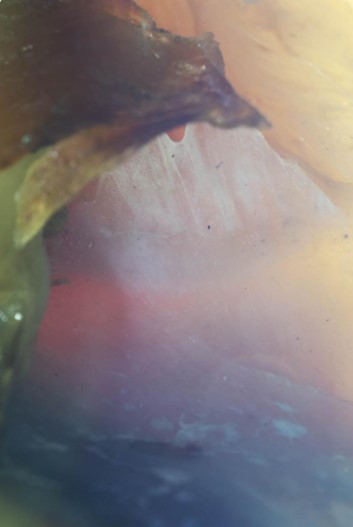
is a good example of what the gallery guide describes his work as exploratory journeys. For this he repeated a journey 9 times over 10 weeks to photograph a decaying fish he’d caught. To achieve this, he prepared the equipment he’d need beforehand, worktop, fridge, microscope, and lights. The gallery description describes the series revealing an unknown but somehow unfamiliar environment as you travel through the fish. The images are microscopic photographs of a fish, although they would be unrecognisable as a fish if you didn’t know this. They appear as unusual abstract shapes in a variety of colours some quite strong, with textures; through these images Gill creates a whole new landscape through the fish’s body.
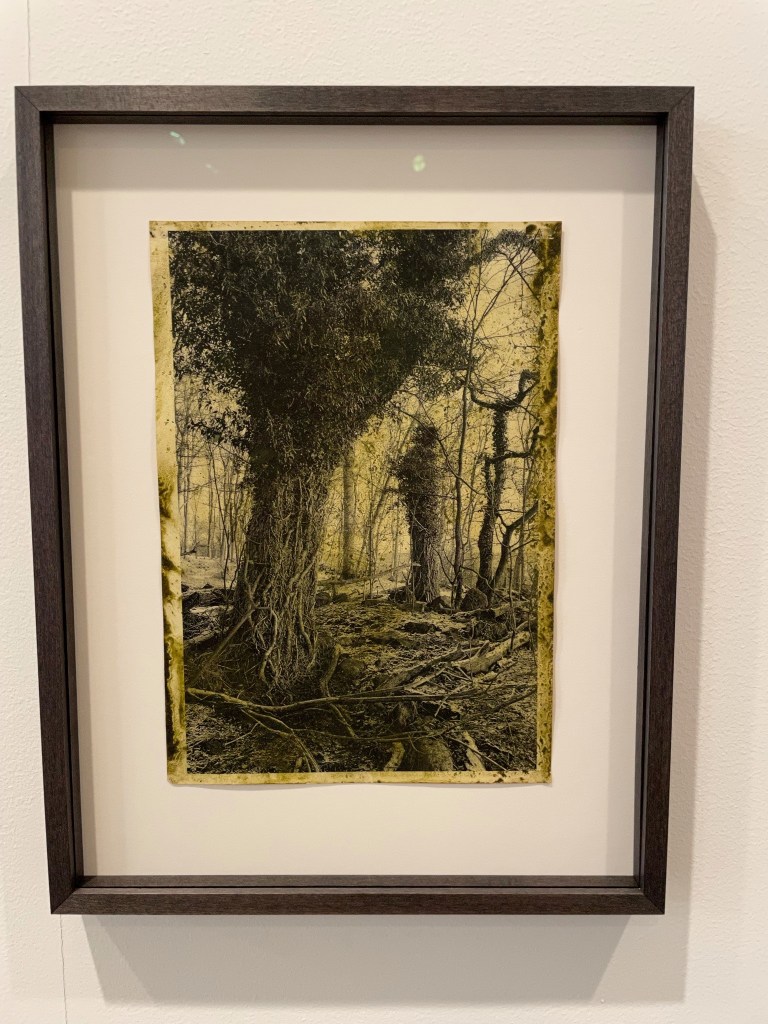
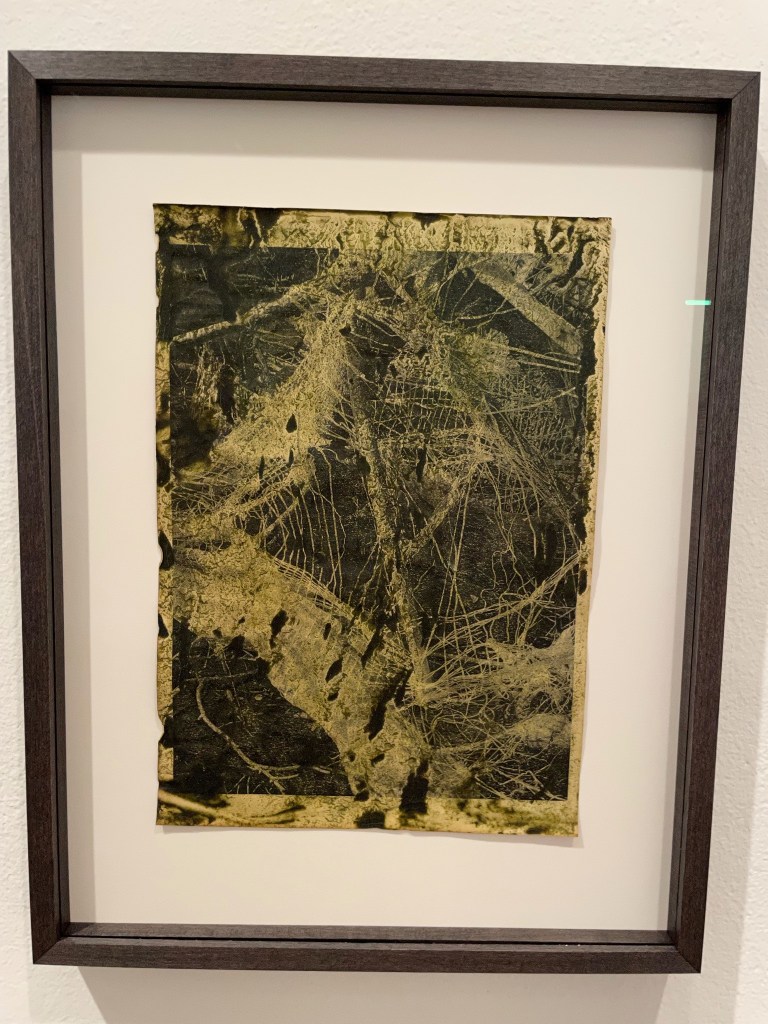
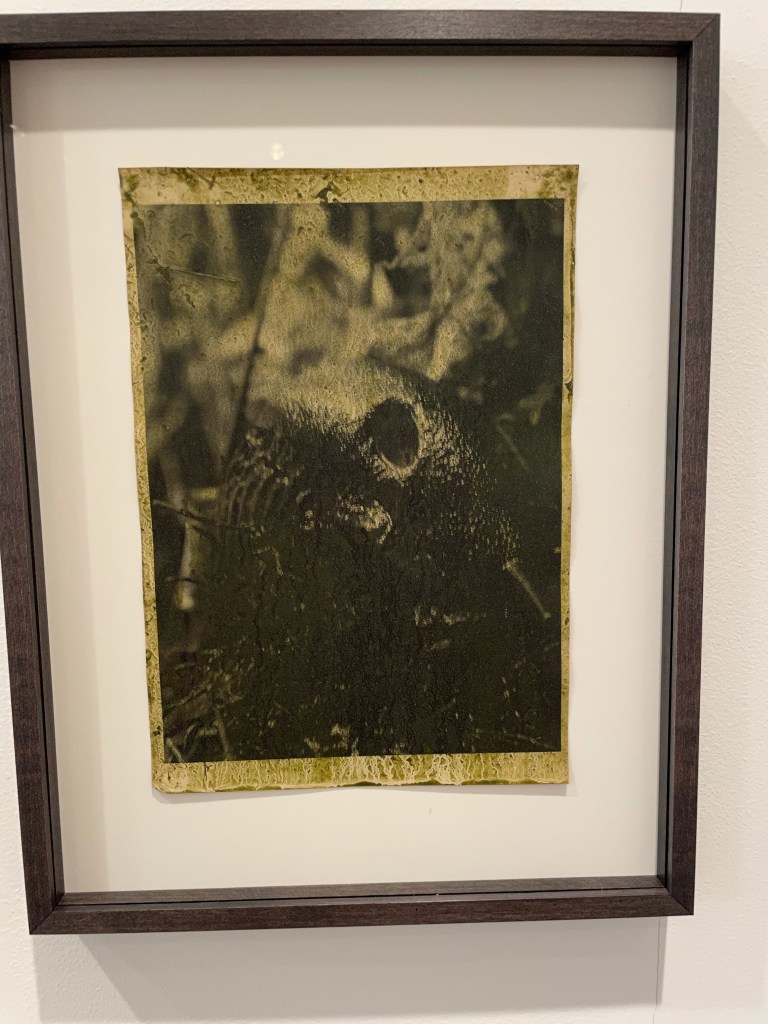
Gill took these images in a Swedish forest by attaching cameras with motion sensors to trees at a low level to capture creatures at night. Here he uses chance as a method, relinquishing to a degree his authorship of the photographs, encouraging the subjects to present themselves. These are printed with locally collected plant pigments, it was the beauty in the organic black and white prints now as collotypes which attracted me, the plant and tree subjects rather than the animal subjects.
Gallery installation images
Buried 2005-6:
The gallery text describes this as a:
“collaboration between myself and the place. I would make half the work and the place would make the other half. It was an early attempt to step back as the author” (Gill, 2021).
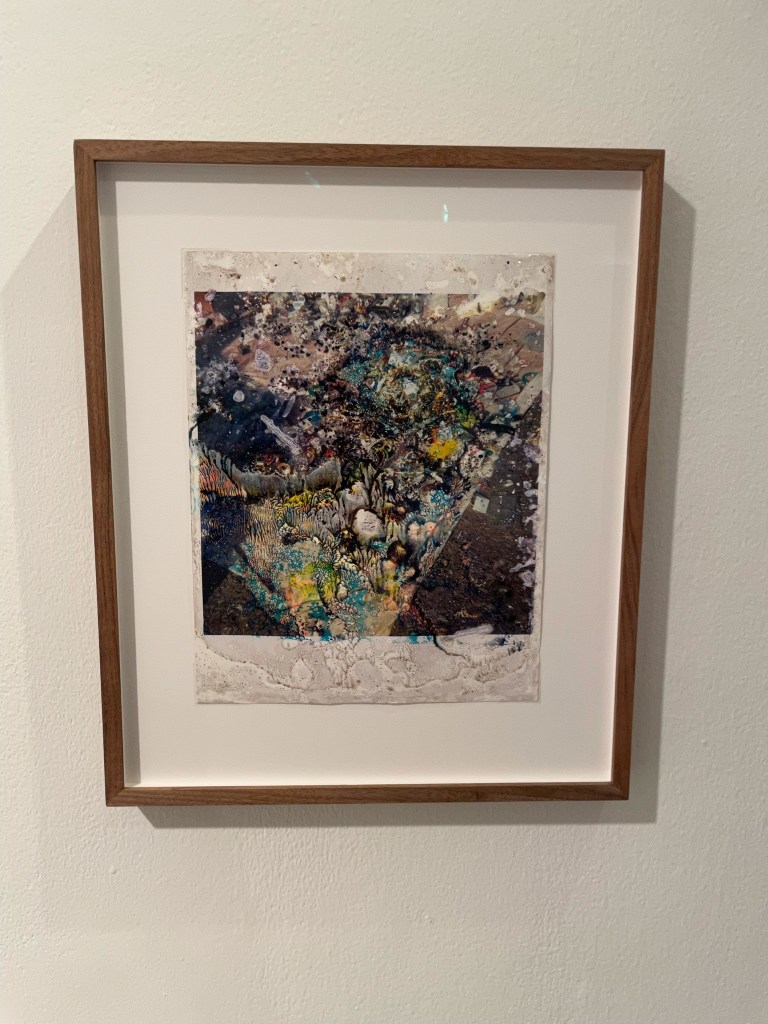
After taking the images he buried them beneath the ground for varying lengths of time, dictated by the amount of rainfall, and varying depths and positions; allowing the “place” to make its mark upon the work. Each photograph bears individual traces of time. The original images are now very distorted:
Gallery installation image
Off ground 2011:
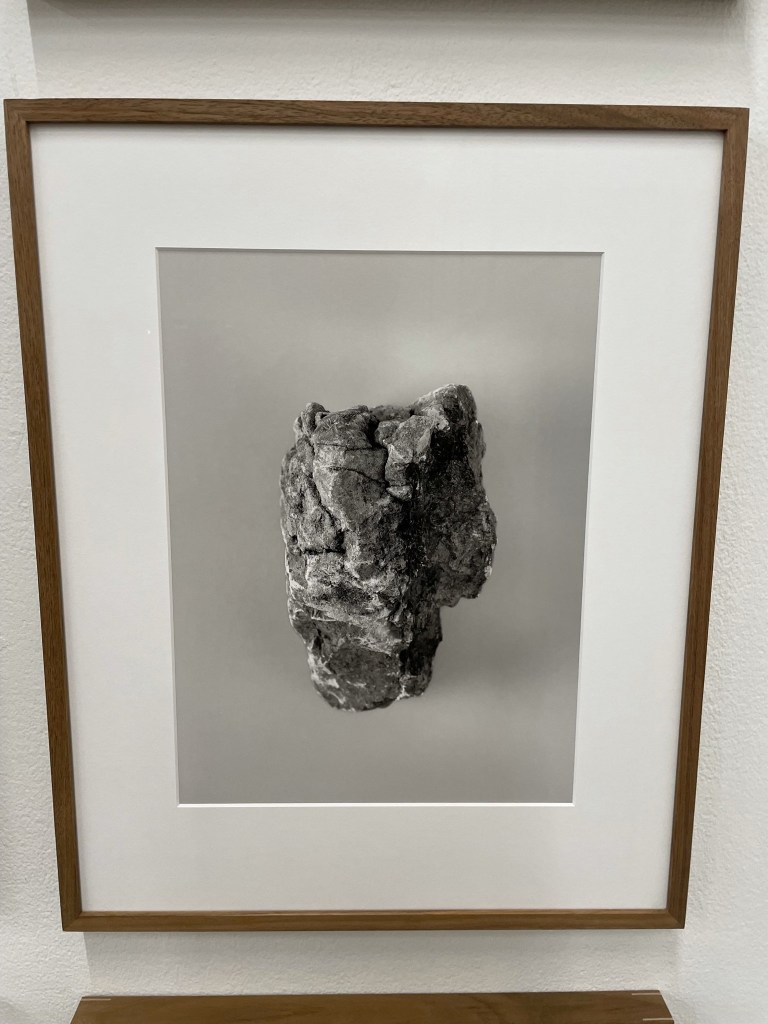
This was Gill’s way of responding to the aftermath of the 2011 London riots. Not wanting to add to the film and stills footage of the violence he collected fragments of thrown rocks and rubble. These he took back to his studio and made photographic portraits of them. An interesting method of capturing an event, Gill says “I see such studies as starting points for reflection, that are pinpointed to a certain time and place” (Gill, 2021).
Talking to Ants 2009-2013:
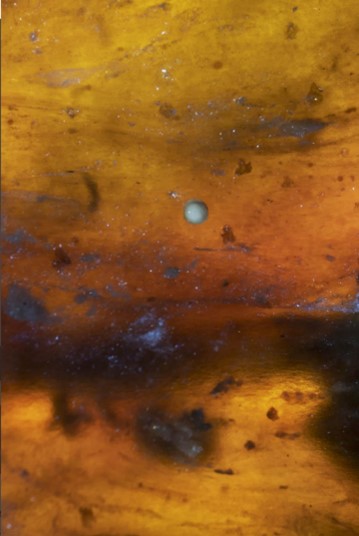
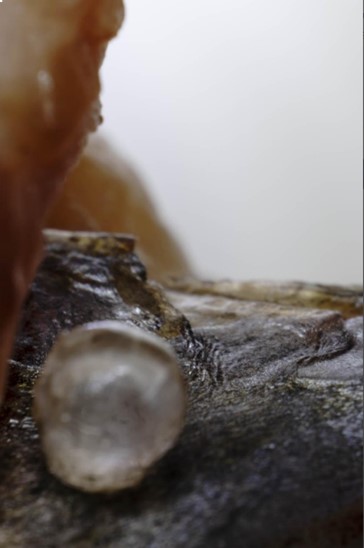
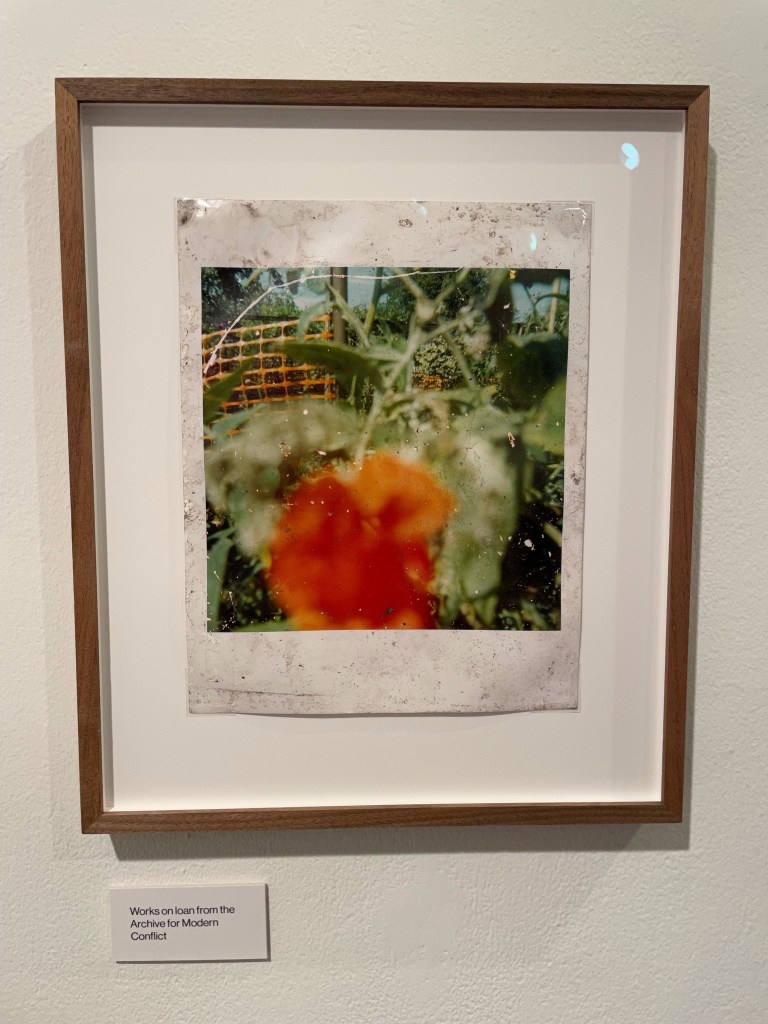
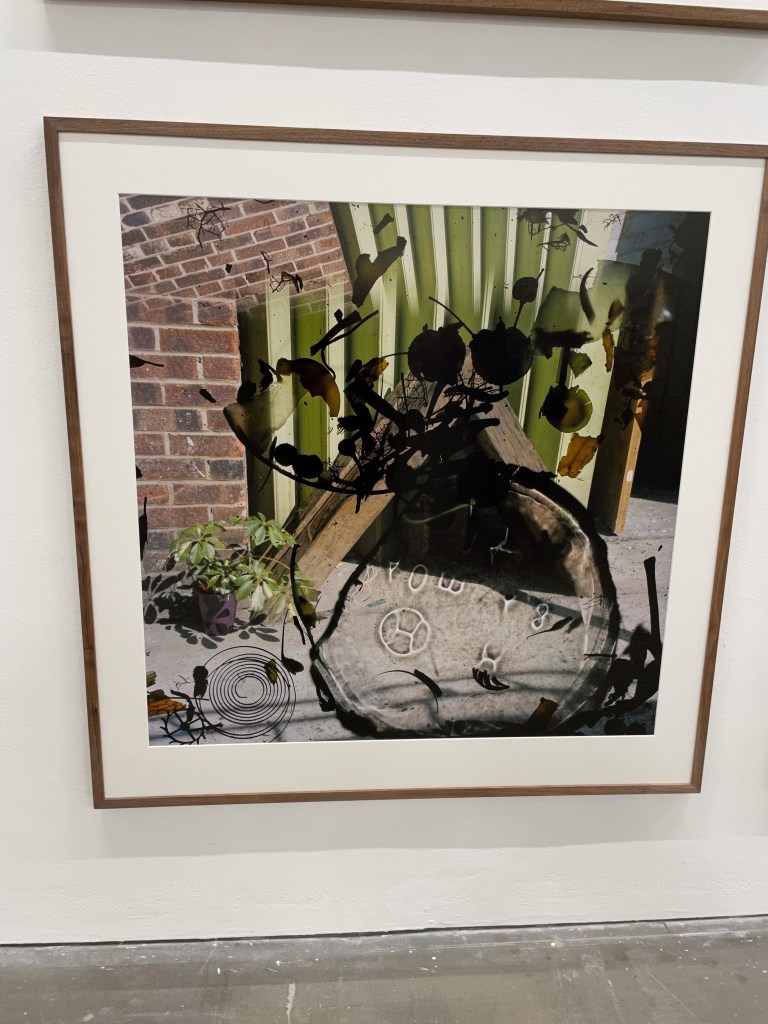
Is described as work that is both in front and behind the lens. Gill scooped up objects and inserted the detritus (dust, glass, plastic, insects, plant life and so on) into the body of the camera, resulting in surprise outcome again, with both chance and intention colliding in the images he knew the ingredients, but not the outcome. He describes this as incapsulating the spirit of the place in film emulsion “like objects embedded in amber” (Gill, 2021). Here again is confusion of scale, lack of information and ambiguity. The background objects are obscured by the items in front of them from inside the camera. The colour of the objects changes the landscape behind and the size of them alters the sense of scale; the layering creates new landscapes.
Hackney flowers 2004-7:
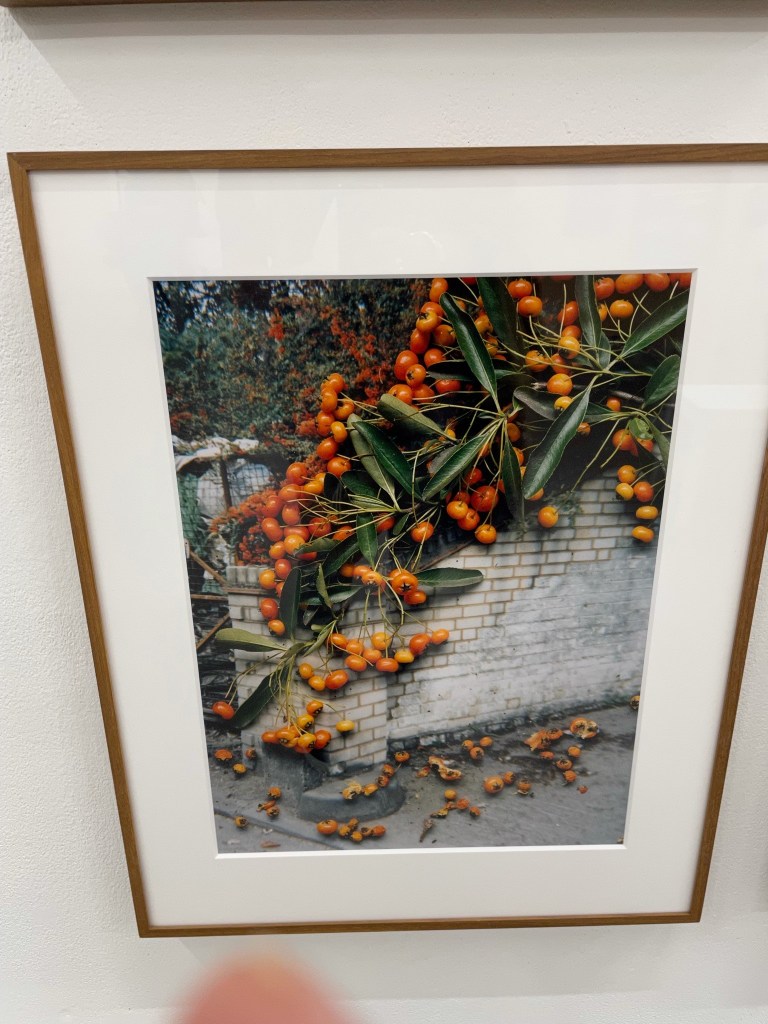
This is an attempt to describe what a place feels like beyond a visual description, an attempt to capture the essence of it. Taken in Hackney like many of his series, he added organic matter, such as flowers to the images, whilst he also buried some of the images. For this series he used a medical camera which resulted in a strange and confusing sense of scale. Base images with people place and objects overlayered with organic matter often to deliberately create an illusion.
My learning:
I was amazed at the breadth of Gill’s work. I had briefly researched Gill for my BOW genre coursework and then commented that his techniques did not appeal to me but that it demonstrates how broad a photographic response to a place can be. However, having viewed his work firsthand I found aspects that I should note:
Value in letting your curiosity lead you.
Playing with scale, whether that is with the equipment used (Camera, lens, lighting) or other methods.
Revealing and denying
Finding ways of allowing chance and intention to work together- possibly relinquishing authorship in some way.
Experimentation
Finding alternative ways of place making its mark on work
HELEN SEAR EXHIBITION WITHIN SIGHT Bristol 23.10.21
This was part of a shared exhibition with 2 distinct series with Robert Darch called Turn to Return. I was interested inDarch’s exhibition The Island, as he made the landscape images as a response to Britain’s vote to leave the European union; interested in that he has used landscape to represent his feelings about a tangible other subject – just as I am contemplating doing in my BOW.
Helen Sear’s series of black and white photographs were made in December 2019 whilst she repeatedly walked a mountain route, Sear says “the photos explore imitation and contagion as forms of magic through repetition and contact…they reveal a path whilst simultaneously denying a view” (Sear, 2021).
I understand from her exhibition notes that the visual denseness of the trees and the contours of the boulders should lead us on and off of the path, and cause us to ask what lies behind them, however without this narrative I would struggle to find meaning in them. Though in relation to myself intending to use landscape as metaphor it reinforces that an artist’s intention may not be taken on by the viewer.
Reference:
Sear, H (2021) Exhibition notes. Within Sight, Bristol. Centre Space Gallery.
I am glad that I had done the course prereading on Photo books before the exhibition and as I enjoyed the books, I was able to assess the books for different criteria. There were those that I appreciated not for their content or concept but for their design.
There were those the design and their concept fitted.
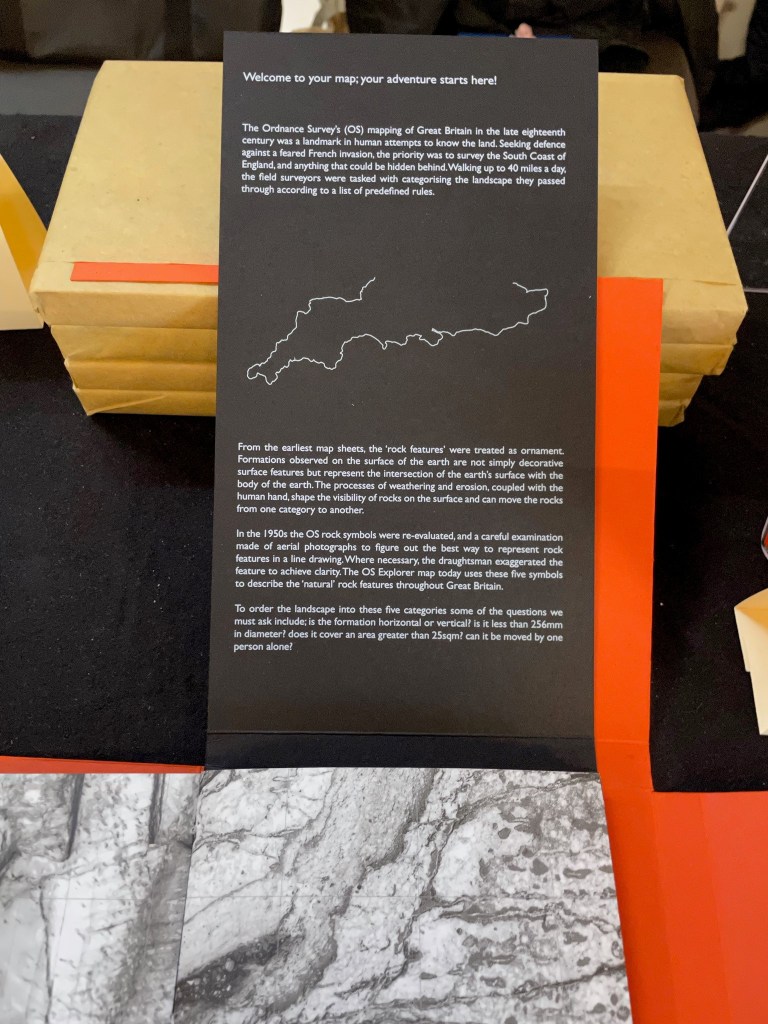
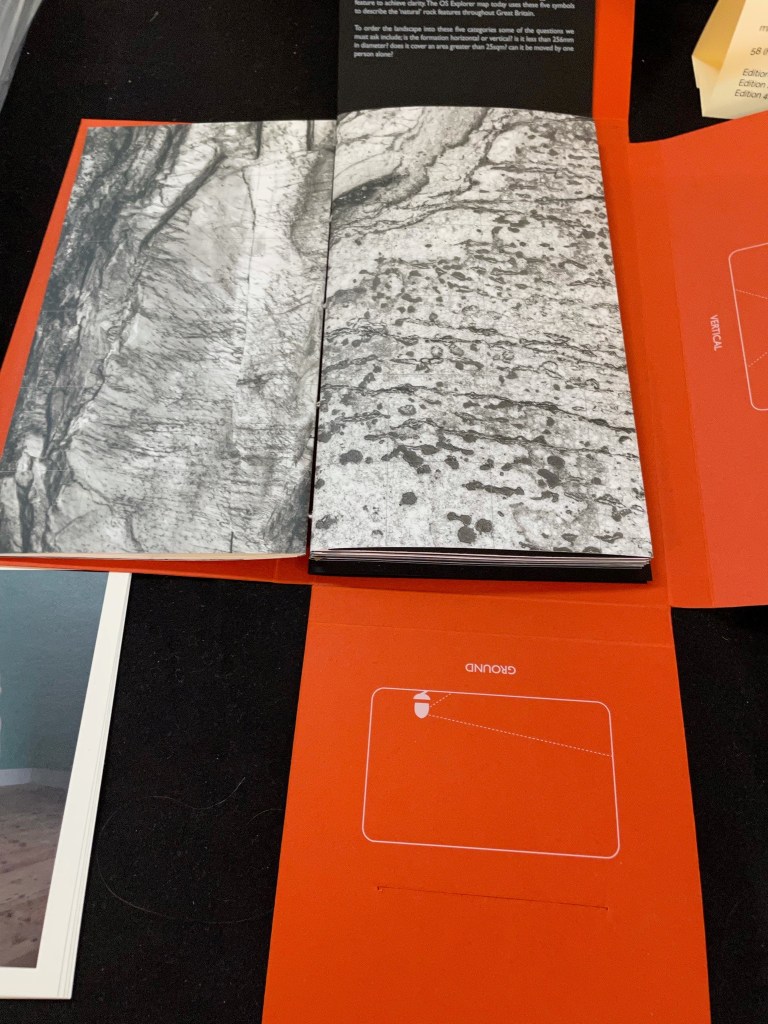
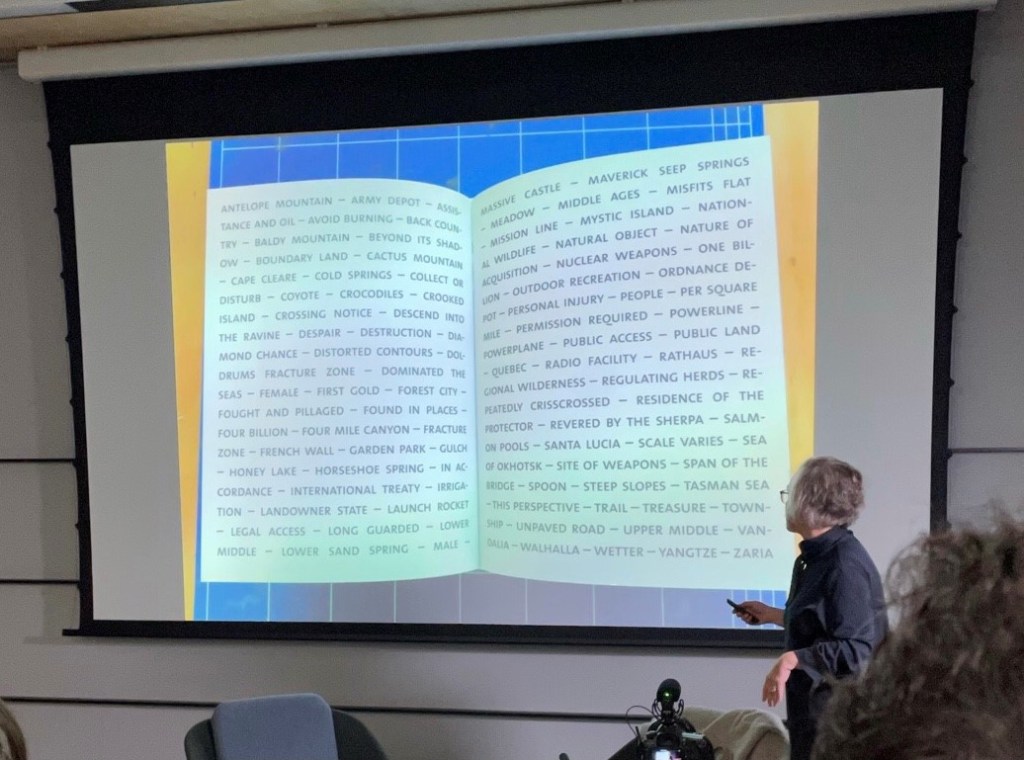
Tamsin Green’s this is how the earth must see itself, was my favourite. She made it whilst repeatedly walking the South Coast of England. It contains her images as well as archival material and uses the Ordinance Survey mapping system and symbols. In her walks she follows rock outcrops and photographs them in different scales. Green says that she:
“oscillates between seeking to know and name the land, and melting into aimless wandering, loosing sense of time and scale. The process of ordering the images into these pre-defined categories throws up questions as pebbles become boulders, flowing water becomes outcrop…As with all classification systems, the rules are subjective, leading to their own telling of the story.”
The handmade book design emulates the shape of an OS map, the haptics has the same tactility and folds. Unfortunately, its price meant that I was unable to buy it to explore it fully, such a shame for me as the content was relevant to the work that I am doing. There is a vimeo video referenced below which takes you through the work, and the beautiful black and white landscape and still life images of rocks can be viewed on her website listed below.
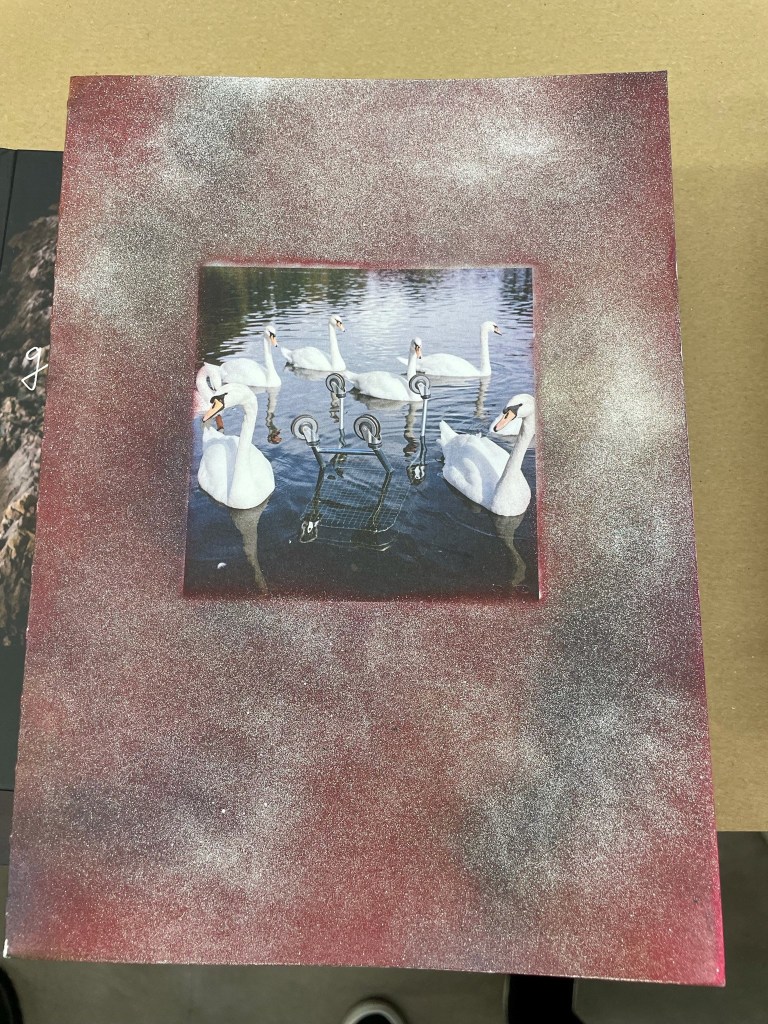
Robin Maddocks England. I was attracted by the tactile and handmade nature of his book, each cover individually spray painted by him, and each with four pages removed by him because he thought the book better without them. I thought that the variety of bold background colours used, and the varied text and image layouts fitted his images which were bold, graphic, and chaotic.
Billy Barraclough’s Murmuration’s, with poems and images of a variety of sizes, where the largest folds out to an A2 image. I would have bought this and been able to describe and comment on it further but unfortunately, he had sold out. From what I remember I think his subject the mass gathering of starlings did suit the book design; murmuration’s come in many different forms and their black and white natural colours was echoed in the black and white minimal book design.
Some designs I noted as interesting were:
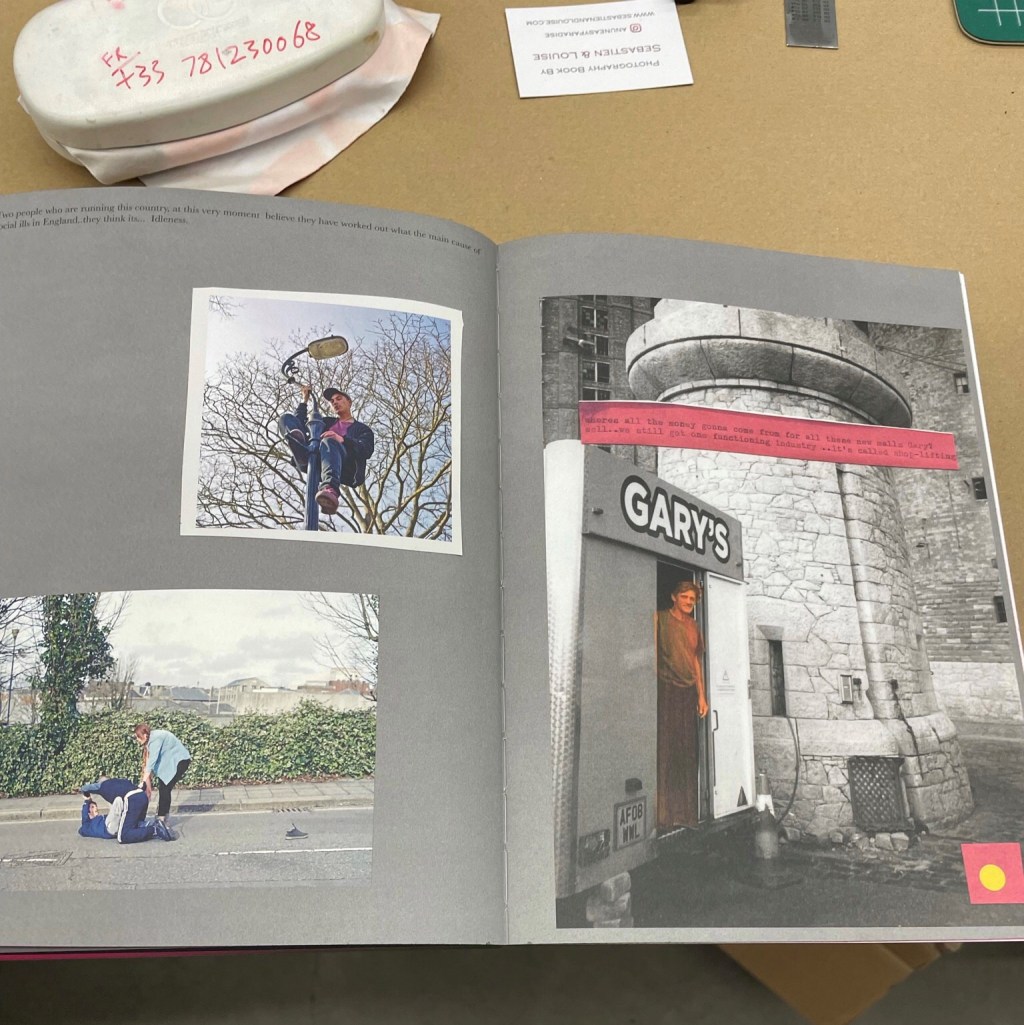
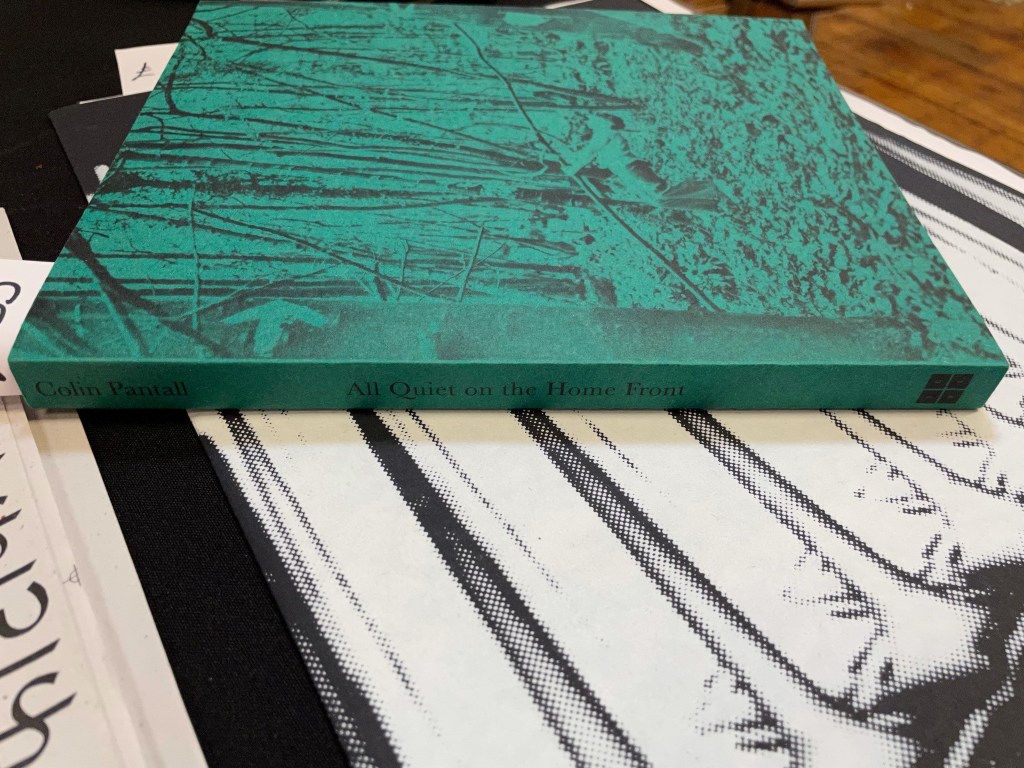
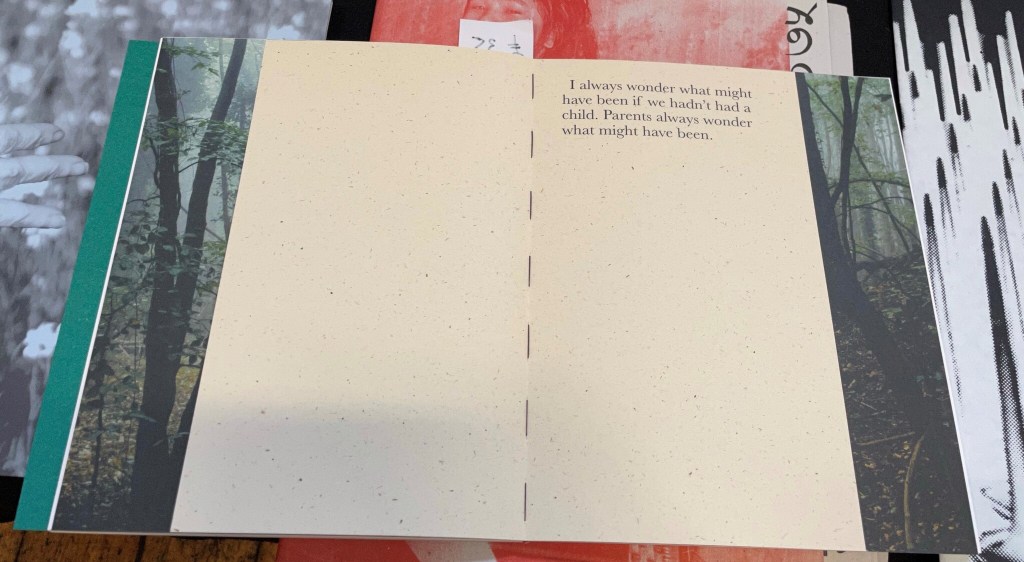
Colin Plantall, All Quiet on the Home front, where I liked the tactile raw, smaller text pages inserted into the book.
There were those that I took things away that were useful to me:
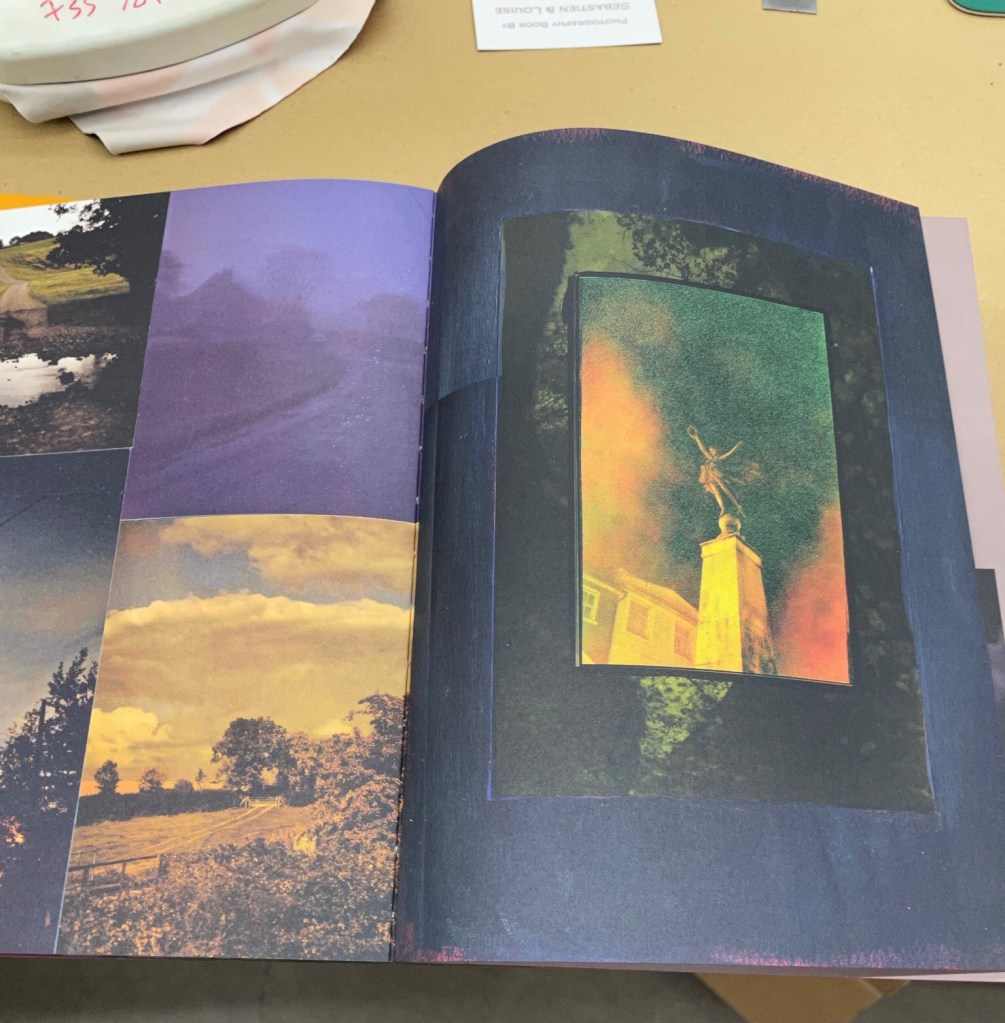
Mark Mattock Spring in the temple of plastic pillars and Where rude boys never think to look, both landscape photography of edge lands. I was taken by the gate folds in the later book of scrubby woodlands. Mattock described to me how he had chosen the gatefolds to emulate the feelings of claustrophobia in those woodlands, and once described this did enhance my experience of his book.
Green, T. (2021) this is how the earth must see itself: A walk with Natural Features – Tamsin Green. At: https://vimeo.com/567428495 (Accessed 31/10/2021).
EVENT PRE-READING REVIEW
The history of the photobook provided by David Company (Company, 2014) gave me lots of background information. I enjoyed the discussion on editing photobooks and his view that photographers are generally lousy editors of their own work. His final paragraph discussing a move from the recent widespread use of the term photo book to something more definable was thought provoking. Campany calls for some discipline around the term. Which led me nicely onto my next read below.
Towards a Photobook Taxonomy (Colberg, 2018), made me reflect on what a photo book actually is and I found his categorization really useful:
Catalog- Structured presentation of bodies of work.
Monograph- presentation of one body of work, usually financed by the artist.
Journalistic- text is often heavy and relies on journalist conventions includes Photojournalistic, Documentary, Encyclopedic,
Lyrical- the images are foremost, and the text is separated, if it does include an essay it is separated. Four types are suggested:
Poetic, without a story but with facets of one, close to a monograph, interpretive.
Elliptical, narrative ambiguity, not a linear story, possibly with visual symbols.
Linear, combines elements of the poetic and elliptical but reliant on its sequencing, more easily decoded.
Narrative driven: Text is often integral:
Photo novel.
Linear.
Elliptical. Subjective documentary.
first person narration
At this stage I would be most interested in Lyrical, elliptical or a narrative driven elliptical or lyrical for my current work.
The Photobook (Steptoe, 2020) also discussed the history of the photobook. But goes on to explain the history of photobook events, sales, fairs, competitions, and exhibitions. Again, it was the discussion it provided on the nature of photobooks which caused me to reflect on them in a new way. I had not thought before about the difference between a book of photographs and a photobook. These are set out here as that the photobook should have a purpose or concept, use physical prints when edit and sequencing, and have limited text, no text or a large amount of text.
In terms reviewing a photobook the description of the process of assessing them in competitions was useful: The value of the concept, the photography, the sequencing, the placement and design of the book spreads and the total look and feel of the book. It was also good to read the view that in terms of the form of the book almost anything can be called a book, even single or folded sheets. If I am to produce a photo book, I will look deeper at this and read Understanding Photobooks (Colberg, 2016).
Overall, I now realise I’d not really considers what makes a photobook, and the varied forms that they can take. This was useful to reflect on before going to the event but also will be invaluable should I decide on a photobook as an outcome for my Body of Work.
Her talk was more useful for my practice and was about a work much different to that which I had researched on her previous work on her website, where it describes her work as focusing on the co-existence of human, animal and natural environments with a rooted interest in magic, realism, surrealism and conceptual art. Particularly of interest to me is her description of photography which “often challenges the dominance of the eye and the fixed-point perspective associated with the camera lens, and explores the potential of the artwork to activate and elicit feeling” (Sear, 2011). I must research her work more deeply.
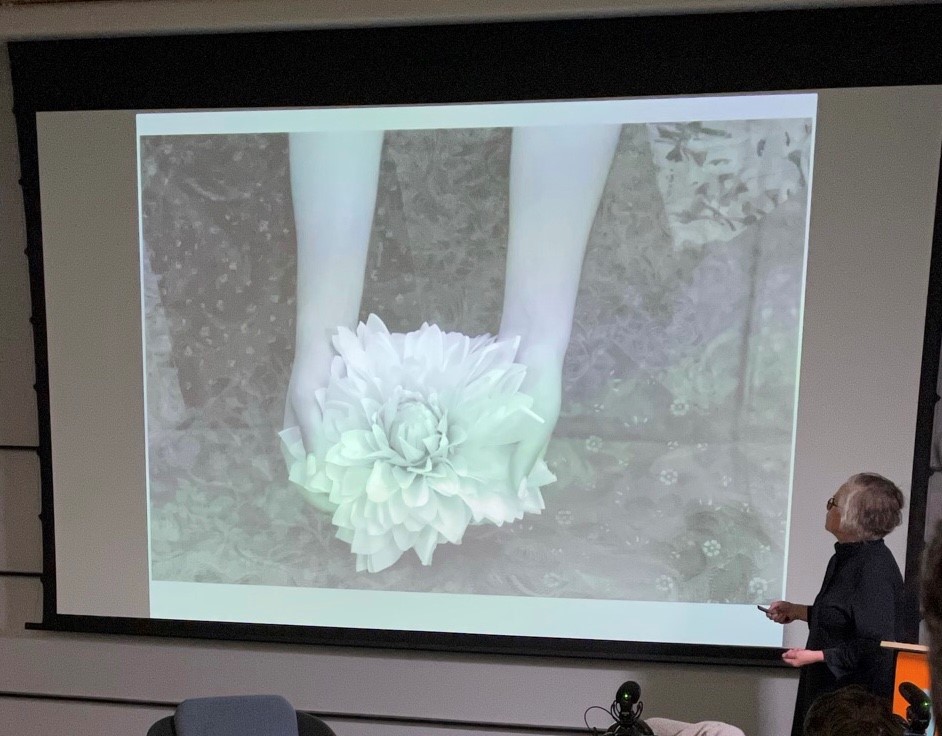
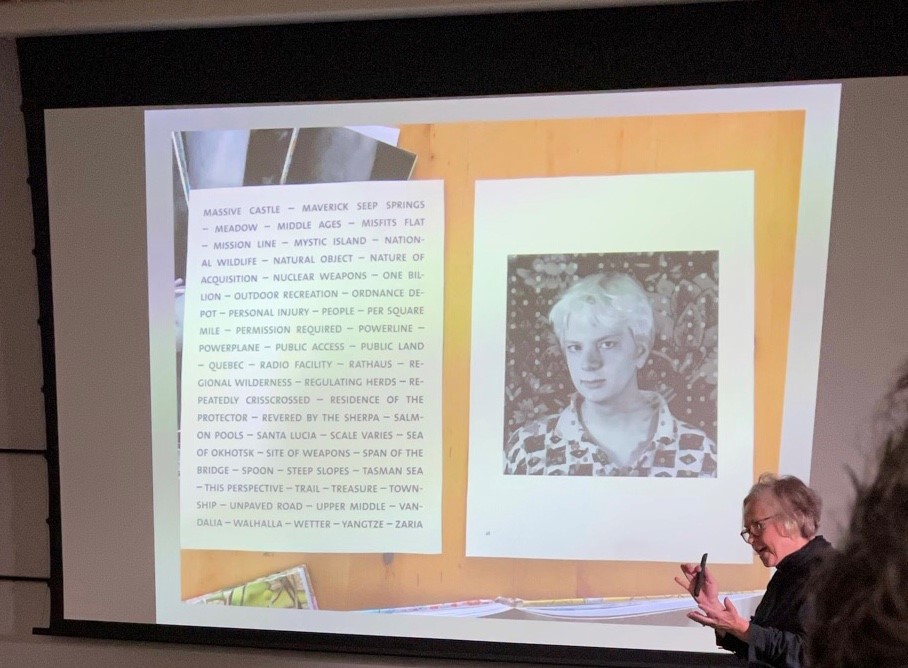
Her talk at the BOP was on the development of her new book Era of Solitude (Dewi lewis publishing, 2018). The project was based in a warehouse premises of The Scrap Exchange, an organisation dedicated to re-diverting surplus materials from landfill. Sear saw it as a microcosm for our human relationships with, and impact on the environment and our immediate surroundings. In a makeshift studio she took portraits of visitors with hands holding chosen objects and photographed the place.
(Dewi lewis publishing, 2018)
She didn’t begin with the idea of making a book, it developed. She asked herself, how do you archive/capture/arrange something? Her process was intriguing:
How do you archive/arrange something?
She put her own story in text
Used layering with scrap fabric as a process to bring texture to portraits
To connect BW and colour images used off white backgrounds
She used monochrome portraits to reduce visual overload which she described as paring back
I took away her idea of putting associated words densely on a page, as a strategy.
She made dummy books before choosing the format.
Also of interest to me is her current work in the ancient forests in France photographing the foresters’ marks on the trees.
My response
It was good to hear from an artist that an idea developed that was not the road they intended to go down initially; meaning when they had the subject, they had no idea how they would execute or present it – comforting to my situation.
Dummy books
How to bring texture to work with fabric, collage and layering.
Materials, techniques, observational skills, visual awareness, design, and compositional skills.
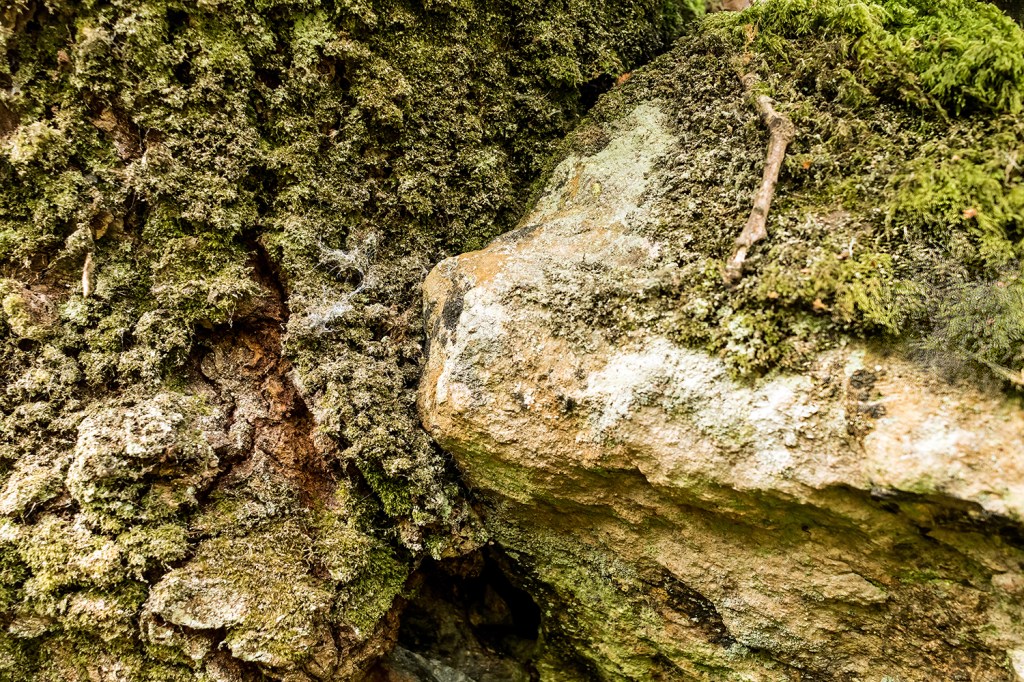
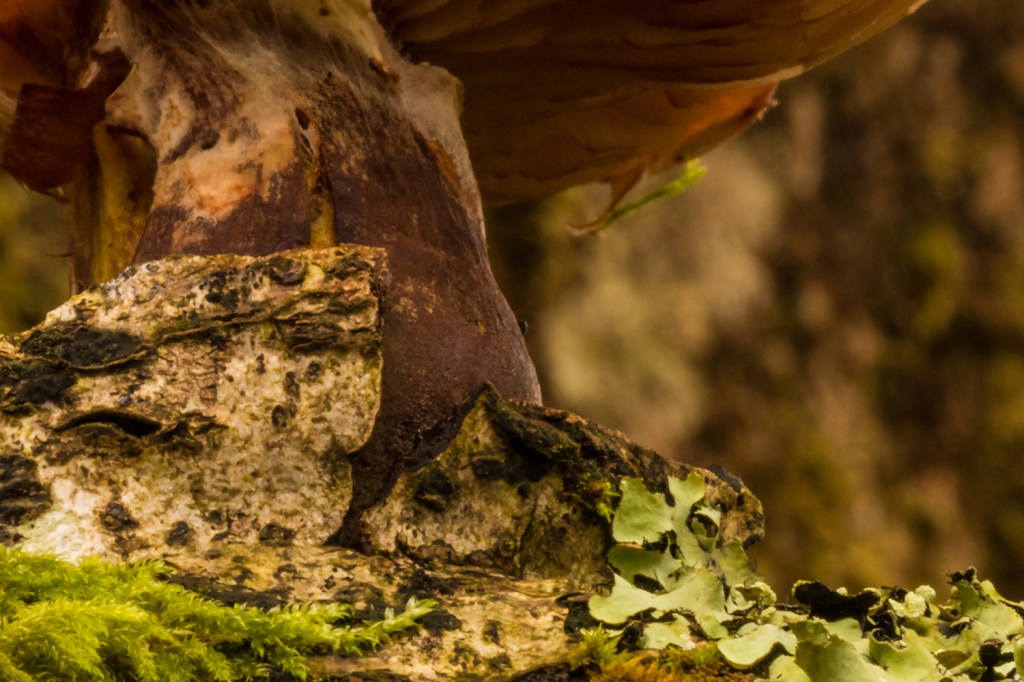
I used Canon 80 D with two different lens, initially a prime lens and then a macro-1:1 lens. The location is extremely dark and consequently I used a tripod for each shot.
Slow and sharp observation was key to finding my subjects. I spent several hours each shoot immersing into the woodlands whilst tapping into the narrative in my mind.
Once I found a subject, I spent a long time composing the image so that it would say what I wanted it to, to me.
Visual language, different ways of seeing and representation are central to this project. But perhaps will become more obvious as my work develops.
I felt it was important to begin by presenting the landscape in colour as I was seeing it. However, going forward, I will represent it in black and white as I think this will provide more space for viewers to interpret as they wish; subjects will become less obvious and more interpretable.
Quality of outcome
Content, application of knowledge, presentation of work in a coherent manner, discernment, conceptualisation of thoughts, communication of ideas.
The images represent the woodlands as they present in colour, but as I’ve said above, I will present in black and white next time, which means that I will need to look differently when photographing.
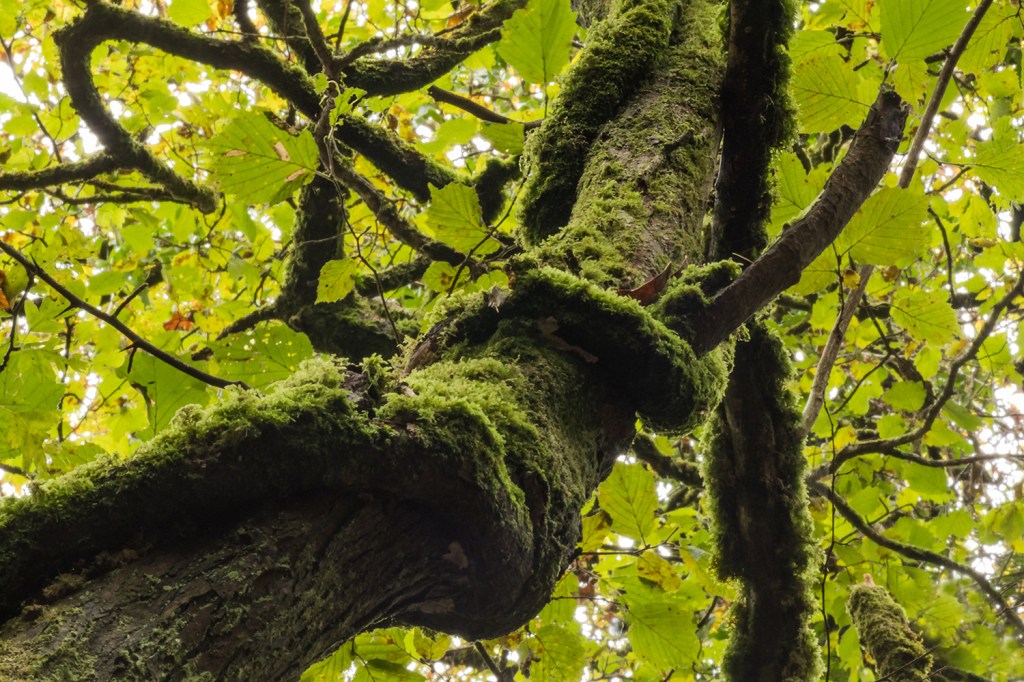
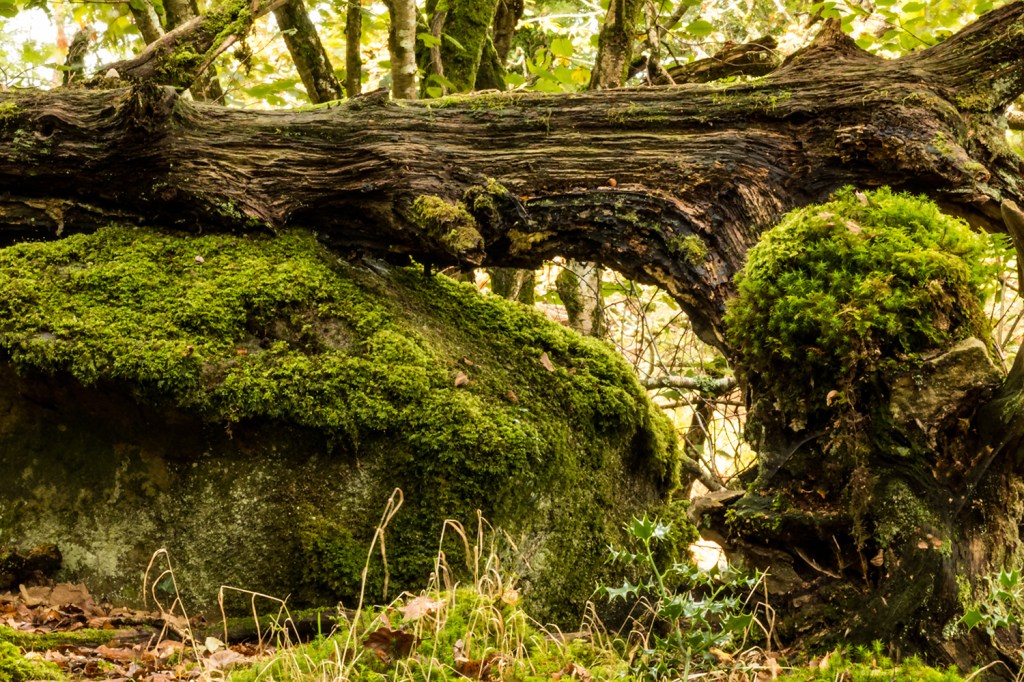
I have presented my work here simplistically, showing my progression from different methods as I experimented moving from psychogeography, to landscape, to abstracts, to close-ups as this assignment was presented as an opportunity to experiment with genre and style.
I am aware that these images are reasonably “straight” and obvious, which is not necessarily a problem, but I do intend from now on to use increasingly use perspective to increase ambiguity. This I think will echo my intention well, as this reflection on community, is in a large part affected by perspective.
I have considered other conceptual strategies but am reserving further experimentation for later assignments.
Imagination, experimentation, invention, development of a personal voice.
My intention to use the ancient woodland community as a visual metaphor for my local community is, I think, inventive.
I have experimented whist shooting these initial images and explored genre. This is shown in the development of my initial psychogeographical shoots and resulting images.
My photography developed as I moved from psychogeography at the beginning, to general landscape representation, then abstract and lastly to the close-up representation of community.
It is early days in this body of work, but I already hope that in my choice of subject for each photograph I am showing imagination and some personal voice.
It is the just the beginning of drawing parallels with the woodland and human community.
As usual I have reflected throughout this process, particularly on how I would represent my narrative. This journey is described in my learning log.
I read widely about woodlands, in particular, before I prepared for photographing, to get a general background on how these community’s work. See my bibliography on Trees and woodlands in my A1 learning log.
I have used and added to previous research on photographers I have studied previously who have stimulated this work such as, Minor White and Alfred Stieglitz.
These images are first explorations of my subject ancient woodlands as a visual metaphor for my theme of community.
I began shooting with the genre of psychogeography, photographing my longer/wider viewpoint unfocused whilst moving, and stopping to shoot still and with clarity and in detail subjects that caught my eye. In this way I emulated my external and internal passage through the place. I photographed as I saw, in colour. My later shoots continued with a psychogeography backbone but certainly with an increasing less objective sight as I worked into my topic, and I began to genre hop. I was aware that I was also thinking conceptually as I looked.
I was influenced in my way of seeing by practitioners such as Minor White and Stieglitz who used the landscape to express ideas and emotions in a representational way. Contemporary landscape photographers such as Rob Hudson, Stephen Segasby, Guy Dickenson, Tom Wilkinson and JM Golding of the Inside Out collective gave me further inspiration to explore space as an internal and external passage. As I shot, I increasingly found ways to enhance the aspect of community that the subject before me spoke to me of and shot as much what was in my sight as what was in my head.
The images I share here can fall into 3 groups (there are some that overlap):
Psychogeography/drifting
General landscape representation
Abstract representation
Close up representation
From these I can reflect further about my next steps, but at this moment I feel it is towards a mixture of landscape, abstract and close up. I may dabble with constructivism and conceptualism which I will do more research into, but I’m not convinced that I need to go down these routes to say what I want to in my work. I feel I need to work more into photographic styles that I have begun to develop so far in particular, landscape in abstract and close up, and use my absorption and new perspectives to share what I am seeing and feeling.










 NIKI SOUTH