The purpose of this assignment is to enable you to explore and develop initial ideas and research as part of a dissertation scoping and planning process. It is a key moment to reflect on possible relations between your ongoing research of visual culture with ideas relating to your photographic practice. The assignment requires you to reflect on how visual culture research and practice can weave together and support each other. Write a 1000-word essay (+/- 10%) (or 5 minute equivalent presentation) that relates your Body of Work to an aspect of visual culture, discussed in Part One. (Alexander, 2020:37)
Alexander, J. et al. (2020) Contextual Studies. Barnsley: Open College of the Arts.
I have removed my essay as it will be made available to my assessors
The overall feedback was that I’d tried to do too much too soon. The advice I was given below was really useful.
General advice given:
Write in the third person.
Only use italics for emphasis not quotations
Avoid redundant speculation/personal opinion
I should have explored a range of visual methodologies to begin with such as compositional analysis moving onto semiotics and discourse.
Use visual methods initially and then allow the context to make points and give evidence.
Weigh up the work being analysed, then use a visual method (poss semiotics) analysis and contextualise with different commentators.
Good semiotic analysis of my own work
I discussed my BOW images for the assignment as suggested but wont be discussing going forward, except possibly as my Tutor suggests I could do as preface to my essay
Actions from the feedback:
Look at the annotations and summarise the key points that I want to review in the contextual literature. Send to Tutor and he will review and revise/suggest others
1.Find a key premise or theme: Minor White expand on. Minor White and Szarkowski as a possible. enquiry. Realism representation or expression? Note: It’s the process of representation that that allows interpretation by the viewer.
2. Find a visual methodology to analyse, without going off on a tangent.
From part 2, for Lit review:
Use leading authors in the field as key resources to research and develop.
Summarise, demonstrate purpose and relevance of text to my rationale.
Critically compare and the approaches and conclusions of others
Indicate what I plan to explore further on my dissertation proposal
Other comments against learning outcomes:
LO1 undertaken research and study demonstrating comprehensive knowledge of your area of specialisation and built a theoretical framework for your creative practice
Keep writes up “tight”, no waffle!
Define terms for general readers. Use sites like the Tate to define key terms.
LO2 synthesised and articulated your critical, contextual and conceptual knowledge and understanding into a coherent critique of advanced academic standard
Think about outlining some of Minor White’s work with reference to Szarkowski – a possible focus for the essay?
In assignment 2 I could consider other visual methodologies that I might use to analyse work. Composition might be a useful methodology at the end of a work but it’s not very detailed.
LO3 applied your own criteria of judgement, reviewed, criticised and taken responsibility for your own work with minimum guidance
Realism is a complex topic – could be interesting to explore representation- representing – revealing -expressing. There is a conflict between representation and expression.
Expand more on the notion of equivalents. The Rose quote on the expressive qualities of photographs? could form the central thrust of Lit review effect/affect– which part? P4?
LO4 selected and applied information management skills and used appropriate technology in the production of an accomplished critique with minimal supervision
Could have begun by defining as a genre – Alexander, Bate, Clarke good for this.
Brief: Spend some time reviewing your personal reflection and your tutor feedback.Develop a series of carefully considered images that moves your idea forward.Hand in this series to your tutor together with a new reflective commentarysetting out where you plan to go from here.
These images follow on from my first genre shoot developing my exploration of my concept, the ancient woodlands, as a visual metaphor for my theme of community. I was encouraged after my last assignment, to get to the knub of my idea and form a working title; I have decided on “A harmonious community”. The how and why of sharing my concept is still developing.
I reread and found new material on woodland species I photographed, trees, lichen, moss, ferns, and fungi. This increased my respect for them as individual subjects and enhanced my understanding of how they work together to create this harmonious woodland community. Sheldrake’s quote about lichens being undividable “They flicker between “wholes and “collections of parts”” (Wildlife Trusts, 2021), could equally apply to all these woodland species. This time as I photographed, I shuttled between the perspectives of the whole and the parts, but increasingly focused on individual woodland species. When I reflected on my images it became obvious that it is almost impossible to separate these parts from the whole, as the woodlands are all about the collective working together.
Photographing these species was a process I needed to go through to understand the parts that make the whole harmonious community. I tried different ways of looking and using unusual perspectives but returned to simply showing the close relationships the species have with each other. I considered various text to signpost my intention, settling on simply adding a border combined with a dictionary definition to add definition to the images. Interestingly these definitions of words that relating to a harmonious community, mostly refer to people or persons. My concept is inspired by humans, they are not evident in my images, although they are the stimulus to my intention and observations, they do not need to be visually evident, I am sure of that.
Next steps
These images were not inspired by the photographers I researched, however returning to this research, when reflecting on my outcomes, helped me to consider on ways forward now. Of those, I identify with the work of Ellie Davies, particularly her practice where she “walks, thinks, sits, listens then creates” (Davies, 2018). Although her outcomes are created by intervention and construction in the woodlands which I don’t lean towards, I share her desire to photograph to explain the landscape’s effect on the photographer; this is something I will focus on going forwards- an intention to communicate the woodland’s exceptional quality of harmony and mutual relationships. Can I put something of myself in the space as Davies does without intervening in the landscape?
After this close focus on interrelationships in the ancient woodlands, I now want to return to a wider view of the moss-covered landscape to express my feelings about this community. I may try like Thomas Struth’s work in forests and jungles to present so much information that viewers will surrender to just looking. I have a thought to try mixing into each image, both the “whole” and the “parts”.
I outlined my BOW ass 2, in particular my intention to use my thoughts and experiences of the local community as a stimulus only, not featuring humans in it, in my work on the woodland community. Since assignment 1, I have honed the knub of my idea for my BOW to “a harmonious community”. I have stayed with my original intention of using the woodland as a visual metaphor for community, and a way of expressing my inner thoughts and emotions as well as my response to place.
I explained that I am inspired by the photographers of the Inside the Outside, landscape photography collective, as well as the work of Minor White and John Blakemore. Also that I want to put myself in the landscape without intervening in it like conceptual photographers such as Ellie Davies. In discussion we drew out that this work is about close up scrutiny of parts of a community, though moving on I will be sharing both the macro and the micro. We talked about looking at the patterns and relationships that emerge from this, as well as considering possible poetic elements to the work.
Tutor comments on my Assignment 2 submission
• She liked my approach using dictionary definitions juxtaposed by images of close-up parts of the woodland, which communicates my inferred reflection of the woodland community to human communities.
• The type face I used is effective, though it was suggested that I could make the definitions more authentic by ensuring that they consistently using verb or nouns and by using the same respected source such as the Oxford English Dictionary. This is not something I need to do now, but that I could do before my final submission. • She suggested that I continue to dig down into my theme of harmonious community that is at the centre of my work • In the future I could use the separate parts of the woodland community that I’ve photographed this time, somewhere in my final work- possibly in an appendix, inserts or overlays. • To experiment with my idea to represent the macro and the micro, we talked about using digital or physical overlays. • My tutor suggested that I might think about patterns and settlements also to combine with my woodland images. • I should check out the writings of Edward Weston. • Ensure my images are of the correct quality to stand enlarged printing if required.
My tutor was encouraging about the work and the developing concept, saying that I am showing that I am open to development and open to inspiration. I should not be afraid to present aesthetically pleasing images, and not look for an alternative way of presenting just to show a point of difference; just to find one that communicates my message. She described my work as slightly poetic, and that I should continue with my photographing, whilst experimenting with methods of communicating the parallels of the woodland community to the human community. She suggested I should look at: • Man Ray’s Dust Breeding. David company essay on: https://davidcampany.com/dust-breeding-man-ray-1920/ • Giles Perez conversation with Gerhard Steidl where he talks about text and images and the new meaning that forms beyond the two: https://thephotographersgallery.org.uk/dbpfp22-gilles-peress
LO1 produce convincing visual products that communicate your intentions, using accomplished techniques in complex and unfamiliar environments, with minimal supervision from your tutor.
I began the process with reconsidering the knub of my idea, this enabled me to focus on harmony in the community
I realise that this work is fairly straightforward on the surface however I had to break down the context, woodlands, into smaller “parts” to understand their relationships, so that I can later work with the “whole” and communicate more fully about the community.
The signposting using a border with a dictionary definition is to aid the communication of this notion and to tenuously draw a parallel to human communities.
LO2 demonstrate comprehensive knowledge of your area of specialisation and be able to situate your own work within a larger context of practice in your field.
To aid my work I researched the species, photographers who photograph these subjects. and photographers who use text to signpost their concepts.
LO3 transform abstract concepts and ideas into rich narratives and integrate them in your images.
I used dictionary definitions pertaining to community adjacent to my images to narrate and integrate my images with my concept.
LO4 critically review your own work and evaluate it against desired outcomes.
These images were a process that I needed to go through to be able to understand the relationships that exist in the ancient woodland. They are a step along the way to my intention to communicate the harmony in the community. As such the work develops my genre development, but importantly leads me to my next stage.
Peer reviews made me reflect on my outcomes along the way, but I have stuck to my intention of not using humans in my work, preferring to know they have stimulated my concept, but that I will find a way to show this without their inclusion visually.
Editing was a good reflection point, and where I realised the importance of what I’d shot, the parts, and relationships, so that I have a clearer understanding how to move on now and use this with more context.
LO5 demonstrate management, leadership and communication skills and have deployed them during the negotiation and production of the final body of work with your tutor and third parties.
Brief: Spend some time reviewing your personal reflection and your tutor feedback.Develop a series of carefully considered images that moves your idea forward.Hand in this series to your tutor together with a new reflective commentarysetting out where you plan to go from here.
These images follow on from my first genre shoot developing my exploration of my concept, the ancient woodlands, as a visual metaphor for my theme of community. I was encouraged after my last assignment, to get to the knub of my idea and form a working title; I have decided on “A harmonious community”. The how and why of sharing my concept is still developing.
I reread and found new material on woodland species I photographed, trees, lichen, moss, ferns, and fungi. This increased my respect for them as individual subjects and enhanced my understanding of how they work together to create this harmonious woodland community. Sheldrake’s quote about lichens being undividable “They flicker between “wholes and “collections of parts”” (Wildlife Trusts, 2021), could equally apply to all these woodland species. This time as I photographed, I shuttled between the perspectives of the whole and the parts, but increasingly focused on individual woodland species. When I reflected on my images it became obvious that it is almost impossible to separate these parts from the whole, as the woodlands are all about the collective working together.
Photographing these species was a process I needed to go through to understand the parts that make the whole harmonious community. I tried different ways of looking and using unusual perspectives but returned to simply showing the close relationships the species have with each other. I considered various text to signpost my intention, settling on simply adding a border combined with a dictionary definition to add definition to the images. Interestingly these definitions of words that relating to a harmonious community, mostly refer to people or persons. My concept is inspired by humans, they are not evident in my images, although they are the stimulus to my intention and observations, they do not need to be visually evident, I am sure of that.
Next steps
These images were not inspired by the photographers I researched, however returning to this research, when reflecting on my outcomes, helped me to consider on ways forward now. Of those, I identify with the work of Ellie Davies, particularly her practice where she “walks, thinks, sits, listens then creates” (Davies, 2018). Although her outcomes are created by intervention and construction in the woodlands which I don’t lean towards, I share her desire to photograph to explain the landscape’s effect on the photographer; this is something I will focus on going forwards- an intention to communicate the woodland’s exceptional quality of harmony and mutual relationships. Can I put something of myself in the space as Davies does without intervening in the landscape?
After this close focus on interrelationships in the ancient woodlands, I now want to return to a wider view of the moss-covered landscape to express my feelings about this community. I may try like Thomas Struth’s work in forests and jungles to present so much information that viewers will surrender to just looking. I have a thought to try mixing into each image, both the “whole” and the “parts”.
Following my tutor feedback on assignment 2 I first focused on refining my project ideas.
I worked to clarify the how and why of my concept.
The why I am clear about already: my appreciation of the effectiveness of the woodland community, as a contrast and stimulated by my general disappointment in human communities. The how is more difficult and I am still working into.
I then focused on developing a working title, which was at first harmony in the woodland versus dissonance in the human community; as I worked into it this became, A harmonious community.
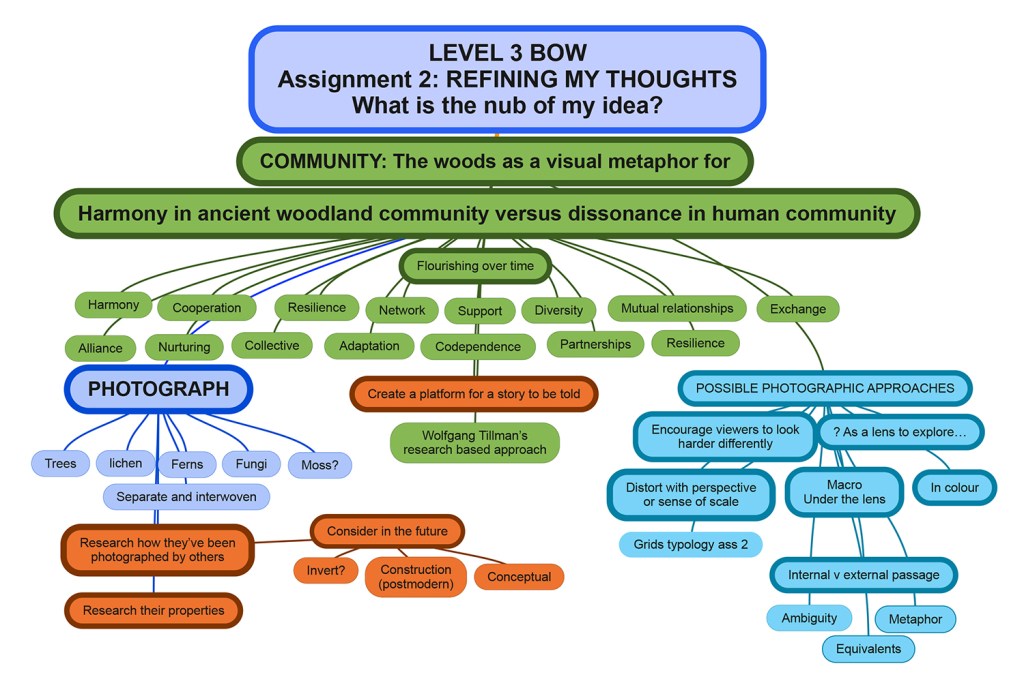
My key words were: Flourishing, harmony, cooperation, resilience, network, diversity, exchange, mutual, nurture, partnerships, mutuality, collective, co dependence.
I briefly noted down some of my previous reading on ancient woodlands, trees, fungi, moss, and lichen. By noting down some of my reading I was able to check that nothing important in their nature or relationship had escaped me. I have noted down further material that I may return to. Reading the science and the ecology behind the species reinforced my feelings about the uniqueness of ancient woodlands.
Refining thoughts mind map:
Shooting
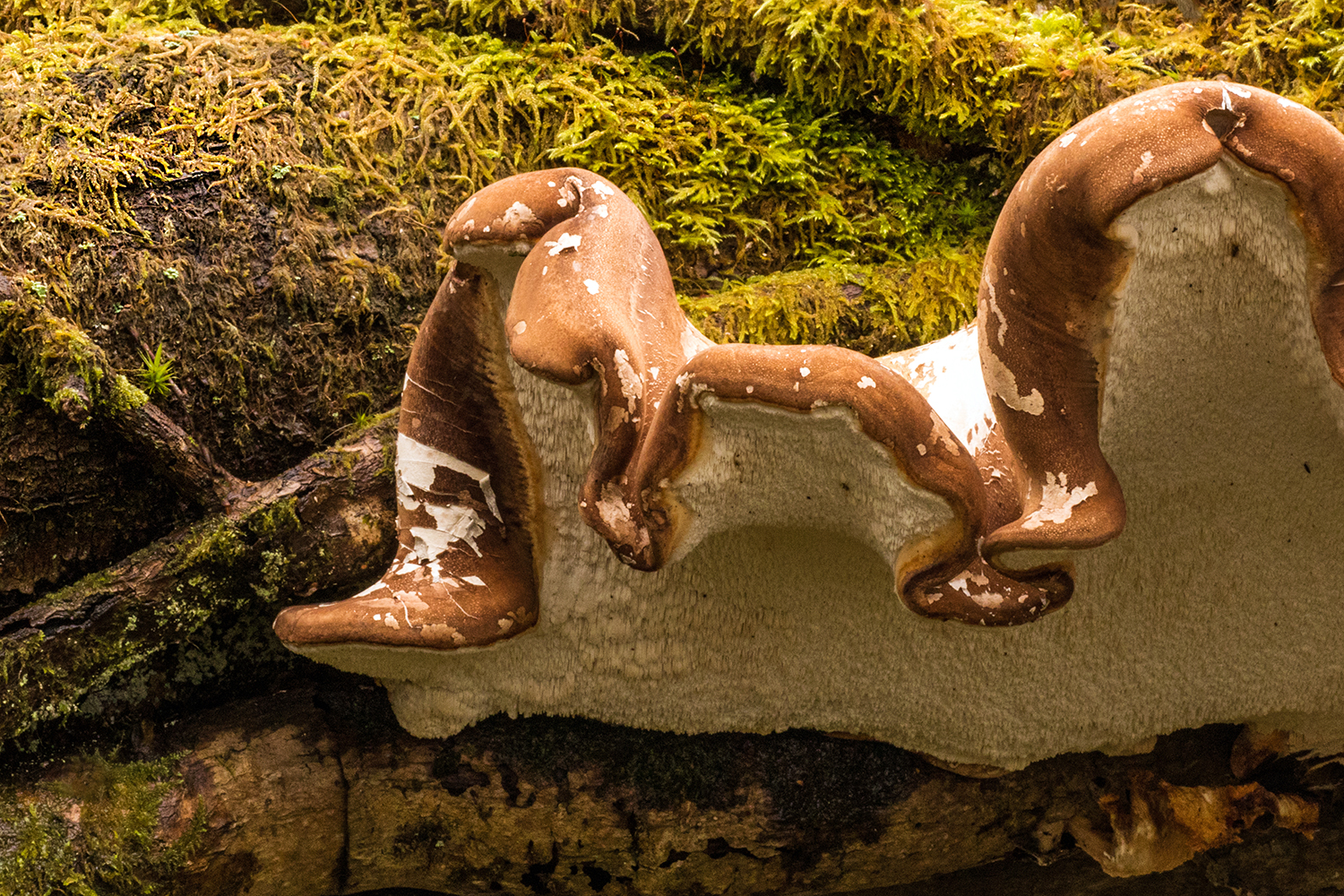
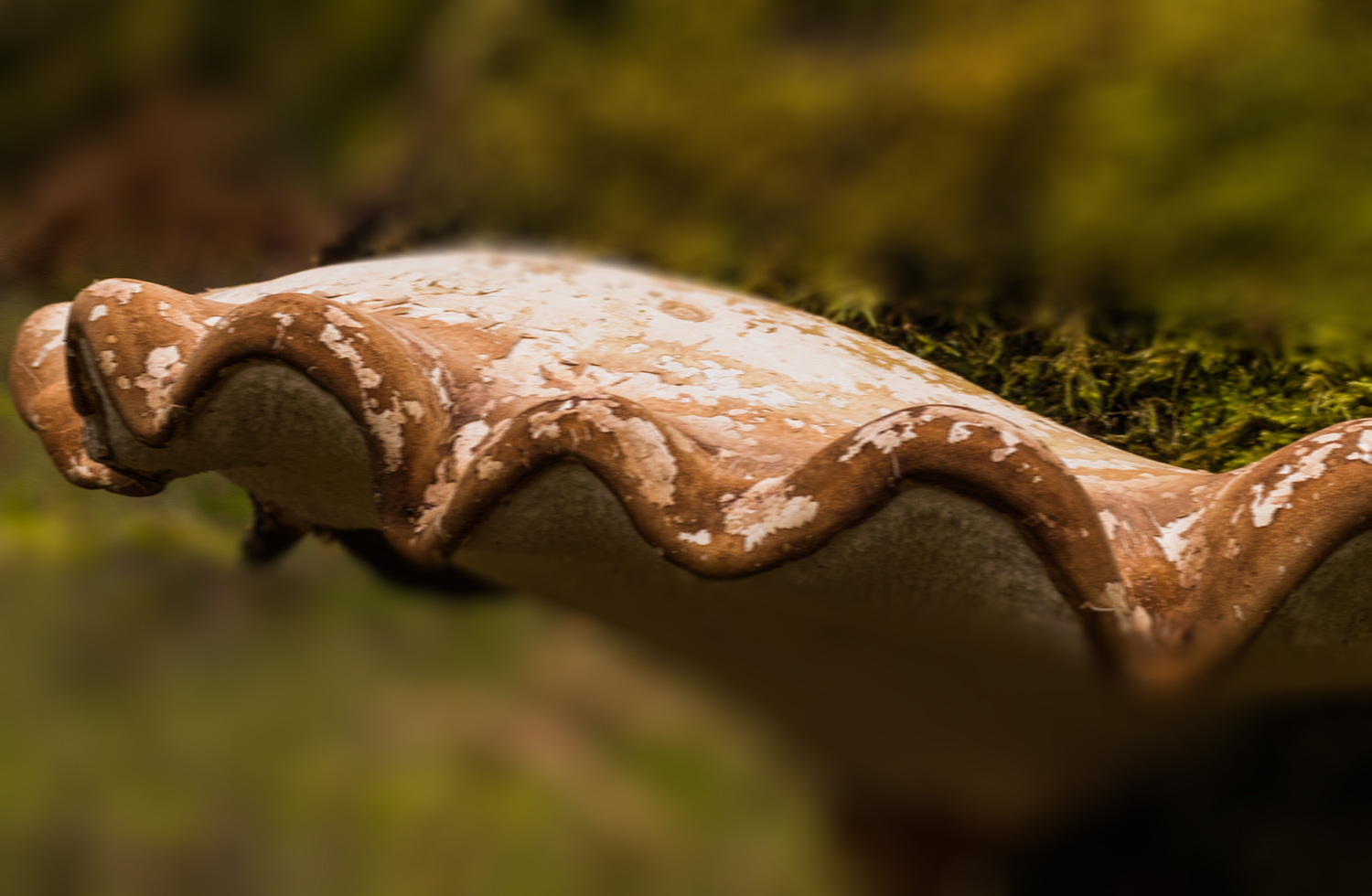
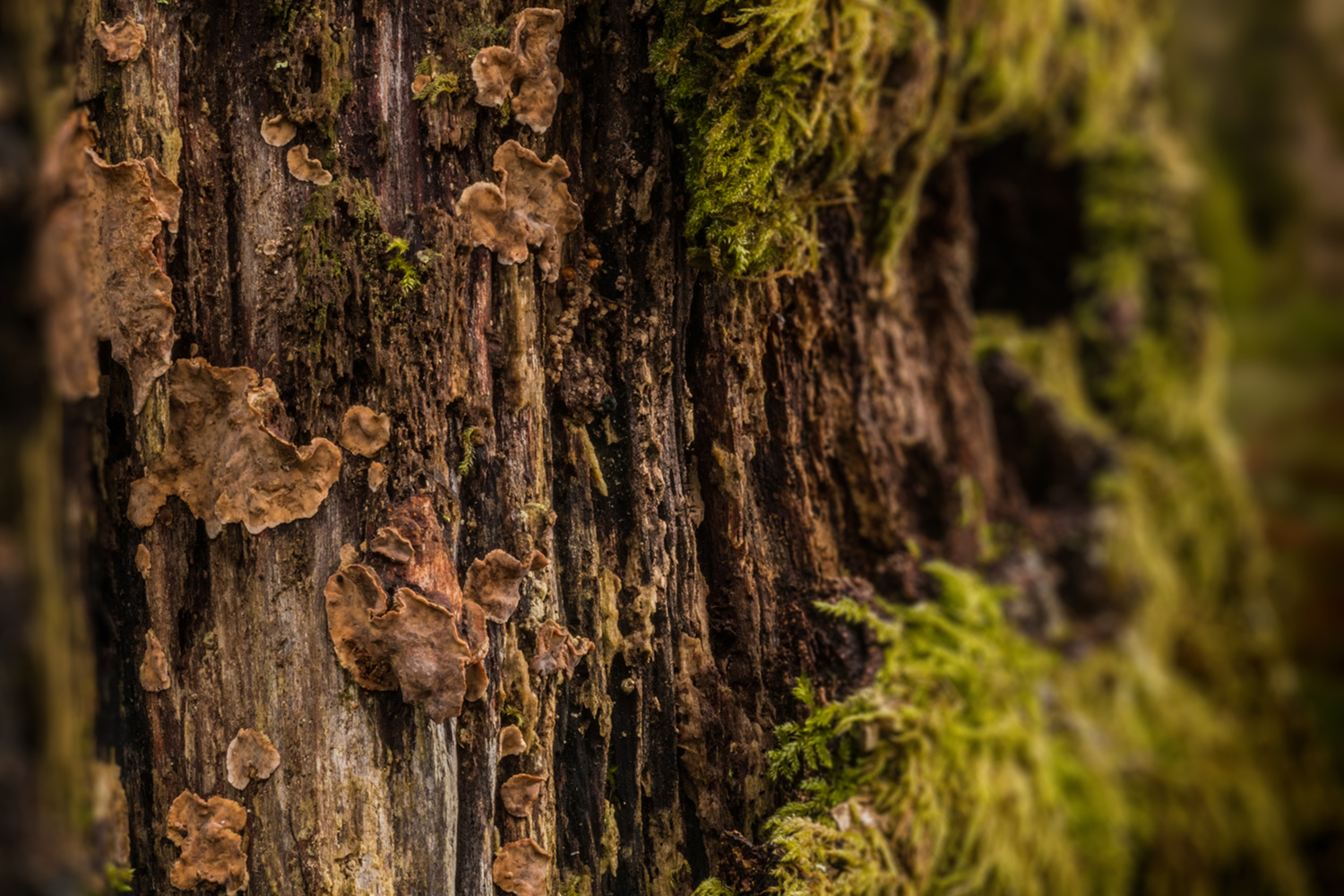
In assignment 1 I shot and shared a variety of aspects of the ancient woodlands that signify community to me, general landscapes, close up, and abstract studies. This time I set out to shoot to capture the various types of organisms that make up this ancient woodland community, trees, lichen, fungi, ferns, moss. Of course, it proved impossible to separate these species as they are interwoven together in many forms. This proved to be the point eventually, the harmonious coexistence of these various parts into a thriving community. For their success they depend on each other, they provide for each other, they exchange and nurture.
I had planned to experiment with scale, perspective, and distortion. However, when photographing I found I was keener to expose the details than disguise them. I shot closer and closer to expose these details, until I had accidentally collected almost a typology of the woodland community.
I returned to shoot many times, but within the same month. Each time I had reviewed previous images and sought to improve technically. Sometimes I returned to the same subject, though I learnt that this usually proved impossible as the landscape changes quickly in response to weather, even though many of these species are slow growing.
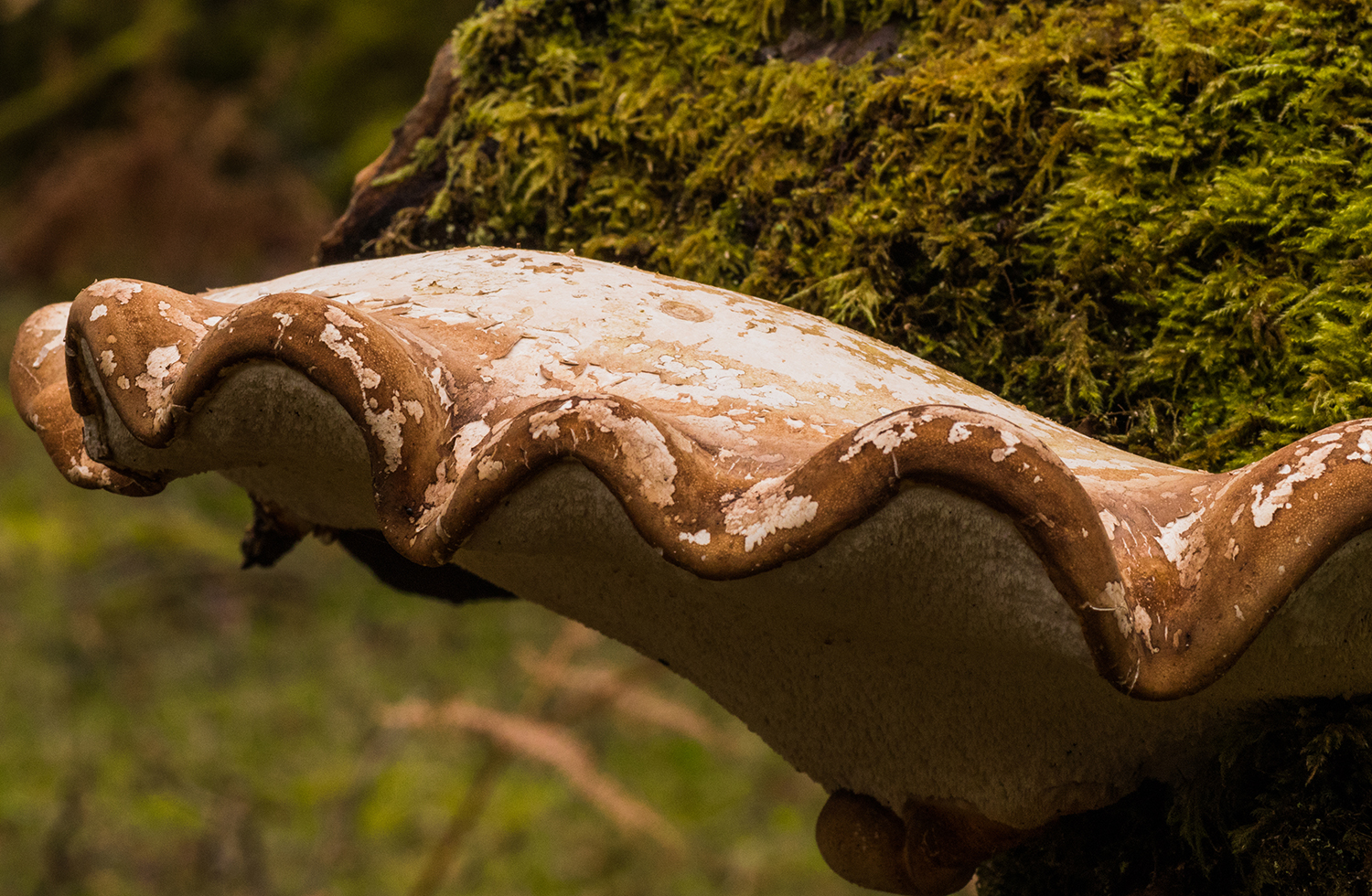
Fungi was naturally the most aesthetic, but other subjects gave a strong message of a harmonious community. Moss was always there in the background, and I only realised with hindsight that this is becoming of more interest to me.
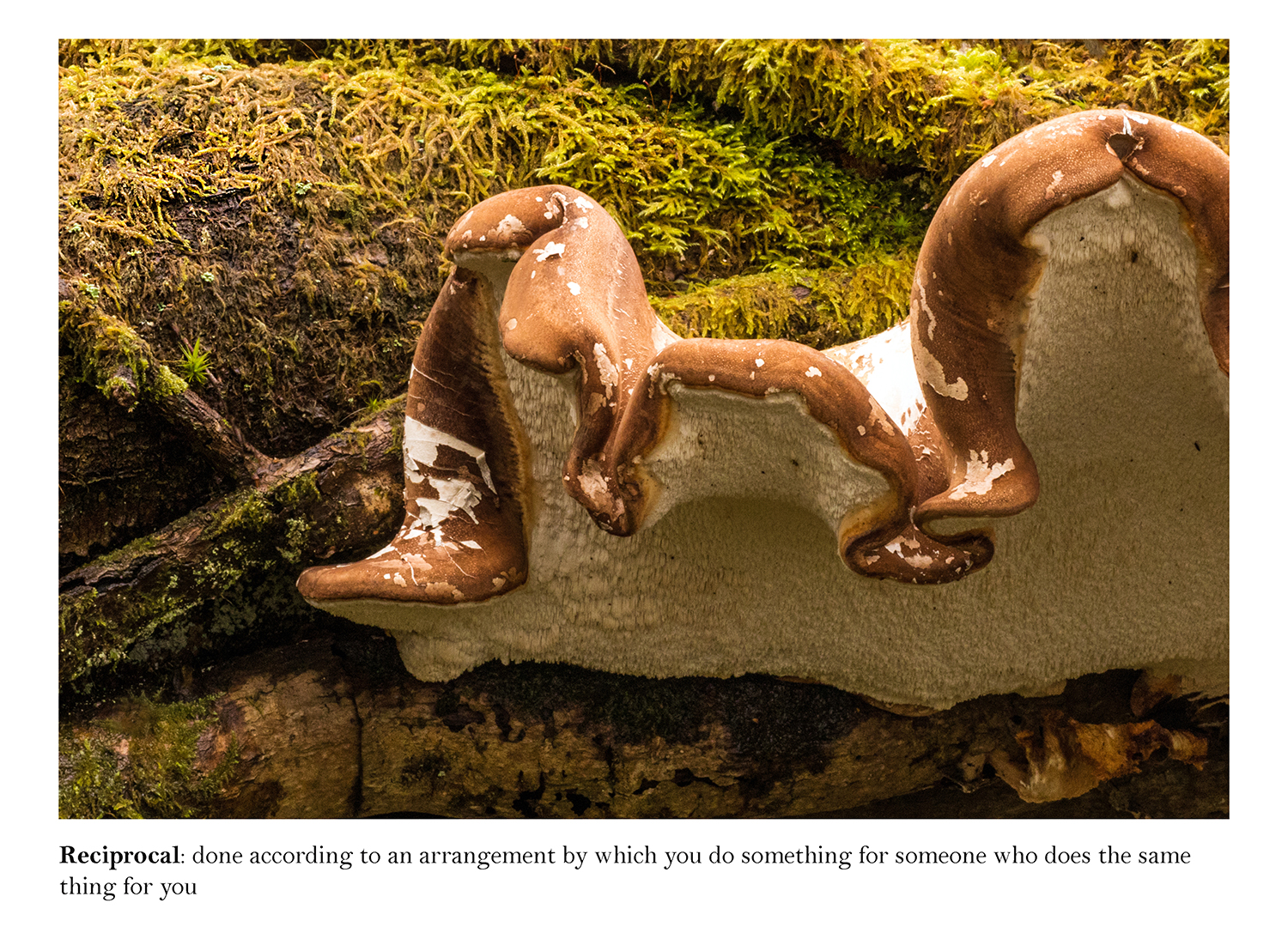
At the same time, I considered the methods that I would use to signpost my message and give an entry point to my viewers. I focused mainly on definitions of the keywords that apply to the ancient woodland community. I narrowed down those that I would use by checking actual dictionary terms, and decided that the most relevant were exchange, network, diversity, interdependent, nourish, harmony, reciprocal, and cooperation. I reviewed the images that I’d shot to check whether I had some of each species that would align with the definitions, which I had and then began to edit.
Editing
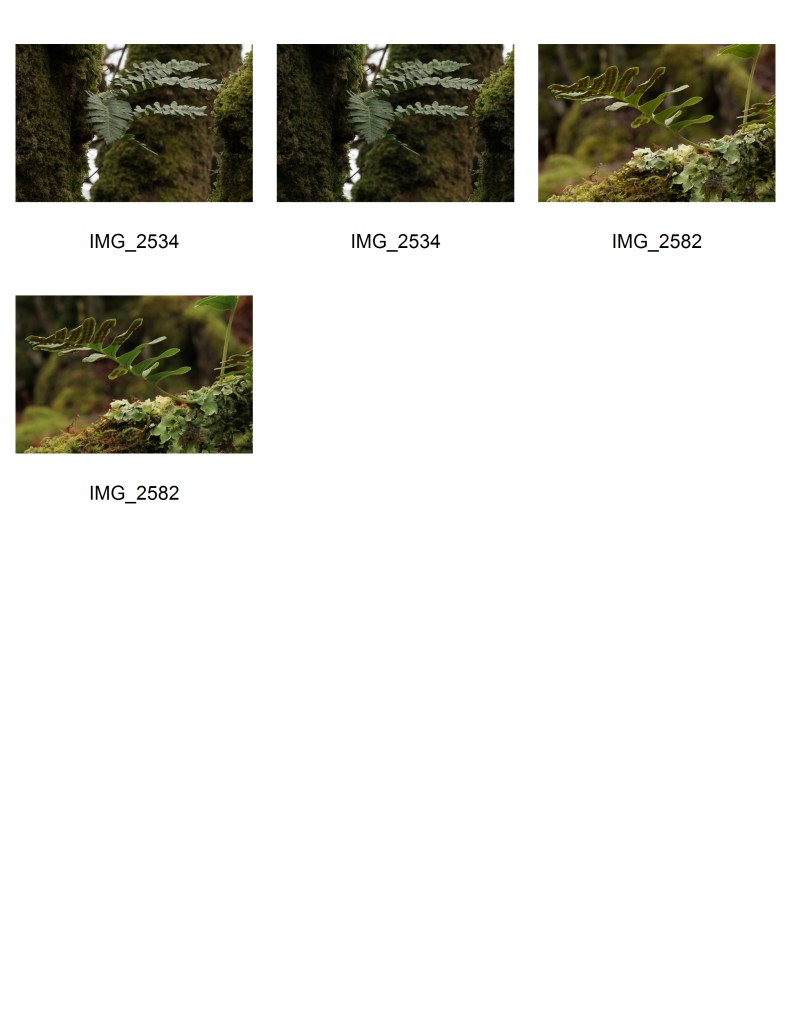
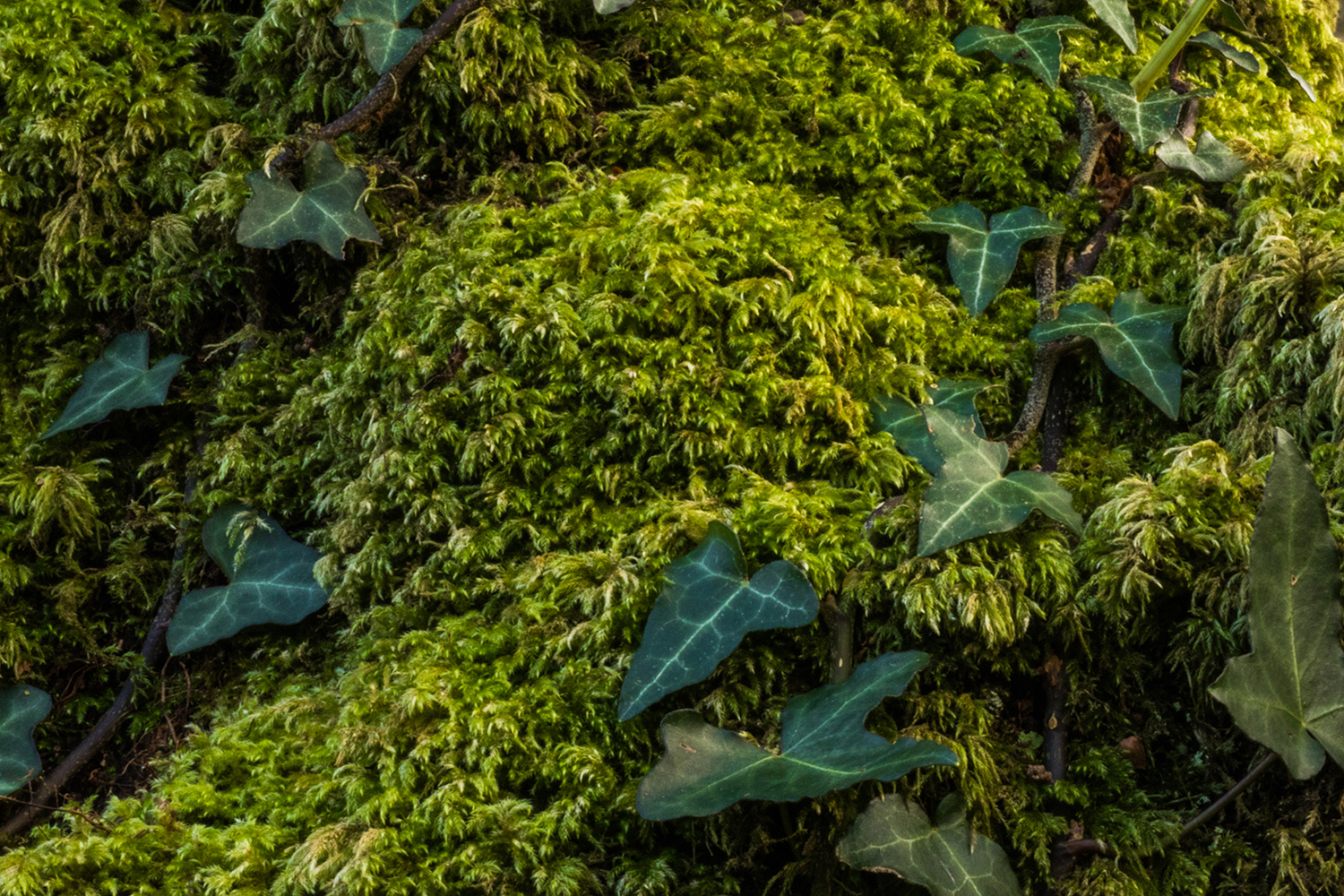
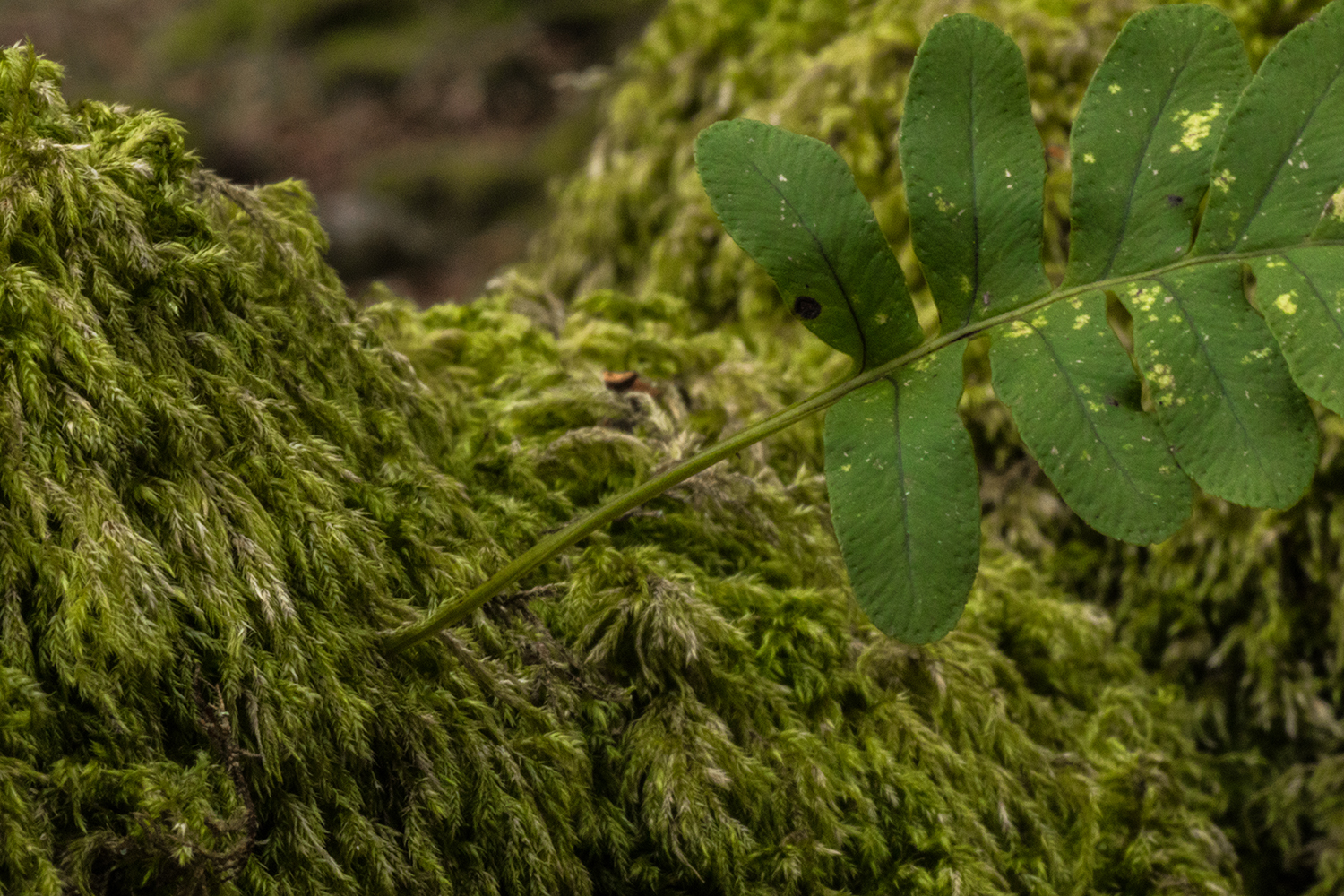
I reflected on the images and their meaning, for instance which of these two fern images I should use:
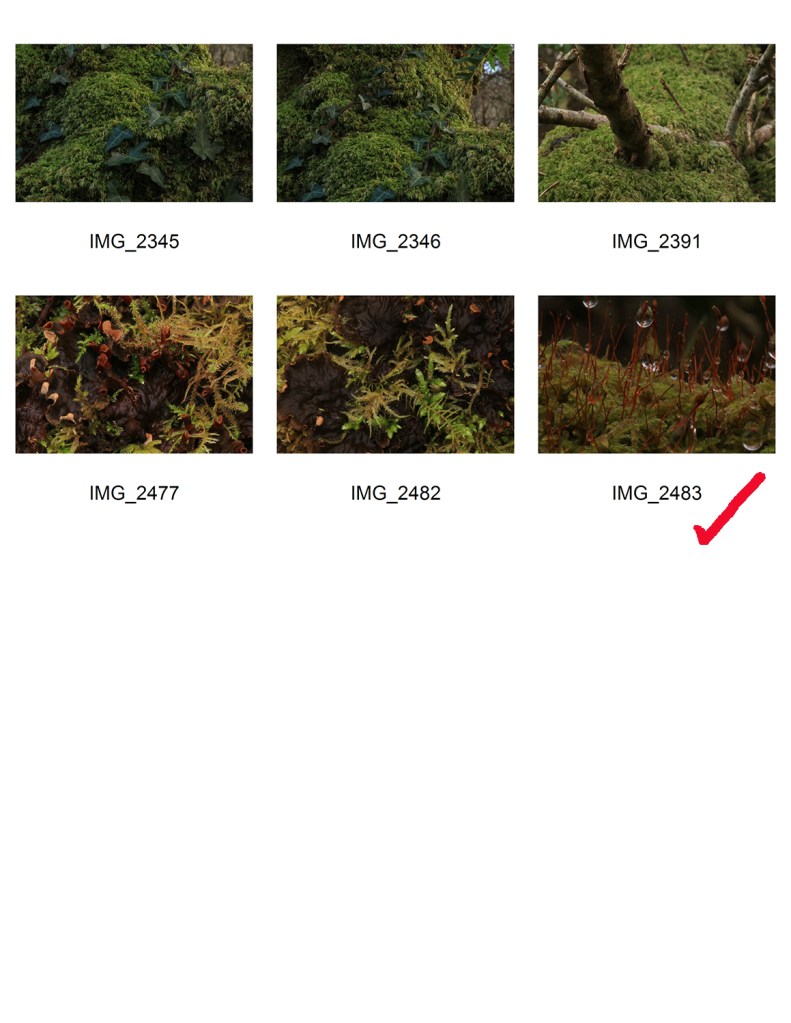
I considered what they each might be saying and decided that the fern emerging from the moss signalled harmony, whilst the ivy and the moss had less desired meaning.
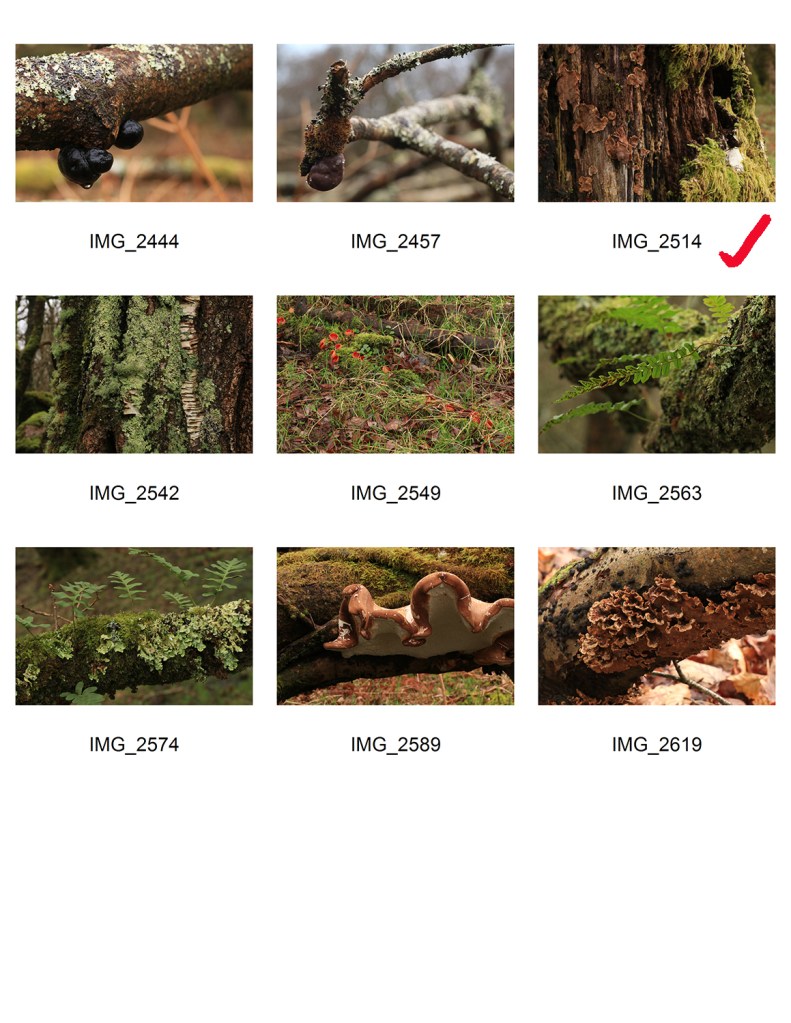
I asked myself whether this image of the fungi said anything about community, so I substituted it for another image which I cropped tighter to show the relationship between the fungi, tree, and moss.
When I shared the images without text, some of my peers were underwhelmed and suggested that the needed more of an angle of some link. Also, I was concerned that the images were rather “straight”, and did think to reshoot in more artistic manner as portrayed below:
However, on sharing this possibility with peers again they like myself preferred the original images. I felt disillusioned when my peers I might add humans as comparisons to the images in some way, but I knew this was not where I wanted my work to go. I know that I will not be producing a documentary project, but that my work sits between the genres of landscape and expressionism. I do realise that I need to find a point of difference so to speak, however I do not want to do this to merely tick a box, or make my work look unusual. Therefore, I decided to stick to my own path. This work is in any case this is nowhere near the final product of the course, merely a steppingstone along the way.
My intention was strengthened when I referred to my tutors’ words that though dissonance in human community may have stimulated my work on the harmony in woodland communities, that doesn’t mean that they must be present in my work – this motivation may just underpin the work.
The images that I’m using depict coexisting/co-dependent ancient woodland plant species. Some are more ambiguous because of their scale of their unusualness, but I am not attempting to disguise them but photographing them in a way to make them and their relationships clearer. I have chosen images that emphasis relationships.
Editing mind map:
Presentation
I contemplated using the definitions that I had chosen as a border of underlying text. Eventually I decided that by simply adding definitions to a border on a print that the message was stronger.
The future
This work is already leading me forwards. I do not intend to develop te work in this style, studies of species that live harmoniously in the woodland community, but it was a process I had to go through, to move myself forwards. Seeing, studying and photographing them, has enabled me to appreciate more clearly and their interrelationships. At this point I feel my next springboard will be to use images of trees and moss to contextualise the success of this community and I might look at overlaying close up images of species onto these i some way.
I have been involved with regular student hangouts for several years and have found them invaluable. If I’m honest, I have not been contributing so actively the past few months, though attending, and need to find the space to give more to peers in between times, this will in turn help me.
The level 2/3 student group that I participate in has been very supporting as we have progressed through from level 2 together. We meet approximately 3 weekly. This seems to focus more on BOW that CS.
As this has recently grown in numbers, I have found lately that I need something a more focused on level 3 and have been accepted to an OCA Level 3 closed group hangout with 6 members. I am just getting started in this group.
I am also participating it Ariadne Xenou’s Contextual Studies online groups monthly, and though based around contextual studies, we do also touch on BOW.
L2/3 group takeaways to March 2022:
24.2.22
Shared my work. Presented my close-up work and discussed my ideas for signposting. Others suggested collaging with humans, and we discussed other possibilities, even jokingly the work of someone who dressed as moss in the woodland! Using druid symbols was also suggested.
6.1.22
A reminder to watch surrealism BBC 4 program
9.12.21
Sharing of others work
25.11.21
Fed back to group on Bristol photo fair.
L3 closed group take aways
23.2.22
A general catch up and motivation session
1.12.21
Lynda suggested the book landscape and memory by Simon Schama
Interesting to hear about those working on SYP
CS group BOW relevant discussions:
28.2.22
Ways to move your work forwards when blocked were shared: break things down into bite sized chunks, use a 15 minute (pomodoro rule), start somewhere else, getting photographing for pleasure without a purpose, divert gaze…
31.1.22
Read widely – tease ideas out
29.11.21
When writing think about visual work and when reading think about your CS.
These sessions are written up in more detail for CS.
I viewed these works at the exhibition in progress at the RPS when I visited the Bristol Book Fair:
Laia Abril’s photography series Menstruation Myths
is part of In Progress on display at Royal Photographic Society during Bristol Photo Festival 24th October 2021.
This work, forms part of her larger body of work, A History of Misogyny, which includes topics such as rape, abortion, mass hysteria and femicide. The gallery text describes the work as an “unfixed and open ended narrative…weaving together both research and visual metaphors” to give an understanding of the politics and miseducation surrounding menstruation. She is known for her multidisciplinary work which is what particularly attracted me this work. Displayed on the wall below her photography were a variety of texts on the theme of menstruation:
Gallery view (24.12.21)
Though I can’t clearly see the sources of her text, the variety that she has used has given me some further ideas on sources I could collect text about community from:
Dictionary definitions
Thesaurus synonyms
Newspaper articles
Italian artist Alba Zari’s ongoing work Occult
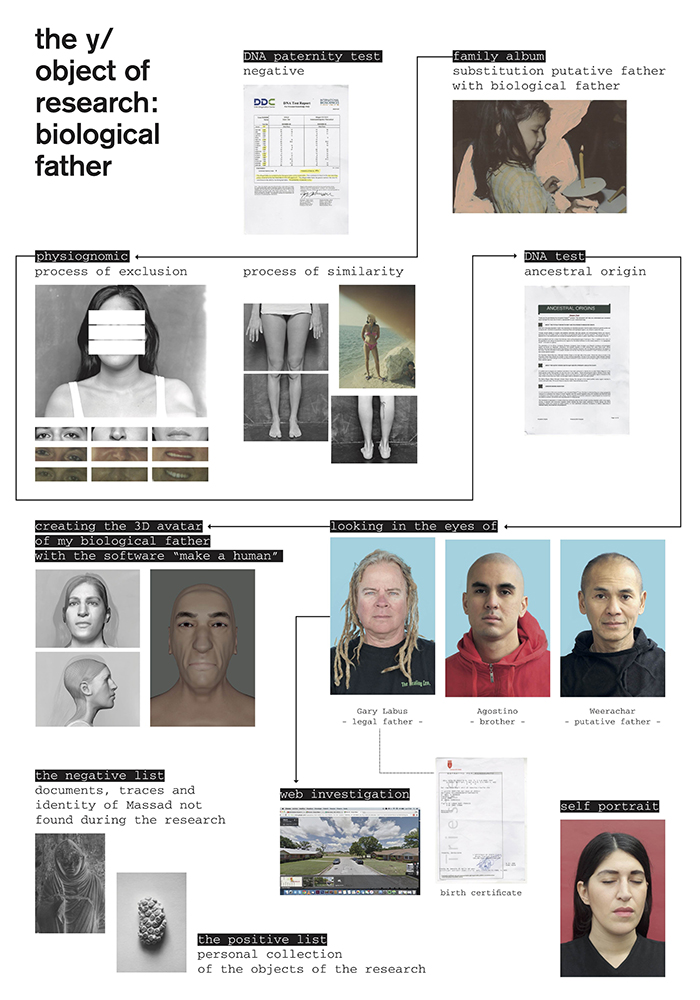
reflects her search for an understanding of the Christian fundamentalist sect into which she was born, The Children of God. What interested me about the work was the mixed media that she used to present her work, The work draws on her family archive, other member archive images, texts, propaganda, and videos.
Occult (Winterthur, 2022)
Her previous work “The Y- Research of Biological Father” (2019), her search for her biological father, similarly includes media such as paternity tests, created avatars, web documents, and self-portraits.
Alba Zari – page spread from the RPS, (Royal Photographic Society, 2021)
Zari shows how we can make our own pictures, with mind maps, diagrams, drawings, photographs, saying that there isn’t just one way to do research and even that making photographs is a kind of research in itself. Photography-based research might also include exploring archival material, from family albums, news pictures or historical images. However, she says that as photographers investigate, explore, compile, map, question, connect, interpret, gather, organise, interrogate, construct etc. and that making photographs becomes part of an extended process of discovery. Even that photographers make images to fill the void if information is missing, to help them imagine what does not already exist. She realises that how that research is presented can be very influential and may even disrupt normal expectations. (Royal Photographic Society, 2021).
explores cultural identity, race, memory and immigration through photography, video, and installation with a series of self-portraits, featuring herself and friend posing as her with abstract landscapes constructed backgrounds.
(Royal Photographic Society, 2021)
What particularly interested me was the way that she presented her research:
Tillmans uses observation of his surroundings in an ongoing investigation of the photographic medium. He engages in this way to transform the world and so uses exhibition space for performing. Tillmans looks at the world with both curious and playful eyes and with his work gives new ways of viewing the world to viewers.
Studying truth with Wolfgang Tillmans
This installation includes Tillman sharing his views on the subject of truth and was on view at the Tate in 2017. Here he shares his reaction to the Iraq War and the presidency of George Bush, using various textual information, political texts, clippings, and erroneous everyday photographs. He was driven by the opinion that many global problems have been driven by false presentations of truth. “By combining a wide variety of mediums, he constructs a scenario that depicts and analyzes this tendency, while also, by extension, diagnoses it” (The Art Story, 2021).
It showcases Tilman’s work using tabletops as an alternative way to examine the present day. He was interested in statements made by people and groups worldwide that their viewpoint was only the truth. This work Truth Study center project where photographs, and clippings from documents are displayed in deliberate, and possibly provocative juxtapositions, reflects the way they come to viewers in print and online. The articles also bring attention to gaps in knowledge, or doubtful areas.
Below is an example of his project truth study center (2005–ongoing), which displays photographs, articles, objects, and drawings that present differing versions of ‘truth’.
(Tate, 2022).
It is an innovative way to question what is real. The installation also shares a brief audio clip of his views on truth. He has previously exhibited installations of taped prints and pinned magazine spreads. His mixture of mediums is interesting. Does this enlarge opportunities for viewers to participate and form their own conclusions, I wonder?
His photography does increase our attentiveness of the world around us, so that we see things differently and take less for granted.
“that my images are random and everyday when they are actually neither. They are, in fact, the opposite. They are calls to attentiveness.” This image reminds us to be present in our relationship with the world; the strongest moments are actually a strange mix of the sensual and the surreal, and often subtly political.








 NIKI SOUTH