Sociologist Tonnies, wrote on Community and Society types, human relationships, and social structures. He describes:
Gemeinschaft: Close knit communities characterised by a sense of togetherness shared values and norms, collective social bond where everyone knows each other, has shared values and a sense of duty to community
Gesellshaft: Impersonal, transactional, and self-interested communities
He suggests as societies modernise, communal bonds weaken giving way to more individualistic relationships.
His concepts have implications for individuals’ sense of identity and belonging, especially with globalisation, the rise of digital communities, urbanisation, modernisation, and the erosion of traditional communities. Here there is a tension between preserving ‘Gemeinschaft’ like bonds and embracing ‘Gesellshaft.’
Tonnies ideas are tools for understanding dynamics of social organisations under the impact of Modernisation. His work inspires reflection on the nature of human relationships identity and social change.
Its relevance to my work:
My ‘town’ (population only 1000) is rural and the ‘locals’ are traditional and close knit. However elements of Gesellshaft (self-interest) are more evident now than in time past. I would attribute this more to the rise of digital communities, than ‘incomers’ moving in. Though incomers bring elements of modernisation they are no more self-interested or lacking social conscience than the ‘locals.’ Certainly, during Covid 19 and continuing on using social media the ‘locals’ hide behind comments and posts that are divisive and self-interested. This I evidenced in a previous body of work ‘Layers of Truth.’
Reference:
Sociologylearners (2023) Gemeinschaft und Gesellschaft by Ferdinand Tönnies | Unveiling the Social Structures of Modernity. At: https://www.youtube.com/watch?v=gVmKi3g9DTw (Accessed 09/11/2024).
I have visited several book fairs, most recently Ffoton in Cardiff and BOP in Bristol. I have a good collection of photo books of course and keep up to date with those published and online reviews.
My latter period of research into photobooks coincided with my research on my A3 enquiry into printers v publishers.
I am concerned in this research how the a subject of a photobook relates to its physical item, rather than reviewing books for their art/text content. I have sought some books of a landscape/equivalent subject matter and some that I like the aesthetics of. I have looked at the images have been assembled, how rhythm and tempo are achieved, and interest is maintained .
My inspiration:
Jem south Four winters (2021): hardback, 300×230, 124 pages, linen cover, embossed title.
This is a ‘clean’ read. The images are all aligned and are mostly on the right pages. He uses white pages with titles to separate elements of the book. There are no page numbers and no image titles or captions. The colour images work well on this silk paper.
Southam, J. (2021) Four Winters. Stanley Barker. Scotland.
Jeffrey Conley. The shadow’s veil (2024). Hardback, 104 pages, 305mm x 355mm, linen cover. The book is a collection of observations about the unfolding of days. It is black and white, and again fairly ‘clean’. The images align on pages except for some full bleeds. I particularly like space around the smaller images, it seems to bring attention to them.
The Land is Yellow, the Sky is Blue. (2023) Marc Wilson. Self-Published. Softback, 108 pages, 200mm x 250mm
‘Is based around a small village in central Ukraine. It and text combines photographs with text written in the shadow of the current war. It has dark end pages printed on in white. Images are a variety of sizes, generally aligned on the right pages apart from those that spread across 2 pages. Some of the images have too much white space around them.
This is a beautiful book with a hard cover and American dust jacket, thread binding. Inside Paper: Munken Lynx 150 gr Cover Paper: Arctic Volume White 130 gr. Cover: 2 mm cupboard + 300 gr. grey carton. Book Cloth. It however signed and expensive so the materials used can be justified. The fact that she is a fine art photographer shines through.
Extensions of photographs with hand drawing, mash-up of the representational and the non-representational. Pace and sequencing of this photobook is varied and engaging, so the reader doesn’t know what the following page spread will reveal – Single images, paired images of the same subject, montage of print and objects, full page bleeds or a photographic image spanning the the two pages with a classic white border. The book is Smyth sewn, which is good for a double page spread where none of the photographic content is lost in the middle gutter.
I like the variety of alignment and sizing of the images, though I don’t like it where two are on facing pages. She does use 4 smaller images on a two page spread as I intend to.
And see the third in her series that continues her investigation of a riverside park in Vienna: Root & Waltz, (2023).
Root & Waltz, Regina Anzenberger (2023). Self-Published (AnzenbergerEdition), Hard cover with (American) dust jacket over boards, thread binding (Smyth sewn), signed and numbered edition of 350 copies.
Brydon. A (2023). As We Wander. Another Place Press. Scotland – Softcover, 40 pages,150m x 200mm
Printed image on cover, black and white landscape images, varied image size and placement. I love the work of Brydon and his colleagues who work with the inside the outside collective. Again, this book appears ‘clean’. No page numbers, no captions. The black and white images work well on what looks like uncoated paper. There is something about the variety of image placement that sits well with me; images are aligned except where they spread across 2 pages or are full bleed. Unusually I don’t object to there being at time 2 images on a double page here.
Passage. Guy Dickinson (2022). Publisher Another Place Press, 245mm x 200mm.
Another contributor to the inside the outside collective, Dickinson’s photography attracts me. This is a softback and in black and white but it’s simplicity attracts me. The images are either full bleed or for the first part of the book have a white space around the images up from the bottom of the page. This irregularity in placement draws you to them.
Cubby’s Tarn. Joseph Wright (2017). Publisher JW editions (himself), Edition Size 500, 240 x 325 mm, Approximately 80 Pages. Hardcover.
Another contributor to inside the outside collective whose work I admire. This book I own a copy of, its most things that I love. Linen foil embossed cover. Natural brown paper end papers and section separators -simple white pages otherwise, with images variously placed and sized.
Nicki Gwynn-Jones (2018) Self-Published, 305mm x 240mm, 96 Pages, Hardcover.
An example of a larger landscape book, which I’m not keen on though it does accommodate 2/3 images easily side by side on a page. I don’t like the printing on the inside back cover, it makes the whole book look poor quality and self-printed.
Hidden Layers of Perception. Alexandra Wesche (2022). Self-Published, Edition Size 25, 210mm x 210mm, 40 Pages, Softcover.
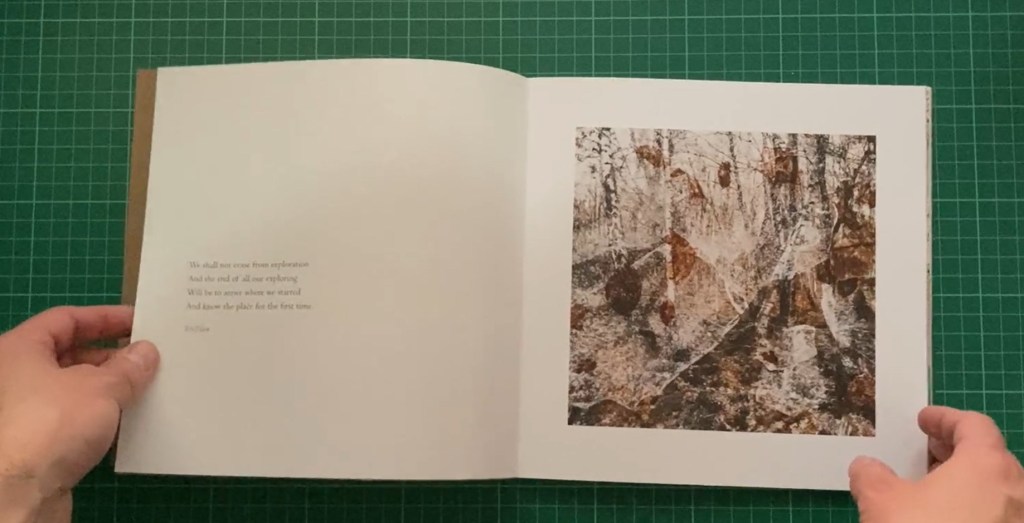
The images are multiple exposure photographs taken in a forest. I am amazed this is self-published. The design and papers are exquisite., she has even been able to use some transparent overlays. I’d have thought it handmade except that it is an edition of 25 copies. I love the cut-out cover, and some variety of image size. No page numbers or captions and minimal text.
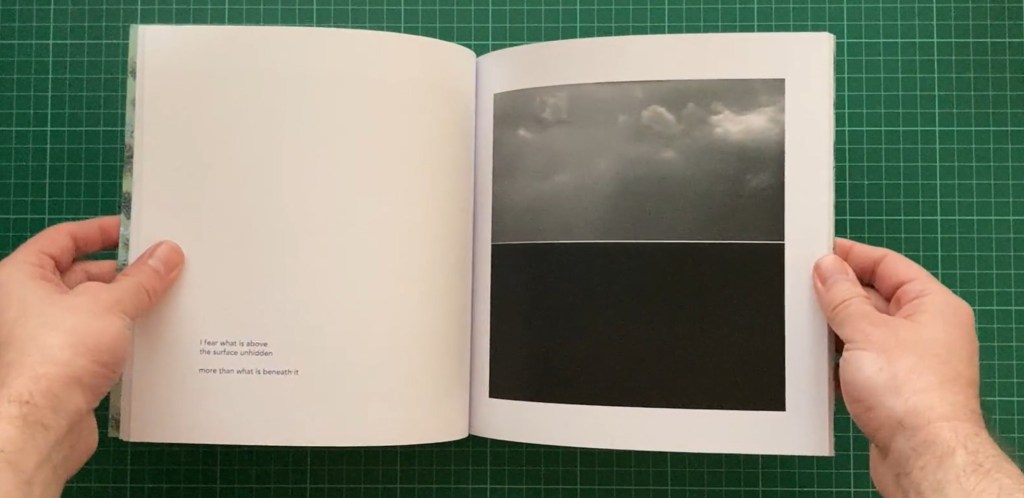
In The Offing. Fiona McCowan (2022). Self-Published, 210mm x 210mm, 52 Pages, Softcover.
Once again I am drawn to a square book. The printed cover this time looks classy. Images of the sea and its horizon are aligned on the pages and either facing or on the right page. The text is bottom left on facing page and section pages have text to the right and not too large.
Meadow Nicholas Pollack (2023) Hardcover book, Offset printing, 112 pages; printed in Italy by Trento,Paper: gardamatt art 150g/m, 10.25 x 8.25 inches.
His book of images of places and portraits are mostly aligned, no page numbers or captions.
Blue Violet. Cig Harvey (2021). Publisher Monacelli Press, 231mm x 288mm, 208 Pages, Hardcover.
I visited this book as Cig Harvey’s ‘You an orchestra you a bomb’ is my favourite photobook that I own – more on this to come.
Blue violet has a printed cover, the whole book is an assault by colour on your senses, just as the above book. The silk paper does pop the colour. I should consider printing my end pages/section pages in a strong colour (Tabacco?) and printing text in a lighter colour? Just a thought.
‘You an orchestra you a bomb’ (2017) Schilt Publishing; 144 pages, 230 x 23 mm.
Is again a colour assault on the senses, with a lovely linen cover in a vibrant yellow. Again with deep coloured pages every so often and printed on lustre paper.
Harvey, C. (2017) You an orchestra you A bomb. Amsterdam, Netherlands: Schilt Publishing b.v.
I could use a square book and take my full bleed images across the page into the other page, but 210 x 210 (exwhyzed the maximum size I can afford) is too small to take my footnotes side by side and be able to read the definitions, and Mixam 300x 300mm (the next size up is too large). I also want to accommodate effectively my 5:4 ratio images.
Linen embossed cover, but that’s out of my budget.
Natural paper end pages and section breaks (can Exwhyzed do?) or deep vibrant colour
White pages
Regular alignment of images with only a few breaks
‘clean pages’ no page numbers or captions
Space around non bleed pages
Silk paper
1 image only per double page – apart from the footnotes which are a different enitiy.
Consider placing the medium sized main images up from the bottom – not even
Text fairly small
I need some irregularity to make the eye work, I know that deviating from an A4 or A5 format does make the eye work and engage you. I need to ensure that the pace and sequencing of this photobook is varied and engaging.
Are you ready to publish a photobook? Chris Pichler in conversation with Lens Culture
Chris Pichler is the founder and publisher of Nazraeli Press (California). He says that it’s important to work out why there is a need to publish this particular group of photographs, he says its important to be honest:
Was it intended for the “book form” rather than being a sequence of images in an exhibition? Yes I always intended the work for a book not an exhibition.
Is it fed by a desire to see your name on the front cover? No I’d be happy to do it anonymously, as long as I could share the story.
Pichler says that he looks for material that gives him a eureka moment, seeing something he’d not seen before.
The best and worst of times talking photobooks with aperture lesley Martin
Lesley talks against the background of an explosion in the photobook medium. She says the bar for book making is high now, and lots of creativity from indie and self publishing.
Asked what advice she gives most often give to aspiring photobook makers?
Assess why you want to make a book: to bring together my images and poetry in a form that can be shared sensitively
ask yourself about the concept behind your project and book—what is it really about? Community – my experience and a model for inclusive and harmonious community
Who is your audience? Myself, some local people and those from communities outside my locality
Identify what you like in a book…Look carefully and try to figure out how the books you like were put together/designed. I have done this in my research
She says making your own book is slightly different to publishing a book – you might want to just make a dummy; make a small private edition; play around with the form.
Lesley looks for photobooks that is thoughtful and pushes boundaries- work that makes you want to look and look again.
Have something to say 30 years of photobooks with Dewi Lewis
This interview is primarily aimed at street photographer’s publishing. He was asked, “Has the photobook become a fetish? How can young photographers avoid this trap for their early-career publications? Dewi replies that the book should always be about content, about what the photographer has to say or show. Design is critical, but only to make work more accessible, and understandable. He believes function comes before form.
He says that photography like other arts should address external things and have a relationship with the world. Dewi suggests that some emerging photographer would be better to focus on getting new work out rather than trying to get published. If you are making a book you should ask
Why do you want a book? Is it the best way forward?
Do you really have something to say? Yes and others have told me so and that this is a global issue
Does it bring the work together coherently? That is my aim during the editing and refining process
Who is the audience and what is the best way of reaching that audience?
What from should the book take?
He also says that there is a great need to be honest, and also self-critical and aware.
This source increased my understanding of photobooks and gave me lots of good advice. These are my notes:
A photo book is its own unique medium, a book that is viewed because of the images inside it. The photographs should carry a book’s message, ant text is subordinate.
Main differences between an exhibition and a photobook:
Exhibitions operate in a specific place, has a limited lifespan, viewers enter to view the images, usually in a clinical space.
The exhibition is constructed around the space someone can cover walking.
Exhibition images can be larger and be viewed from further away.
More control over with an exhibition on how it’s viewed than a book
Photobook is an intimate object, viewed individually as and when wanted
Photobooks live in the space between a person’s hands and eyes
Photobooks go out into the world, they are a ‘photographers ambassadors’ (Colberg, 2016:26)
Photobooks can be viewed over and over again
A photo book as an object:
They have a physicality, is to be handled, the size, the weight, affects how you hold it.
The end pages, page paper, have an effect on your experience – makes it feel cheap/expensive
Is the printing good quality?images true, light and showing detail? Does the whole book have an unwanted colour cast?
A softcover can be too flimsy, though a hard cover might not lay flat
Is the texture attractive and easy to read?
Colberg says it is important for photographers to ‘be aware of how the process of making a photo book will inevitably entail making compromises’ (Colberg, 2016:33). He divides publishing into 1) production and 2) postproduction stages,
Production:
The concept
Editing the images
Sequencing the edit
Text production
Design and layout
Materials printing and binding decisions
Preprinting file preparation
Printing
Binding
Postproduction:
transportation to warehouse/shop
Advertising
Selling
He usefully lists the challenges as:
Quality of printing – especially on on-demand printers
Correct binding – so nothing is trimmed off or unprinted. Perfect binding, which I’ll use, can be satisfactory if attention is paid to not putting images across the gutter, made cheaply
Getting the correct overall feel of a quality book
Preparing a digital file effectively- this I will have to learn to do with affinity software.
His seventeen rules for how to make a photobook:
Know why your book has to be made- what will this contribute that hasn’t been in this form before? Don’t make them for their own sake.
Do your own research to support your decision making during the process. What are my preferences? What works well?
Avoid shortcuts
Best made through collaboration. Use other eyes, a designer, use whatever expert help you can get.
Have a budget – it’s always a balancing act. Understand the costs.
Everything has to be in the service of the book- to desired end, e.g. Edit, sequencing, design, materials…
There has to be a good reason for every decision made. As above
Be prepared to make compromises. This may well be in my case because of budget.
Aim for the perfect book then make the best possible.
There is no such thing as the perfect photobook. As above use the best solutions.
A photobook plays more than one role, e.g. expression, selling, promotion…
Keep your audience in mind – ensure it is understandable.
Don’t approach editing and sequencing as if they are dark arts. ‘editing is based on recognizing form and content’ (Colberg, 2016:189)- give the images your full attention over time.
Allow the process to take time – do not let the deadline dictate the outcome
Always work with physical objects: notebooks, prints, dummies…
All aspects of photobook making are important
Don’t worry about money. He suggests if you don’t have the money-don’t do it!
My takeaways:
Reading this book has enforced my belief that a book is the best medium for my work.
I know why I am making a book – to share my feelings about community and to encourage others to reflect on community – and by sharing through artist talks only I have control locally about who views the images and poetry.
The book will be an ambassador for my work, but most importantly it is an intimate object that can be viewed where and when liked. I intend my work to be reflective and a book that can be viewed over and over supports this ethos.
Reference:
Colberg, J. (2016) Understanding photobooks. London, England: Routledge.
Sustainable Book / Art Fair Ffotogallery Cardiff 13.7.24
The book/art fair will be focused on similar themes to their current exhibition (Sustainable Vision: Arts and Culture Confronting Climate Change), They invited book makers, book publishers, writers, artists, photographers and crafters influenced by the climate emergency, environmental issues and sustainability.
I visited looking for:
Further in-depth knowledge of a publishing and how the role fits into the broader economy and/or arts community.
Self publishing V publishing.
Inspiration/angles on an essay on publishing: are there any publishers working with students at an affordable level? Current developments in publishing?).
Michal Iwanowski: Go Home Polish project and book production.
Yellow Back books:https://arcade-campfa.org/yellow-back-books ArcadeCampfa, Braeval Street Studios, 11 – 13 Braeval Street, Cardiff, Wales CF24 4SJ Digital residencies I’ve subscribed to the newsletter
Shelf Life Books & Zines: https://www.shelflifebookshop.com/ A not-for-profit radical bookshop in Cardiff working with independent publishers and DIY zine-makers to make space for marginalised and under-represented voices.
I also networked with other photographers visiting and exhibiting at the fair:
Had a long conversation with David Maynea self publishing photographer and contributor/writer for offline journal He said ask yourself why you’re publishing? Who’s it for? He suggested self-publishing gives you control.
Walter Waygood: Art lecturer and self publishing photographer. We had a long and interesting discussion about publishing versus self- publishing, and how he funds his many projects/photo books. He works with various grant issuers and arts councils. Prefers to self-publish, not just from a cost perspective but also to retain control and enjoys having the creative design input, in fact the whole book making process. He said of publishers “you do all the work and they take all the profits”. Said I could email him. https://walterwaygood.com/
Brian Carroll- Offline Journal a bi annual self published journal (1 issue contains an essay and one an exhibition booklet. Offline Journal documents the development of contemporary photography in, from and of Wales – a country rich in photographic history and talent. Established in 2018, Offline Journal exists in parallel but away from the distraction and noise of online platforms and, instead, is printed as limited edition issues published April & October each year. Offline Journal is edited and published in Wales by Brian Carroll. He likes the control of self-publishing.I asked him where he gets his inspiration for his journals, he replied mainly from exhibitions. He mentioned that funding for arts has been cut and this has driven more photgraphers into self publishing. He publishes only welsh based photographers. It made me think that I could focus my work on Welsh photographers trying to publish, and welsh independent publishers.Offline journal free newsletter is at: https://www.offline.wales/substack.com . I purchased some of his journals and published essays by photographers as a stimulus for my writing/publishing.
Shaun Lowde a post graduate photographer now teaching at Carmarthen University, an old friend offered help with printing/publishing if I needed, and is starting up a photography magazine in the Autumn. I was heartend that my work had been accepted in some places that his work hadn’t been!
Photographer talk: Michal Iwanowski (https://www.michaliwanowski.com/) talked about his book ‘Go Home Polish’ with designer Olga Lacna. I was interested to hear about as a freelance photographer with no money, he brought his book to the published stage. Sadly, the sound quality was almost unintelligible and I was unable to glean much from it. He did say that the designer made him change his ideas and use more practically achievable formats. He talked about the anxiety it caused publishing essentially parts of himself.
It was a useful networking and fact-finding visit. It consolidated what I knew about how to self publish and clarified its benefits. It was a very useful professional network building afternoon.
For me to follow up:
Use adobe Idesign or Affinity (USA software) also recommended by OCA student have used there is a free trial) as software.
Publishers for self publishing, Mixam or Youloveprint.co.uk (they put how to do in a PDF). Exwhyzed have also been recommended.
Issuu -Can make a book or zine and if set to PDF can create a dummy
I attended this seminar to increase my knowledge of working in the photographic industry
Nick Dunmur, Commercial Photographer, Advisor to the Association of Photographers (AOP), and chair of the British Photographic Council.
“The Business of Being a Creative’ deals with the nuts and bolts of getting started as a creative business. In this Creative Conversations session, Nick Dunmur walks us through the foundations of getting set up properly, such as business structures, insurance, tax and probably most importantly, knowing how to set your rate properly, to make sure you make money and start a business which not only survives but thrives”. (At: https://learn.oca.ac.uk/mod/book/view.php?id=27053&chapterid=10018 (Accessed 29/06/2024).
My Learning:
This was an excellent seminar, where I learnt much about the business elements of operating as a commercial photographer. I gained detailed knowledge of professional contexts, such as my collective responsibility as well as own (fee setting, use of AI).
This learning supports my own practice as I disseminate my work and operate in the professional dimensions of the photographic industry. It is also timely as the knowledge I have gained will support the writing of my project resolution plan (assignment 2).
I made detailed notes, further down, which I will return to for specific information as needed but here is my top line learning:
If developing a commercial practice:
Consider how you could carve out a niche for your photography?
I have a responsibility to myself and to others, and to the industry. When quoting if you pitch yourself too cheap you won’t have a long career for very long and it lowers cost expectations for other professionals.
Set a creative fee not a day rate (see below)
Consider funding sources
MY NOTES:
Best practice in business basics – Its ‘commercial’ if you’re making a living from it.
AOP promotes connections between organisations and photographers.
Reminder that my AOP membership gives me a 3 years access membership for £40. This keeps me in touch.
Importance of collective responsibility (eg. AI).
Useful information:
Clients often want a day rate. He suggests you pitch as a creative fee so not specifying a length of time but to an outcome, which can’t be compared to other’s day rate, and can be increased as your work becomes well known.
How to fund your life if regular income is needed? This requires setting a day rate, :
Do you need to make money from it?
Are you wedding, portrait editorial photographer, Fine art photographer?
My reasonable requirement + costs of doing business (office costs: Insurance, rent) he suggested 12k office costs 48K as reasonable salary.
Allow for holidays (30 days) illness 4 days, maybe allow 200 days for editorial work which with 60K income needed, divided = £300 a day, apparently this is the going rate today.
Consider the number of shooting days available to me/Number of bookings I’ll get = number of opportunities. Divide what I need annually by this for each event.
Some market sectors you can charge more such as advertising, but the expectation of the value that the photographer can bring is high, as can stress levels.
Consider overheads for your business:
Equipment: Buy hire lease?
Insurance: these define professional photographers, esp first two. Tell your clients that you are properly insured.
Public liability? Covers you against causing injury (say a trip) to others and being sued against their loss of earnings. Cheap approx. £100 a yr.
Professional indemnity (PI) (AOP): covers against infringing someone else’s copyright, but can be messy, against your own mistakes like loss of images/data when you have to reshoot. Can get it through AOP if associate (£160 pa )/accredited member then they provide a blanket group professional indemnity cover (would probably cost £200 pa)
I won’t need employer liability
Portfolio (can be expensive to produce and insure), goods in trust (eg goods photographing), hired in kit & accident and health.
Can get insurance on a shot by shoot basis. Good insurance brokers: Williams and Carson, Glover and Howe, Hancella Canworth….
Cyber and data (data protection cover/breaches, hacking, ransoms eg. Instagram). Office/studio
Doing workshops – overhead CPD
Business plan: needed if making a funding bid eg arts council. Templates for these in the AOP member dashboard. Also consider:
Profit and loss outline
Cash flow forecast – when’s your money coming in?
1/3/5/yr plan
Raising funds: long term/short term
Think how you will fund your own bodies of work – how many average pa, where do the sales come from are they through book sales or gallery, online print sales
The paperwork trail:
Own Terms and conditions (AOP 5 pages long bullet proof T&C that covers most eventualities -geared to business to business, rather than business to consumer, which are less contract heavy)
Estimate (general overview of expectations and outcome: encouraged as give wriggle room) or quotation (avoid as can be legally binding) include terms of use.
Confirmation of commission: to get in writing what has been verbally agreed, as recollections can vary .
Their purchase order
Model release/property release form –if photographing people or on location. (there is an app called ‘easy release’ if want to do on your phone)
Third party/crew agreements- if working with others, assistants, lighting etc.
Issue your invoice and licence to shoot (aka usage agreement or terms of use of your work). You are not handing out your intellectual property/copyright you are renting the use of it out. Eg exclusive licence only they can use this work, cheaper is an non exclusive licence where you can sell the work to others.
Other tips:
Check AOP resources of documents
Artists network £36 pa lots of information and resources on funding opportunities esp useful for fine art practice.
Plus see beyond the lens resource
LO1 demonstrate comprehensive knowledge of the professional context(s) relevant to your practice and have an understanding of the professional dimensions that underpin a successful photographic practice.




 NIKI SOUTH