DRAFT MATERIALS SUBMITTED TO TUTOR:
See padlet for all elements: https://oca.padlet.org/nicola514516/syp-assignment-four-publication-draft-recents-posts-at-top-9izzyahdg6i9qo1p
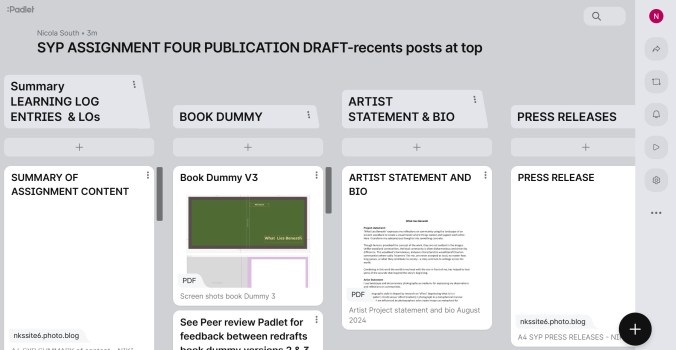
See padlet for all elements: https://oca.padlet.org/nicola514516/syp-assignment-four-publication-draft-recents-posts-at-top-9izzyahdg6i9qo1p
To support my work, open calls and publicity I built a web site. I already had a OCA blog, and built a website in March 2024 to host my work for a wider audience: https://nikisouth.myportfolio.com/home.

I built it using Adobe portfolio, so with no annual fee for a domain name and after a few days of research and trials I achieved what I wanted to. It is simple to refresh e.g. my portfolio, bio, CV.
I am aware that my website is a first landing place and should look professional for interested in my work and considered:
Content:
Visual strength, I considered:
All peer reviewed and spent time looking at other photographers’ websites; I believe it stands up well against other photographers websites.
As I do not intend to sell my book it will not be encompassed on the website for sale- though in the future I may mention that artist talks are available with a personal showing of the work in a book.
Apparently I can get Get Google Analytics (free) on my site to see where people are visiting from, what content is popular, what search terms people use to discover your site, how people move around the site. I need to look into this.
LO2 coherently present a body of work, making creative presentation decisions that complement your subject and/or your artistic strategies.
Brief: Submit a 2,000-word reflective account of the resolution of your publication (i.e. the work you have done since Body of Work). You should discuss in depth how you have resolved your major publication and justify your particular choices relating to its publication. Evaluate your efforts to engage an audience with your major project and the related themes.
This should be a fully illustrated and referenced piece of academic writing.
You should also reflect upon the feedback you documented throughout the publication of the work, and also describe how you might either develop and/or promote the work further. If appropriate, you should include installation shots and a press book and/or visitor’s book.
This Essay has been submitted via the G drive and on my Critical Reflective Padlet for assessment
This was a end of course change of Tutor as my course tutor was suddenly unable to give feedback or a tutorial for assignments 3 (I submitted 18.8.24) and assignment 5 (I submitted 28.10.24). This delayed me by a few weeks. The OCA assigned me a new Tutor who after familiarisating themselves with my work gave a video feedback tutorial for this assignment.
It was useful to have a fresh pair of eyes on my work. He was complimentary about and commented that the project is very interesting. Advice given was all around presenting my work in assignment 5 and the assessment shorter evaluation, to evidence my learning and dissemination of the work.
Video feedback session: 9.11.24
Reflective evaluation
Make a critical reflective padlet (CRS) to bring everything together
Barrett (2010) Principles Interpreting Photographs, In: The Weight of Photography: Photography History Theory and Criticism, Johan Swinnen and Luc Deneulin, Editors. Brussels: ASP, 2010, pages 147-172.
Killip (2001) interview 55 Journal, Phaidon
See original draft prior to Tutor feedback here:
And Tutor feedback here: https://nkssite6.photo.blog/2024/08/21/assignment-2-reflections-on-formative-feedback/
LO1 demonstrate comprehensive knowledge of the professional context(s) relevant to your practice and have an understanding of the professional dimensions that underpin a successful photographic practice.
This is a large file which takes time to download
The process of making the book is recorded in my A4 Learning log part 2:
and my book making padlet summary: https://oca.padlet.org/nicola514516/syp-book-making-process-5nr3ffikcotklq9q
To combine the images and poetry in a way that offers audiences a platform to reflect on the nature of community. It is intended for two purposes:
I showed the finished book to a printer, framer, photobook publisher who was impressed with the design, layout quality and content. He commented favourably on:
Overall he was surprised at the professional outcome I’l achieved whilst self publishing.
Revising the design and product over time seems to have paid off. Some compromises are inevitable. Had the budget been limitless:
However I believe I found the best solutions for my budget for the final product.I paid a total of £278 for 5 copies. Quite an outlay but I budgeted £350 and saved £60 bu using affinity software 6 month trial.
It is a good quality hardback book, with the durability needed for artist talks. It gives the professional look needed for audiences and the final images, text content and overall design exactly meet my intention to provide a platform for audiences to reflect on the nature of community.
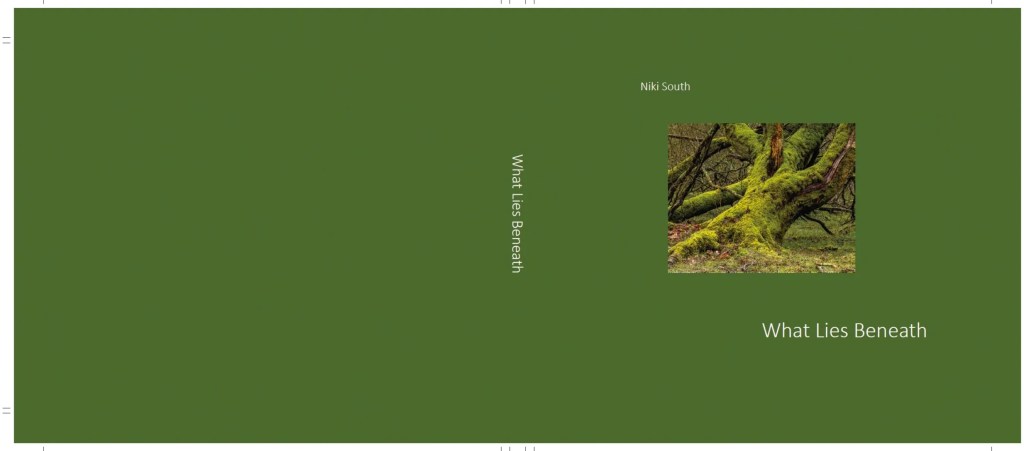
PDF Proof copy of book:
LO5: confidently engage a public audience with your practice and analyse, review and evaluate information relevant to your practice, identifying opportunities for professional development
(Evaluation details below in Part 3)
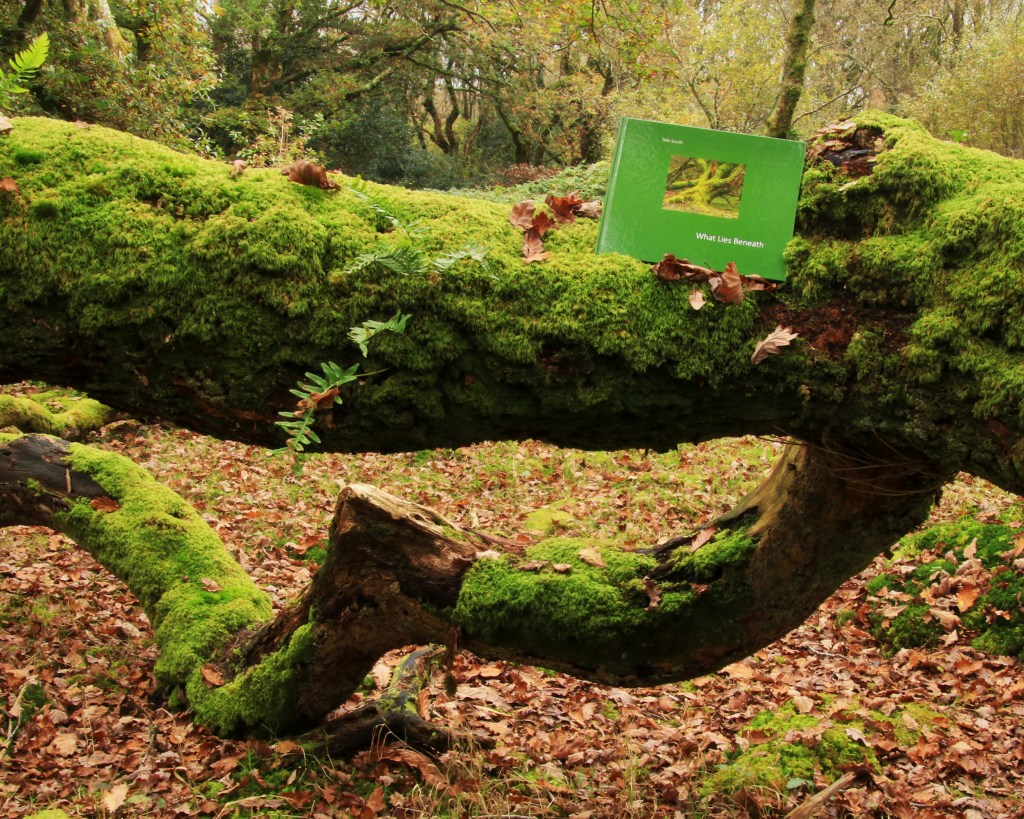
At the outset of the project (Project Proposal draft Assignment 2) I was adamant that wanted to attract limited local attention, due to local sensitivities. My Tutor challenged this as did my peers as my work began to take shape. I revised my intention a few months later as feedback told that the narrative was common to many localities, and decided to offer artist talks to a range of local people, to engage with an audience and offer the opportunity for them to reflect on the nature of community
I chose initially to do these 1:1 as I thought this would be more likely to give frank responses. I invited people via promotional postcards and offered another of their choice to takeaway and as potential promotional material:
As I gave publicity postcards away, word got around and I had locals ask me if they could see my book
Artist talks in the woodland where the images were photographed

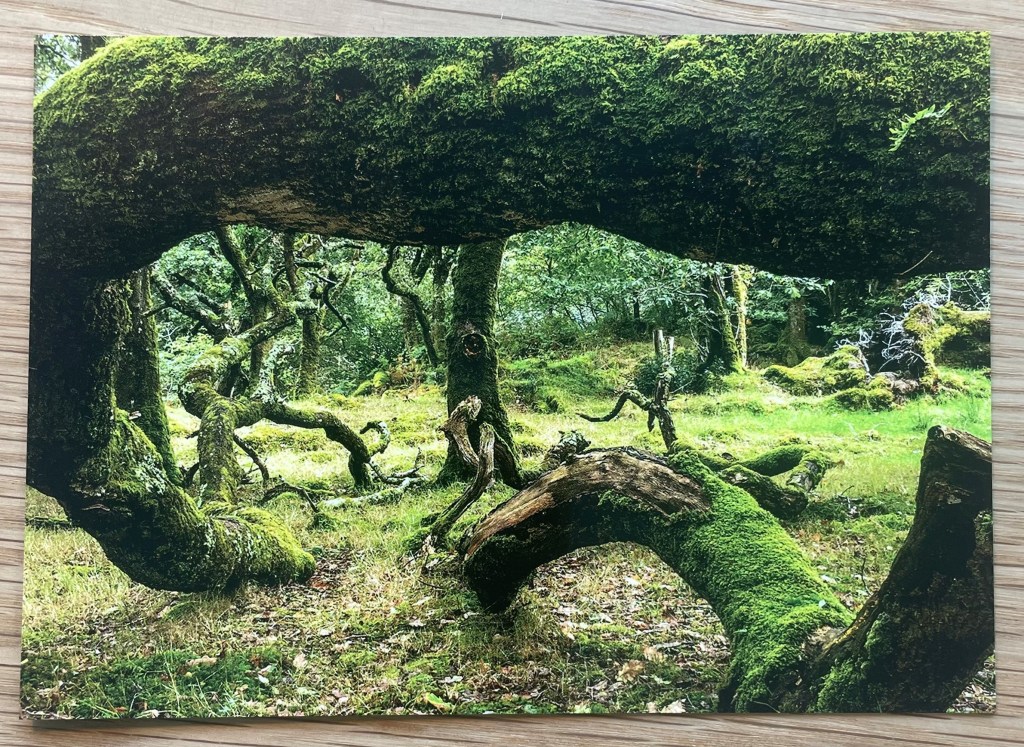

21.10.24 with Kathryn
She said that the preface prepared her for the upcoming content well – the what and the why.
As she viewed the main images and couplets, she said “it made me reflect on my previous experience of human relationships, in fact ones away from this locality”. She spoke of her experience of others often not being generous, and how a lot of social etiquette is in fact ‘bollocks’. She liked many of the word choices such as ’festering’ which she called evocative. Kathryn said that the images and words relating to the woodlands conveyed a softness and peacefulness which is what she experienced in the woods at that moment, and of a sadness that is evident in the work. She particularly like the ‘residents’ images and definitions, saying it brought it home that diversity in a community can be quite simple.
She offered an interesting suggestion that the ‘residents’ images would be good behind ’flaps’ as readers may expect to see human portraits next to the definitions, and then be surprised.
My learning from this first artist talk was that the 1:1 talks are an effective method for sharing and gaining personal feedback on the work. It seems to create a mirror for a reader to reflect on human relationships in a fruitful way as well as offering an opportunity to enjoy the woodland community featured in it.
A big learning point was that the work is not obviously about one particular place (e.g. This local community) as the experience described in the work is very generic and applicable to most locations and networks; she believes I am reading too much into it with my fear of discovery.
Kathryn also said that the work doesn’t come across as harmful in any way, as it is sensitive, and not at all negative; it just has a feeling that it was made by someone who has experienced sadness and wishes for better relationships. She actually said I had “boiled the pettiness out of it”. I was able to explain about ethics in photography and how this project meets my aims.
She said she was very ‘affected’ by the photography, and enjoyed the self-reflection it provoked.

23.10.23 with Marianne

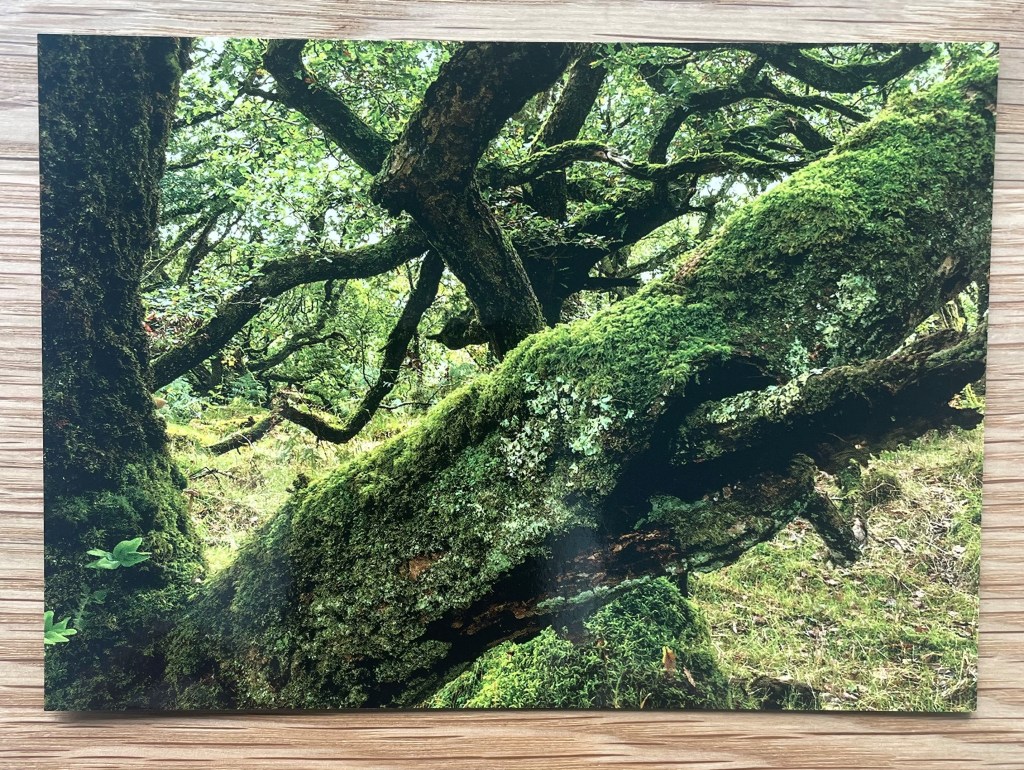

Beginning with the preface she immediately recalled a conversation with some tourists she bumped into recently and a conversation shared about locals an incomers. They related that where they have lived for 30 years they will never be considered local. Marianne referred to herself a ‘blown in’ though she’s lived here for years. She concurred with a line in the preface that incomers contribution to communities are rarely acknowledged.
Viewing the 1st image, and looking around herself at the woodland, she reflected how diverse the woodland is and it yet adapts over time; conversely that humans seem resistant to change. Reading on she commented on the layering there is in the words and how it draws her into the images.
When musing on the ‘residents’ section of the book, she reflected on how in small human communities there can be a lack of perspective as they lack context, and the feeling that you can’t sneeze without someone knowing. This led her on the recount an experience she’d had with a local neighbour.
Marianne said that she found the book very honest and that I had done well to share my thoughts in a way that isn’t harmful to others but causes you to reflect and respond.
We discussed how I could share with a broader audience locally as she thought it could be shared more widely and that it could be beneficial for others. I said I should be conscious not to restrict my sharing to certain sectors. She commented that we have a very eclectic mix of people living here and that actually to tick all bases would be impossible.

29.1.24 with Jane
She remarked straight away on the quality of the book and paper. Then the strength of the images.
She pointed out that you could construct the same work and point to a different view of human community. Also, that those with less friendly behaviours are just an element of the community and that it is possible that thier expressions are simply their way of functioning in a community – you get gossipers in every community.
She went on to say “the work is very thought provoking as I don’t normally dwell on community behaviours”. She has lived here for 30 years and said she is aware of conflict in the community, but tries to insulated herself from it, by not dwelling on it.
We talked at the end about how the woodland might respond if it had ‘incomers’, aka invasive species; this was a reflection point for myself.
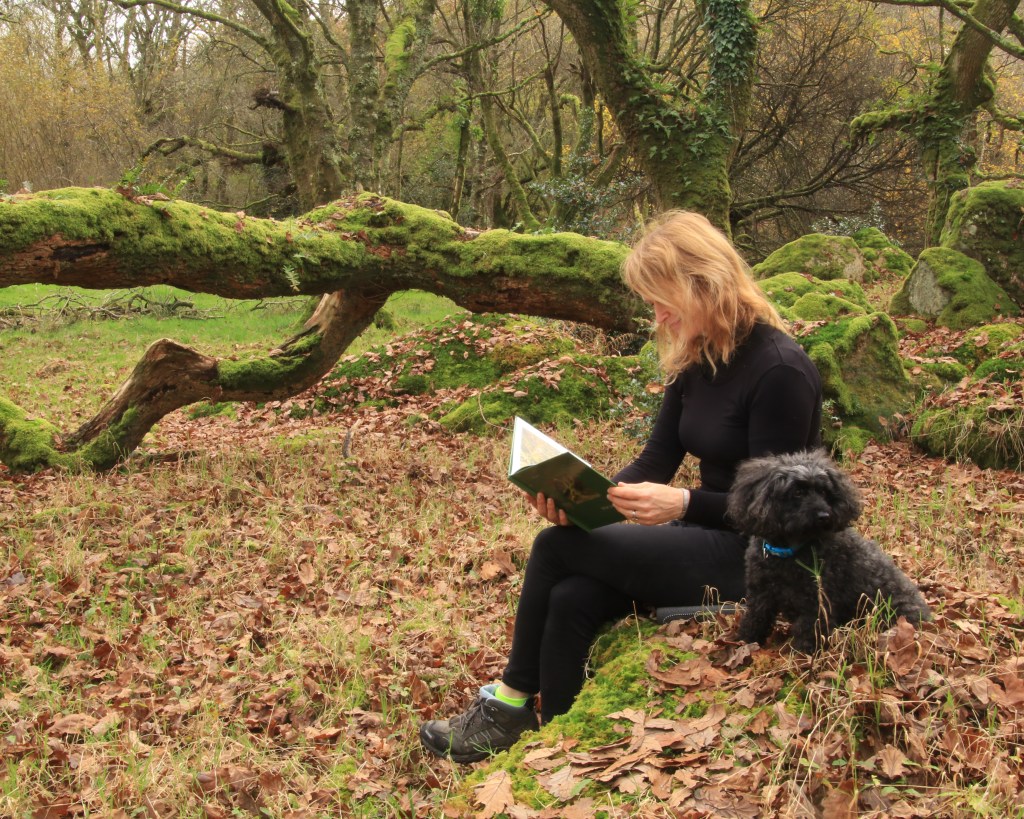
2.11.24 with Rachel
As sat in the woodland the leaves fell around us. Rachel read the book to the end of the ‘community’ section before asking me the background. She then commented that the poetry made her feel sad.
She queried that all is harmonious in the woodland if you widen out from the flora I focused on, for instance the elements and the fauna (food chain) but agreed that for such a diverse community it is relatively harmonious.
She then focused on the images and said the 1st image conjured up a feeling of protection. and spotted that main images 2 & 5 appear chaotic on the surface, though they were ordered underneath. She also commented that image 6 seemed hopeful and spring like. I shared that she was perceptive as images 2 & 5 were taken when I photographed elements that appear chaotic and image 6 for a subset I called rebirth.
She noted how the top and bottom couplet lines are the extremes of positive and negative, and the language used evocative, e.g. Contentedly and festering. She shared her own always positive attitude to human community, saying it made her consider that all may not be as it appears on the surface and there be other that have different views.
She continued with the ‘resident’ section of the book and enjoyed the close-up images. Her observation was that they could just carry a headline title each, like nourish, and not have the definition as well, leaving more to the viewers imagination.
Overall, apart from loving the images, she commented “the book has made me reflect on the nature of community and consider how others might feel about it”. She read the book quietly several times and said she would like to reread again, saying she enjoyed the layers in it and the reflection it was provoking.

6.11.24 with Sharon
She initially commented that the woodland ‘just is’, whereas words like prejudice and ….are labels that we have in human communities, as humans seem to need to put limits/labels on things. She said that the images made her realise how nature coexists naturally whilst humans need to work hard to come together/ be together.
She said the images showed the diversity and richness of the woodland community.
I asked if she thought my signposting text was harsh on humans, and she replied that no she thinks it’s a reality in communities generally, and agreed that the contrasting words chosen for the poetry was completely appropriate.
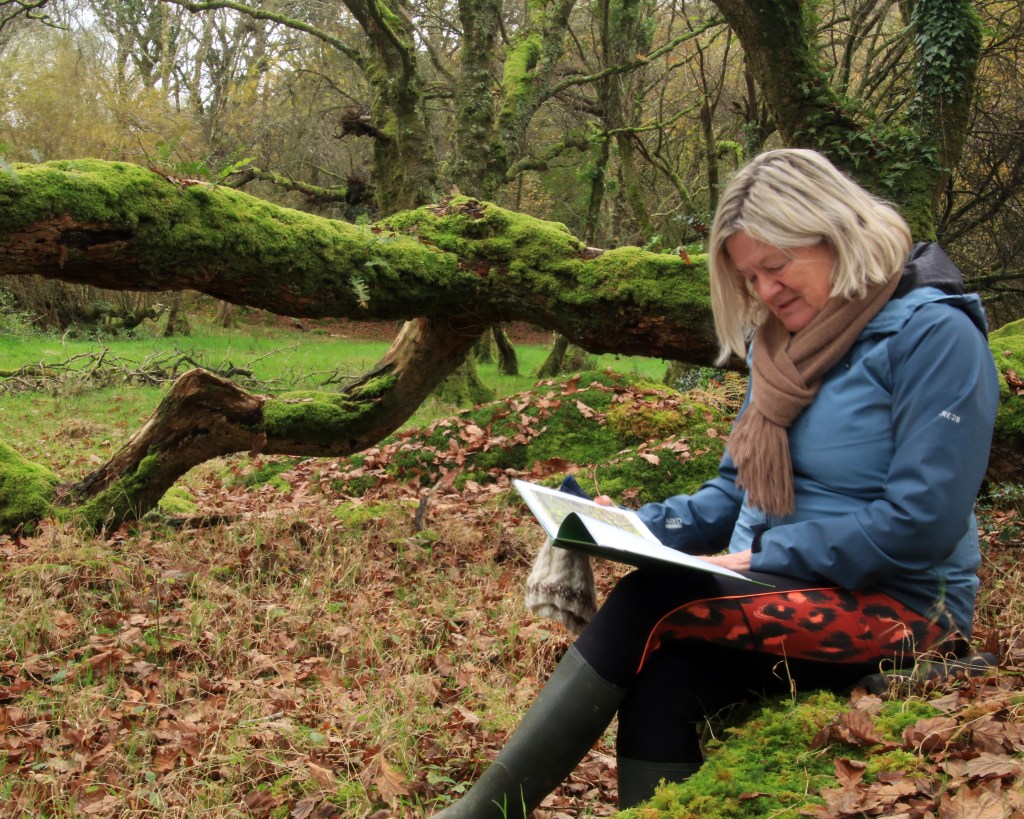
I am realising that the book can have a wide appeal and could be recognised as fitting many neighborhoods, readers relate the theme is common in many neighbourhoods; my fear of upsetting locals who may think I’m shining a light on them seem unfounded. Viewing in the woodland seems to encourage ‘slow reading’ and revisiting of the book. I am surprised at the impact the work has on viewers and how it prompts them to reflect verbally on their own experiences of community; I suspect that this is only the tip of their reflection.
It has given me further ideas on how I could develop my work through artist talks:
Had I not disseminated my work through Artist talks I would not know that I’d met my project intentions, nor would have evidence of this:
” The book has made me reflect on the nature of community and consider how others might feel about it” (Rachel at artist talk)
”

LO5 confidently engage a public audience with your practice and analyse, review and evaluate information relevant to your practice, identifying opportunities for professional development
I am bringing together here the elements that support my work and book’s public discourse
I have fine-tuned my artist statement and bio, and gained experience numerous experiences of adapting it for various audiences and open calls. Give examples for an LO?
I have written an introduction for my book that draws from these and adapted them for my press release for artist talks.
They:
Artist Project statement and bio August 2024Download
2. Website
I already had an OCA blog, however I am aware that my website is a first port of call for interested in my work. I built a website in March 2024, using Adobe portfolio (with no annual fee for a domain name), to host my work for a wider audience: https://nikisouth.myportfolio.com/home .
This appeared a technical challenge initially but after a few days of research and trials I achieved what I wanted to. I considered:
Content:
It is simple to refresh e.g. my your portfolio, bio, CV.
I spent time looking at other photographers’ websites and had my website peer reviewed. As I do not intend to sell my book it will not be encompassed on the website for sale- though I may mention that artist talks are available with a personal showing of the work in a book. I have been contacted about my work via my website
3. Social media and enhancing my online presence
Instagram – I began a professional photography Instagram earlier in the year and am posting on it and extending my followed and followers. I have a widget for it on my website.
LinkedIn – I updated my profile to include my photography. I will see going forwards if I need to use it to seek specific professionals or direct them to me.
My facebook remains a personal rather than professional tool, and is geared towards local contacts so is not appropriate for the engagement that I want for this work.
Twitter – Can take a very long time to acquire enough followers on to make meaningful contributions towards publicity, so I have left this for now. Should I change my mind in the future about how much I want to engage with an audience going forwards then I can revisit the idea.
4. Press releases
If I wanted wide local engagement I am aware that I could advertise locally using event listing websites and publications. These would be:
None of these are appropriate for my project/book which is sensitive locally. However in a press release I would address:
I wrote a theoretical press release for my book and a press release for my artist talks, These have helped me to focus on the important points that I need people to know. I revised these extensively and they can be seen here: https://nkssite6.photo.blog/category/sustaining-your-practice/assignments/a4-syp/a4-syp-press-releases/
5. Publicity PDF which I revised after assignment 1 reviews
6. I have prepared publicity postcards as both invites to my artist talks and for participants to write their feedback on, as well as having a takeaway image from the talks. See post: https://nkssite6.photo.blog/category/sustaining-your-practice/assignments/a4-syp/a4-syp-publicity-material/
—
Gathering feedback for my publication after it is ‘released’ is part of this process and will help me assess the success of my publication – how much my work has managed to communicate the ideas or explore the themes that you set out to. I think this, rather than the numbers of visitors will be more appropriate for my work. I will use this feedback to help reflect upon how to develop the work further, or where or how I might exhibit it in the future.
Whilst developing and resolving my project ‘What Lies Beneath’ I have been aware at all times of ethics in photography and my ethical code. See my previous post:
Principle: My photography maintains my freedom of thought and expression, whilst not harming others.
Enacting: I will be aware of the possible impact of my images and accompanying text and recognise other’s perspectives. I will be honest in my representations. If I wish to publish or exhibit my work I will seek permissions from any individuals represented. If my work does not represent individuals but does points to generic groups/sets, it will retain anonymity to any particular locations or groups of people.
Principle: I support the protection of sensitive environmental locations.
Enacting: I will be cognizant of whether there is a need to protect a habitat or location, if so I may choose to keep it anonymous, by not sharing with others where my work was photographed.
Principle: Whilst working I do not spoil enjoyment of others in the same location or setting.
Enacting: When photographing I am conscious of others around me. I am careful not to impede their access, and don’t act in any way that would impair their experience of the place. I will be discrete and respect others privacy.
Principle: I am considerate of the environment.
Enacting: When working in the landscape I will leave no trace behind. I will be aware of how the landscape is when I enter, then tread carefully and leave everything as I find it.
Principle: My photography represents subjects with integrity.
Enacting: When photographing, editing and presenting my images, I try to give as much context as is necessary, and do not change or manipulate the context of a subject if it misrepresents or harms another.
As I choose what I photograph and how I present it, I know I am responsible for being critically, situationally and culturally aware. I self-reflected throughout the process asking:
Who am I in relation to the story I am telling? I am both an incomer and a local resident, but not a born and bred ‘local’. I have spoken with a broad range of community members and researched economic, social and political facts.
What assumptions do I carry? What biases do I carry? I can appreciate the position of incomers who suffer disadvantages locally as well as the benefits of enjoying the area. I can also understand the viewpoints of locals who sometimes embrace the benefits of incomers and visitors and sometimes bemoan them. I can see the benefits and the economic need for seasonal tourism but share the discomfort of ‘locals’ in season when the population swells.
What are my motivations, reasons for documenting the story? Though I can understand the various perspectives, I am saddened by the behaviours and the lack of understanding that this diversity provokes.
Is the language that I’m using honest? I believe so.
Consider the impact the work may have make careful decisions about where work is shared – how to share my work without upsetting others – minimising harm – recognising other’s perspectives. I am mindful that my representation should not cause harm to others. This is why I have reservations about sharing my work widely locally. I have learnt that to be accepted in the community it is best to keep your opinions and feelings hidden. This particularly when you are not a ‘local’ here. Most are quite gentle here apart from their tongues; however there have been times when ‘outsiders’ property has been damaged as well as their reputations in response to locals feeling threatened in some way.
This is why I am not exhibiting locally, I have not named the Town I live in, or the location of the woodland.
I have also protected the location of the woodland, a rare temperate rainforest, and acted environmentally responsibly when photographing.
 NIKI SOUTH