LO3 operate in complex commercial contexts requiring the application of specific interpersonal, professional and business skills within an ethical framework
The process of submitting my work to my printer shows ability to operate within a commercial context using interpersonal and business skills. I met printer specifications using professional publishing software, liaised on physical proof checks, negotiated discount, and overcame commercial difficulties when there were errors on their part https://nkssite6.photo.blog/2024/10/06/sustaining-your-practice-assignment-4learning-log-part-2/
Researching Assignment 3 analytical text on the benefits and challenges of self-publishing and publishing. I applied interpersonal skills at a professional level in a commercial context to obtain primary research. This blog post evidences the way that I operated to gain primary sources, and learn about the publishing industry, and my outcomes: https://nkssite6.photo.blog/2025/01/22/assignment-3-the-photography-industry-learning-log-for-crs-copy/
LO5 confidently engage a public audience with your practice and analyse, review and evaluate information relevant to your practice, identifying opportunities for professional development
Sociologist Tonnies, wrote on Community and Society types, human relationships, and social structures. He describes:
Gemeinschaft: Close knit communities characterised by a sense of togetherness shared values and norms, collective social bond where everyone knows each other, has shared values and a sense of duty to community
Gesellshaft: Impersonal, transactional, and self-interested communities
He suggests as societies modernise, communal bonds weaken giving way to more individualistic relationships.
His concepts have implications for individuals’ sense of identity and belonging, especially with globalisation, the rise of digital communities, urbanisation, modernisation, and the erosion of traditional communities. Here there is a tension between preserving ‘Gemeinschaft’ like bonds and embracing ‘Gesellshaft.’
Tonnies ideas are tools for understanding dynamics of social organisations under the impact of Modernisation. His work inspires reflection on the nature of human relationships identity and social change.
Its relevance to my work:
My ‘town’ (population only 1000) is rural and the ‘locals’ are traditional and close knit. However elements of Gesellshaft (self-interest) are more evident now than in time past. I would attribute this more to the rise of digital communities, than ‘incomers’ moving in. Though incomers bring elements of modernisation they are no more self-interested or lacking social conscience than the ‘locals.’ Certainly, during Covid 19 and continuing on using social media the ‘locals’ hide behind comments and posts that are divisive and self-interested. This I evidenced in a previous body of work ‘Layers of Truth.’
Reference:
Sociologylearners (2023) Gemeinschaft und Gesellschaft by Ferdinand Tönnies | Unveiling the Social Structures of Modernity. At: https://www.youtube.com/watch?v=gVmKi3g9DTw (Accessed 09/11/2024).
Obtaining Primary research for assignment 3 analytical text (Assessment 3 CRS Padlet) on the photo book publishing industry & to increase my knowledge
I chose to focus my research on the publishing area of the photographic industry as I am publishing a book, and at the outset of my publishing journey I had no idea whether I would self-publish or be published-in fact frankly I had no understanding of the processes at all.
To network and obtain primary sources I used my interpersonal skills at a professional level.
Things began to fall into place when I attended at photobook fair at Ffoto Gallery in Cardiff and spoke with publishers, self-publishers, book sellers and photographers. I visited to gain more in-depth knowledge of a publishing and how the role fits into the broader economy and/or arts community. My focus was already on exploring the differences between self-publishing and publishing.
I had particularly useful conversations with Brian Carroll, publisher or Offline Journal (documenting Welsh photography), David Mayne self-publisher and Walter Waygood, a prolific photobook self-publisher and photography lecturer, see my blog entries above.
This visit completed the gaps in terms of how I would publish my own project. It gave me some good ideas and leads for this assignment:
Publishing in Wales, or Welsh based photographers? too niche
Reasons why photographers chose to publish or self-publish
Why photographers publish zines rather than books?
Funding for photobook publishing? not an area that I need to explore myself
Affordable publishing? hard if impossible to find anyone doing
Sustainable publishing? too niche
How the future is looking for photobook publishing? too broad
My conversation with OCA postgraduate photographer Anna Sellen (17.6.24) also fed into these ideas: Where is publishing going? What new is happening? Doing it differently or sustainably? Why do we have to pay so much to get books published? Small publishing houses? Any publishers working more cheaply with students?
Making my dummy book for assignment 4 gave me more insight into publishing, especially self publishing, and helped me to frame my questions to put to those in the industry for my primary research.
Primary Research Survey contact record
The survey was sent to 32 in the photobook publishing industry:
To 15 publishers – 4 responded
To 18 published photographers:
5 who use publishers, 1 responded
7 who use both routes, 3 responded
6 who self publish, 5 responded
This gave me a good range of views/experience to analyse.
Summary (Main findings are incorporated in my essay):
Motivations for publishing photobooks, photographers V publishers. The later are more focused on financial viability.
Publishers say the photo book market is over saturated & their professional services are essential for success.
Those using publishers agree this.
The self-published primarily mention control of the end product and affordability.
These research findings led me to self publish my own book, but to be aware of audience & quality as well as costs.
Industry interview:
As a result of this I was invited to interview a photobook photographer who had been published many times, and had some useful responses to my questions, see blog post:
Al Brydon – Photographer and published photobook photographer interview 10.9.24
Al responded to my email survey questions saying he was happy to take a call instead of answering by email. I prepared for the call by doing more background research on him.
This opportunity to interview a often published photographer was invaluable. It gave me deeper information:
benefits of collaboration & good working relationship with publisher & objective eyes.
the importance of questioning the suitability of each project for a book.
understanding that publishers don’t want work aimed a photographer’s ‘followers’.
He has to work hard to promote his work as well as the publisher
Outcome:
After this primary research, I made an informed choice to self publish myself and was able to confidently write the assignment 3 analytical text, backed up with secondary sources.
LO3: operate in complex commercial contexts requiring the application of specific interpersonal, professional and business skills within an ethical framework
LO2 coherently present a body of work, making creative presentation decisions that complement your subject and/or your artistic strategies.
Process of revising images & creating complimentary presentation for final SYP output – Photobook
I had a clear concept in mind- A woodland community as a model for inclusive harmonious behaviour. Through my various stages of editing my Body of Work images for each photograph, I asked ‘how does this relate to my concept?
Part 1: Transforming BOW images into a coherent series of images
(See final Pdfs book proofs sent to printer at bottom of post)
I began by editing my BOW images for SYP. I asked my peers for their input as well. Peer critique session 24.2.24
Brief for peers and their comments:
Editing board shared with peers:
Outcomes: They suggested I exchange 2 images for those with extra dimensions of woodland for context. I asked their thoughts about the ‘signposting’ in the work & consensus was that it was the right level. They thought my reworked ‘footnote’ images didn’t need any changes. They are now more consistent than before (lighting/perspective). I fed their review ideas into my next editing decisions:
Bow images chosen after editing for SYP:
I revisited the ‘footnote images to try the definitions off of the borders of the footnotes:
Part 2: Presenting the body of work images with complimentary text and book design
Following this and photobook research I revised the sequencing for the book layout. I wanted a rhythm and a tempo, with quieter images punctuating the ‘louder’ images; a sequence for my narrative.
A mock up of book sizes drove my choice of book size: 260mm x 210mm to echo my 5:4 images, and to accommodate the size of the ‘footnote’ images (2 a page).
From here I created and revised book dummies (using Blurb self publisher only to produce PDF review purposes).
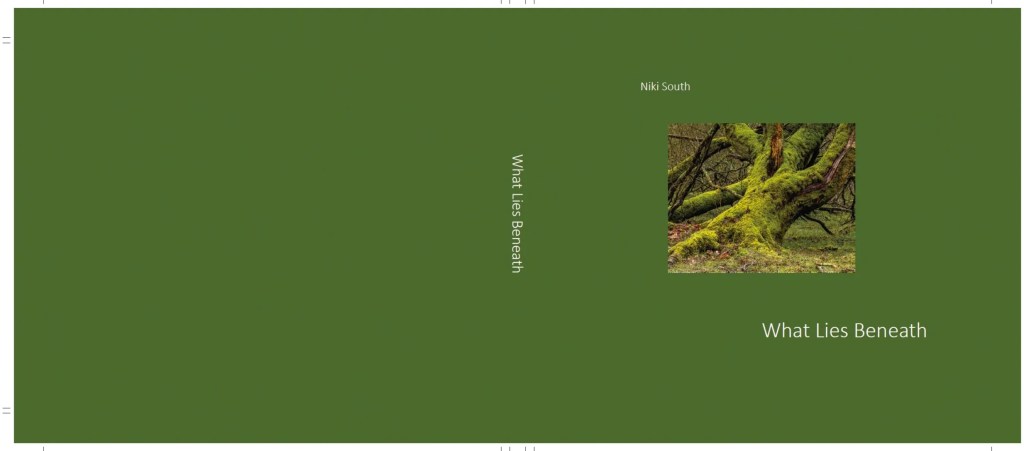
Should I have an image on the front cover? A. Can leave without
Are font sizes correct? Advised to keep font as small as readable, will look professional. Great tip & enabled me to reduce the font size of some of the text- done
Can I mix fonts headings/subheadings/text? -Took advice to use the same throughout
Also discussed & made some of these revisions in my final book CRS Padlet output 1:
make cover margin at bottom larger than top & move text in a little- Done
Realign text and try Futura font. I realigned but decided against futura font, I don’t like the’?’ & have alot of them.
Chose Calibri light as (similar to futura), Tutor recommended light
Do I need the Introduction heading? Check other’s books – Done I changed the heading from ‘introduction’ to ‘Preface’
Use thirds to place on page, imagine a 3×3 grid on a page and position elements in the centre box then move a bit upwards eg. p11 -done
Make page margins smaller- and text wider -done
Page 11 couplets move text lower to 1/3s -done
Is subheading, ‘constituents’ too political/formal? – I changed to ‘residents’
Footnotes: consider realigning – done
Think about how the book will look when pages turn, ensure that all text has the same bottom margin -done
Justify to the left, not ‘blocking – done
leave more space at bottom of page than top, like a polaroid photo -done
Make text 85% black only. This doesn’t conflict with the black in the images and makes the images ‘pop’. I adjusted to 88% black as advised by the printer – done
I revised the previous 3rd draft as above using affinity software with my chosen publisher Exwhyzed.
The revisions I made with creative/artistic choices using feedback and personal reflection took many hours but resulted in a book which complemented the images, set off the narrative of the project and enabled my final outcomes.
To support my work, open calls and publicity I built a web site. I already had a OCA blog, and built a website in March 2024 to host my work for a wider audience: https://nikisouth.myportfolio.com/home.
I built it using Adobe portfolio, so with no annual fee for a domain name and after a few days of research and trials I achieved what I wanted to. It is simple to refresh e.g. my portfolio, bio, CV.
I am aware that my website is a first landing place and should look professional for interested in my work and considered:
Content:
It has a landing page
About page: With my bio
Portfolio page: one for my major project What Lies Beneath and 1 for an earlier work Brexit. Both include introductions to my work.
Contact page
Visual strength, I considered:
Considered typeface
Layout
Colours/tones
Navigability is simple and obvious.
I checked how my website looks on a variety of devices.
All peer reviewed and spent time looking at other photographers’ websites; I believe it stands up well against other photographers websites.
As I do not intend to sell my book it will not be encompassed on the website for sale- though in the future I may mention that artist talks are available with a personal showing of the work in a book.
Apparently I can get Get Google Analytics (free) on my site to see where people are visiting from, what content is popular, what search terms people use to discover your site, how people move around the site. I need to look into this.
LO2 coherently present a body of work, making creative presentation decisions that complement your subject and/or your artistic strategies.
To combine the images and poetry in a way that offers audiences a platform to reflect on the nature of community. It is intended for two purposes:
To accompany artist talks in the woodland where shot, with local audiences
For exposure to professional via open calls, networking and reviews.
EVALUATION:
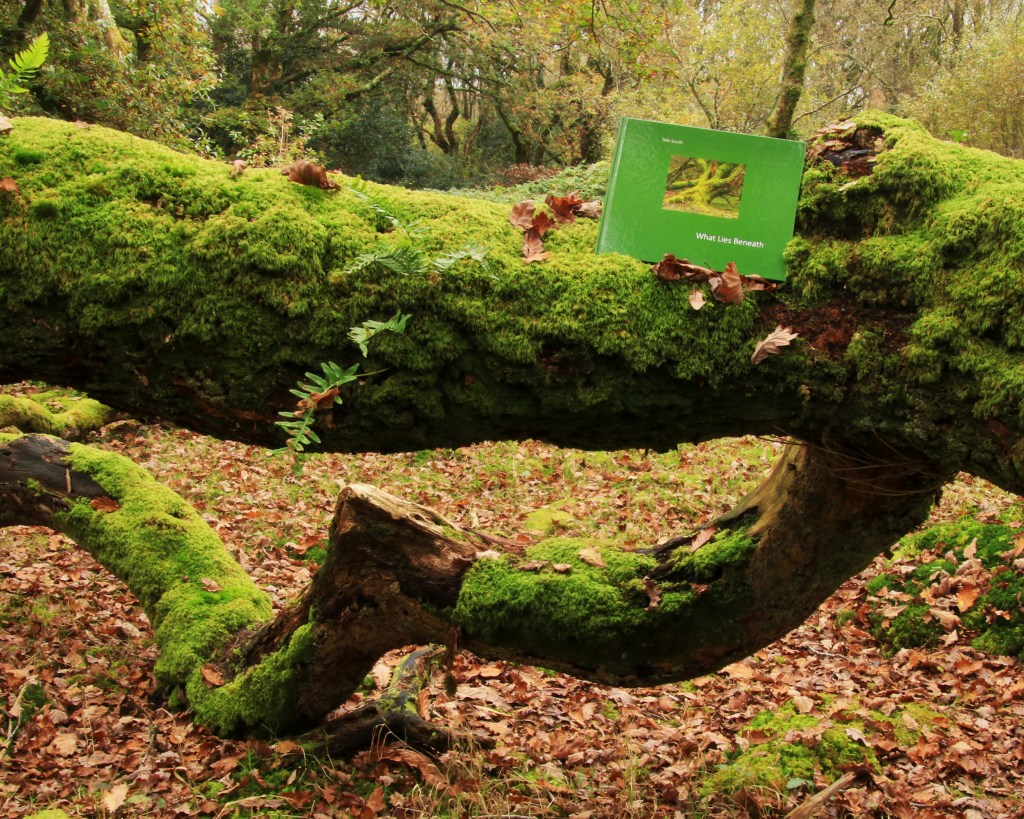
I am pleased I paid for a laminated hardback cover as this gives it the durability it needs to be handled and used in the woodland.
The green end pages give it a professional look.
The section dividing pages in green provide good punctuation.
The alignment and margin revisions work well, especially the tip to have a larger margin underneath an image.
Advice given to print text in only 85% black to help the images to ‘pop’ works well
The change to a lighter font (I used Calibri light instead of Garamond) is effective.
The change of label ‘Introduction’ to ‘preface’ in this final version gives a more professional tone to the page and book, as does the considerably shortened ‘preface’.
The sub title ‘Residents’ instead of ‘footnotes’ or ‘Constituents’ hits the right note.
I am glad that I added an image to the cover, looks more interesting and creates some intrigue.
The quality when delivered as my order: inner pages silk 170gsm not 115 gsm, and the cover laminated not un-laminated were important and I am glad that I picked these order errors and insisted on a reprint.
Professional feedback:
I showed the finished book to a printer, framer, photobook publisher who was impressed with the design, layout quality and content. He commented favourably on:
The way that the 85% black text is softer on the eye and makes the images ‘pop’
The uneven top/bottom margins like Polaroid pictures
The tone of the green colour used for the cover, end pages and section breaks
The small size of the text
The placement of text on facing page not below the images
That the design complements the subject and message well
Overall he was surprised at the professional outcome I’l achieved whilst self publishing.
Final reflections
Revising the design and product over time seems to have paid off. Some compromises are inevitable. Had the budget been limitless:
I would have chosen a linen embossed cover, I was quoted an extra £250 for this.
I would have experimented with end pages and section breaks in a natural brown paper, for texture and look.
However I believe I found the best solutions for my budget for the final product.I paid a total of £278 for 5 copies. Quite an outlay but I budgeted £350 and saved £60 bu using affinity software 6 month trial.
It is a good quality hardback book, with the durability needed for artist talks. It gives the professional look needed for audiences and the final images, text content and overall design exactly meet my intention to provide a platform for audiences to reflect on the nature of community.
LO5: confidently engage a public audience with your practice and analyse, review and evaluate information relevant to your practice, identifying opportunities for professional development
At the outset of the project (Project Proposal draft Assignment 2) I was adamant that wanted to attract limited local attention, due to local sensitivities. My Tutor challenged this as did my peers as my work began to take shape. I revised my intention a few months later as feedback told that the narrative was common to many localities, and decided to offer artist talks to a range of local people, to engage with an audience and offer the opportunity for them to reflect on the nature of community
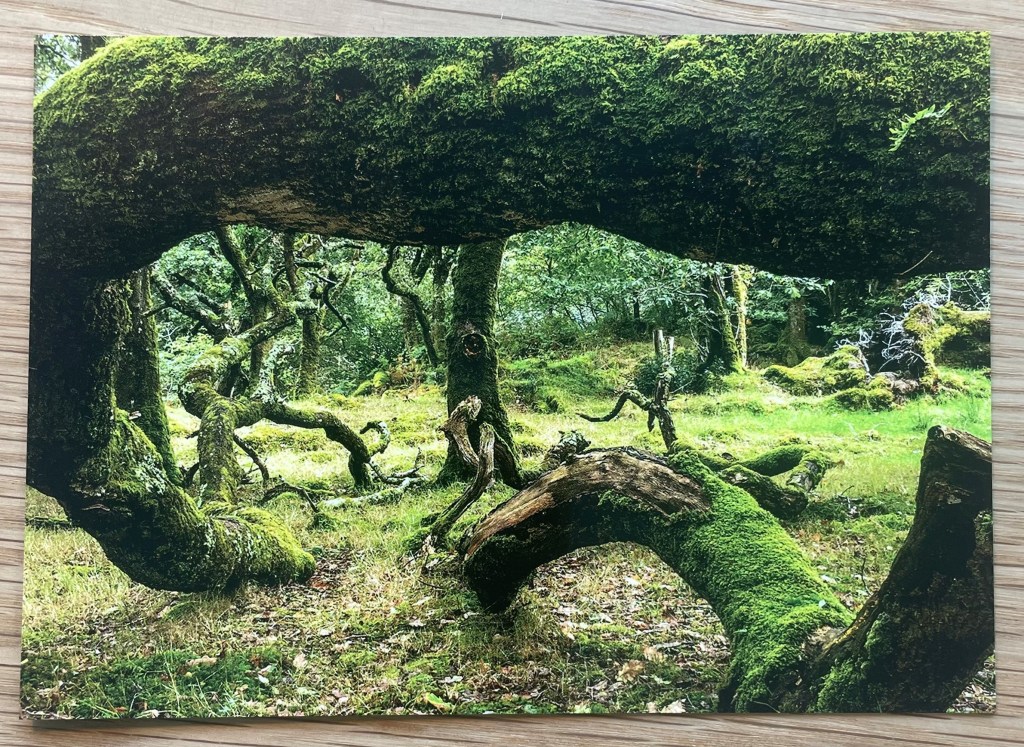
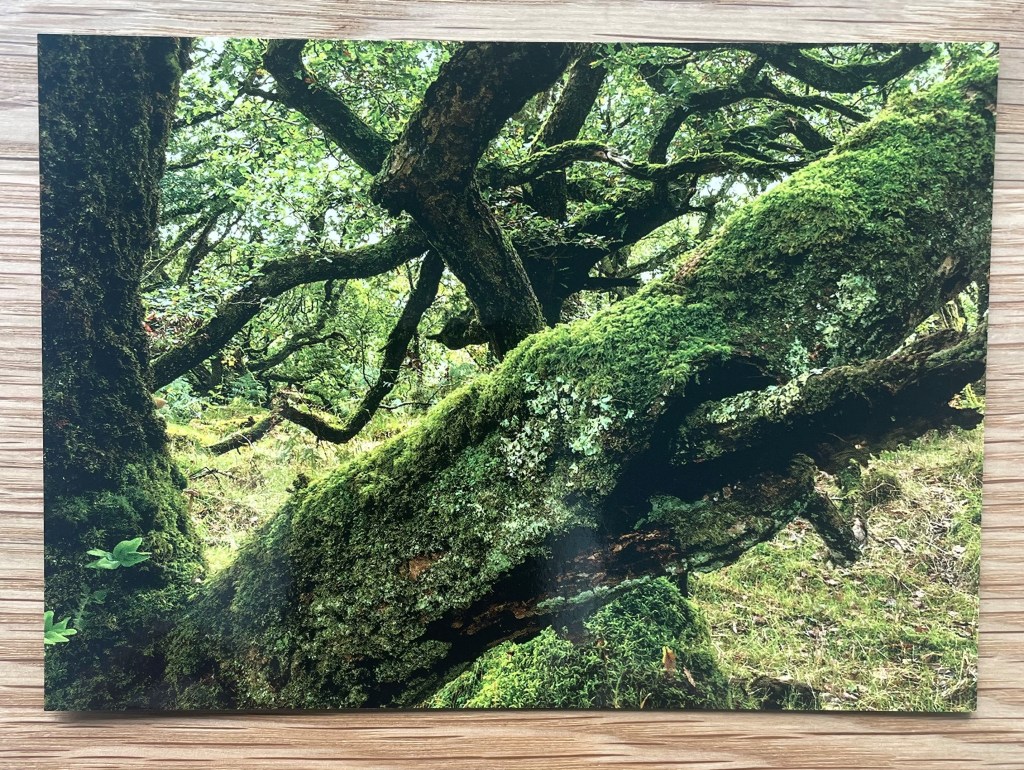
I chose initially to do these 1:1 as I thought this would be more likely to give frank responses. I invited people via promotional postcards and offered another of their choice to takeaway and as potential promotional material:
As I gave publicity postcards away, word got around and I had locals ask me if they could see my book
Part 2. EXECUTION
Artist talks in the woodland where the images were photographed
21.10.24 with Kathryn
She said that the preface prepared her for the upcoming content well – the what and the why.
As she viewed the main images and couplets, she said “it made me reflect on my previous experience of human relationships, in fact ones away from this locality”. She spoke of her experience of others often not being generous, and how a lot of social etiquette is in fact ‘bollocks’. She liked many of the word choices such as ’festering’ which she called evocative. Kathryn said that the images and words relating to the woodlands conveyed a softness and peacefulness which is what she experienced in the woods at that moment, and of a sadness that is evident in the work. She particularly like the ‘residents’ images and definitions, saying it brought it home that diversity in a community can be quite simple.
She offered an interesting suggestion that the ‘residents’ images would be good behind ’flaps’ as readers may expect to see human portraits next to the definitions, and then be surprised.
My learning from this first artist talk was that the 1:1 talks are an effective method for sharing and gaining personal feedback on the work. It seems to create a mirror for a reader to reflect on human relationships in a fruitful way as well as offering an opportunity to enjoy the woodland community featured in it.
A big learning point was that the work is not obviously about one particular place (e.g. This local community) as the experience described in the work is very generic and applicable to most locations and networks; she believes I am reading too much into it with my fear of discovery.
Kathryn also said that the work doesn’t come across as harmful in any way, as it is sensitive, and not at all negative; it just has a feeling that it was made by someone who has experienced sadness and wishes for better relationships. She actually said I had “boiled the pettiness out of it”. I was able to explain about ethics in photography and how this project meets my aims.
She said she was very ‘affected’ by the photography, and enjoyed the self-reflection it provoked.
23.10.23 with Marianne
Beginning with the preface she immediately recalled a conversation with some tourists she bumped into recently and a conversation shared about locals an incomers. They related that where they have lived for 30 years they will never be considered local. Marianne referred to herself a ‘blown in’ though she’s lived here for years. She concurred with a line in the preface that incomers contribution to communities are rarely acknowledged.
Viewing the 1st image, and looking around herself at the woodland, she reflected how diverse the woodland is and it yet adapts over time; conversely that humans seem resistant to change. Reading on she commented on the layering there is in the words and how it draws her into the images.
When musing on the ‘residents’ section of the book, she reflected on how in small human communities there can be a lack of perspective as they lack context, and the feeling that you can’t sneeze without someone knowing. This led her on the recount an experience she’d had with a local neighbour.
Marianne said that she found the book very honest and that I had done well to share my thoughts in a way that isn’t harmful to others but causes you to reflect and respond.
We discussed how I could share with a broader audience locally as she thought it could be shared more widely and that it could be beneficial for others. I said I should be conscious not to restrict my sharing to certain sectors. She commented that we have a very eclectic mix of people living here and that actually to tick all bases would be impossible.
29.1.24 with Jane
She remarked straight away on the quality of the book and paper. Then the strength of the images.
She pointed out that you could construct the same work and point to a different view of human community. Also, that those with less friendly behaviours are just an element of the community and that it is possible that thier expressions are simply their way of functioning in a community – you get gossipers in every community.
She went on to say “the work is very thought provoking as I don’t normally dwell on community behaviours”. She has lived here for 30 years and said she is aware of conflict in the community, but tries to insulated herself from it, by not dwelling on it.
We talked at the end about how the woodland might respond if it had ‘incomers’, aka invasive species; this was a reflection point for myself.
2.11.24 with Rachel
As sat in the woodland the leaves fell around us. Rachel read the book to the end of the ‘community’ section before asking me the background. She then commented that the poetry made her feel sad.
She queried that all is harmonious in the woodland if you widen out from the flora I focused on, for instance the elements and the fauna (food chain) but agreed that for such a diverse community it is relatively harmonious.
She then focused on the images and said the 1st image conjured up a feeling of protection. and spotted that main images 2 & 5 appear chaotic on the surface, though they were ordered underneath. She also commented that image 6 seemed hopeful and spring like. I shared that she was perceptive as images 2 & 5 were taken when I photographed elements that appear chaotic and image 6 for a subset I called rebirth.
She noted how the top and bottom couplet lines are the extremes of positive and negative, and the language used evocative, e.g. Contentedly and festering. She shared her own always positive attitude to human community, saying it made her consider that all may not be as it appears on the surface and there be other that have different views.
She continued with the ‘resident’ section of the book and enjoyed the close-up images. Her observation was that they could just carry a headline title each, like nourish, and not have the definition as well, leaving more to the viewers imagination.
Overall, apart from loving the images, she commented “the book has made me reflect on the nature of community and consider how others might feel about it”. She read the book quietly several times and said she would like to reread again, saying she enjoyed the layers in it and the reflection it was provoking.
6.11.24 with Sharon
She initially commented that the woodland ‘just is’, whereas words like prejudice and ….are labels that we have in human communities, as humans seem to need to put limits/labels on things. She said that the images made her realise how nature coexists naturally whilst humans need to work hard to come together/ be together.
She said the images showed the diversity and richness of the woodland community.
I asked if she thought my signposting text was harsh on humans, and she replied that no she thinks it’s a reality in communities generally, and agreed that the contrasting words chosen for the poetry was completely appropriate.
I will continue with and expand my artist talks to local audiences
Experiment with Artist talks outside of the woodland, where and will be open to holding group sessions
Capture feedback.
I have been asked to present my work to a group audience, at a County organisation, and will look for similar opportunities.
Had I not disseminated my work through Artist talks I would not know that I’d met my project intentions, nor would have evidence of this:
” The book has made me reflect on the nature of community and consider how others might feel about it” (Rachel at artist talk)
”
LO5 confidently engage a public audience with your practice and analyse, review and evaluate information relevant to your practice, identifying opportunities for professional development
I have fine-tuned my artist statement and bio, and gained experience numerous experiences of adapting it for various audiences and open calls. Give examples for an LO?
I have written an introduction for my book that draws from these and adapted them for my press release for artist talks.
They:
Address the core themes that the project addresses.
Address only the current work
Address the audience, as they may be mainly not photographic professionals locally.
are enthusiastic, and stress the importance/relevance of the project.
Don’t impose a definitive statement of the work’s meaning on your audience. Leave some intellectual space to engage with it and draw their own conclusions.
Written in 1st person.
Artist Project statement and bio August 2024Download
2. Website
I already had an OCA blog, however I am aware that my website is a first port of call for interested in my work. I built a website in March 2024, using Adobe portfolio (with no annual fee for a domain name), to host my work for a wider audience: https://nikisouth.myportfolio.com/home .
This appeared a technical challenge initially but after a few days of research and trials I achieved what I wanted to. I considered:
Professionalism: I believe it stands up well against other photographers websites.
Content:
It has a landing page
About page: With my bio
Portfolio page: one for my major project What Lies Beneath and 1 for an earlier work Brexit. Both include introductions to my work.
Contact page:
Visual strength, I considered:
Considered typeface
Layout
Colours/tones
I have checked how my website looks on a variety of devices.
Navigability is simple and obvious.
It is simple to refresh e.g. my your portfolio, bio, CV.
I spent time looking at other photographers’ websites and had my website peer reviewed. As I do not intend to sell my book it will not be encompassed on the website for sale- though I may mention that artist talks are available with a personal showing of the work in a book. I have been contacted about my work via my website
3. Social media and enhancing my online presence
Instagram – I began a professional photography Instagram earlier in the year and am posting on it and extending my followed and followers. I have a widget for it on my website.
LinkedIn – I updated my profile to include my photography. I will see going forwards if I need to use it to seek specific professionals or direct them to me.
My facebook remains a personal rather than professional tool, and is geared towards local contacts so is not appropriate for the engagement that I want for this work.
Twitter – Can take a very long time to acquire enough followers on to make meaningful contributions towards publicity, so I have left this for now. Should I change my mind in the future about how much I want to engage with an audience going forwards then I can revisit the idea.
4. Press releases
If I wanted wide local engagement I am aware that I could advertise locally using event listing websites and publications. These would be:
The local facebook ‘who what where when’
The well-used village telegraph pole
I could also contact the editors of my local newspapers like the Western Telegraph
None of these are appropriate for my project/book which is sensitive locally. However in a press release I would address:
Gathering feedback for my publication after it is ‘released’ is part of this process and will help me assess the success of my publication – how much my work has managed to communicate the ideas or explore the themes that you set out to. I think this, rather than the numbers of visitors will be more appropriate for my work. I will use this feedback to help reflect upon how to develop the work further, or where or how I might exhibit it in the future.
Option 2: If it’s not possible to conduct a work placement, write a 2,000-word analytical text that discusses a particular role, either one of those discussed in Part Three or another role related to the photographic industry. This task should be informed by primary research (i.e. direct contact with practitioners) as well as other resources.
The aim of this assignment is to:
Gain an in-depth knowledge of a particular complementary role and/or the roles and responsibilities of a particular type of photographer.
Understand how the role fits into the broader economy and/or arts community.
Understand the duties and responsibilities of a particular role, including any conflicts of interest there may be with other professionals.
Continue to build your professional network. (Boothroyd, S. and Alexander, J; 60, 2020)
Reference: Boothroyd, S. and Alexander, J. (2020) Sustaining Your Practice Course Manual. Barnsley, UK: Open College of the Arts.
REFLECTIONS AGAINST LEARNING OUTCOMES
LO1 demonstrate comprehensive knowledge of the professional context(s) relevant to your practice and have an understanding of the professional dimensions that underpin a successful photographic practice.
To support the final resolution of my work in the form of a photo book I chose to write my essay on the photobook publishing industry.
My knowledge of the photobook publishing industry is demonstrated in my essay, What are the benefits and challenges of self-publishing or having your photobook published, submitted and sent to my Tutor.
LO3 operate in complex commercial contexts requiring the application of specific interpersonal, professional and business skills within an ethical framework.











 NIKI SOUTH