BODY OF WORK RESEARCH: PART TWO GENRE DEVELOPMENT

Brief background on lichen, ferns and mosses

Lichen

Are composite organisms made up of fungus and algae living together in the lichen body. The algal partner produces by photosynthesis nutrients (simple sugars) for the fungus and the fungus the body for the algae to live in protected from extreme conditions of heat or drought– a symbiotic partnership.

Lichens are extremely sensitive to environmental changes and are natural indicators of the health of our environment. They are affected by pollutants such as sulphur dioxide from coal burning and industry, as well as nitrogen compounds from intensive farming activities.

They form numerous shapes, sizes and structures ranging from tiny ‘pinheads’ to porridge-like crusts, to large leafy structures. They colonise most habitats on earth, even your car, but are very evident in ancient woodlands, where the levels of sunlight and moisture are ideal for lichens.

On twigs epiphytic lichens will quickly colonise new growth on branches but must compete with mosses and algae. There are three types of lichen, Crustose which looks like a crust on a bark, such as this one on a deciduous tree:
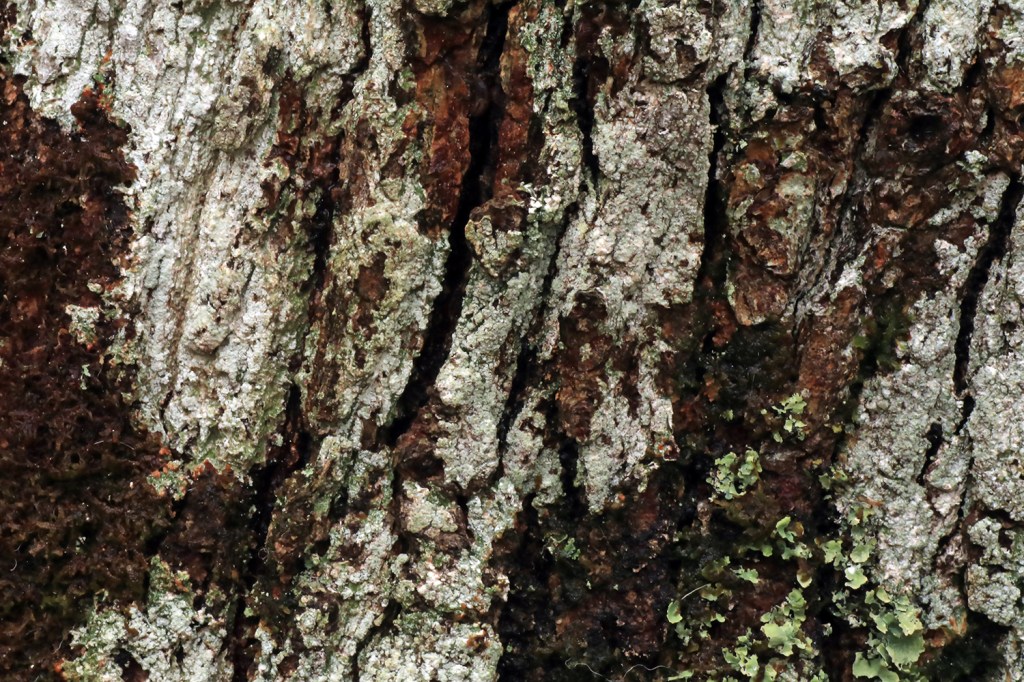
(South, own collection 2022)

Foliose which attaches like a leaf and Fruticose that attaches to twigs with a sucker like stem and grows like a mini shrub, both can be seen here:

(South, own collection, 2021)

Merlin Sheldrake, author of “Entangled Life: How Fungi Make Our Worlds, Change Our Minds and Shape Our Futures”, gives a good description of lichens saying:

 “They flicker between “wholes” and “collections of parts.” Shuttling between the two perspectives can feel strange. The word individual comes from the Latin meaning “undividable.” Is the whole lichen the individual? Or are its constituent members, the parts, the individuals? This confusion is healthy.” (Look at a lichen, 2021).

References:

Burt, E. (2018) Haloing, lichens and our ancients. At: https://naturebftb.co.uk/2018/03/14/haloing-lichens-and-our-ancients/ (Accessed 07/03/2022).

Woodland Trusts (2021) Look at a lichen At: https://www.wildlifetrusts.org/blog/guest/look-lichen (Accessed 07/03/2022).

Mosses

Also known as Bryophytes, there are 20,000 species around the world which may be microscopic or over a metre in size. They grow in many climates and environments. Tiny, non-flowering mosses are one of the oldest land plants known to Earth, believed to have first appeared around 350 million years ago, long before dinosaurs, and even though they grow slowly, about ¼ inch per century, they are virtually unchanged. In ancient woodlands they grow as green carpet-like mats across forest floors or covering tree trunks. Instead of seeds, mosses have evolved spores to give rise to new plants. They have no vascular system to move substances up through their roots, or move liquid around the plant, and depend on obtaining their water and nutrients by directly absorbing the resources into their leaves while using threadlike rhizoids instead of roots to anchor themselves into the ground. This means that in they need to be almost completely saturated with water. Moss leaves are only one cell thick so have complex leaf structures to maximize photosynthesis.

When in unfavourable, hot conditions: they can almost completely halt their metabolism when stressed. By slowing their biological processes, they just wait until water is available again. As mossy mats can help to prevent soil erosion and increase soil enrichment.

Uses of moss 

Moss has been used for drinking water, decoration, food, fuel, and shelter over the years. In World War I, Sphagnum mosses (the most widespread moss) were used to dress wounds and stem bleeding from injuries. It is the major constituent in peat, a slowly renewable fossil fuel, though emitting more carbon dioxide than coal or natural gas.

References:

Evans, C. (2018) Mighty moss: how these ancient plants have survived for millenia. At: https://www.howitworksdaily.com/mighty-moss-how-these-ancient-plants-have-thrived-for-millenia/ (Accessed 07/03/2022).

Moss: The 350-million-year-old plants that turn the unsightly ‘into things radiant of beauty’ (2019) At: https://www.countrylife.co.uk/nature/moss-350-million-year-old-plants-turn-unsightly-things-radiant-beauty-203327 (Accessed 07/03/2022).

Ferns

Ferns are common in woodlands as most are shade tolerant and can grow all year round.

Hard fern is common in the wet conditions of west and north of Britain, preferring acidic rocks and walls, and are found growing amongst other plant species in ancient woodlands.

(South, own collection 2022)

The epiphyte fern grows on trees and are very common in ancient woodlands. This fern lives half its life cycle on another plant such as a tree, usually the bark and the other rooted in the soil. These ferns start as epiphytes, low on the trunk of a tree, and later grow a single root down to the soil. Though rooted in the soil the fern continues to grow up the tree. Interestingly these ferns cannot live on the bark or on the soil alone and are an exception to the general rule that plants are adapted to live in just one habitat. In this case the fern must cope with living with both water poverty, on the bark, and water excess in the soil. Also, there are less nutrients that the fern needs to survive on the bark, so it must be very efficient at nutrient uptake before its root reaches the soil. What an amazing plant!

(South, own collection 2021)

Reference:

Salt, A. and Salt, V. A. P. by (2019) A fern thought to grow on trees still keeps a root on the ground. At: https://www.botany.one/2019/10/a-fern-thought-to-grow-on-trees-still-keeps-a-root-on-the-ground/ (Accessed 10/03/2022).

Next post: https://nkssite6.photo.blog/category/research/bow-research/other-photographers-same-material/
BODY OF WORK RESEARCH: PART TWO GENRE DEVELOPMENT

FUNGI RESEARCH

Mushrooms: The Art, Design and Future of Fungi (2020) Exhibition Somerset House

I visited this exhibition in 2020. In just a small couple of rooms the works of over 40 artists, musicians and designers inspired by fungi were brought together, collages, watercolours, recipes, illustrations as well as new ways of using mushroom materials especially mycelium.

According to the exhibition catalogue fungi having been objects of witchcraft and decay, became prevalent in art and design in the 1960s, especially after their appearance in children’s literature and botany and recently even more so

Background:

Fungi are closer to animals than plants. There are 2 types, those that carry water and those that break down organic matter. The mushroom that we see are the fruiting bodies of mycelium. Mycelium is the thread like underground root network of fungi, sometimes called the wood wide web. It passes nutrients and messages between plants. Chemically the substance that mycelium uses is similar to the neurotransmitters in our brain.

Plants, animals, humans, bacteria, and mushrooms live symbiotically, and such an “entanglement” are necessary for life. Fungi are needed also for creating products such as cheese, bread, penicillin, and vaccines. Mushrooms are also known for their psychedelic qualities and ritualistic and medicinal uses. Fungi are even used for cleaning oil spills and rehabilitating radioactive sites.

Mycelium can also be nurtured in laboratories by mycelium engineering as a biodegradable alternative to plastic and can be used to make shoes, clothing furniture and so on.

Notable mushroom artists:

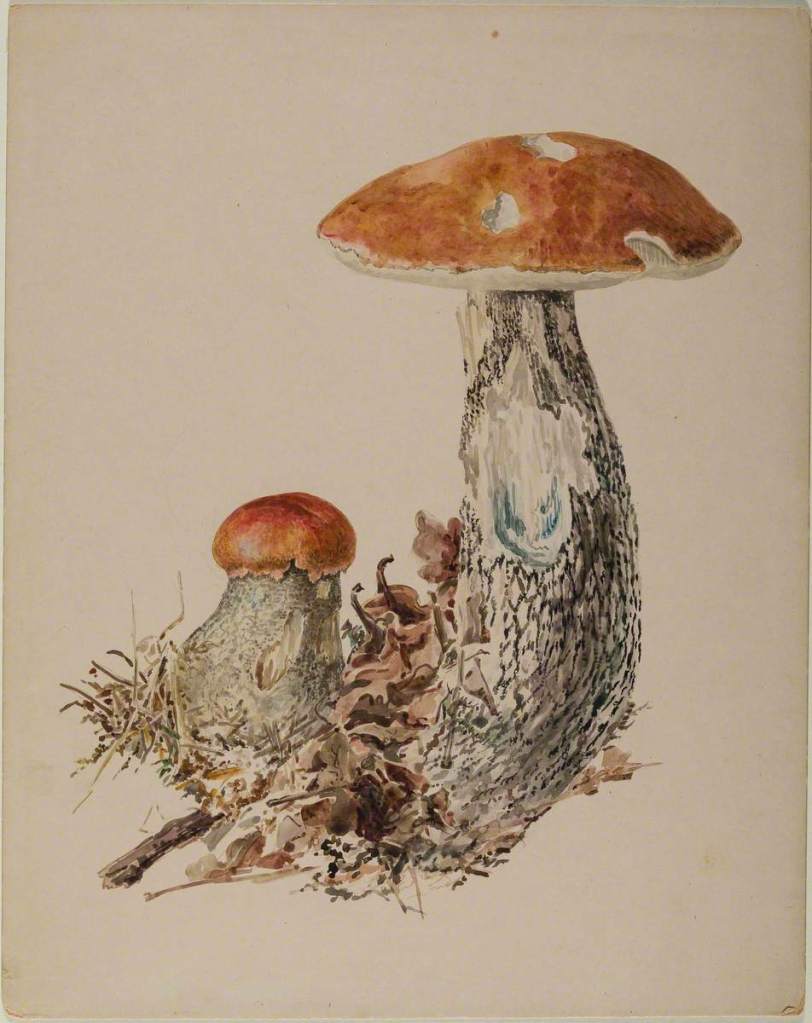
Beatrix Potter had a fascination with mushrooms and painted over 300 water colours of them; her detailed analysis of them was a starting point for her illustrations of nature and landscape in her books. It is suggested that interest in them is partly due to out of interest in the fragility of the natural world and wanting to connect ourselves to nature.

Potter, (Leccinum versipelle, 2022)

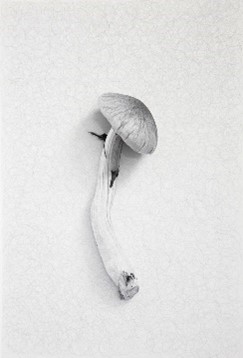
Annie Ratti’s series of overdrawn photographs are part of a larger body of work on psilocybe mushrooms, where she uses photography, drawing, installation, and text to explore their significance and how they grow in a rhizomatic way.

Psilocybin mushroom (The shroom project, 2022)

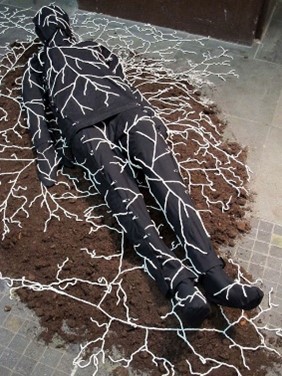
Jae Rhim Lee a Korean American artist, has designed an organic cotton, wood, and biomaterial burial suit, where she has sewn in mushroom spores to help a body decompose and deliver nutrients but not toxins to the environment.

Psilocybin mushroom (The shroom project, 2022)

The exhibition made me look at mushrooms in different ways as well as rethink their potential in areas from art to industry. It illustrates that the mushroom has become a figure of resilience, and points to new ways of living as humans become more disconnected from the natural world.

References:

Catterall, C. and Gavin, F. (2019) Mushrooms: The Art, Design and Future of Funghi. (s.l.): Somerset House Trust.

Hintz, C. (2016) Mushroom Death Suit: Funerals Go Fungal. At: https://www.cultofweird.com/death/mushroom-burial-suit/ (Accessed 04/03/2022).

Leccinum versipelle (2022) At: https://artuk.org/discover/artworks/leccinum-versipelle-312447 (Accessed 04/03/2022).

Mushrooms: The Art, Design and Future of Fungi (2019) At: https://www.somersethouse.org.uk/whats-on/mushrooms-art-design-and-future-fungi (Accessed 06/02/2022).

The Shroom Project (2022.) At: https://www.slashseconds.co.uk/annie-ratti/14/210/submission/the-shroom-project/ (Accessed 04/03/2022).

Further reading/research on mushrooms I’m yet to complete:

ECOLOGY WITHOUT NATURE (2022) At: http://ecologywithoutnature.blogspot.com/2011/04/david-reids-mushrooms.html (Accessed 10/03/2022).

Hall, S. et al. (2006) ‘Dr Derek Reid’ In: The Daily Telegraph 28/01/2006 At: https://www.telegraph.co.uk/news/obituaries/1508984/Dr-Derek-Reid.html (Accessed 10/03/2022).

Netflix (2020) Fantastic fungi. Director: Louie Schwartzberg Writer: Mark Munroe 2019.

Sheldrake, M. (2021) Entangled Life: How Fungi Make Our Worlds, Change Our Minds and Shape Our Futures. (s.l.): Vintage Penguin Random House.

Tsing, A. L. (2021) The Mushroom at the End of the World: On the Possibility of Life in Capitalist Ruins. (s.l.): Princeton University Press.

Weston, P. et al. (2021) ‘Why is it hard to get our head around fungi? (Part one) – podcast’ In: The Guardian 30/03/2021 At: http://www.theguardian.com/science/audio/2021/mar/30/why-is-it-hard-to-get-our-head-around-fungi-part-one-podcast (Accessed 26/10/2021).

Next post: https://nkssite6.photo.blog/category/research/reading/woodland-reading/lichen-ferns-and-moss/

BODY OF WORK RESEARCH: PART TWO GENRE DEVELOPMENT

TREES RESEARCH

A NOTE ON ANCIENT WOODLANDS:

Ancient woodlands are woods that have been continuously wooded for a minimum of 3-400 years (AD 1600 in England and Wales) and this is just half the lifespan of a large oak tree. Britain has lost almost half its ancient woodland since the 1930s, and it makes up only 2 % of British woodland. Ancient trees are recognised as exceptionally valuable, which may be due to their: size, age, condition, or biodiversity.

Ancient woodlands are temperate, not tropical rainforests but their biodiversity is as rich and there are less of them. These old trees provide great micro habits for other species, and the absence of disturbance here provides good habitats for rarer species. Ferns and mosses, species that need damp conditions can thrive on the woodland floor and on the bark of trees. Lichens are a good indicator of ancient woodlands due to their extremely slow growth and need for unpolluted environments. Fungi, usually invisible unless in fruit penetrate and then decompose rotting trees, whether standing or fallen, though mostly hidden are essential to the success and maintenance of ancient woodlands.

Podcast: The hidden language of trees with Suzanne Simard 14.5.21

Simard is a scientist, Professor of Forest Ecology at University of British Columbia. She wrote a PhD thesis and as researched tree connectivity and communication, and its impact on the health and biodiversity of forests (1997), written about in her book: Finding the Mother tree: uncovering the wisdom and intelligence of the forest (Simard, 2021).

  • Forests are not just natural resources, or commodity based, they have memories, wisdom, complex communities, web of fungi through the mother tree. A mother tree is the biggest oldest in the forest. They have vast root systems with old fungi networks which nurture the new seedlings and enhance their defence chemistry, which gets passed onto multiple generations- this is teaching the next generation how to survive.
  • Forests are complex systems showing, interconnectivity, diversity, clean air, hold water, resilient, transport systems.
  • Value the non-resource elements: Carbon, water biodiversity, rather than as a commodity.
  • There are parallels with the brain an example of a not a neurological network, but a biological neural network with conduits for transporting resources, glutamate, serotonin, synapses. When you map the networks in the forests they are constructed like neural networks with interlinked nodes and synapses (where exchanges happen), with glutamate moving throughout the network, these are highly evolved, resilient, efficient networks.
  • There is a symbiotic mutual relationship between fungi and trees mycorrhizal (which means fungal root) below ground network, trees provide the photosynthesis, the fungi provide nutrients from the soil – a physical connection. All trees form these relationships as they are essential for their fitness, whilst fungi rely on trees as they collect nutrients and water from the soil for the trees who provide the fungi with energy from photosynthesis.
  • Trees have a way of communicating, for instance communicating against threat with biological neural network.
  • Trees are also conduits for transporting resources. E.g., Douglas firs have been found to warn ponderous pine about injury and herbivores in the environment that are causing them to die back.
  • Climate change is adapted to and recorded in their seeds, if you destroy trees, you lose this adaptability record.
  • Don’t short circuit natural selection, as when planting conifer forests. Single species ae not resilience. Don’t isolate trees, use the connections between species, collaboration is important. Birch and Fir transport carbon back and forwards between themselves, the community is helping the individual – arboreal socialism? They compete but collaborate, are diverse and resilient forming productive community. Other species don’t grow in isolation, a society with dominant individuals would not succeed. Diversity is strength, and with this tree’s productivity and resilience increases. Single species are more open to destruction by disease, as you often get in cities.
  • Trees in old growth forests hold carbon that have accumulated for centuries. When cut two-thirds disappears into the atmosphere fairly immediately, not to mention the system below ground. This can’t be recaptured within the time we have left to change the course of climate change.
  • Need to increase old woodlands, rather than replant trees. Challenge consciousness and business models. In Monkswood in East Anglia, Wilderness plots were established (1960s), where a barley field was left next to ancient woodland and now has a variety of ancient species growing there – natural regeneration. Stop cutting down old growth forests. If encouraging recovery of old forest, leave oldest trees in place, take out smaller trees to boot strap the natural regeneration to make a healthy diverse eco system. As climate changes more rapidly than trees can adapt, evolve, and migrate, if they can’t achieve this they’ll die, so to help them to survive and hold carbon, we need to enable a mix of naturally regenerated seedlings to support migration by scaffolding to create a viable ecosystem. Naturally, regenerated trees are more successful than planted forests, they hold adaptations in their seeds.
  • Consumption: use alternatives or less. At least, use only second growth forest where losses have already been made and enhance them by leaving any older trees.

My reflections:

  • Forests are about connections, resilience.
  • Species don’t grow in isolation diversity is important for the strength of both individuals and communities, they compete but they collaborate, and resilience and productivity increases.
  • We should value forests by their true impact on our lives, for example producing water, carbon, clean air. Convert and preserve what we have left.

References:

Intelligence Squared (2021) The Hidden Language of Trees with Suzanne Simard (Subscribers only). At: https://www.youtube.com/watch?v=bIn4CWSjiEg (Accessed 01/03/2022).

Simard, S. (2021) Finding the Mother Tree: Discovering the Wisdom of the Forest. (s.l.): Penguin Books, Limited.

Other books that I will write about later:

Beresford-Kroeger, D. (2019) To Speak for the Trees: My Life’s Journey from Ancient Celtic Wisdom to a Healing Vision of the Forest. (s.l.): Random House of Canada.

Deacon, A., and V. D. A. (2020) For the Love of Trees. (s.l.): Black and White Publishing Limited.

Deakin, R. (2008) Wildwood: A Journey Through Trees. (s.l.): Penguin UK.

Geddes, L. and Finlay, M. (2021) ‘Unearthing the secret social lives of trees – podcast’ In: The Guardian 29/04/2021 At: http://www.theguardian.com/science/audio/2021/apr/29/unearthing-the-secret-social-lives-of-trees-podcast (Accessed 26/10/2021).

Next Post: https://nkssite6.photo.blog/category/research/reading/woodland-reading/fungi/