RESEARCH ON SIGNPOSTING
Ideas for text to signpost my BOW:
I viewed these works at the exhibition in progress at the RPS when I visited the Bristol Book Fair:
Laia Abril’s photography series Menstruation Myths
is part of In Progress on display at Royal Photographic Society during Bristol Photo Festival 24th October 2021.
This work, forms part of her larger body of work, A History of Misogyny, which includes topics such as rape, abortion, mass hysteria and femicide. The gallery text describes the work as an “unfixed and open ended narrative…weaving together both research and visual metaphors” to give an understanding of the politics and miseducation surrounding menstruation. She is known for her multidisciplinary work which is what particularly attracted me this work. Displayed on the wall below her photography were a variety of texts on the theme of menstruation:

Though I can’t clearly see the sources of her text, the variety that she has used has given me some further ideas on sources I could collect text about community from:
- Dictionary definitions
- Thesaurus synonyms
- Newspaper articles
Italian artist Alba Zari’s ongoing work Occult
reflects her search for an understanding of the Christian fundamentalist sect into which she was born, The Children of God. What interested me about the work was the mixed media that she used to present her work, The work draws on her family archive, other member archive images, texts, propaganda, and videos.

Her previous work “The Y- Research of Biological Father” (2019), her search for her biological father, similarly includes media such as paternity tests, created avatars, web documents, and self-portraits.
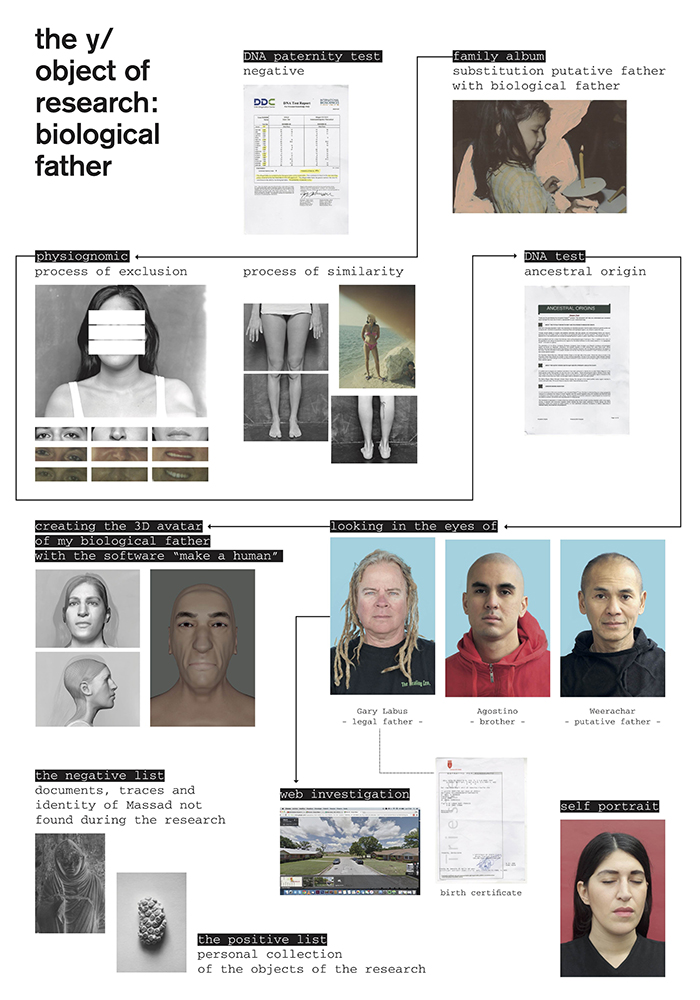
Zari shows how we can make our own pictures, with mind maps, diagrams, drawings, photographs, saying that there isn’t just one way to do research and even that making photographs is a kind of research in itself. Photography-based research might also include exploring archival material, from family albums, news pictures or historical images. However, she says that as photographers investigate, explore, compile, map, question, connect, interpret, gather, organise, interrogate, construct etc. and that making photographs becomes part of an extended process of discovery. Even that photographers make images to fill the void if information is missing, to help them imagine what does not already exist. She realises that how that research is presented can be very influential and may even disrupt normal expectations. (Royal Photographic Society, 2021).
Widline Cadet: Seremoni Disparisyon (Ritual [Dis]Appearance),
explores cultural identity, race, memory and immigration through photography, video, and installation with a series of self-portraits, featuring herself and friend posing as her with abstract landscapes constructed backgrounds.
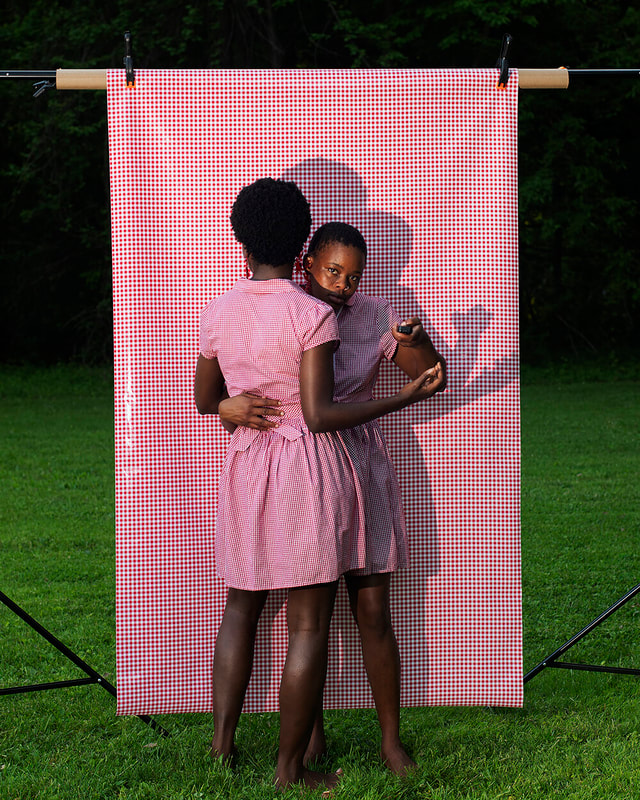
What particularly interested me was the way that she presented her research:

References:
Kynoch, G. (2021) Women photographers come together for Bristol Photo Festival with ‘In Progress’. At: https://hundredheroines.org/exhibition/women-photographers-come-together-for-bristol-photo-festival-with-in-progress/ (Accessed 28/12/2021).
Royal Photographic Society (2021) In Progress. At: https://www.photopedagogy.com/inprogress.html (Accessed 06/02/2022).
Winterthur, F. (2022) Occult. At: https://www.fotomuseum.ch/en/situations-post/occult/ (Accessed 06/02/2022).
Zari, A. (2022) albazari. At: https://albazari.info/ (Accessed 06/02/2022).
Wolfgang Tillmans research-based photography
Tillmans uses observation of his surroundings in an ongoing investigation of the photographic medium. He engages in this way to transform the world and so uses exhibition space for performing. Tillmans looks at the world with both curious and playful eyes and with his work gives new ways of viewing the world to viewers.
Studying truth with Wolfgang Tillmans
This installation includes Tillman sharing his views on the subject of truth and was on view at the Tate in 2017. Here he shares his reaction to the Iraq War and the presidency of George Bush, using various textual information, political texts, clippings, and erroneous everyday photographs. He was driven by the opinion that many global problems have been driven by false presentations of truth. “By combining a wide variety of mediums, he constructs a scenario that depicts and analyzes this tendency, while also, by extension, diagnoses it” (The Art Story, 2021).
It showcases Tilman’s work using tabletops as an alternative way to examine the present day. He was interested in statements made by people and groups worldwide that their viewpoint was only the truth. This work Truth Study center project where photographs, and clippings from documents are displayed in deliberate, and possibly provocative juxtapositions, reflects the way they come to viewers in print and online. The articles also bring attention to gaps in knowledge, or doubtful areas.
Below is an example of his project truth study center (2005–ongoing), which displays photographs, articles, objects, and drawings that present differing versions of ‘truth’.

It is an innovative way to question what is real. The installation also shares a brief audio clip of his views on truth. He has previously exhibited installations of taped prints and pinned magazine spreads. His mixture of mediums is interesting. Does this enlarge opportunities for viewers to participate and form their own conclusions, I wonder?
His photography does increase our attentiveness of the world around us, so that we see things differently and take less for granted.
“that my images are random and everyday when they are actually neither. They are, in fact, the opposite. They are calls to attentiveness.” This image reminds us to be present in our relationship with the world; the strongest moments are actually a strange mix of the sensual and the surreal, and often subtly political.
References:
Tate (2022) Studying truth with Wolfgang Tillmans. At: https://www.tate.org.uk/whats-on/tate-modern/exhibition/wolfgang-tillmans-2017/studying-truth (Accessed 17/01/2022).
The Art Story (2021) Wolfgang Tilmans. At: https://www.theartstory.org/artist/tillmans-wolfgang/ (Accessed 24/01/2022).
There are others that I could research:
Hamish Fulton: A walking artist with his own text, but this doesn’t seem relevant to me.
Barbara Kruger who works with photos and collaged text. However her work doesn’t seem relevant to me at this point.
Next post: https://nkssite6.photo.blog/category/reflective-journal/hangouts/bow-hangout-summaries-to-15-3-22/
 NIKI SOUTH