PHOTOGRAPHERS WORKING WITH SIMILAR SUBJECTS
TREES
Ellie Davies works with UK forests, particularly in the south of England, exploring the relationship between the landscape and individuals. She talks of the cultural backdrop of human processes in the woodlands, symbols of folklore, fairy tale, magic, and myth, as well as psychological states such as the unconscious. She engages in the landscape with a variety of strategies:
“making and building using found materials, creating pools of light on the forest floor, using craft materials such as paint and wool, introducing starscapes taken by the Hubble Telescope or glittering light from the surface of the sea.”
Her final images are the outcome of these interventions and alterations to the landscape, and she says reflects her personal relationship with the forest, she says she, “walks, thinks, sits, listens then creates.” I can identify with this. These outcomes are she says a reflection of her relationship with the forest, her meditations on what she calls universal themes and the concept of landscape as a social and cultural construct – a visual experience.
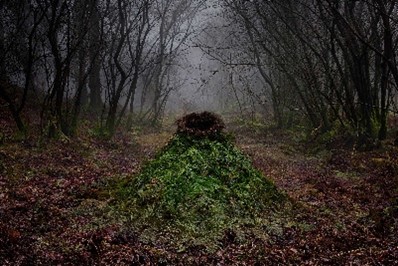


Davies mentions that she was inspired by the Twilight photography in the Magic Hour (2006), which explored twilight and I can see the influence in her work. In a Lens culture video (2015) she explains how in her photography she tries to explain the atmosphere in the woods, and the effect on you, to give the viewer a fresh look at landscapes, and enable them to interact with the landscape. She puts something of herself in the space, with the woodland as a backdrop, with a “light touch.” The landscape is the subject, and the intervention mustn’t take over, or leave an impact on the woodland.
Reflection
This research underlines my feelings about using photography the landscape to share the sensations and the effect on myself. But also, my search to try to ensure that what I want to say can be seen in my images. I could experiment with some construction in the landscape with, wool, flour, or organic paints but at this stage I would hope not to.
References:
Davies, E. (2016) Ellie Davies. At: https://elliedavies.co.uk/statement/ (Accessed 07/02/2022).
LensCulture (2015) Ellie Davies. At: https://vimeo.com/125002260 (Accessed 07/02/2022).
Smith, B. (2020) A Small Voice Podcast – 122 – Ellie Davies. At: https://bensmithphoto.com/asmallvoice/ellie-davies (Accessed 07/02/2022).
AMONG THE TREES EXHIBITION AT THE HAYWARD GALLERY (2020)
This exhibition showed how artists over the last 50 years have made works relating to trees. As trees live much longer than us, we can see our impact on them and how they act on us and our imaginations. The exhibition shows how entwined human culture is with tree culture. It brought together artworks that encourage us to think about trees and forests in diverse ways:
“Trees are stunningly complex and often visually confounding” (Hayward, 2020) and the artists in this exhibition highlight this to engage us in an exploratory process of looking. By subverting traditional images of the natural world helps us to see afresh. This is a multimedia exhibition, and the modern work helps to avoid the way traditional images may invite us “to get lost, and to experience – on some level – that uncanny thrill of momentarily losing our way in a forest and seeing our surroundings with fresh eyes” (Hayward, 2020).
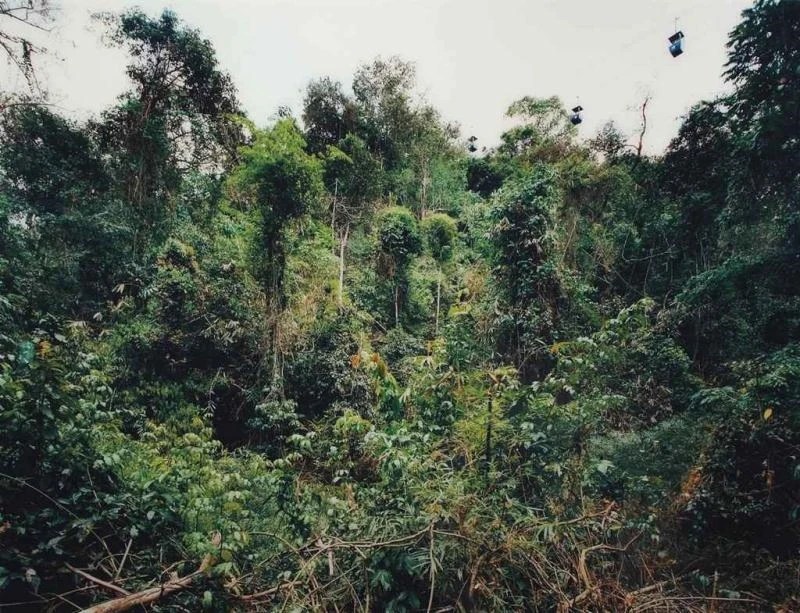
Thomas Struth has photographed forests and jungles around the world. He made this series after observing the trees in the garden of his Düsseldorf flat, after seeing the dense network of branches he thought to make pictures so full of information that they might encourage us to abandon our analytical tools, and ‘surrender to just looking.’ The images in this series, New Pictures from Paradise (1998–2007) all have a decentralised composition, with no single focus point, and no clearly defined foreground or background encouraging our eyes to wander across the image to both take in and get lost in the amount of detail.
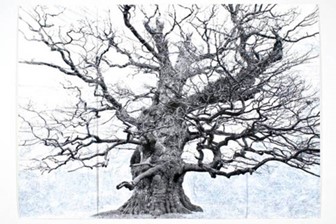
Tacita Dean’s, Majesty (2006) Crowhurst II, is one of a series of ‘painted trees’ that the artist began in 2005. It was made from a black and white photograph that Dean took of one of the oldest complete oak trees in England, which she greatly enlarged and printed on four overlapping sections of fibre-based paper. She then overlay the area surrounding the image with a gouache brushwork that partially obscures the surrounding wood to isolate the structure and form; this draws your eye to the silhouette, the tree, and its personality. Some of the branches of this tree have been propped up with crutch-like supports. Dean combines ideas driven by research with chance, accident, and coincidence.
Dean created also made a series of Deformed Trees (2005) by painting over the background, and sometimes also the foreground, of old black and white postcards depicting trees.
Rodney Graham began his series of ‘inverted tree’ photographs in the late 1980s. This photograph of a ‘Garry oak’ (native to the Pacific Northwest), was taken in British Columbia, Canada. The series grew from his earlier project, where he used a camera obscura opposite a lone tree where visitors encountered the inverted image of the tree projected on a far wall. Graham describes this as a way to talk about ‘man’s skewed experience of nature.’ In a different way to Ellie Davies Graham is again giving us a way to look again at something familiar – this time by turning it upside down. He says, ‘It’s always disturbing to look at something upside down,’ (Hayward gallery, artist notes (2020). Rodney was influenced by the artist’s work below.

Robert Smithson photographed an upside tree in a different manner, in reality the tree was upside down. He photographed a series of three Upside Down Trees as he travelled from New York to the Yucatán peninsula (Mexico) via Florida; one in in Alfred, New York; the second in Captiva Island, Florida, and the third in Yucatán, Mexico. Each time he removed the branches from a young tree, and replanted it, root-side up. By doing this he has drawn attention to the structural similarity of a tree’s branch and root system. Smithson’s action “challenges our anthropomorphic tendency to identify with the vertical stature of trees” (Hayward, 2020). Alongside Davies and Graham, Smithson calls for an examination of what is.

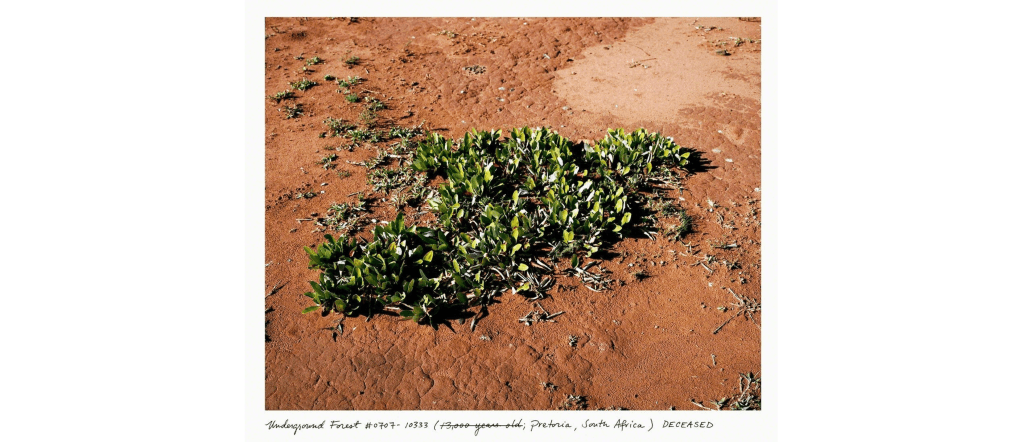
I came across the work of Rachel Sussman when I saw her photograph Underground Forest #0707-1333. This is actually the top of a tree that is 13,000 years old, growing underground in South Africa. These trees have possibly migrated underground to escape forest fires.
(Artsy.net, 2022)
My research led me to discover that Sussman has written a book The oldest living things in the world. She focuses on organisms over two thousand years old such as this llereta a distant relative of carrots and this slow growing lichen (1 cm per one hundred years). It is the oddity of these organisms rather than her photography that is arresting, it’s the subjects themselves that are captivating; that said there is still a familiar theme here, that of focusing on something natural that stops you and makes you look hard. There is a poignant quote by Susan Sontag in Sussman’s book “All photographs are memento mori. To take a photograph is to participate in another person’s (or thing’s) mortality, vulnerability, mutability. Precisely by slicing out this moment and freezing it, all photographs testify to time’s relentless melt”


(Design Observer, 2022)
In the exhibition some artists like Sussman explore the relationship between trees and time passing, seasonal changes, rings, as Sontag says “memento mori.” I would like to explore how trees might teach us some ways forwards; how I have yet to discover.
What I take away from this exhibition’s treatment of trees is the value of finding ways to encourage viewers to look hard or differently at the subject.
References:
Artsy Net (2022) Rodney Graham. At: https://www.artsy.net/artwork/rodney-graham-gary-oak-galiano-island-1 (Accessed 11/02/2022).
Design Observer (2022) The Oldest Living Things In the World. At: https://designobserver.com/feature/the-oldest-living-things-in-the-world/38462 (Accessed 11/02/2022).
Hayward gallery (2020) Among the Trees large print Exhibition guide. At: https://www.southbankcentre.co.uk/whats-on/art-exhibitions/among-the-trees?tab=exhibition-guide-large-print- (Accessed 08/02/2022).
Holt Smithson Foundation (2022) Upside Down Tree II. At: https://holtsmithsonfoundation.org/upside-down-tree-ii (Accessed 11/02/2022).
Rachel Sussman. At: https://www.artsy.net/artwork/rachel-sussman-underground-forest-number-0707-10333-13000-years-old-pretoria-south-africa-deceased (Accessed 11/02/2022).
Tate (2022) ‘Majesty’, Tacita Dean, 2006. At: https://www.tate.org.uk/art/artworks/dean-majesty-t12805 (Accessed 08/02/2022).
Thomas Struth (2022) At: https://www.mutualart.com/Artwork/Paradise-11/10A559DE5A47C094 (Accessed 08/02/2022).
Westall, M. (2010) Tate Announces Tacita Dean to Undertake Next Commission in The Unilever Series. At: https://fadmagazine.com/2010/12/16/tate-announces-tacita-dean-to-undertake-next-commission-in-the-unilever-series/ (Accessed 08/02/2022).
I ALSO RESEARCHED CONSTRUCTED LANDSCAPE WORK:
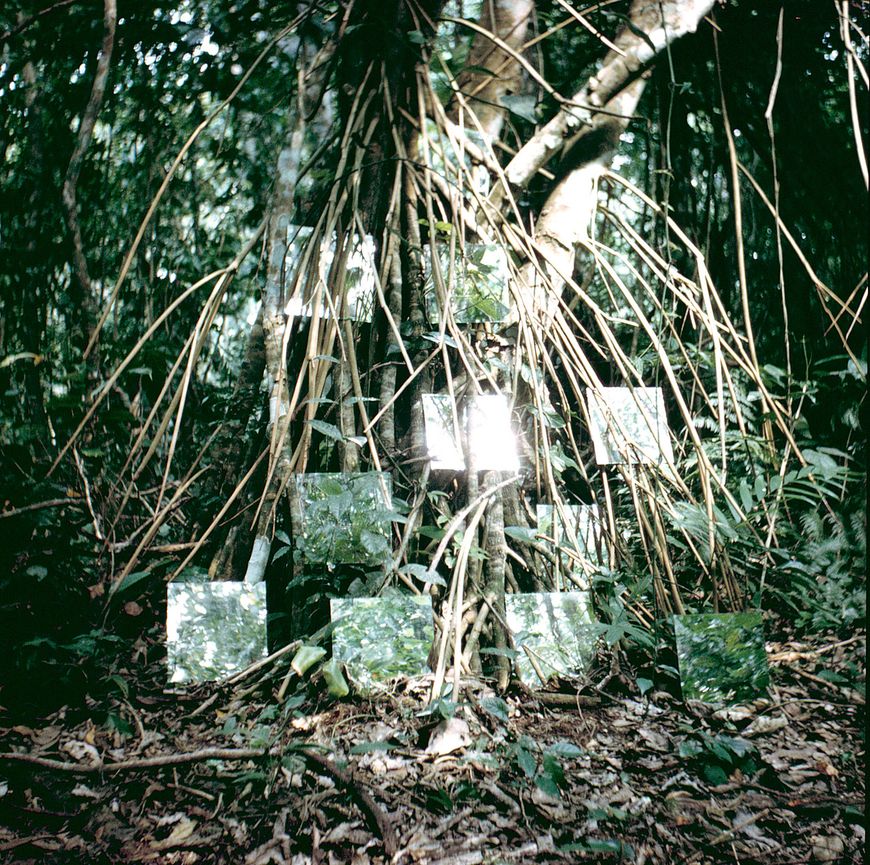
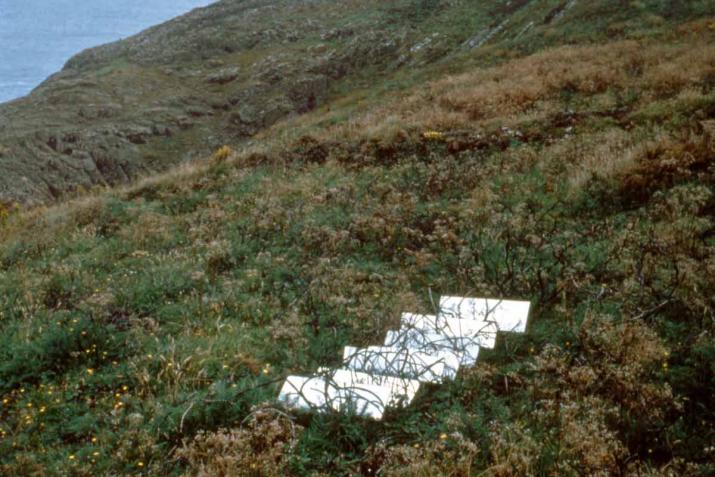
Robert Smithson’s Yucatan Mirror displacements (1-9) 1969.
I have mentioned Smithson’s work “Upside down” previously. He is best known for his earthworks and yet his interests were broad. He produced paintings, drawings, sculptures, architectural schemes, films, photographs, writings, as well as earthworks. He explored the conceptual and physical boundaries of landscape and his work encouraged viewers to ask questions.
In this work he installed 12-inch square mirrors on dispersed sites, resulting in nine photographs. The mirrors refracted as well as reflected their environments, “displacing the solidarity of the landscape and shattering its forms” (Guggenheim, 2022). It has been suggested that the mirror records the passage of time, though that I don’t understand, and the photograph suspends time, this I do understand.
Noemie Goudal’s
photograph Les Amants (Cascade, 2009), depicts a waterfall made from plastic draped through a woodland setting, the natural and the manmade placed together, organic and synthetic which are generally in opposition. Nature is important I her work and here she is playing with our visual senses and ability to process, which Alexander describes as “a parody of what we would expect in a landscape” (Alexander, 2015:58). Goudal is subverting the picturesque but showing that in postmodern work nature and culture need not be in opposition to each other. This image sits easier with me that Smithson’s Mirror displacements,

I don’t feel that constructed work is for me right now, but I will reconsider it if necessary to share my message.
References:
Alexander, J. P. (2015) Perspectives on Place: Theory and Practice in Landscape Photography. London: Bloomsbury Publishing.
Guggenheim (2022) Yucatan Mirror Displacements (1–9). At: https://www.guggenheim.org/artwork/5322 (Accessed 12/02/2022).
Holt Smithson Foundation (2022) Photo and Slideworks. At: https://holtsmithsonfoundation.org/artworks-robert-smithson/photo-and-slideworks (Accessed 12/02/2022).
Saatchi gallery (2022) Noémie Goudal. At: https://www.saatchigallery.com/artist/noemie_goudal (Accessed 12/02/2022).
Next post: https://nkssite6.photo.blog/category/research/bow-research/text-signposting/
 NIKI SOUTH