CONTEXTUAL STUDIES SOUNDBITES FROM TUTOR LED HANGOUTS

L3 Study group with Ariadne Xenou 31/5/22

How does the literature review relate to the dissertation?

  • Articulation of process
  • Reflections are important
  • A snapshot of the discourse
  • In depth summary of no more than 20 sources
  • Not going too far down  a road, the dissertation is for detail.
  • Question anything no longer relevant when you write your dissertation

Writing:

  • Articulating means we own it & articulation is discovery
  • The importance of resources will change as we write- flexibility is important
  • Dissertation for balance can put the research method/ methodology at the beginning, but only what the reader needs to know.
  • Footnotes for not required but interesting

Audiences: Tutor- Academics/peers/other photographers -Authors of the sources – imagine internal dialogues with them

Copyright and use of images: If they are part of the public domain you don’t need to get permission to use them on your blog.

L3 Study group with Ariadne Xenou 26/6/22

Ideas from Anna Sellen: http://www.annanas.co.uk/

Padlet use for keeping track of work, thoughts and research

Chop up written dissertation to edit as we do with photo sequencing

Ideas from Helen Rosemier: https://helenrosemierphotography.co.uk/

Showed how her work I CS followed into BOW, allowing an intellectual connection with BOW

L3 Study group with Ariadne Xenou 25/7/22

Learning objectives: Use to stay on track, or change track as the evidence changes, or find the missing bits of evidence. See post

L3 Study group 29/8/22

How to turn Los into questions to work with.

L3 Study group 26/9/22 – lost notes!

L3 Study group 31/10/22

We discussed how to mesh BOW and CS. I explained that I find it difficult to work on them both concurrently however They are both in my minds when working practically on either. My BOW is an exploration of ideas that I have arrived at through my CS study, research and writing, whilst my CS is fed by my photographic exploration of CS methodologies.

Ariadne pointed out that they don’t need to mirror each other , they contextualise and offer support to each other. But they should stand on their own.

Next post: https://nkssite6.photo.blog/category/contextual-studies/c-s-assignments/cs-assignment-3/cs-ass-3-learning-log/

TUTOR LED GROUPWORK ONLINE: ARIADNE XENOU

CONTEXTUAL STUDIES AND BODY OF WORK

31.10.22

Q: How do you mesh BOW and CS? we concluded that most of us began working them together but later tended to work them at separate periods.

CS doesnt have to mirror BOW. They contextualise each other offering context and support. You shouldn’t have to read them together to understand them individually.

29.8.22

We shared how we had turned the learning outcomes into questions. These are mine:

CS: Learning outcomes Turned into questions

LO1 undertaken research and study demonstrating comprehensive knowledge of your area of specialisation and built a theoretical framework for your creative practice.

Q: Have I researched and studied my specialisation and demonstrated a comprehensive knowledge?

Q: Have I built a theoretical framework for my creative practice?

LO2 synthesised and articulated your critical, contextual and conceptual knowledge and understanding into a coherent critique of advanced academic standard.

Q: Have I pulled together research and written using evidence?

Q: Have I referred to my BOW contextualising practise and theory?

Q: Have I evidenced in writing my concept thoroughly and how broader concepts have fed into this?

LO3 applied your own criteria of judgement, reviewed, criticised and taken responsibility for your own work with minimum guidance.

Q: Have I reviewed, judged, and critiqued myself?

LO4 selected and applied information management skills and used appropriate technology in the production of an accomplished critique with minimal supervision.

Q: Have I used information management skills and technology?

Q: Have I produced a good critique myself?

BOW: Learning outcomes

LO1 produce convincing visual products that communicate your intentions, using accomplished techniques in complex and unfamiliar environments, with minimal supervision from your tutor.

Q: Have I produced a convincing visual product?

Q: Have I communicated my intentions?

Q: Have I used accomplished techniques?

Q: the above in complex and unfamiliar environments?

LO2 demonstrate comprehensive knowledge of your area of specialisation and be able to situate your own work within a larger context of practice in your field.

Q: Have I shown comprehensive knowledge in my area?

Q: Have I placed my work in the context of practise in my field?

LO3 transform abstract concepts and ideas into rich narratives and integrate them in your images.

Q: Have I transformed abstract concepts and ideas?

Q: Have I created rich narratives? Are they integrated into my images?

LO4 critically review your own work and evaluate it against desired outcomes.

Q: Have I critically reviewed my work?

Q: Have I evaluated it against learning outcomes?

LO5 demonstrate management, leadership and communication skills and have deployed them during the negotiation and production of the final body of work with your tutor and third parties.

Q: Have I shown management, and communication skills.

Q: Have I used these when discussing with my Tutor, and others?

Alexander, J. (2013) Contextual Studies. Barnsley: Open College of the Arts.

25.7.22

Discussion on previous session which I missed which showcased Anna and Helen’s work – I must watch the recording.

Comments were particularly about the visual impact of the work and that their self-reflection was also presented visually which was good. Remember the assessors are visual as well.

Their work showed their commitment and how they entwined BOW and CS.

Learning Objectives:

Q: why do we have Los? Suggested to work against LO’s so that you stay on track and understand the expectations of the units

Engage with the level, context, and quality of the work at each stage every time you submit – this gives you the opportunity to achieve your best. It helps to keep you coming back to the bigger picture.

To find your research question you first need to decide on your subject (broad) which may change when you find evidence.

You need to be able to articulate your work in terms of LO’s. Articulate how you’re fulfilling the LO’s because it will change, and will help you to find evidence of how you have fulfilled the LO’s. 

LO’s force you to change perspective on your work – find your niche, find the missing bits and evidence

Makes you think how your project/research does this – do it regularly. Reflecting on LO’s enable you to undertake reflective learning and to write your self-reflection at the end.

Evidence in Research, essay, self reflection.

LO example: Synthesized and articulated your critical contextual and conceptual Knowledge and understanding into a critique of advanced academic standards. Coherent (in assessment criteria)

Key words:

  • Synthesise- pull together from research cross pollinated ideas- something that led me to write the dissertation but isn’t explicitly in it. So maybe in a reflective commentary, could photograph evidence in docs of evidence used. But need to be showing them process, so some elaboration is needed. Choose evidence that is straightforward then it’s evident
  • Articulate- shown by writing in order
  • Critical – forming judgement with evidence
  • Contextual Referring to BOW showing assessor how you’ve done it contextualising practise and theory
  • Conceptual- that you’ve fulfilled a broad idea and taken other concepts
  • Knowledge and understanding: anything above falls under understanding – so showcase the above and the rigour and thoroughness of your concept.

3 or 4 per LO but could do more Find in assessment and the module

Break them down and consider these learning outcomes as questions. Turn them into critical direct questions that you can pose to yourself. How have I? Ask How did I review critique…take responsibility for my work…undertake research that demonstrates…     Target your area of specialisation.

Theoretical framework is found in academic arguments and creative practice. How did I build a theoretical framework for my creative practise – showcase how my creative practise and my contextual topic relate BOW & CS.

NB. Proposals easier to write when you’ve finished a project

For next time:

Turn your Learning outcomes into direct questions. If they are cumbersome, break them down into more than one question.
Locate the keywords that allow you to turn abstract sentences into tangible guidance.
Consider how your topic and research relate to each learning outcome.
Articulate this as an answer to each of the questions (LOs).
Consider what evidence you could submit to prove your articulated answers.

31.5.22

Q: How to fit your literature review to your dissertation? Can adjust your literature review later or simply write a reflective piece explaining why the dissertation and literature review have ultimately differed. The importance of resources will change.

When writing articulation means that we own our thoughts, articulation is discovery.

When including research methodologies in the dissertation think about what the reader needs to know- how much or how little?

Audience needs to understand your work although the work is aimed at the theoretical audience the ultimate authors are the sources in your work. Have theoretical debates with your sources.

25.4.21

This was a general, Q&A session.

Q: How to decide what to cut out from your work to meet a word count.

  • Be concise- eradicate the imprecise
  • Take out repetition
  • Move some info to footnotes
  • Be especially precise in introductions and conclusions, Only 5-6 sentences each. The first and the  last sentences are particularly important and should echo each other

Remember the literature review can morph, as long as you explain your reasoning. Later Q: so how would I rewrite? Completely? Or as a comment on?

My question: How do I stop researching and write my literature review?

A: The literature review is the framework to form my argument – to form the context. In order to avoid self plagiarism need to reformulate later.

  • Ask what do I really need for this?
  • What would I need to include if explaining to someone else
  • Keep to the essentials – it is important to analysis to the full potential
  • Analyse the most important blocks I need – 4-5 sources only

My question: If the literature review is to form the theoretical framework for my argument do I only use theorists/philosophers?  Ie; not those who critique the work of my chosen photographers?

A:

  • Ask how important is their work to the topic?
  • Do they argue about the photographers work or the central arguments?
  • If semiology is important it would be daft not to include Barthes

Other tips on sources:

  • Download books to google books as PDFs.
  • Use google scholar
  • Get articles sent by local libraries????

28.3.22

Discussions on literature reviews

  • It’s an abstract concept which should not be rigid, it should allow you to change direction, it’s just a step in the research
  • Though it might not seem immediately relevant it is about the journey rather than the output
  • Treat it as a theoretical framework to return to
  • It is relevant to everything we do including BOW – could theoretically do one for BOW
  • Helps you to synthesis things that are relevant and not so relevant and to synthesis them
  • Helps you to find and make links in your own work

Q to those who’ve finished it: How has the lit review developed in your dissertation drafts?

  • It gives a structure
  • Keeps you on track

Q: How can you work out what is relevant in your research?

  • Tutor guidance – so I should seek this now
  • Look at potential sources
  • Abstracts, summaries, tables of contents, introductions

Best if the literature review has some uniformity:

  • Relate the sources to each other
  • Firstly, discuss them source by source but then connect them together to make a theoretical framework

How to open up more sources?

  • Find and make links in your work and research

Dissertation: 500 words inc quotes

  • Is for your interpretation of others theories, where you find links, to show your perspective.
  • Paraphrasing is better than quoting as you are then filtering and showing your understanding

Footnotes

  • Put in the text definitions, elaborations that our text cant do without
  • Put in footnotes that which isn’t intrinsic but could help a reader understand better- that which is helpful. Clarity and guidance that is beneficial but not needed, eg. recommending sources not embedded in our sources, to show wider reading.

Next time I should ask for support on finding texts, sources, libraries.

28.2.22

Much of this session was around being “stuck” and how to move on.

Learning points for me were:

  • Consider why what I am working on fascinates me?
  • Why does what I’m reading fascinate me?
  • Don’t be too focused on the outcome at the beginning
  • Follow the tracks (continuing on from the last tutorial on Ginsberg, before they grow cold, or you lose the trail
  • Ensure I’m keeping bibliography list – extract from paper pile
  • When reading think/visualise my practical work and when photographing think about my writing

Next time ask about theories of realisim? Garry interested in?

Can an artist represent something of themselves in a place?

31.1.22

We began with a Q & A session which was useful:

Matt Q: In the Lit review and dissertation proposal, what is the normal number of photographers to use? Ariadne: Less is more, with analysis, we are not here to provide lists but contextual analysis, ask how many do you need to contextualise your work? Think why are they there, and why have you chosen them, use 4-5 maximum. The Lit review should be a clear, in depth review of my literature, to contextualise my thoughts; but you will read more than you’ll summarise in your lit review. The lit review should be the backbone of my contextual framework, texts that my argument can’t do without, interrelationship, extrapolation – be brutal to get depth.

Sue Q: If you change track should you revise your lit review? Ariadne: moving away from the lit review will show development of research, so no. For final assessment interlink your lit review and your final thoughts explaining why you moved away from it. Or develop also a final lit review, but then you would need to cover in your presentation as the assessor may not have time to read it – a summary of the core lit underpinning my dissertation.

Lit review advice: https://advice.writing.utoronto.ca/types-of-writing/book-review/ and https://advice.writing.utoronto.ca/types-of-writing/literature-review/ These are very useful

Catherine Q: Referencing? Referencing a bibliography alphabetically doesn’t show which sources were the most important. Could we do a reflection on this bibliography as we don’t have many words?

Ariadne: Yes you could do a primary, secondary and tertiary sources bibliography in alphabetical order, but suggests avoid separating these types of sources.

Holly Q: A bibliography just helps you see where the reference sources have come from? What about footnotes? Ariadne: everything relevant about your argument should be in essay, that that informs your essay should be in footnotes, everything else should be omitted. Your bibliography may lead you elsewhere in he future.

Rob Q: How to narrow a topic down? Lynda says the reading, keep reading for your “ahha” moment. Ariadne agrees. Susan ahha moment came from the body of work.

Ariadne: Ahha moments come when you don’t expect them so have a notebook with you.

Ariadne says ask why are you photographing what you are in your BOW? You’re not trying to explain your BOW in your CS, but just contextualising it?

Ariadne set out before the session what we would cover, a discussion on methodologies; a topic suitable for all stages of research and all models of level 3. We were asked to watch the video interview below and to consider the notions of clues, evidence and hunters as well as the definition of microhistories in relation to a methodological approach to L3 theory and practice.

The Hunter’s Evidence: Carlo Ginzburg

Carlo Ginzburg & David Kutcher anthropologist

In “The Hunter’s Evidence” Carlo Ginzburg used the Stone Age hunter as his intellectual metaphor, He said the hunter could look for evidence as he wasn’t hindered by other things:

“Man has been a hunter for thousands of years. In the course of countless chases he learned to reconstruct the shapes and movements of his invisible prey from tracks on the ground, broken branches, excrement, tufts of hair, entangled feathers, stagnating odors. He learned to sniff out, record, interpret, and classify such infinitesimal traces as trails of spittle. He learned how to execute complex mental operations with lightning speed, in the depth of a forest or in a prairie with its hidden dangers…The hunter would have been the first ‘to tell a story because he alone was able to read, in the silent, nearly imperceptible tracks left by his prey, a coherent sequence of events…What may be the oldest act in the intellectual history of the human race [is] the hunter squatting on the ground, studying the tracks of his quarry”.

My notes and our discussion on the above:

Micro histories is the unfolding of small events into larger information clues, putting things under a microscope, and magnifying things in such detail that we see grand narrative. It is the analytical element, which is crucial. Ginzburg also relates micro histories as being about generalisations, but using analytical methods, a methodology to make sense of fragments of evidence. He also described it as a method for finding the relationship between the written and visual world.

This was described by Ariadne as “Grand narratives through small case studies”.

Ariadne: “Research is about sniffing out our prey, so that we can tell a compelling story, as researchers we have to be hunters”.

But where should we look for the best evidence, and reconfigure our scopes to find it? The ahha” moment which is unpredictable which can lead to something larger. However interesting a piece of evidence may be, we don’t know where the evidence will lead us. The larger relevance may not be immediately visible. Ariadne suggests even if it’s a tiny thing, collect it and it may make more sense later.

In Ginzburg’s essay “Clues,” in Myths, Emblems, Clues (1990), he gives 3 models of micro historians, Sherlock Holmes (detective), Sigmund Freud (uses semiotics in a medical sense) and Giovanni Morelli (19th Century art historian). The trick, as Freud put it, is to divine “secret and concealed things from unconsidered or unnoticed details, from the rubbish heap, as it were, of our observations.” He is thereby suggesting, detective, medical and historical methods of looking for minor details. Ginzburg says the skill is “the flexible and rigorous insight of a lover or a horse trader or a card shark.” To deduce from evidence he also gives analogies of the flexible and rigorous eye/experience of the lover (the relationship between two lovers), the card shark (eg the hesitation in a card game- a silence). I think he is talking about intuition.

What Ginzburg is teaching is a way of looking at the world right around us.

Ariadne pointed out not to assume your narrative is evident in the evidence, the fragments that you have pieced together.

References:

The Hunter’s Evidence: Carlo Ginzburg (2022) At: https://radioopensource.org/the-hunters-evidence-carlo-ginzburg/ (Accessed 31/01/2022).

Ginzburg, C. (1990) ‘Myths, Emblems, Clues, trans’ In: John and Anne C. Tedeschi, London: Hutchinson Radius

29.11.21

Old course model and new model: New is research unit 1st, then practical: 1 year each.

Course

Research and ideas for CS & BOW are different but may overlap. CS is not for explaining our visual work with the theory but the 2 do come together and the end result should be bigger than the sum of its parts.

Level 3 is about your passion and interests, must be sustainable.

  • Anna talked about changing her topic but Ariadne said it was only a “hange of prism”, where the research led her down a different route, and that this is the correct approach:

The wild goose chase is not about the goose, its about the chase” Ariadne

Consider-redefine- reconsider- redefine

  • We articulate better visually when we articulate in writing and vice versa, the two aid each other. Articulation is needed to open the next door.
  • Research helps you to work out where your work fits into the photographic world, and eventually you won’t differentiate between your practical and academic work.
  • Ariadne: Talk about your ideas, your methodology, challenges…
  • Ariadne: Pinpoint areas of academic areas that you need help with- vocalise on the forum.

I shared my experience about being hesitant to write, Ariadne did say get on with writing; ask why something interests me, what overlaps, document your journey. I should also diary key words and how one idea leads onto another.

Me: Landscape as a visual metaphor for community. Different ways of seeing, perception, and responding.

What is ontology in simple terms?

In brief, ontology, as a branch of philosophy, is the science of what is, of the kinds and structures of objects. In simple terms, ontology seeks the classification and explanation of entities. … Ontology concerns claims about the nature of being and existence.

Liminality ia state of transition between one stage and the next, especially between major stages in one’s life or during a rite of passage. … In a general sense, liminality is an in-between period, typically marked by uncertainty.

I am in a state of liminality!

31.1.22

We began with a Q & A session which was useful:

Matt Q: In the Lit review and dissertation proposal, what is the normal number of photographers to use? Ariadne: Less is more, with analysis, we are not here to provide lists but contextual analysis, ask how many do you need to contextualise your work? Think why are they there, and why have you chosen them, use 4-5 maximum. The Lit review should be a clear, in depth review of my literature, to contextualise my thoughts; but you will read more than you’ll summarise in your lit review. The lit review should be the backbone of my contextual framework, texts that my argument can’t do without, interrelationship, extrapolation – be brutal to get depth.

Sue Q: If you change track should you revise your lit review? Ariadne: moving away from the lit review will show development of research, so no. For final assessment interlink your lit review and your final thoughts explaining why you moved away from it. Or develop also a final lit review, but then you would need to cover in your presentation as the assessor may not have time to read it – a summary of the core lit underpinning my dissertation.

Lit review advice: https://advice.writing.utoronto.ca/types-of-writing/book-review/ and https://advice.writing.utoronto.ca/types-of-writing/literature-review/ These are very useful

Catherine Q: Referencing? Referencing a bibliography alphabetically doesn’t show which sources were the most important. Could we do a reflection on this bibliography as we don’t have many words?

Ariadne: Yes you could do a primary, secondary and tertiary sources bibliography in alphabetical order, but suggests avoid separating these types of sources.

Holly Q: A bibliography just helps you see where the reference sources have come from? What about footnotes? Ariadne: everything relevant about your argument should be in essay, that that informs your essay should be in footnotes, everything else should be omitted. Your bibliography may lead you elsewhere in he future.

Rob Q: How to narrow a topic down? Lynda says the reading, keep reading for your “ahha” moment. Ariadne agrees. Susan ahha moment came from the body of work.

Ariadne: Ahha moments come when you don’t expect them so have a notebook with you.

Ariadne says ask why are you photographing what you are in your BOW? You’re not trying to explain your BOW in your CS, but just contextualising it?

Ariadne set out before the session what we would cover, a discussion on methodologies; a topic suitable for all stages of research and all models of level 3. We were asked to watch the video interview below and to consider the notions of clues, evidence and hunters as well as the definition of microhistories in relation to a methodological approach to L3 theory and practice.

The Hunter’s Evidence: Carlo Ginzburg

Carlo Ginzburg & David Kutcher anthropologist

In “The Hunter’s Evidence” Carlo Ginzburg used the Stone Age hunter as his intellectual metaphor, He said the hunter could look for evidence as he wasn’t hindered by other things:

“Man has been a hunter for thousands of years. In the course of countless chases he learned to reconstruct the shapes and movements of his invisible prey from tracks on the ground, broken branches, excrement, tufts of hair, entangled feathers, stagnating odors. He learned to sniff out, record, interpret, and classify such infinitesimal traces as trails of spittle. He learned how to execute complex mental operations with lightning speed, in the depth of a forest or in a prairie with its hidden dangers…The hunter would have been the first ‘to tell a story because he alone was able to read, in the silent, nearly imperceptible tracks left by his prey, a coherent sequence of events…What may be the oldest act in the intellectual history of the human race [is] the hunter squatting on the ground, studying the tracks of his quarry”.

My notes and our discussion on the above:

Micro histories is the unfolding of small events into larger information clues, putting things under a microscope, and magnifying things in such detail that we see grand narrative. It is the analytical element, which is crucial. Ginzburg also relates micro histories as being about generalisations, but using analytical methods, a methodology to make sense of fragments of evidence. He also described it as a method for finding the relationship between the written and visual world.

This was described by Ariadne as “Grand narratives through small case studies”.

Ariadne: “Research is about sniffing out our prey, so that we can tell a compelling story, as researchers we have to be hunters”.

But where should we look for the best evidence, and reconfigure our scopes to find it? The ahha” moment which is unpredictable which can lead to something larger. However interesting a piece of evidence may be, we don’t know where the evidence will lead us. The larger relevance may not be immediately visible. Ariadne suggests even if it’s a tiny thing, collect it and it may make more sense later.

In Ginzburg’s essay “Clues,” in Myths, Emblems, Clues (1990), he gives 3 models of micro historians, Sherlock Holmes (detective), Sigmund Freud (uses semiotics in a medical sense) and Giovanni Morelli (19th Century art historian). The trick, as Freud put it, is to divine “secret and concealed things from unconsidered or unnoticed details, from the rubbish heap, as it were, of our observations.” He is thereby suggesting, detective, medical and historical methods of looking for minor details. Ginzburg says the skill is “the flexible and rigorous insight of a lover or a horse trader or a card shark.” To deduce from evidence he also gives analogies of the flexible and rigorous eye/experience of the lover (the relationship between two lovers), the card shark (eg the hesitation in a card game- a silence). I think he is talking about intuition.

What Ginzburg is teaching is a way of looking at the world right around us.

Ariadne pointed out not to assume your narrative is evident in the evidence, the fragments that you have pieced together.

References:

The Hunter’s Evidence: Carlo Ginzburg (2022) At: https://radioopensource.org/the-hunters-evidence-carlo-ginzburg/ (Accessed 31/01/2022).

Ginzburg, C. (1990) ‘Myths, Emblems, Clues, trans’ In: John and Anne C. Tedeschi, London: Hutchinson Radius

Next post: https://nkssite6.photo.blog/category/reflective-journal/hangouts/l2-l3-stundent-led-hangouts/

BODY OF WORK ASSIGNMENT THREE: REFLECTIONS AGAINST LEARNING OUTCOMES

Nicola South        Student number:514516

LO1 produce convincing visual products that communicate your intentions, using accomplished techniques in complex and unfamiliar environments, with minimal supervision from your tutor.

  • I believe I have communicated my intentions both in the images and in the accompanying reflection, that this is about place and self.
  • My images support these intentions to use the woodlands as a metaphor for a harmonious community, the transformation of subject and object. However, there is ambiguity and room for the viewer to interpret.
  • The subjects chosen for this series I believe give the overriding presentation of harmony and yet there is a twist, as on first look they may appear chaotic. Chaos in the woodlands caused by diversity is a complex situation as the place remains highly successful
  • The techniques used may appear simple, it is through the straightforward use of a digital camera, with little postproduction work; the colours are as shot and I have rarely cropped, I prefer to create in camera.
  • The environment is becoming very familiar to me and yet it changes daily with the ever-changing weather and seasons.

LO2 demonstrate comprehensive knowledge of your area of specialisation and be able to situate your own work within a larger context of practice in your field.

  • My study for Contextual Studies is deepening my understanding of “affect” and expression in landscape photography both conscious and sub-conscious. This detailed CS reading is not literally evident in my BOW as the research I present is that for my BOW, but I hope that my photographic and reflective progress demonstrates that there is increasing understanding of Semiotics, indexical relationships (sharing the idea of an object/subject) without a physical likeness, transient meaning, and the existence of both affect and effect in photographs.
  • The background reading and research into photographers both in the field of landscape and using landscape to share internal and external passage is feeding a belief in what I am trying tom achieve and offering me new ideas to try. Their ideas on personal landscapes, and literal appearances as metaphors for internal experience are central to my work.
  • I have increasing knowledge in these areas which is explicit in my Contextual Studies, however do I need to make it more explicit in my Body of Work commentaries?

LO3 transform abstract concepts and ideas into rich narratives and integrate them in your images.

  • I have demonstrated that I can transform abstract concepts into a narrative, that diversity can be harmonious, and I think that narrative is in each image and reinforced by the images as a series. However, it is subjective expressionism.
  • I believe working in a series has strengthened the message I am sharing as I was very careful during editing to ask myself the question of each image: does the image detract or contradict from the rest of the series? or even better does it emphasise and add impact to my message?  
  • I have signposted meaning for the viewers with my title and captions but hope that it is sufficiently open for them to interpret my and their own meaning also.

LO4 critically review your own work and evaluate it against desired outcomes.

  • I have reviewed this work against the course learning objectives as well as against my personal intentions.

Next post: https://nkssite6.photo.blog/2022/11/16/bow-assignment-three-submission/

BODY OF WORK PART THREE: REFLECTIONS ON PROGRESS TO DATE

20.8.22                                           

I have taken some time to complete CS assignment 2 and have been reading a researching widely. I am now ready to re immerse myself in BOW. To do this I have been re-reading my BOW to date. The following notes are to help me proceed with BOW assignment 3:

On Assignment 1:

  • My theme began as community
  • Influenced in my way of seeing by practitioners mentioned below.
  • Used prime and macro 1:1 lens
  • Used scale or perspective to distort
  • Researched how other have presented
  • Represented images of using: psychogeography, landscape, Abstract, and close up.

On preparing for assignment 2:

  • Thought I might move from colour to black and white but decided the greenness is vital.
  • Advised to give entry point so viewers can access through signposting what I’m representing.

Note I mentioned in my learning log: Rob Hudson Stephen Segasby, Guy Dickenson, Tom Wilkinson and JM Golding. Also Alfred Stieglitz and Minor White: https://nkssite6.photo.blog/category/body-of-work/bow-assignments/assignment-1/a1-learning-log/ (may need to protect v self-plagiarism in CS Dissertation)

On Assignment 2:

  • Theme: A harmonious community
  • Used text for signposting – might change text to consistently verbs/nouns and use one dictionary source for submission?
  • Collection of a typology of woodland species: Moss, lichen, fungi, trees, ferns – might combine this with other work later
  • Concepts inspired by humans but they are not evident in my work.
  • A selection of learning log entries with a related selection of assignment outcomes is advised. This ties in with the advice from Ariadne in the L3 study group.

Before assignment 3:

Reread woodland researchhttps://nkssite6.photo.blog/category/research/reading/woodland-reading/ lead to reminders:

  • Lichens: undividables (latin for individuals) Is the whole an individual or the parts? Analogy with the woodlands?
  • Ferns: live half their life cycle on other plants like trees – not adapted to one habitat.
  • Fungi: live symbiotically

Further reading/research on mushrooms that I’ve scan read but have yet to complete:

And on trees: Takeaways: symbiotic/mutual relationships

  • Beresford-Kroeger, D. (2019) To Speak for the Trees: My Life’s Journey from Ancient Celtic Wisdom to a Healing Vision of the Forest. (s.l.): Random House of Canada.
  • Deacon, A., and V. D. A. (2020) For the Love of Trees.(s.l.): Black and White Publishing Limited.
  • Deakin, R. (2008) Wildwood: A Journey Through Trees.(s.l.): Penguin UK.
  • Geddes, L. and Finlay, M. (2021) ‘Unearthing the secret social lives of trees – podcast’ In: The Guardian 29/04/2021 At: http://www.theguardian.com/science/audio/2021/apr/29/unearthing-the-secret-social-lives-of-trees-podcast (Accessed 26/10/2021).

Have re-read work of other practitioners https://nkssite6.photo.blog/category/research/bow-research/other-photographers-same-material/  Takeaways: value of finding ways to encourage viewers to look hard/differently at the subject.

Tutor suggested reading:

Next post: https://nkssite6.photo.blog/category/research/bow-research/bow-research-part-3/

CONTEXTUAL STUDIES: UPDATE

31.3.22

So it been a while, I’ve been working on my BOW assignment 2 which is now submitted. I probably should have been working on my literature review at the same time, however I have needed to get a direction in my head for that before I could move on. Now I’ve got that direction, I’ve the confidence to start on my dissertation proposal and literature review.

Preparations

  • I have pulled together much of the advice and information that I have gathered on writing a literature review into one document. This has helped to focus my mind on what is required and how to be effective,
  • I have collated ideas, that I’ve gained from various peer groups that I engage with.
  • I have revisited the feedback given by my Tutor form CS assignment 2 and noted suggestions made for CS part 2. Stimulated by this I have begun research in some of those areas.
  • I have collected together research that I’ve not yet used, which will feed into my literature review and my dissertation proposal, some may also inform my BOW.

Reflection

I now feel in a good position to begin putting together my ideas so that I might in turn send as my tutor suggested key points that I want to review in my contextual literature and move myself towards ta core premise or theme and a visual methodology to analyse in my work.

21.4.22

Back again and ready to re-immerse. I have been reading and researching, both paths I have found and texts suggested by my CS Tutor, who I contacted a few weeks ago with a summary of key points that I want to review in my contextual literature.

I have expanded my reading and investigated my area of interest further, made notes as I have gone along. Whilst reading I reflected on:

•       Documentary and artistic expression in Landscape photography

•       Landscape genre as a genre

  • Tension between effect- express, and affect -emotional responses

•       Possible title: Mirrors & windows in the Landscape photography of Minor White and John Blakemore. However I think I need to reform this as a question.

My reading covered:

  • Practitioners who express or inspire emotional responses in their work:  John Blakemore and Minor White.
  • Methodology: Semiotics (Rose, Saussure, Pierce- most relevant to images)
  • Rose “The good eye”- how contemporary image makers work against that interpretation

Rose: Discourse analysis but I don’t see the relevance to my work at the moment

I have decided to exclude the more contemporary work of the Inside the Outside collective, to narrow down my focus, however this means that I can use these inspirations in my BOW work.

From this I have organised my research notes and made links. I now have enough research to begin writing my literature review and have narrowed down the focus of my proposed dissertation yet have still to completely define my question foor enquiry/title. This is where I am currently on key issues and debates:

  • The tension between effect (social/cultural) and affect (emotional/personal responses) in landscape photography
  • Mirrors (reflection of the artist/expression) and windows (knowing the world better/reality).

I recapped on my research on White and Blakemore to define my premise and form a title with a question and read dissertation advice especially on defining titles.

To form my tentative dissertation title, I then created a mind map to help brainstorm ideas and keywords and make related ideas, focus on the Key issues and debates and to find the main questions I intend to talk to.

Mind map:

The tentative title that I will work to at this stage is:

Does the camera have a good capacity to express an artist’s own thoughts, and emotional response to the landscape; Discuss with reference to the work of Minor White and John Blakemore.

My primary visual methodology is semiology, supplemented by compositional analylsis; I have yet to decide whether to also use Rose’s discourse analysis 1, more research is required.

25.4.22

Advice that I’ll use:

My Tutor:

  • Paragraph on each piece of major literature and how it links to my premise/title:
  • Relate the sources to each other and connect to make a theoretical framework

Ariadne at L3 study session:

I asked: How do I stop researching and write my literature review?

A: The literature review is the framework to form my argument – to form the context. In order to avoid self plagiarism need to reformulate later.

  • Ask what do I really need for this?
  • What would I need to include if explaining to someone else
  • Keep to the essentials – it is important to analysis to the full potential
  • Analyse the most important blocks I need – 4-5 sources only
  • That the writers should be significant theorists that argue about the photographers work I Other advice:
  • am using in CS, or my central arguments.

Other advice:

  • methodology: approach how I intend to go about my work
  • Objects of enquiry are elements I’ll examine to answer these question (texts, artists)
  • Content and conclusion of author
  • Relevance of text to my rationale
  • Critically compare approaches and conclusions of others, their consent and disagreement, how their work was received by critics
  • Indicate what I plan to explore further
  • How this relates to my BOW – reasons for choosing
  • Set my subject in the broad historical/social context with parameters

30.4.22

I need to stop researching now and write my literature review. I have determined my Core premise or theme and the main questions I want to address as well as the key points/theorists that I want to review in my contextual literature

One point I am unclear on is whether I include in the literature review commentary on the work of White and Blakemore whose landscape work I will use to contextualise the debate I the eventual dissertation.

22.5.22

The literature review and the dissertation proposal are now finished and just have to update my blog before posting to my tutor.

I only gave the briefest mention of Minor White and John Blakemore and commentators on their work in my Literature review, but have included them in my dissertation proposal. I hope that this was the right approach.

Next post: https://nkssite6.photo.blog/2022/06/05/contextual-studies-relevant-notes-from-study-meetings-and-hangouts/

BOW REFLECTIONS: HANGOUTS

Hangout summaries – relevant to BOW as of 15.3.22

I have been involved with regular student hangouts for several years and have found them invaluable. If I’m honest, I have not been contributing so actively the past few months, though attending, and need to find the space to give more to peers in between times, this will in turn help me.

The level 2/3 student group that I participate in has been very supporting as we have progressed through from level 2 together. We meet approximately 3 weekly. This seems to focus more on BOW that CS.

As this has recently grown in numbers, I have found lately that I need something a more focused on level 3 and have been accepted to an OCA Level 3 closed group hangout with 6 members. I am just getting started in this group.

I am also participating it Ariadne Xenou’s Contextual Studies online groups monthly, and though based around contextual studies, we do also touch on BOW.

L2/3 group takeaways to March 2022:

24.2.22

  • Shared my work. Presented my close-up work and discussed my ideas for signposting. Others suggested collaging with humans, and we discussed other possibilities, even jokingly the work of someone who dressed as moss in the woodland! Using druid symbols was also suggested.

6.1.22

  • A reminder to watch surrealism BBC 4 program

9.12.21

  • Sharing of others work

25.11.21

  • Fed back to group on Bristol photo fair.

L3 closed group take aways

23.2.22

  • A general catch up and motivation session

1.12.21

  • Lynda suggested the book landscape and memory by Simon Schama
  • Interesting to hear about those working on SYP

CS group BOW relevant discussions:

28.2.22

  • Ways to move your work forwards when blocked were shared: break things down into bite sized chunks, use a 15 minute (pomodoro rule), start somewhere else, getting photographing for pleasure without a purpose, divert gaze…

31.1.22

  • Read widely – tease ideas out

29.11.21

  • When writing think about visual work and when reading think about your CS.

These sessions are written up in more detail for CS.

Next post: https://nkssite6.photo.blog/category/body-of-work/bow-assignments/assignment-2/bow-a2-learning-log/

BODY OF WORK RESEARCH PART TWO: GENRE DEVELOPMENT

RESEARCH ON SIGNPOSTING

Ideas for text to signpost my BOW:

I viewed these works at the exhibition in progress at the RPS when I visited the Bristol Book Fair:

Laia Abril’s photography series Menstruation Myths

is part of In Progress on display at Royal Photographic Society during Bristol Photo Festival 24th October 2021.

This work, forms part of her larger body of work, A History of Misogyny, which includes topics such as rape, abortion, mass hysteria and femicide. The gallery text describes the work as an “unfixed and open ended narrative…weaving together both research and visual metaphors” to give an understanding of the politics and miseducation surrounding menstruation. She is known for her multidisciplinary work which is what particularly attracted me this work. Displayed on the wall below her photography were a variety of texts on the theme of menstruation:

Gallery view (24.12.21)

Though I can’t clearly see the sources of her text, the variety that she has used has given me some further ideas on sources I could collect text about community from:

  • Dictionary definitions
  • Thesaurus synonyms
  • Newspaper articles

Italian artist Alba Zari’s ongoing work Occult

reflects her search for an understanding of the Christian fundamentalist sect into which she was born, The Children of God. What interested me about the work was the mixed media that she used to present her work, The work draws on her family archive, other member archive images, texts, propaganda, and videos.

Occult (Winterthur, 2022)

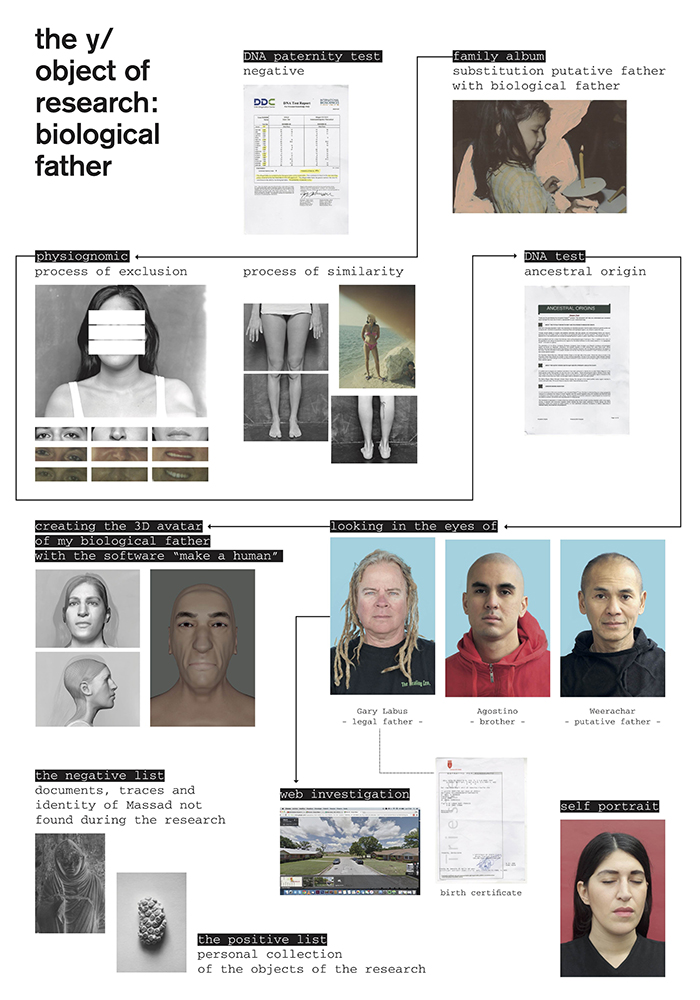
Her previous work “The Y- Research of Biological Father” (2019), her search for her biological father, similarly includes media such as paternity tests, created avatars, web documents, and self-portraits.

Alba Zari – page spread from the RPS, (Royal Photographic Society, 2021)

​Zari shows how we can make our own pictures, with mind maps, diagrams, drawings, photographs, saying that there isn’t just one way to do research and even that making photographs is a kind of research in itself. Photography-based research might also include exploring archival material, from family albums, news pictures or historical images. However, she says that as photographers investigate, explore, compile, map, question, connect, interpret, gather, organise, interrogate, construct etc. and that making photographs becomes part of an extended process of discovery. Even that photographers make images to fill the void if information is missing, to help them imagine what does not already exist. She realises that how that research is presented can be very influential and may even disrupt normal expectations. (Royal Photographic Society, 2021).

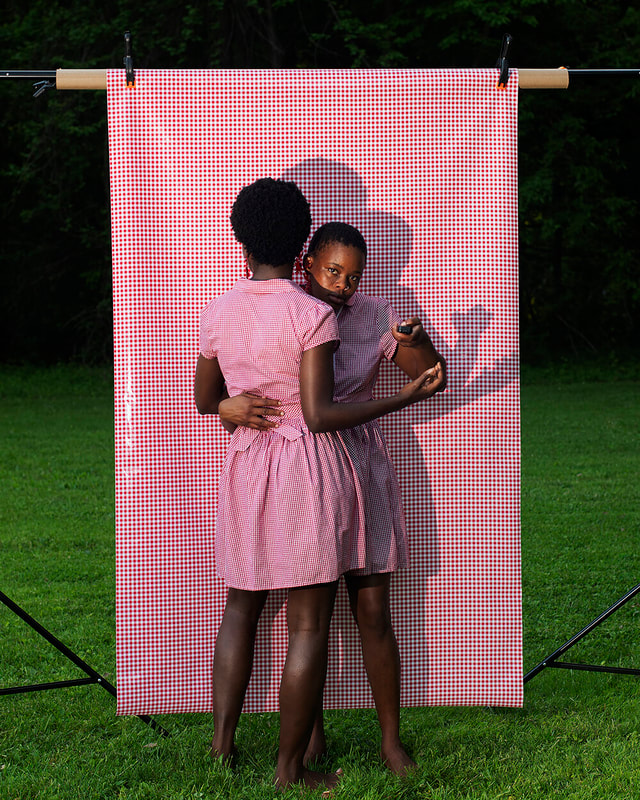
Widline Cadet: Seremoni Disparisyon (Ritual [Dis]Appearance),

explores cultural identity, race, memory and immigration through photography, video, and installation with a series of self-portraits, featuring herself and friend posing as her with abstract landscapes constructed backgrounds.

(Royal Photographic Society, 2021)

What particularly interested me was the way that she presented her research:

 (Gallery view 2021)

References:

Kynoch, G. (2021) Women photographers come together for Bristol Photo Festival with ‘In Progress’. At: https://hundredheroines.org/exhibition/women-photographers-come-together-for-bristol-photo-festival-with-in-progress/ (Accessed 28/12/2021).

Royal Photographic Society (2021) In Progress. At: https://www.photopedagogy.com/inprogress.html (Accessed 06/02/2022).

Winterthur, F. (2022) Occult. At: https://www.fotomuseum.ch/en/situations-post/occult/ (Accessed 06/02/2022).

Zari, A. (2022) albazari. At: https://albazari.info/ (Accessed 06/02/2022).

Wolfgang Tillmans research-based photography

Tillmans uses observation of his surroundings in an ongoing investigation of the photographic medium. He engages in this way to transform the world and so uses exhibition space for performing. Tillmans looks at the world with both curious and playful eyes and with his work gives new ways of viewing the world to viewers.

Studying truth with Wolfgang Tillmans

This installation includes Tillman sharing his views on the subject of truth and was on view at the Tate in 2017. Here he shares his reaction to the Iraq War and the presidency of George Bush, using various textual information, political texts, clippings, and erroneous everyday photographs. He was driven by the opinion that many global problems have been driven by false presentations of truth. “By combining a wide variety of mediums, he constructs a scenario that depicts and analyzes this tendency, while also, by extension, diagnoses it” (The Art Story, 2021).

It showcases Tilman’s work using tabletops as an alternative way to examine the present day. He was interested in statements made by people and groups worldwide that their viewpoint was only the truth. This work Truth Study center project where photographs, and clippings from documents are displayed in deliberate, and possibly provocative juxtapositions, reflects the way they come to viewers in print and online. The articles also bring attention to gaps in knowledge, or doubtful areas.

Below is an example of his project truth study center (2005–ongoing), which displays photographs, articles, objects, and drawings that present differing versions of ‘truth’.

(Tate, 2022).

It is an innovative way to question what is real. The installation also shares a brief audio clip of his views on truth. He has previously exhibited installations of taped prints and pinned magazine spreads. His mixture of mediums is interesting. Does this enlarge opportunities for viewers to participate and form their own conclusions, I wonder?

His photography does increase our attentiveness of the world around us, so that we see things differently and take less for granted.

“that my images are random and everyday when they are actually neither. They are, in fact, the opposite. They are calls to attentiveness.” This image reminds us to be present in our relationship with the world; the strongest moments are actually a strange mix of the sensual and the surreal, and often subtly political.

References:

Tate (2022) Studying truth with Wolfgang Tillmans. At: https://www.tate.org.uk/whats-on/tate-modern/exhibition/wolfgang-tillmans-2017/studying-truth (Accessed 17/01/2022).

The Art Story (2021) Wolfgang Tilmans. At: https://www.theartstory.org/artist/tillmans-wolfgang/ (Accessed 24/01/2022).

There are others that I could research:

Hamish Fulton: A walking artist with his own text, but this doesn’t seem relevant to me.

Barbara Kruger who works with photos and collaged text. However her work doesn’t seem relevant to me at this point.

Next post: https://nkssite6.photo.blog/category/reflective-journal/hangouts/bow-hangout-summaries-to-15-3-22/

BODY OF WORK RESEARCH: PART 2 GENRE DEVELOPMENT

PHOTOGRAPHERS WORKING WITH SIMILAR SUBJECTS

TREES

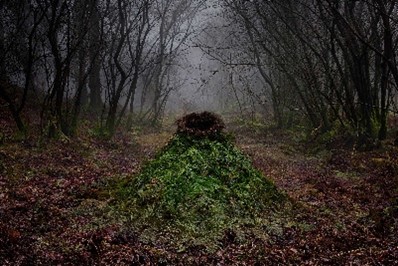
Ellie Davies works with UK forests, particularly in the south of England, exploring the relationship between the landscape and individuals. She talks of the cultural backdrop of human processes in the woodlands, symbols of folklore, fairy tale, magic, and myth, as well as psychological states such as the unconscious. She engages in the landscape with a variety of strategies:

“making and building using found materials, creating pools of light on the forest floor, using craft materials such as paint and wool, introducing starscapes taken by the Hubble Telescope or glittering light from the surface of the sea.”

Her final images are the outcome of these interventions and alterations to the landscape, and she says reflects her personal relationship with the forest, she says she, “walks, thinks, sits, listens then creates.” I can identify with this. These outcomes are she says a reflection of her relationship with the forest, her meditations on what she calls universal themes and the concept of landscape as a social and cultural construct – a visual experience.

Another Green world 2013
Come with me 2011 
Knit one pearl one 2011


Davies mentions that she was inspired by the Twilight photography in the Magic Hour (2006), which explored twilight and I can see the influence in her work. In a Lens culture video (2015) she explains how in her photography she tries to explain the atmosphere in the woods, and the effect on you, to give the viewer a fresh look at landscapes, and enable them to interact with the landscape. She puts something of herself in the space, with the woodland as a backdrop, with a “light touch.” The landscape is the subject, and the intervention mustn’t take over, or leave an impact on the woodland.  

Reflection

This research underlines my feelings about using photography the landscape to share the sensations and the effect on myself. But also, my search to try to ensure that what I want to say can be seen in my images. I could experiment with some construction in the landscape with, wool, flour, or organic paints but at this stage I would hope not to.

References:

Davies, E. (2016) Ellie Davies. At: https://elliedavies.co.uk/statement/ (Accessed 07/02/2022).

LensCulture (2015) Ellie Davies. At: https://vimeo.com/125002260 (Accessed 07/02/2022).

Smith, B. (2020) A Small Voice Podcast – 122 – Ellie Davies. At: https://bensmithphoto.com/asmallvoice/ellie-davies (Accessed 07/02/2022).

AMONG THE TREES EXHIBITION AT THE HAYWARD GALLERY (2020)

This exhibition showed how artists over the last 50 years have made works relating to trees. As trees live much longer than us, we can see our impact on them and how they act on us and our imaginations. The exhibition shows how entwined human culture is with tree culture. It brought together artworks that encourage us to think about trees and forests in diverse ways:

 “Trees are stunningly complex and often visually confounding” (Hayward, 2020) and the artists in this exhibition highlight this to engage us in an exploratory process of looking. By subverting traditional images of the natural world helps us to see afresh. This is a multimedia exhibition, and the modern work helps to avoid the way traditional images may invite us “to get lost, and to experience – on some level – that uncanny thrill of momentarily losing our way in a forest and seeing our surroundings with fresh eyes” (Hayward, 2020).

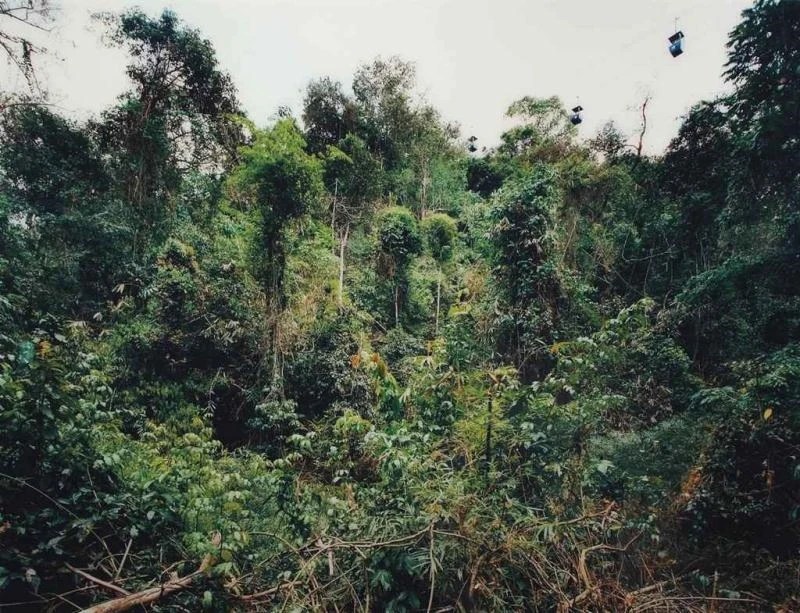
Thomas Struth has photographed forests and jungles around the world. He made this series after observing the trees in the garden of his Düsseldorf flat, after seeing the dense network of branches he thought to make pictures so full of information that they might encourage us to abandon our analytical tools, and ‘surrender to just looking.’ The images in this series, New Pictures from Paradise (1998–2007) all have a decentralised composition, with no single focus point, and no clearly defined foreground or background encouraging our eyes to wander across the image to both take in and get lost in the amount of detail.

(Struth, Paradise 11, 1999)

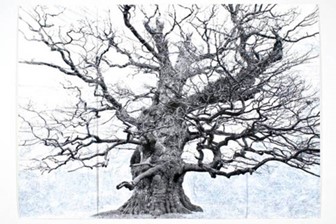
Tacita Dean’s, Majesty (2006) Crowhurst II, is one of a series of ‘painted trees’ that the artist began in 2005. It was made from a black and white photograph that Dean took of one of the oldest complete oak trees in England, which she greatly enlarged and printed on four overlapping sections of fibre-based paper. She then overlay the area surrounding the image with a gouache brushwork that partially obscures the surrounding wood to isolate the structure and form; this draws your eye to the silhouette, the tree, and its personality. Some of the branches of this tree have been propped up with crutch-like supports. Dean combines ideas driven by research with chance, accident, and coincidence.

(Westall, 2010)

Dean created also made a series of Deformed Trees (2005) by painting over the background, and sometimes also the foreground, of old black and white postcards depicting trees.

Rodney Graham began his series of ‘inverted tree’ photographs in the late 1980s. This photograph of a ‘Garry oak’ (native to the Pacific Northwest), was taken in British Columbia, Canada. The series grew from his earlier project, where he used a camera obscura opposite a lone tree where visitors encountered the inverted image of the tree projected on a far wall. Graham describes this as a way to talk about ‘man’s skewed experience of nature.’ In a different way to Ellie Davies Graham is again giving us a way to look again at something familiar – this time by turning it upside down. He says, ‘It’s always disturbing to look at something upside down,’ (Hayward gallery, artist notes (2020). Rodney was influenced by the artist’s work below.

(Artsy Net, 2022)

Robert Smithson photographed an upside tree in a different manner, in reality the tree was upside down. He photographed a series of three Upside Down Trees as he travelled from New York to the Yucatán peninsula (Mexico) via Florida; one in in Alfred, New York; the second in Captiva Island, Florida, and the third in Yucatán, Mexico. Each time he removed the branches from a young tree, and replanted it, root-side up. By doing this he has drawn attention to the structural similarity of a tree’s branch and root system. Smithson’s action “challenges our anthropomorphic tendency to identify with the vertical stature of trees” (Hayward, 2020). Alongside Davies and Graham, Smithson calls for an examination of what is. 

Upside Down Captiva Island, Florida, USA 1969 (Holt Smithson Foundation, 2022)

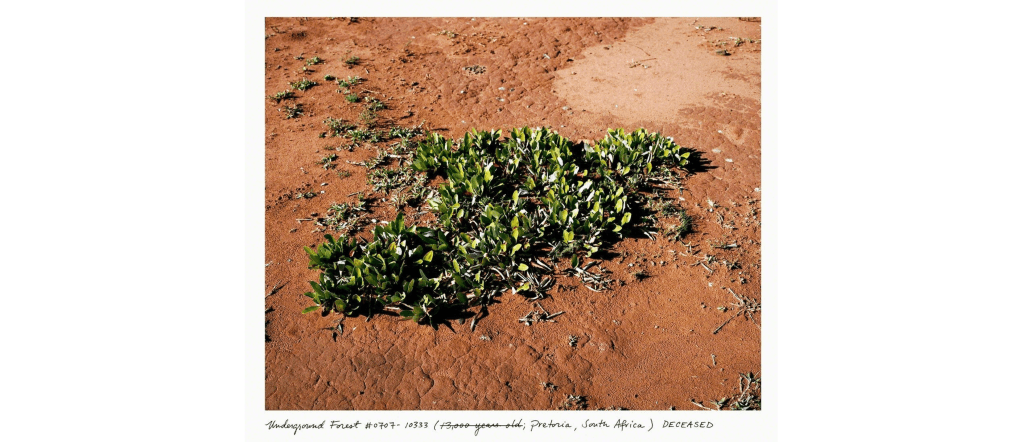
I came across the work of Rachel Sussman when I saw her photograph Underground Forest #0707-1333. This is actually the top of a tree that is 13,000 years old, growing underground in South Africa. These trees have possibly migrated underground to escape forest fires.

(Artsy.net, 2022)

My research led me to discover that Sussman has written a book The oldest living things in the world. She focuses on organisms over two thousand years old such as this llereta a distant relative of carrots and this slow growing lichen (1 cm per one hundred years). It is the oddity of these organisms rather than her photography that is arresting, it’s the subjects themselves that are captivating; that said there is still a familiar theme here, that of focusing on something natural that stops you and makes you look hard. There is a poignant quote by Susan Sontag in Sussman’s book “All photographs are memento mori. To take a photograph is to participate in another person’s (or thing’s) mortality, vulnerability, mutability. Precisely by slicing out this moment and freezing it, all photographs testify to time’s relentless melt”

(Design Observer, 2022)

In the exhibition some artists like Sussman explore the relationship between trees and time passing, seasonal changes, rings, as Sontag says “memento mori.” I would like to explore how trees might teach us some ways forwards; how I have yet to discover.

What I take away from this exhibition’s treatment of trees is the value of finding ways to encourage viewers to look hard or differently at the subject.

References:

Artsy Net (2022) Rodney Graham. At: https://www.artsy.net/artwork/rodney-graham-gary-oak-galiano-island-1 (Accessed 11/02/2022).

Design Observer (2022) The Oldest Living Things In the World. At: https://designobserver.com/feature/the-oldest-living-things-in-the-world/38462 (Accessed 11/02/2022).

Hayward gallery (2020) Among the Trees large print Exhibition guide. At: https://www.southbankcentre.co.uk/whats-on/art-exhibitions/among-the-trees?tab=exhibition-guide-large-print- (Accessed 08/02/2022).

Holt Smithson Foundation (2022) Upside Down Tree II. At: https://holtsmithsonfoundation.org/upside-down-tree-ii (Accessed 11/02/2022).

Rachel Sussman. At: https://www.artsy.net/artwork/rachel-sussman-underground-forest-number-0707-10333-13000-years-old-pretoria-south-africa-deceased (Accessed 11/02/2022).

Tate (2022) ‘Majesty’, Tacita Dean, 2006. At: https://www.tate.org.uk/art/artworks/dean-majesty-t12805 (Accessed 08/02/2022).

Thomas Struth (2022) At: https://www.mutualart.com/Artwork/Paradise-11/10A559DE5A47C094 (Accessed 08/02/2022).

Westall, M. (2010) Tate Announces Tacita Dean to Undertake Next Commission in The Unilever Series. At: https://fadmagazine.com/2010/12/16/tate-announces-tacita-dean-to-undertake-next-commission-in-the-unilever-series/ (Accessed 08/02/2022).

I ALSO RESEARCHED CONSTRUCTED LANDSCAPE WORK:

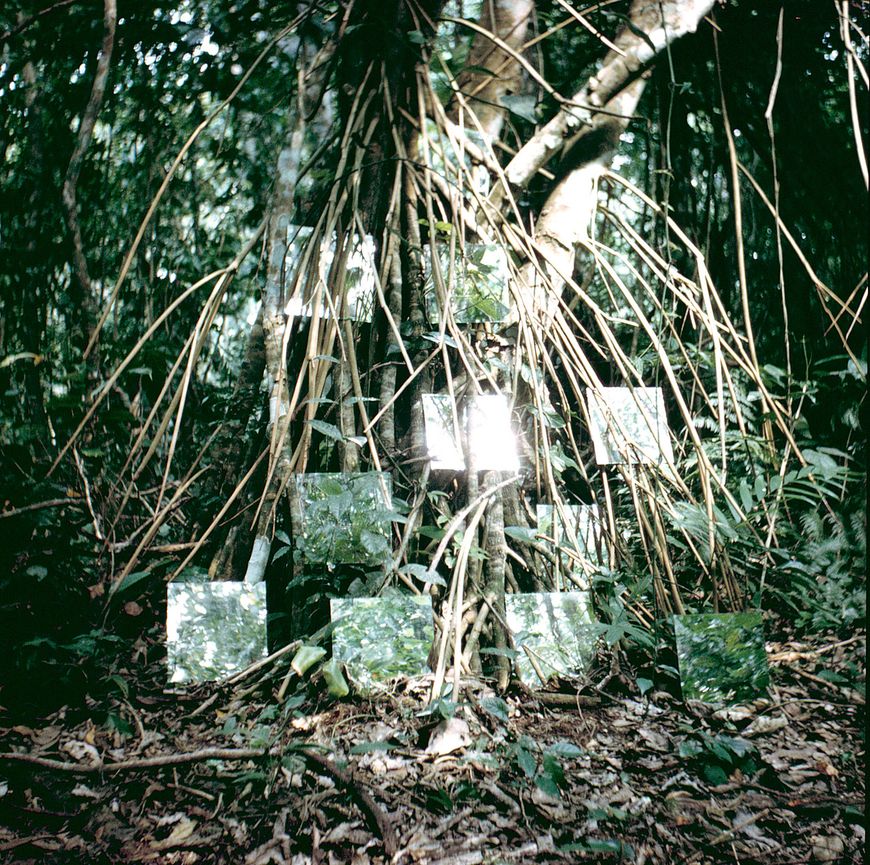
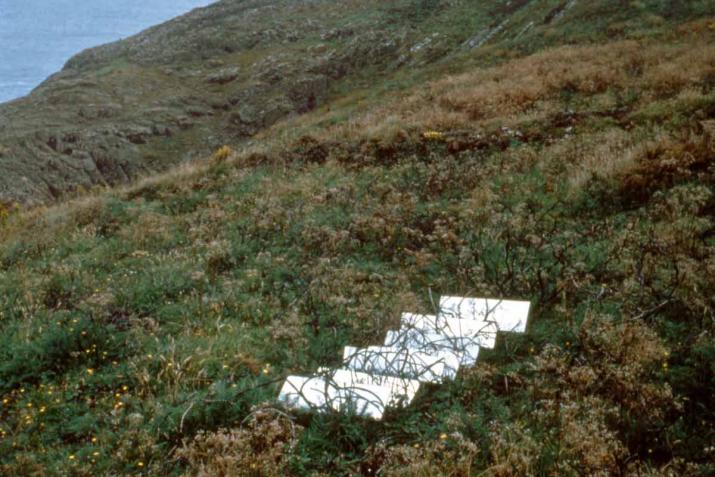
Robert Smithson’s Yucatan Mirror displacements (1-9) 1969.

I have mentioned Smithson’s work “Upside down” previously. He is best known for his earthworks and yet his interests were broad. He produced paintings, drawings, sculptures, architectural schemes, films, photographs, writings, as well as earthworks. He explored the conceptual and physical boundaries of landscape and his work encouraged viewers to ask questions.

In this work he installed 12-inch square mirrors on dispersed sites, resulting in nine photographs. The mirrors refracted as well as reflected their environments, “displacing the solidarity of the landscape and shattering its forms” (Guggenheim, 2022). It has been suggested that the mirror records the passage of time, though that I don’t understand, and the photograph suspends time, this I do understand.

(Guggenheim, 2022)
(Holt Smithson Foundation, 2022)

Noemie Goudal’s

photograph Les Amants (Cascade, 2009), depicts a waterfall made from plastic draped through a woodland setting, the natural and the manmade placed together, organic and synthetic which are generally in opposition. Nature is important I her work and here she is playing with our visual senses and ability to process, which Alexander describes as “a parody of what we would expect in a landscape” (Alexander, 2015:58). Goudal is subverting the picturesque but showing that in postmodern work nature and culture need not be in opposition to each other. This image sits easier with me that Smithson’s Mirror displacements,

(Saatchi Gallery, 2022)

I don’t feel that constructed work is for me right now, but I will reconsider it if necessary to share my message.

References:

Alexander, J. P. (2015) Perspectives on Place: Theory and Practice in Landscape Photography. London: Bloomsbury Publishing.

Guggenheim (2022) Yucatan Mirror Displacements (1–9). At: https://www.guggenheim.org/artwork/5322 (Accessed 12/02/2022).

Holt Smithson Foundation (2022) Photo and Slideworks. At: https://holtsmithsonfoundation.org/artworks-robert-smithson/photo-and-slideworks (Accessed 12/02/2022).

Saatchi gallery (2022) Noémie Goudal. At: https://www.saatchigallery.com/artist/noemie_goudal (Accessed 12/02/2022).

Next post: https://nkssite6.photo.blog/category/research/bow-research/text-signposting/