The purpose of this assignment is to enable you to explore and develop initial ideas and research as part of a dissertation scoping and planning process. It is a key moment to reflect on possible relations between your ongoing research of visual culture with ideas relating to your photographic practice. The assignment requires you to reflect on how visual culture research and practice can weave together and support each other. Write a 1000-word essay (+/- 10%) (or 5 minute equivalent presentation) that relates your Body of Work to an aspect of visual culture, discussed in Part One. (Alexander, 2020:37)
Alexander, J. et al. (2020) Contextual Studies. Barnsley: Open College of the Arts.
I have removed my essay as it will be made available to my assessors
Brief: Spend some time reviewing your personal reflection and your tutor feedback.Develop a series of carefully considered images that moves your idea forward.Hand in this series to your tutor together with a new reflective commentarysetting out where you plan to go from here.
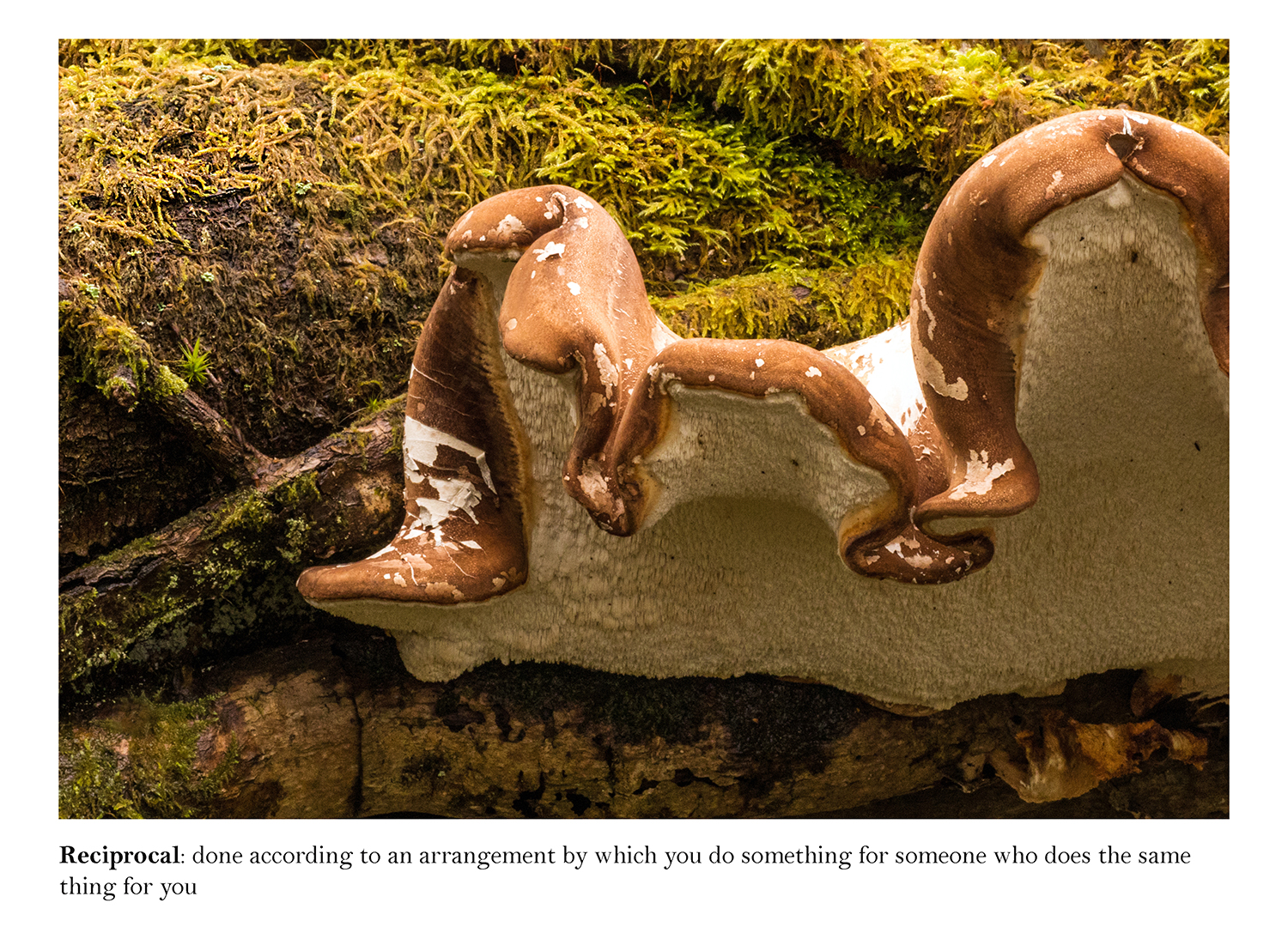
These images follow on from my first genre shoot developing my exploration of my concept, the ancient woodlands, as a visual metaphor for my theme of community. I was encouraged after my last assignment, to get to the knub of my idea and form a working title; I have decided on “A harmonious community”. The how and why of sharing my concept is still developing.
I reread and found new material on woodland species I photographed, trees, lichen, moss, ferns, and fungi. This increased my respect for them as individual subjects and enhanced my understanding of how they work together to create this harmonious woodland community. Sheldrake’s quote about lichens being undividable “They flicker between “wholes and “collections of parts”” (Wildlife Trusts, 2021), could equally apply to all these woodland species. This time as I photographed, I shuttled between the perspectives of the whole and the parts, but increasingly focused on individual woodland species. When I reflected on my images it became obvious that it is almost impossible to separate these parts from the whole, as the woodlands are all about the collective working together.
Photographing these species was a process I needed to go through to understand the parts that make the whole harmonious community. I tried different ways of looking and using unusual perspectives but returned to simply showing the close relationships the species have with each other. I considered various text to signpost my intention, settling on simply adding a border combined with a dictionary definition to add definition to the images. Interestingly these definitions of words that relating to a harmonious community, mostly refer to people or persons. My concept is inspired by humans, they are not evident in my images, although they are the stimulus to my intention and observations, they do not need to be visually evident, I am sure of that.
Next steps
These images were not inspired by the photographers I researched, however returning to this research, when reflecting on my outcomes, helped me to consider on ways forward now. Of those, I identify with the work of Ellie Davies, particularly her practice where she “walks, thinks, sits, listens then creates” (Davies, 2018). Although her outcomes are created by intervention and construction in the woodlands which I don’t lean towards, I share her desire to photograph to explain the landscape’s effect on the photographer; this is something I will focus on going forwards- an intention to communicate the woodland’s exceptional quality of harmony and mutual relationships. Can I put something of myself in the space as Davies does without intervening in the landscape?
After this close focus on interrelationships in the ancient woodlands, I now want to return to a wider view of the moss-covered landscape to express my feelings about this community. I may try like Thomas Struth’s work in forests and jungles to present so much information that viewers will surrender to just looking. I have a thought to try mixing into each image, both the “whole” and the “parts”.



 NIKI SOUTH