Tableaux
Research point: Gregory Crewdson and theatricality in art.
“Gregory Crewdson is a photographer who operates with strong directorial control in his image- making. His photographs function like film stills to the point where there is arguably not much ‘reality’ left in the scene”.
Do some research into Gregory Crewdson online and for a broader discussion on theatricality in art try to find a copy of Fried (2008) ‘Why Photography Matters in Art as Never Before’ at your nearest large library (Boothroyd, 2020:22).
I visited an exhibition of Crewdson’s work Cathedral of the Pines (2013-14) at the Photographer’s gallery in 2017. I then described each of his images as elaborately constructed melodrama “every shot is crafted to the tiniest detail and contains a multitude of layers –narrative, photographic and psychological” (Plowright, 2017). Crewdson “discovered an ability to read and understand a still image, to analyse the way an artist had framed, lit and composed a subject, as a child” he says that “It came very naturally to me…I grasped how a photograph is connected to our actuality, but also has way of fictionalising our realities as well.” (British Journal of Photography, 2017).
This series evidences his strong directorial control. To complete the work, he staged 3 productions with crews over 2 years; with an image in mind, he formed scripts so that the actors knew exactly where to stand, and he describes the carefully selected actors as empty vessels. Lighting is important in all photography but is the very essence of Crewdson’s images; in thus series he worked with quieter less substantial lighting than usual, making the most of ambient light usually if set inside, with daylight entering from outside through doors and windows; he uses window frames frequently in these images, supposedly to reference the act of looking through the window at another world. The images are strongly cinematic whether shot in or outside. His work is never a single image but is collaged from different shots.
Crewdson considers himself a storyteller but his photographs unlike other narrative forms have no beginning and end, are condensed, and remain mysterious:
“It’s important to me that the setting for my pictures feels familiar. The settings, the props, the costumes, the subjects, they are supposed to feel ordinary, but then I use light and color and mood and atmosphere to charge it in some way.” (Time.com, 2017).
The images concentrate on one, to three figures, involved in an enigma or caught in a blank or reflective state, hinting at invisible challenges, though what these challenges are, and what fate awaits these blank figures, are left to our imagination. In The Haircut (2014) Crewdson places the characters in the heart of the forest as with many of the images:
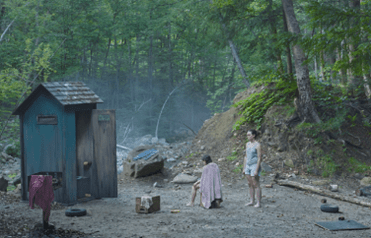
The broken shed/toilet behind them appears in several of his shots. The two teenagers, one seated after a haircut stare passively, as is usual in these images. Why is there a bicycle on the floor? Does it connect him to his childhood? The dirty blankets are there again, but why is the tyre on the floor? As a viewer I know that everything is there for a reason. In the middle of this forest their actions are suburban which provides the uncanny element and an open-ended narrative.
As in Woman in parked car (2014):

He often shoots in the twilight of dusk, although the mist may be added for effect. A woman apparently in only her underwear sits in the cab of a car, whilst a man stands inside at the sink also staring into space. The driver’s door is open, why? The cabin door is open as many of the doors in his images are.
Crewdson achieves the look of the surreal by placing characters in uncomfortable situations, though often you have to look harder for the uncanny elements. In The Barn (2013):
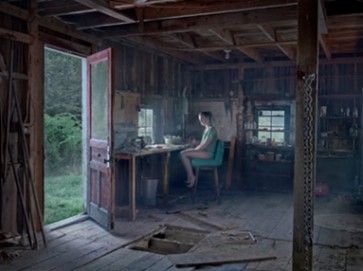
A girl with a non-expression staring at dead flowers on a bench, sits in a dilapidated barn with the door open. Look closely and where the floorboards are up, suggesting a hiding place, and dead birds lay on a shoe box lid, next to the void. As a viewer I am beset with questions that I have no answers to.
This series is produced in the same way as most of his work, with huge production teams, lighting plans, purpose-built sets, and strong direction- he has control of everything. Crewdson adopts the mechanics of the cinema to stunning effect; his images remind me of stills from a dream. There is plenty of narrative in his work, but unlike most theatre there is no beginning or end to his series. Ambiguity is key in his work and usually incorporates psychological tension. Whilst he creates stories from the ordinary, the cinematic scale of his work turns the ordinary into hyperreality I think.
Further research on Tableaux:
In Tableaux photography pictorial narrative is concentrated into a single image. Tableaux’s roots were in pre photographic art and particularly the figurative painting of the 18th 19th century; the compositional devices are often used which are “similar to renaissance painting, the angles and objects …directing us through the picture and leading our understanding of the action and narrative” (Cotton, 2015, p50). Tableaux images are of “something that we know is significant because of the way it’s set up in the photograph, but whose meaning is reliant on our investing the image with our own trains of narrative and psychological thought” (Cotton, 2015, p49).
The set of the image has the look of a theatre set viewed from on stage, and the use of actors and crew redefines the photographer as a conductor or film director. The dramatic use of cinematic lighting supports the idea that it is a theatrical blend of reality and storytelling, whilst ambiguous drama adds to the viewer’s narrative.
I experimented with Tableaux in my own work during my context and narrative course for assignment 5 “making it up” (South, 2017). I constructed it to express a personal reflection on stressful mealtimes, following a spoiled meal I often resolve never again to cook a special meal, thus the title “The Last Supper” came to mind. I researched Da Vinci’s version of painting, along with other’s and thought it would be interesting to borrow some of its visual symbolism, motifs, and choreography to add interest and emphasis to my modern tableaux- vivant.
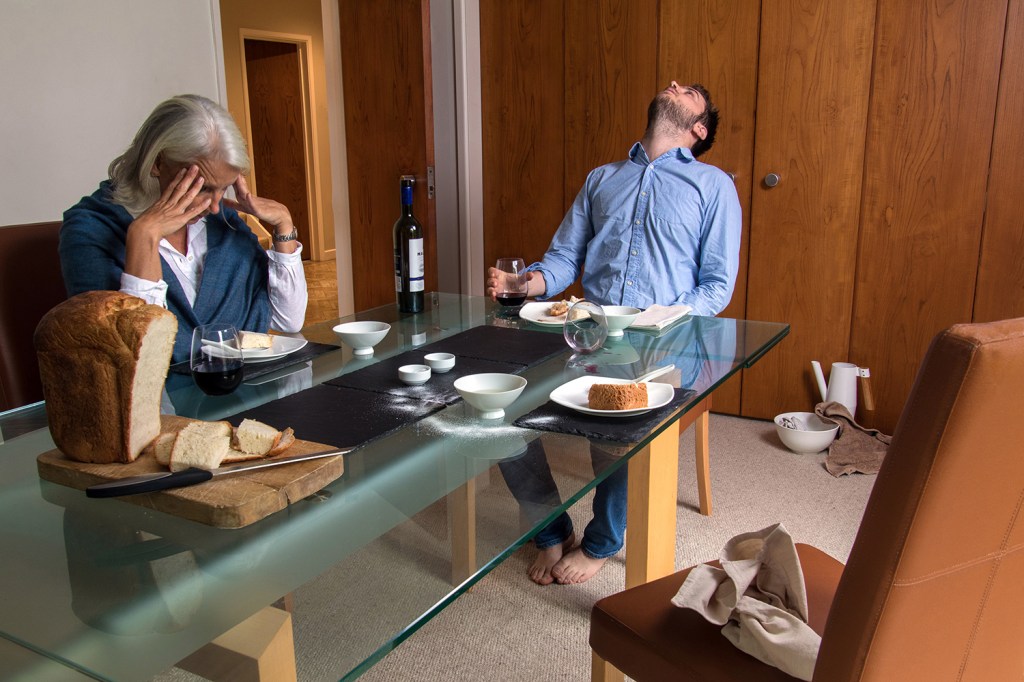
For this constructed reality I wanted to achieve the look of a fabricated theatre stage, but with a rich seductive aesthetic, despite some disturbing detail. It is a narrative of memories, reshaped and refabricated to the minutest detail, as. The props are the clues to the implied disturbance – the punctum. I want the reader to notice the deliberate way the photograph is set up and realise their significance.
Tom Hunter’s classically inspired modern scenes helped me to continue with my own fabrication of the last supper. Hunter often constructs his work around stories in the local newspapers such as his series Living in Hell, are carefully constructed tableaux re-enacting incidents reported his local paper the Hackney Gazette is a homage to the pre-Raphaelites. “Living in hell” references Gauguin, the Le Nain Brothers, Constable, and Ingres (Adage.com, 2021). This image was inspired by Vermeer’s “Girl reading a letter”, except that this girl he is a squatter reading a possession order (Pulver, 2021):

The work of Frances Kearney and Hannah Starkey offered me the notion of obscuring faces to increase ambiguity. Frances Kearney’s work “Five people all thinking the same thing” (1998) is concerned with the passing of time in a domestic setting, the subjects are often absorbed in what Kearney has described as “lost time” (Collections.vam.ac.uk, 2021). The ambiguity in the images leaves the viewer to draw their own conclusions about the characters, their lives and possible meanings of the props and locations.
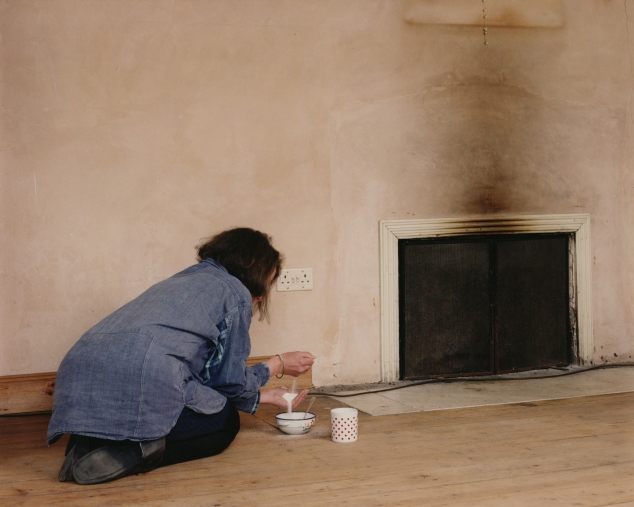
Hannah Starkey also uses the device of faces turned away to add ambiguity to the characters. Her work reconstructs everyday life in careful settings, captured with a sense of detachment, “with the concentrated stylisation of film” (Gallery, 2021). It has been suggested that by adopting filmography, Starkey’s images are intensified with voyeuristic intrusion, offering these private moments to the public.
In an interview Starkey is asked about the staged and cinematic and their centrality to her work. She replied that she doesn’t think of herself as a staged photographer, but composes instinctively, storing up observations and visual influences and then communicating it in a burst of photography. She says “I prefer the term ‘constructed photograph’ because it describes the reconstruction of the real as an act of redefining the real to reveal a psychological truth. Constructing the elements of the narrative into the frame of a photograph is second nature within photography” (Elephant, 2021).
Starkey explains that the “obstructions” in her work, are layering that makes the eye work harder because the obstructions block the viewers gaze and slow down the deciphering of the picture “I think of myself as a storyteller and good stories have multiple layers of meaning. By incorporating windows, mirrors, and reflective surfaces into my work I can take the eye on a visual journey to the heart of the narrative in the photograph and then back out” (Elephant, 2021).
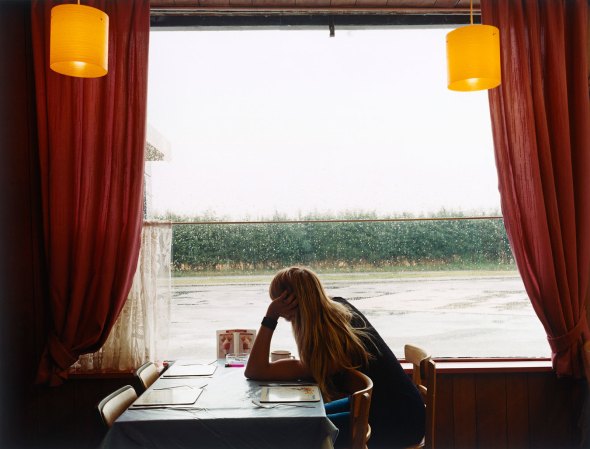
I was inspired by Jeff Wall’s realistic set constructions, and subtly dramatic rather than cinematic lighting, to encourage acceptance of “tableau photography as an imaginative blending of fact and fiction, of a subject and its allegorical and psychological significance” (Cotton, 2015 p52). Wall describes this as just a way of reassembling details after an event, as the pictures are made from his experience. Wall’s cinematographic technique is described as “near documentary”, and near photography is also the way Wall describes his work as recreations of moments made afterwards, enabling him to capture them carefully.

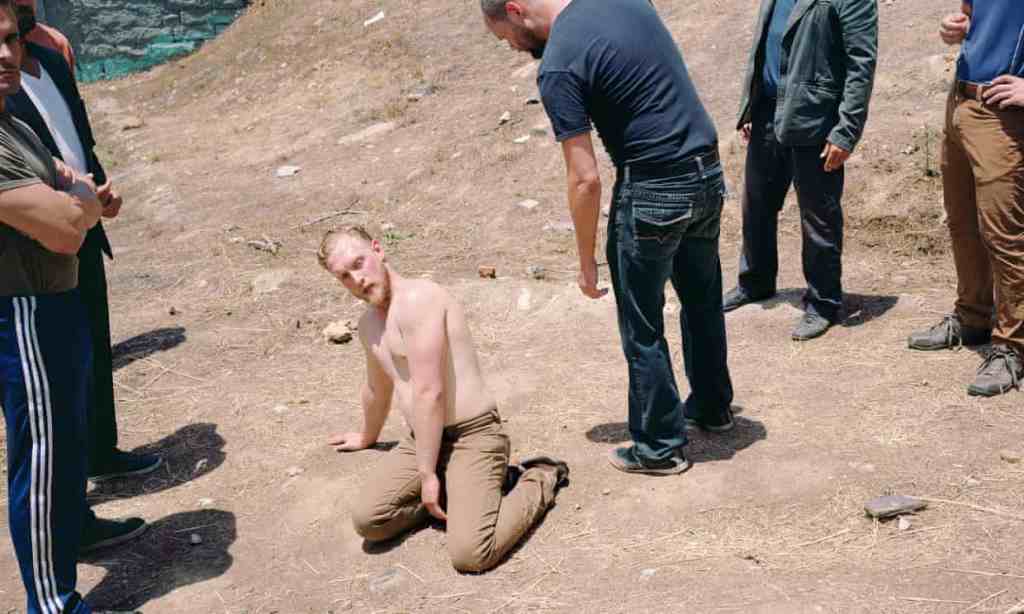
His work can be contentious such as Approach (2014) above shows a homeless woman standing by cardboard shelter, it’s contentious as he admits that this took a month to recreate but not whether the woman was an actor or not. Likewise, Listener (2015) shows a kneeling, shirtless man speaking to the leader of a group gathered around him in a bleak, harshly sunlit place. Wall describes this as something you could see in reportage but omits to tell whether it is actually a moment that he’s seen previously. I would prefer it if he was transparent about the basis of an image.
I was also affected by the work of Lottie Davies, whose work Memories and Nightmares (2008-2009), is around stories, personal histories, and identity; she says, “What counts for us in the memory…is ultimately not its reference to the ‘objective facts’ of a particular moment but its capacity to act as a founding myth” (Lottiedavies.com, 2021)

I was surprised how much research I have done previously on Tableaux photography previously – It was useful to revisit it now I have more experience in both research and photography.
My learning points on Tableaux photography and the use of theatricality in art:
- In Tableaux the photographer is a conductor or film director. Working as Crewdson does as a director with large production teams, lighting plans, purpose-built sets, and actors- you basically have control of everything.
- The dramatic use of cinematic lighting enhances the idea that it is a theatrical blend of reality and storytelling,
- Theatrically produced photographs are often like stills from dreams.
- These images usually contain a lot of ambiguity which adds to the viewers narrative.
- The cinematic scale of this work helps to turns the ordinary into hyperreality.
- Concentrating pictorial narrative into a single image culminates in a constructed reality. It leads viewers to believe there must be something of significance in the image because it’s deliberately constructed.
- Clarity and depth of field are needed to help viewers to be able to read the detail in an image.
- Tableaux images encourage slow looking so that viewers work hard to decipher content and meaning.
- Some tableau photography like Starkey’s images seem voyeuristic.
I have learnt a lot by revisiting tableaux. Whilst it is unlikely that I will wholly use this genre, it has made me think about things that I could incorporate to my work, like both clarity and depth of field, construction, and devices to encourage slow looking.
References:
Adage.com. (2021). PHOTOGRAPHY: Tom Hunter’s “Living in Hell and Other Stories”. [online] Available at: http://adage.com/article/printdesign-events/photography-tom-hunter-s-living-hell-stories/107702/ [Accessed 23 Sept 2021].
Boothroyd, S (2020) Photography 3: Body of work coursebook. Open College of the Arts. Barnsley.
British Journal of Photography (2021). Gregory Crewdson’s Cathedral of the Pines. [online] Available at: http://www.bjp-online.com/2017/06/crewdson-cathedral/ [Accessed 6 Sept 2021].
Collections.vam.ac.uk. (2021). Five People Thinking the Same Thing III | Kearney, Frances | V&A Search the Collections. [online] Available at: http://collections.vam.ac.uk/item/O83971/five-people-thinking-the-same-photograph-kearney-frances/ [Accessed 26 Sept. 2021].
Cotton, C. (2015). The photograph as contemporary art. London: Thames & Hudson.
Elephant. (2021). 5 Questions with Hannah Starkey – ELEPHANT. [online] Available at: https://elephantmag.com/5-questions-with-hannah-starkey/ [Accessed 26 Sept 2021].
Frances Kearney. (2021). Five People Thinking the Same Thing. [online] Available at: http://www.franceskearney.com/five-people-thinking-the-same-thing/ [Accessed 26 Sept. 2021].
Gallery, S. (2021). Anne Hardy – Artist’s Profile – The Saatchi Gallery. [online] Saatchigallery.com. Available at: http://www.saatchigallery.com/artists/anne_hardy.htm [Accessed 26 Sept. 2021].
Lottiedavies.com. (2021). Lottie Davies [online] Available at: https://www.lottiedavies.com/PROJECTS/Memories-and-Nightmares/2 [Accessed 8 Sept 2021].
Maureenpaley.com. (2021). Maureen Paley | Hannah Starkey. [online] Available at: http://www.maureenpaley.com/artists/hannah-starkey?image=5 [Accessed 26 Sept 2021]
My Favorite Arts. (2021). The Barn by Gregory Crewdson. [online] Available at: https://theartstack.com/artist/gregory-crewdson/barn-17 [Accessed Sept 2021].
O’Hagan, S. (2015) ‘Jeff Wall: ‘I’m haunted by the idea that my photography was all a big mistake’’ In: The Guardian 03/11/2015 At: http://www.theguardian.com/artanddesign/2015/nov/03/jeff-wall-photography-marian-goodman-gallery-show [Accessed September 8, 2021].
Plowright, N. (2017). Loose associations vo.3. issue ii summer 2017. London: Loose associations.
Pulver, A. (2021). Photographer Tom Hunter’s best shot. [online] the Guardian. Available at: https://www.theguardian.com/artanddesign/2009/nov/04/photography-tom-hunter-best-shot [Accessed 23 Sept 2021].
South, N. (2017) A5 Submission – Photography 1: Context and Narrative: Making it up. At: https://nkssite2.wordpress.com/category/a5-submission/ [Accessed Sept 7, 2021].
Telegraph.co.uk. (2021). Tom Hunter. [online] Available at: http://www.telegraph.co.uk/culture/photography/7994873/Tom-Hunter.html [Accessed 23 Sept. 2021].
The Photographers Gallery.org.uk. (2021). Gregory Crewdson: Cathedral of the Pines | The Photographers’ Gallery. [online] Available at: http://thephotographersgallery.org.uk/content/gregory-crewdson-cathedral-pines [Accessed 6 Sept 2021].
Time.com. (2017). Discover Gregory Crewdson’s New Surreal Photographs. [online] Available at: http://time.com/4166380/discover-gregory-crewdsons-new-surreal-photographs/ [Accessed 6 Sept 2021].
Trendland. (2017). Cathedral of the Pines. [online] Available at: http://trendland.com/cathedral-of-the-pines/ [Accessed 5 Sept 2021].
 NIKI SOUTH