We are asked in the coursebook to reflect on the significance of genre as a photographic concept.
Bate writes that genre was introduced in film theory to introduce more systematic thinking and to “encourage the question of the social and cultural function that genres perform”, the use of conventions for structuring (Neale, 1990:3). He explains that ascribing a genre to work in photography creates an expectation for the meanings to be derived from them though they are “promiscuous” as in they are not mutually exclusive.
The question was posed in the coursebook about genre “if the boundaries between genres are blurred, how useful is genre as a concept?” (Boothroyd,2020 :42). I would say that genres are useful as a way of sharing expectations and meanings, however in turn they may be limiting to both the photographer and the viewer if they are accepted rigidly. What I have learned from my revisiting of some genres here, is that there are elements of overlap and indeed elements of some genres which can be taken across to other genres deliberately – and I may try this.
Boothroyd, S (2020) Photography 3: Body of work coursebook. Open College of the Arts. Barnsley.
Neale, S (1990) Questions of Genre, Screen (Oxford university press, volume 31, number 1, spring 1990, p45) cited in: Bate, D. (2009) Photography: The Key Concepts. New York: Berg publishers.
John Hilliard talks about being known as a conceptual artist in the 1960s and 70s. Hilliard is still taking photographs today. Watch the video What is Conceptual Photography? (SOURCE Photographic Review, 2012) and then write a paragraph explaining what you understand by the term ‘conceptual photography’. Provide some examples of recent work that you believe falls into this category. (Boothroyd, 2020:41).
My response:
The video discussed conceptual photography predominantly in relation to the art movement of the late 60s. It was suggested that though the term “Concept” is important for understanding modern work, artists don’t use the term it is more commonly applied by others. In the late 60s artists were working in many ways that were difficult to categorise or even talk about, and the term conceptual art seemed to give a greater rationale for talking about the work. It was also suggested that as Modern art was different from what viewers were used to, the work is more dependent on documentation. It was suggested that some conceptual photographers claimed not to be interested in fine art or outstanding examples of photography.
Hilliard calls conceptual photography a prescriptive activity, such as when he drafts out the idea before taking a photograph. This becomes a “nameable” a set of ideas which you can speak about; and if the purpose is to embed the ideas in the image, then they are in turn intended to be retrievable. Hillard explained that his conceptual art must be contextualised by what is around it, as different contexts can give it quite different readings.
Additional research to illustrate this:
During the 60s and 70s photography became used by conceptual artists to record their ideas and projects. Liz Wells (2015) writes that where Modernist theory had focused on the medium of photography, Conceptual art focuses on ideas rather than objects; with artists concentrating on the way they have expressed themselves an as Hilliard suggested the contexts of interpretation, as well as the influence of the situation to which a viewer might respond.
Photography can be a useful bridge between conceptual art and the gallery. It doesn’t have to have traditional aesthetics, “its beauty could emerge in the clarity of ideas” (Company, 2012:17). Some say that form in photography is not important to conceptual artists, however once photography was accepted into conceptual art, importance was given to its form.
JOSPH KOSUTH in “One and three chairs” represents one chair in 3 ways, a photograph, an installed chair, and a dictionary definition; none of these were created by him, only the gallery installation by bringing them together. In doing so he invites us to question the meaning of the work, using art as a platform for exploring new meanings. The value of this work is rooted in its concept.
(MoMA, 2021)
Douglas Huebler a pioneer of conceptual art, used his work to challenge photography’s documentary abilities. From 1970 he made a series of “Duration Pieces”, “Variable Pieces”, and “Location Pieces”, documenting everyday activities with photographs, drawings, maps, and text. He experimented by shooting at intervals of 5 miles, 5 yards, or 5 feet, where it was the information, not the technique, the composition, or the material that mattered. He said he only aimed to state the existence of objects in the world.
(Mutual art 2021)
Within the document above he shares that several photographs were made to document various aspects of “everyone alive”, and one was chosen to represent “At least one person who is most probably more interesting than the artist” (Huebler, 1971). I find his concepts perplexing, but this is one of the purposes of conceptual art, provoking thought.
The conceptual artist Keith Arnatt made a series of images “Self-burial” and broadcast them on television over several days, intriguing viewers. His work plays with themes of trace and an artist’s presence in the landscape. He didn’t consider himself an artist but used photography to document his concepts, such as the notion of the invisibility of the artist.
Self-Burial (Television Interference Project) 1969 Keith Arnatt 1930-2008 Presented by Westdeutsches Fernsehen 1973 http://www.tate.org.uk/art/work/T01747
The absence of the Artist 1968 Self Burial 1969 (Sritharan, 2015)
Conceptual art interests me more than it used to. It is photography that illustrates an idea, but I would say and abstract idea. In this way to me it has some things in common with theatrical/cinematic photography: construction, layering and ultimately ambiguity. I am surprised to find after revisiting conceptual photography that it may have some influence on my photographic project, and I do have other conceptual photographers that I am holding off sharing my research on for now.
References:
Boothroyd, S (2020) Photography 3: Body of work coursebook. Open College of the Arts. Barnsley.
Campany, D. (2012) Art and Photography. (s.l.): Phaidon Press.
Psychogeography can be described as, responding to a physical space in a literary or artistic manner, and recording and analysing the emotions, feelings, and ideas of being in these spaces. The person capturing this may be called a Flaneuse who drifts through a place responding to the environment.
I have encountered work like this with literacy outcomes when reading the work of Robert MacFarlane who has written various books such as Underland (Macfarlane, 2020) and the Wild Places (Macfarlane, 2007). When writing these he walks through landscapes and responds in prose to his experience, adding amongst other subjects discussions of his concerns on the relationship of man to his landscapes. Roger Deakin’s book Wildwood: A journey through trees (2008), is of particular interest to me; here he explores first by walking and then by writing mans relationship with trees.
I also listened to a very interesting podcast about the Flaneur (BBC, 2016) which led me to the work of Lauren Elkin and her book Flaneuse: Woman walk the city. (2021). If I am to go deeper into this genre, I will explore the writings of Charles Baudelaire and, more currently, Will Self, Iain Sinclair, and Ken Worpole.
I have briefly at this point, explored some work of suggested photographers working in this genre:
Francis Alÿs
Though he often explores cities on foot to inspire his work, his outcome is usually performative art exploring human engagement and the human impact on the environment, I find hard to relate currently to much that I have seen of his work. His work Seven Walks (1999-2005), where he walked the streets of London and represented it through a range of media including photography, leaves me wanting to understand his methodology (Artangel, 2021).
He uses poetic and allegorical methods to address various realities and “addresses anthropological and geopolitical concerns through observation of engagement with everyday life” (Zwirner, 2020), and much of his work is videos. In the work below 2004 in Jerusalem, he walked trailing green paint, along the armistice border, known as ‘the green line’, which had been pencilled on a map by Moshe Dayan at the end of the war between Israel and Jordan in 1948. Though bewildering to onlookers, apparently his action did bring back memories of the green line when the separation fence, was being constructed to the east of the green line. His action did cause discussion and reflection from Israel, Palestine, and other countries.
antiAtlas (2013) Francis Alÿs – The Green Line
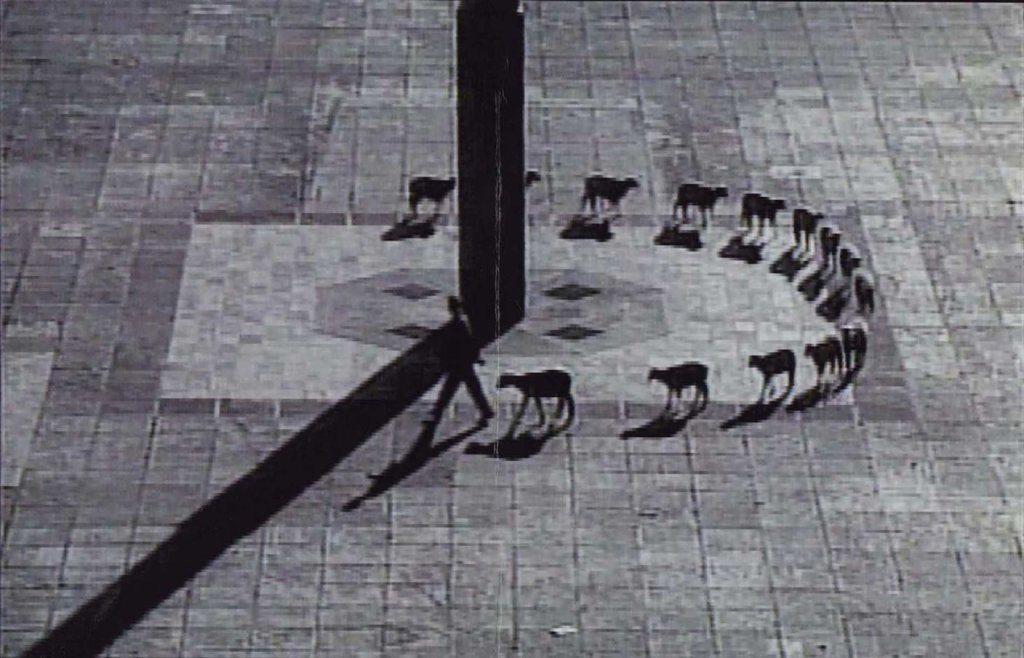
He uses land-based and social practices that examine individual memory and collective mythology, as well as shared cultural histories, urban engagement, and the human impact on the environment. One piece of his work that I can engage with is Patriotic Tales which documents the artist’s re-enactment of a moment in Mexico’s political history. Here Alÿs leads a flock of sheep in single file round a flagstaff in the ceremonial square in Mexico City. In this work he mirrors an event when civil servants were forced to congregate in the Zócalo to welcome the new government, and yet “bleated like sheep to mark their protest” (Francis Alÿs, 1997). Though this strikes me as conceptual work more than psychogeographic.
Francis Alÿs, Cuentos Patrioticos (Patriotic Tales), 1997 (still)
I do find interesting how he combines psycho-geography with conceptual art in my mind. I may return later to his work; and it does also illustrate another outcome as a response to place.
Stephen Gill
A conceptual artist used various unusual techniques to document Hackney to “encourage the spirit of the place to become trapped in the emulsion like amber creating a series of surreal interventions in the photographs” (Galerie, 2021). His techniques like inserting detritus into the camera body, and burying images, do not appeal to me but once again it demonstrates how broad a photographic response to a place can be.
(Stephen GILL, 2021)
Mark Power
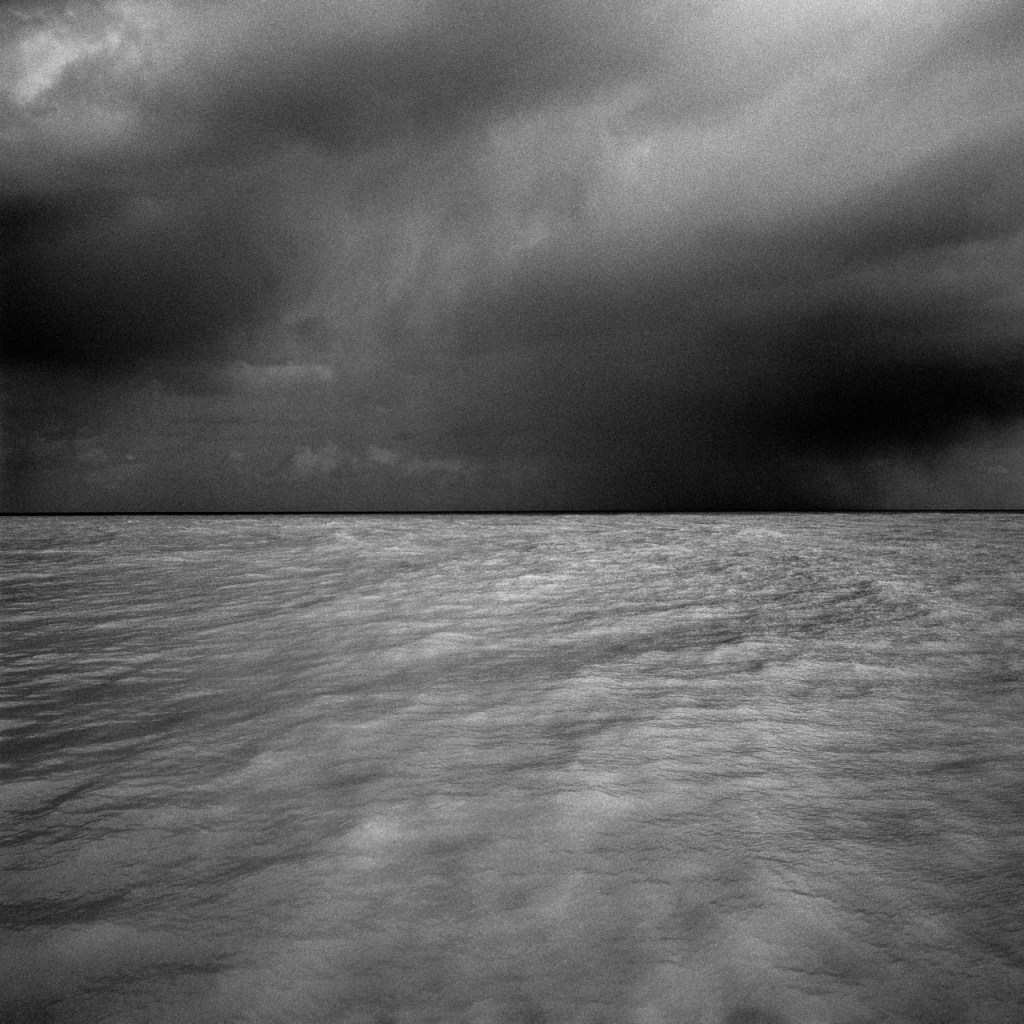
My foray into his works led me to 2 projects The Shipping Forecast (1993-1996) a poetic response to the language of the report “I was looking for pictures that were visual metaphors for the spoken words” (Magnum, 2018).
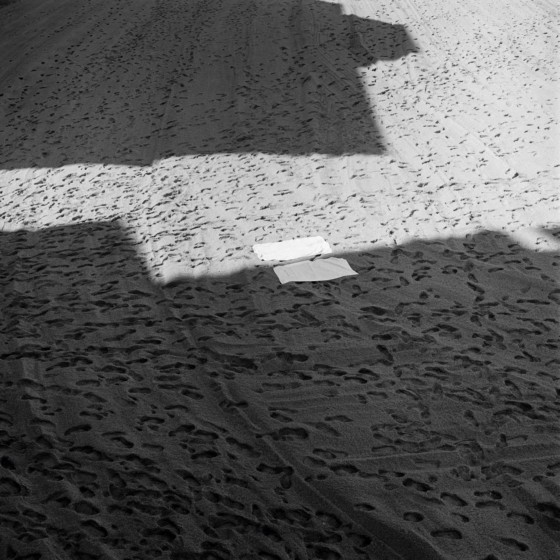
His other project that struck me was 26 different endings (2003-2006) where he photographed the places that fell off the edge of the London A-Z street atlas – a very interesting concept. I will definitely explore his work further to support me with my own ideas.
Debra Fabricius
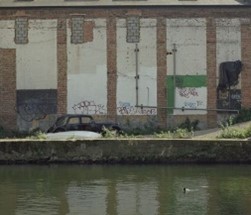
She is a self-confessed Flaneur who explores the spaces around her, it is unfortunate her web site is no longer accessible. However, I have found her MA work Urban drift on the University of Westminster website. Urban drift focused around a 9 mile stretch of Regents canal with an “an archaeological way of seeing and the process of a journey within a city” (Hull, 2020) a fragmented and fragile space and how the social, cultural, domestic, and industrial have impacted on the space. I would have liked to be able to see more of her work.
(Hull, 2020)
I am particularly interested in how she infuses her images with the feelings that she absorbs as a Flaneur and how they “create a platform for a story to be told” (Boothroyd,2020:39) and this is what I would like to do with my work, infuse images with feelings and tell a story.
What I take away from my initial research on psychogeography photography:
This genre could be an interesting starting point for my assignment 1 as I ultimately hope to infuse images with the feeling and spirit of a place whilst telling a story. My research has also opened my perspective on ways to respond and represent my experience of place. I will explore further some of these photographer’s work.
I am asked to answer the question: In terms of psychogeography, do you think it’s possible to produce an objective depiction of a place or will the outcome always be influenced by the artist? Does this even matter? Feel free to answer this with reference to the artists discussed in this section – or any others you’ve come across. (Boothroyd,2020:40).
My response:
It seems unrealistic to expect a flaneur to produce an objective representation of a place, as it is accepted that the purpose of a Flaneur is to absorb and express the spirit of a place. So no, as outlined in my research above, the value of the work of such photographers is in their ability to communicate what they see/feel about a location or journey.
At a time when we are inundated with people taking photographs it has become increasingly commonplace to look back at photographs that would otherwise be lost to history. Thinking about photographs and creating stories, re-contextualising them for a contemporary audience, are important considerations for practitioners working in this genre.
This essay Sekula uses the example of an archive of Mining photographs in the Cape Breton region between 1948 and 1968 made by a commercial photographer Leslie Shedden; these were for the coal company and the coal miners. Sekula says that his aim is to understand the relationship between photographic culture and economic life, “How does photography serve to legitimise and normalise existing power relationships?…how is social memory and historical memory preserved, transformed, restricted and obliterated by photograph?” (Sekula, 1999, p 182).
He explores what photographic archives are: Commercial, corporate, government, museum, historical, collectors for instance. All of which are the property of individuals and defined by their ownership which he calls a “territory of images”. He points out that unusually photograph are often in archives that are not owned or controlled by the author. This means that their meanings may be reinterpreted. He is right to point out that whilst photographs used to be thought as absolute truths “meaning is always directed by layout, captions, text, site and mode of presentation” (Sekula, 1999:194). So, archives are never neutral, and rely on institutions for their authority, and though it is today accepted that the truth in an image is an interpretation, sitting in an archive influences their reading.
Sekula also considers the effect of an archive if we simply treat photographs as artworks. He concludes that then the archive becomes an inventory of aesthetic achievement, but then concludes that to consider the collector as an artist themselves is a romantic indulgence.
Photography is both an art and science, though a subjective experience and not as objective as science. Returning towards the end of his essay to the archive of mining images, he points out that this is a mixture of official pictures, private pictures, and personal pictures which are not mutually exclusive categories. This of course may not be so in other archives.
When viewing an archive readers need to be well aware, just as they should be in curated exhibitions, that the meanings and purposes of the photographs may be supplanted by the change of context caused by how they have been collected/arranged. Meaning in photography is most affected by context, and as Sekula points out the archive can never be neutral. Furthermore, I would suggest that if a photographer is to use and archive for their work you then have the possibility of a further mutation of meaning.
References:
Boothroyd, S (2020) Photography 3: Body of work coursebook. Open College of the Arts. Barnsley.
Sekula, A. (1999) ‘ Reading an Archive: Photography between Labour and Capital ‘ In: Evans, J.H. (ed.) Visual culture: The Reader. London: SAGE. pp.181–192.
Research point: Gregory Crewdson and theatricality in art.
“Gregory Crewdson is a photographer who operates with strong directorial control in his image- making. His photographs function like film stills to the point where there is arguably not much ‘reality’ left in the scene”.
Do some research into Gregory Crewdson online and for a broader discussion on theatricality in art try to find a copy of Fried (2008) ‘Why Photography Matters in Art as Never Before’ at your nearest large library(Boothroyd, 2020:22).
I visited an exhibition of Crewdson’s work Cathedral of the Pines (2013-14) at the Photographer’s gallery in 2017. I then described each of his images as elaborately constructed melodrama “every shot is crafted to the tiniest detail and contains a multitude of layers –narrative, photographic and psychological” (Plowright, 2017). Crewdson “discovered an ability to read and understand a still image, to analyse the way an artist had framed, lit and composed a subject, as a child” he says that “It came very naturally to me…I grasped how a photograph is connected to our actuality, but also has way of fictionalising our realities as well.” (British Journal of Photography, 2017).
This series evidences his strong directorial control. To complete the work, he staged 3 productions with crews over 2 years; with an image in mind, he formed scripts so that the actors knew exactly where to stand, and he describes the carefully selected actors as empty vessels. Lighting is important in all photography but is the very essence of Crewdson’s images; in thus series he worked with quieter less substantial lighting than usual, making the most of ambient light usually if set inside, with daylight entering from outside through doors and windows; he uses window frames frequently in these images, supposedly to reference the act of looking through the window at another world. The images are strongly cinematic whether shot in or outside. His work is never a single image but is collaged from different shots.
Crewdson considers himself a storyteller but his photographs unlike other narrative forms have no beginning and end, are condensed, and remain mysterious:
“It’s important to me that the setting for my pictures feels familiar. The settings, the props, the costumes, the subjects, they are supposed to feel ordinary, but then I use light and color and mood and atmosphere to charge it in some way.” (Time.com, 2017).
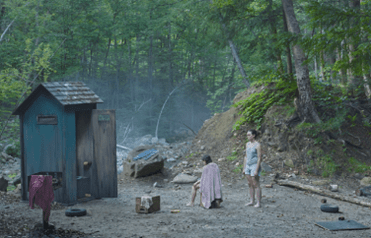
The images concentrate on one, to three figures, involved in an enigma or caught in a blank or reflective state, hinting at invisible challenges, though what these challenges are, and what fate awaits these blank figures, are left to our imagination. In The Haircut (2014) Crewdson places the characters in the heart of the forest as with many of the images:
(Thephotographersgallery.org.uk, 2017b)
The broken shed/toilet behind them appears in several of his shots. The two teenagers, one seated after a haircut stare passively, as is usual in these images. Why is there a bicycle on the floor? Does it connect him to his childhood? The dirty blankets are there again, but why is the tyre on the floor? As a viewer I know that everything is there for a reason. In the middle of this forest their actions are suburban which provides the uncanny element and an open-ended narrative.
As in Woman in parked car (2014):
(Trendland, 2017)
He often shoots in the twilight of dusk, although the mist may be added for effect. A woman apparently in only her underwear sits in the cab of a car, whilst a man stands inside at the sink also staring into space. The driver’s door is open, why? The cabin door is open as many of the doors in his images are.
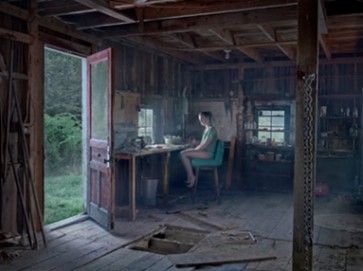
Crewdson achieves the look of the surreal by placing characters in uncomfortable situations, though often you have to look harder for the uncanny elements. In The Barn (2013):
(My Favorite Arts, 2021)
A girl with a non-expression staring at dead flowers on a bench, sits in a dilapidated barn with the door open. Look closely and where the floorboards are up, suggesting a hiding place, and dead birds lay on a shoe box lid, next to the void. As a viewer I am beset with questions that I have no answers to.
This series is produced in the same way as most of his work, with huge production teams, lighting plans, purpose-built sets, and strong direction- he has control of everything. Crewdson adopts the mechanics of the cinema to stunning effect; his images remind me of stills from a dream. There is plenty of narrative in his work, but unlike most theatre there is no beginning or end to his series. Ambiguity is key in his work and usually incorporates psychological tension. Whilst he creates stories from the ordinary, the cinematic scale of his work turns the ordinary into hyperreality I think.
Further research on Tableaux:
In Tableaux photography pictorial narrative is concentrated into a single image. Tableaux’s roots were in pre photographic art and particularly the figurative painting of the 18th 19th century; the compositional devices are often used which are “similar to renaissance painting, the angles and objects …directing us through the picture and leading our understanding of the action and narrative” (Cotton, 2015, p50). Tableaux images are of “something that we know is significant because of the way it’s set up in the photograph, but whose meaning is reliant on our investing the image with our own trains of narrative and psychological thought” (Cotton, 2015, p49).
The set of the image has the look of a theatre set viewed from on stage, and the use of actors and crew redefines the photographer as a conductor or film director. The dramatic use of cinematic lighting supports the idea that it is a theatrical blend of reality and storytelling, whilst ambiguous drama adds to the viewer’s narrative.
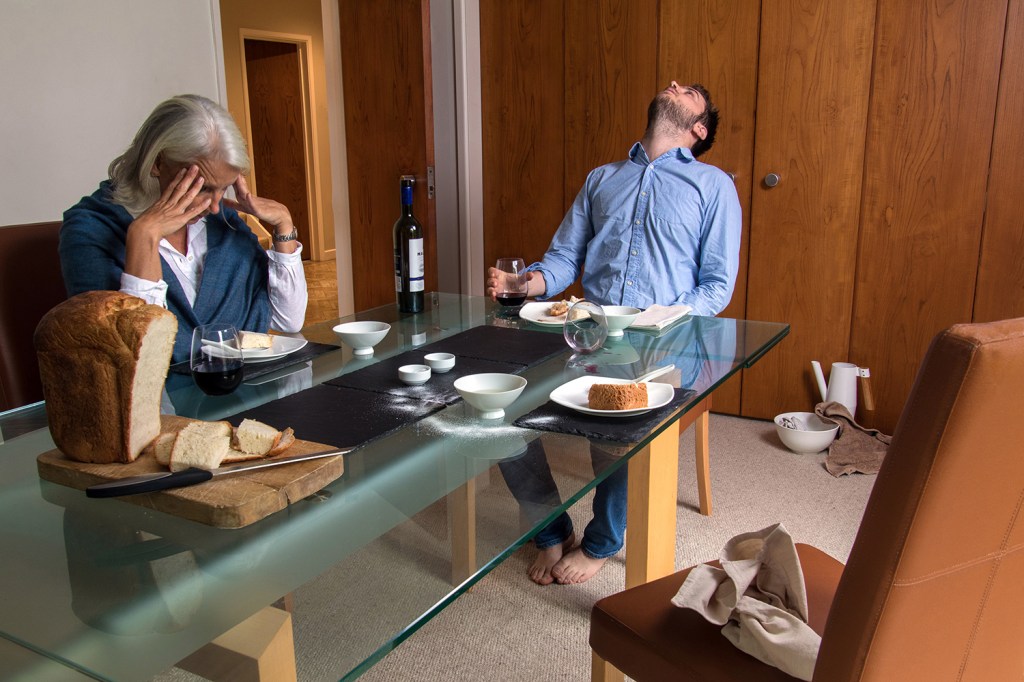
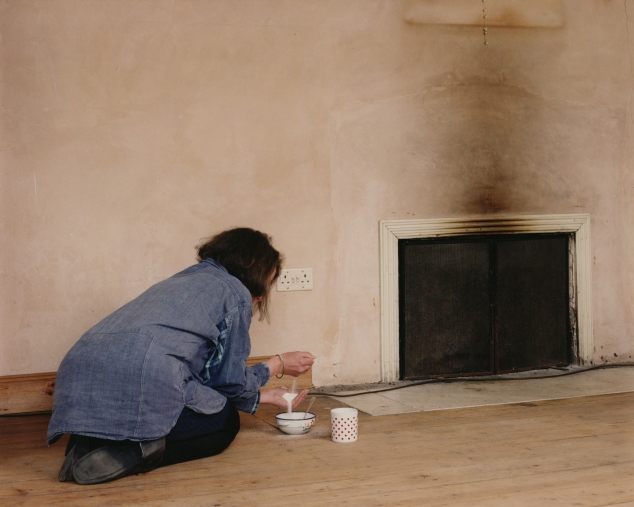
I experimented with Tableaux in my own work during my context and narrative course for assignment 5 “making it up” (South, 2017).I constructed it to express a personal reflection on stressful mealtimes, following a spoiled meal I often resolve never again to cook a special meal, thus the title “The Last Supper” came to mind. I researched Da Vinci’s version of painting, along with other’s and thought it would be interesting to borrow some of its visual symbolism, motifs, and choreography to add interest and emphasis to my modern tableaux- vivant.
(South, 2017)
For this constructed reality I wanted to achieve the look of a fabricated theatre stage, but with a rich seductive aesthetic, despite some disturbing detail. It is a narrative of memories, reshaped and refabricated to the minutest detail, as. The props are the clues to the implied disturbance – the punctum. I want the reader to notice the deliberate way the photograph is set up and realise their significance.
Tom Hunter’s classically inspired modern scenes helped me to continue with my own fabrication of the last supper. Hunter often constructs his work around stories in the local newspapers such as his series Living in Hell, are carefully constructed tableaux re-enacting incidents reported his local paper the Hackney Gazette is a homage to the pre-Raphaelites. “Living in hell” references Gauguin, the Le Nain Brothers, Constable, and Ingres (Adage.com, 2021). This image was inspired by Vermeer’s “Girl reading a letter”, except that this girl he is a squatter reading a possession order (Pulver, 2021):
(Telegraph.co.uk, 2021)
The work of Frances Kearney and Hannah Starkey offered me the notion of obscuring faces to increase ambiguity. Frances Kearney’s work “Five people all thinking the same thing” (1998) is concerned with the passing of time in a domestic setting, the subjects are often absorbed in what Kearney has described as “lost time” (Collections.vam.ac.uk, 2021). The ambiguity in the images leaves the viewer to draw their own conclusions about the characters, their lives and possible meanings of the props and locations.
(Frances Kearney, 2021)
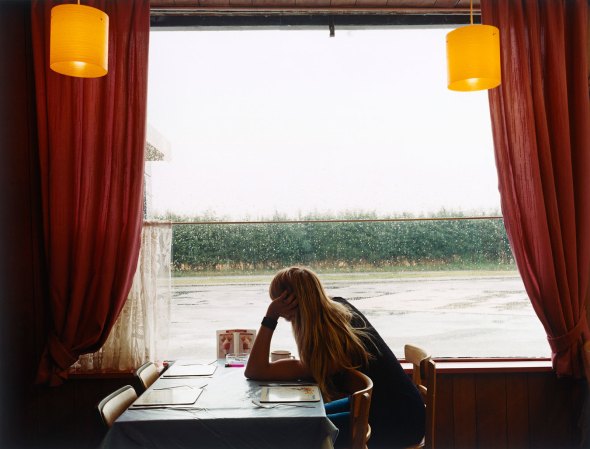
Hannah Starkey also uses the device of faces turned away to add ambiguity to the characters. Her work reconstructs everyday life in careful settings, captured with a sense of detachment, “with the concentrated stylisation of film” (Gallery, 2021). It has been suggested that by adopting filmography, Starkey’s images are intensified with voyeuristic intrusion, offering these private moments to the public.
In an interview Starkey is asked about the staged and cinematic and their centrality to her work. She replied that she doesn’t think of herself as a staged photographer, but composes instinctively, storing up observations and visual influences and then communicating it in a burst of photography. She says “I prefer the term ‘constructed photograph’ because it describes the reconstruction of the real as an act of redefining the real to reveal a psychological truth. Constructing the elements of the narrative into the frame of a photograph is second nature within photography” (Elephant, 2021).
Starkey explains that the “obstructions” in her work, are layering that makes the eye work harder because the obstructions block the viewers gaze and slow down the deciphering of the picture “I think of myself as a storyteller and good stories have multiple layers of meaning. By incorporating windows, mirrors, and reflective surfaces into my work I can take the eye on a visual journey to the heart of the narrative in the photograph and then back out” (Elephant, 2021).
(Maureenpaley.com, 2021).
I was inspired by Jeff Wall’s realistic set constructions, and subtly dramatic rather than cinematic lighting, to encourage acceptance of “tableau photography as an imaginative blending of fact and fiction, of a subject and its allegorical and psychological significance” (Cotton, 2015 p52). Wall describes this as just a way of reassembling details after an event, as the pictures are made from his experience. Wall’s cinematographic technique is described as “near documentary”, and near photography is also the way Wall describes his work as recreations of moments made afterwards, enabling him to capture them carefully.
Approach 2014 (O’Hagan, 2015)
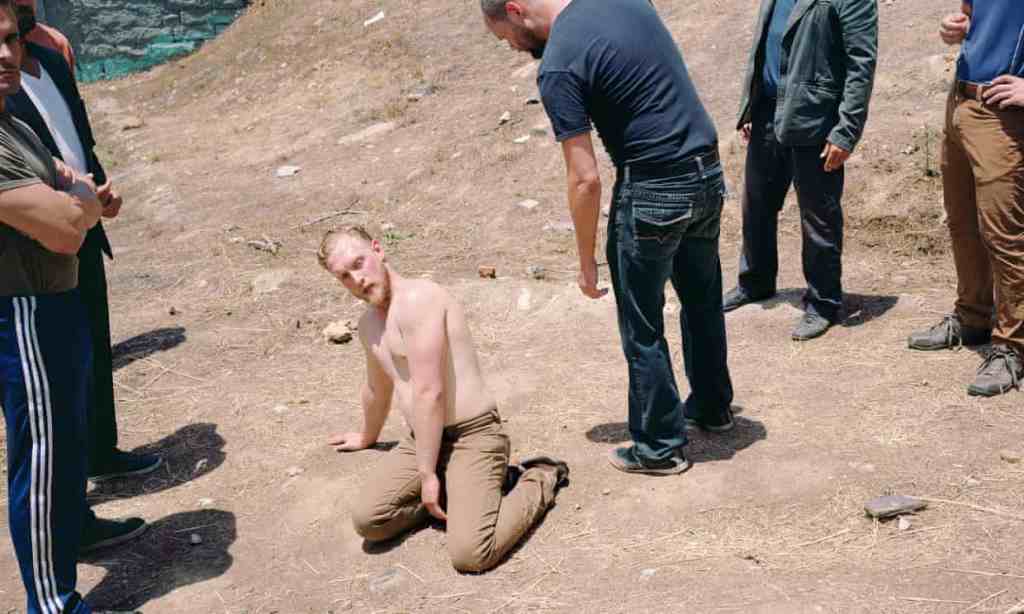
His work can be contentious such as Approach (2014) above shows a homeless woman standing by cardboard shelter, it’s contentious as he admits that this took a month to recreate but not whether the woman was an actor or not. Likewise, Listener (2015) shows a kneeling, shirtless man speaking to the leader of a group gathered around him in a bleak, harshly sunlit place. Wall describes this as something you could see in reportage but omits to tell whether it is actually a moment that he’s seen previously. I would prefer it if he was transparent about the basis of an image.
listener 2015 (O’Hagan, 2015)
I was also affected by the work of Lottie Davies, whose work Memories and Nightmares (2008-2009), is around stories, personal histories, and identity; she says, “What counts for us in the memory…is ultimately not its reference to the ‘objective facts’ of a particular moment but its capacity to act as a founding myth” (Lottiedavies.com, 2021)
(Lottiedavies.com, 2021)
I was surprised how much research I have done previously on Tableaux photography previously – It was useful to revisit it now I have more experience in both research and photography.
My learning points on Tableaux photography and the use of theatricality in art:
In Tableaux the photographer is a conductor or film director. Working as Crewdson does as a director with large production teams, lighting plans, purpose-built sets, and actors- you basically have control of everything.
The dramatic use of cinematic lighting enhances the idea that it is a theatrical blend of reality and storytelling,
Theatrically produced photographs are often like stills from dreams.
These images usually contain a lot of ambiguity which adds to the viewers narrative.
The cinematic scale of this work helps to turns the ordinary into hyperreality.
Concentrating pictorial narrative into a single image culminates in a constructed reality. It leads viewers to believe there must be something of significance in the image because it’s deliberately constructed.
Clarity and depth of field are needed to help viewers to be able to read the detail in an image.
Tableaux images encourage slow looking so that viewers work hard to decipher content and meaning.
Some tableau photography like Starkey’s images seem voyeuristic.
I have learnt a lot by revisiting tableaux. Whilst it is unlikely that I will wholly use this genre, it has made me think about things that I could incorporate to my work, like both clarity and depth of field, construction, and devices to encourage slow looking.







 NIKI SOUTH