BODY OF WORK ASSIGNMENT 3: RESEARCH

An Interview with Gregor Radonjič: METAPHORICAL AND METAPHYSICAL SPACES

(Gregor Radonjič & Alexandra Wesche February 27, 2022)

Finding this interview with Gregor Radonjic led me to an exploration of his work as his motivation for photographing resonates with my own at this time, he says that he is “deeply interested in photography which moves our spirits closer to the silent places beyond what is meant by ‘real” (Wesche, 2022), and that he relies on  Alfred Stieglitz’s concept of “equivalency”, where images were intended to be interpreted as metaphors for emotional states. Radonjič comments on the work of Minor White, where symbols in images forms a metaphor for something beyond the subject being photographed, as he also believes that an image can be a transformation as well as a document, and that they should be open to individual interpretations.

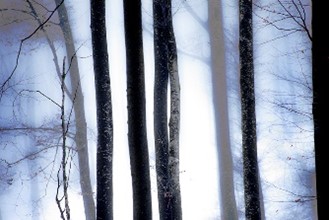
Like myself Radonjič is interested in tree-related photography, believing that photographing trees and forests is a serious artwork.One of hisprojects is dedicated to trees and is published as a book ‘Drevesa’ (trees in Slovenian). In the introduction he refers to trees as social beings, as well as individual characters and to the ancient connection that humans have with them. I was interested that Radonjič says that photographs of trees can add to this hidden connection between humans and trees. He describes the liberating feeling of being in a forest where you are all alone without any distractions as well as being attracted to the “visually intertwined living space” (Wesche, 2022); this is something that I feel strongly. He also describes forests as very visually chaotic and complex as place. His photo book combines poetry and images which he considers synergetic.
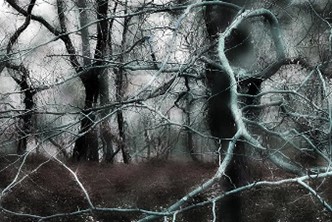
(Radonjič, Trees 2016)

His work Metascapes is about transformation and representing what is in our subconscious. He explains it as transforming places into personal ‘mindscapes’ which reflect his intimate inner relationship with those places. Radonjič describes his images as a mental projection of how we perceive our surroundings, that they “function as “distorted” mirror of the reality we see. They are not pure documentations, but rather artworks somewhere between fiction and abstraction, metaphors of an outlook on the world and beyond” (Radonjič, 2016). On landscapes he quotes the anthropologist Orvar LofgrenThe real landscape is in your head.” Radonjič describeslandscapes as spatially based perceptual units, constructed in our minds as we view the world by means of “aesthetic categories that are socially mediated” (Radonjič, 2016).

You can see in his work Metascapes to achieve this he uses creative intervention in post-production.

 (Radonjič, Metascapes,2016)

He considers colour a very important element in visual art and comments that he uses colours to communicate his vision to the viewers. However, he doesn’t adhere to right or true colours, and this is evident in his work. He explains that he uses postproduction techniques to “transfer inner feelings and memory to photographs”, as he knows what he was experiencing at the moment he pressed the shutter, and using digital tools makes it easier and more effective for me to convey these inner feelings”. He does also point out that using analogue techniques is also a manipulation of reality and believes that using them is another part of a creative path.

My reflections:

His photographic style and final output, particularly his use of post-production work doesn’t particularly appeal to be, but his photographic philosophy does. I sympathise with his ideas on equivalence, metaphor for something beyond the subject being photographed, that there should be room for interpretation by viewers and note his idea that photography can be a transformation as well as a document. His description of place being transformed into personal ‘mindscapes’, that reflect his intimate relationship with those places is part of what I am trying to achieve, but I am also sharing something beyond the forest.

The fact that he enjoys working in forests undistracted and is attuned to Trees as connecting to humans aligns with my practice. His ideas on forests being visually chaotic, is exactly what I am seeking to show in my BOW assignment 3.  

I will consider his comments on not using true colour and may see where that takes me sometime in the future.

Overall, I completely concur with his view that the real landscape is in one’s head.

References:

Radonjič, G. (2015) Trees At: https://gregorradonjic.wordpress.com/portfolio/places-perspectives/ (Accessed 31/08/2022).

Radonjič, G. (2016) Metascapes. At: https://gregorradonjic.wordpress.com/metascapes/ (Accessed 30/08/2022).

Wesche, A. (2022) ‘An Interview with Gregor Radonjič’ In: On Landscape (250). Ed. Tim Parkin. pp.97–118. Found at: https://www.onlandscape.co.uk/2022/02/interview-with-gregor-radonjic/ [accessed 30.7.22)

GUY TAL: COLOUR AS FORM

This article interested me as I have recently made the decision to shoot in colour for the rest of this project. Tal outlines the history of colour in photography and I was interested to learn that in 1946 about a decade after releasing colour film Kodak commissioned photographers, including Paul Weston, to use colour for an advertising campaign. Apparently, Weston was surprised that he enjoyed shooting in colour and maybe only didn’t produce much more in colour, as he was at the end of his photographic career by that stage.

Tal explains that Edward Weston understood that black and white and colour were not interchangeable and a deliberate choice was needed depending on subject and form. Weston suggested colour is needed when it separates the objects in the composition more so than other elements like tone, shape, pattern, or texture; and believed the mistake was in not thinking of colour as form. I hadn’t realised that Weston’s son Cole was a pioneering colour photographer, who said “to see colour as form means looking at the image in a new way, trying to free oneself from absorption in subject matter” (Tal,2022:45).

Tal speaks of colour as a means of subjective expression, and interestingly for my work in Contextual Studies the importance of subjective expression over objective representation if artistic expression is an artist’s goal (Tal, 2022:47). He points out that unfortunately some think that the use of colour may attract viewers attention, instead of skillful composition.

Interestingly like Radonjič , he explains that photographer’s do not have to remain true to colour, just as black and white photographers don’t, as colour can be controlled just as tonality can “many photographers consider colour as something to reproduce rather than as something to control and to use expressively” and suggests that “A good way to think about artistic expression in photography is as the act of creating and using form consciously and expressively” (Tal, 2022:47).

Tal suggests form may be:

  • Rendering 3-d objects onto a 2-d surface using lines, tonality, tonality and colour to create the perception of depth.
  • Form as composition of the meaning inferred from an image, combining visual elements so they express the visual elements to express the artists meaning.

He ends with a quote from Ernst Haas, “The camera only facilitates the taking. The photographer must do the giving in order to transform and transcend ordinary reality. The problem is to transform without deforming.” (Tal, 2022:55).
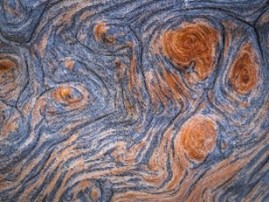
  (Tal, 2022)

My reflections:

It is interesting that like Radonjič doesn’t believe that it is important to retain true colour and that it can be used for subjective expression – I should definitely consider this. He also mentions transforming; I like his challenge to transform without distorting.

Reference:

Tal, G. (2022) ‘Colour as Form: Transforming without deforming’ In: On Landscape 254 pp.41–66. Ed. Parkin T. Found at: https://www.onlandscape.co.uk/2022/04/colour-as-form/ [accessed 27.8.22]

TUTOR SUGGESTED RESEARCH/READING

Gilles Peress

In this interview Giles Peress, he talks about text and images and the new meaning that forms beyond the two. It is a conversation between Peress and Gerhard Steidl publisher of his book Whatever you say, say nothing (2021). This book is a response to his time in Northern Ireland in the 1970s, images combined with much contextual material which he calls “documentary fiction”. Peress sees an enormous gap between language and reality. These are the points that I found most interesting:

  • Perez makes books to process possible traumas and relationship to everything, in the book for him “everything happens”.
  • He says he is suspicious of attempts to construct definitive documentary or “stable truths”.
  • He explains that the title is the essence of a book as it is the Gestalt of the idea (an organized whole that is perceived as more than the sum of its parts) and leads to what it can become- it gives you a clear vision of what you are doing. So, you should continually refer back to the title; I do this when writing, but do I do it always when shooting?
  • He describes how when he sees something that slows down the narrative in the book that he “kills” it. This is good advice.
  • He says that there are many voices in a book, primarily, reality, you and the interpreters, so there is a multiplicity of authors in a book.
  • Peress suggests that the actual process of making a book, is very important, as photography explores what happens between the moment of perception and the moment of the work, which brings a space in which different ideas take shape.

Reflection: His ideas give some good advice on book making and narrative.

Reference:

Peress, G (2022) DBPFP22: Gilles Peress (s.d.) At: https://thephotographersgallery.org.uk/dbpfp22-gilles-peress (Accessed 07/09/2022). At: https://thephotographersgallery.org.uk/dbpfp22-gilles-peress (Accessed 07/09/2022).

DUST BREEDING MAN RAY (1920)
 (Man Ray, 1920)  (Man Ray, 1929)

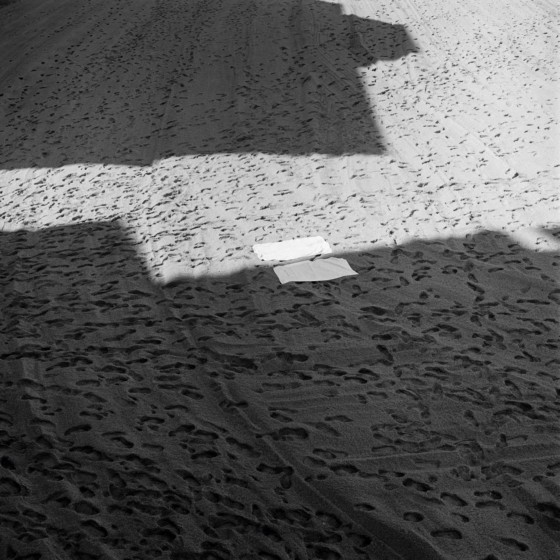
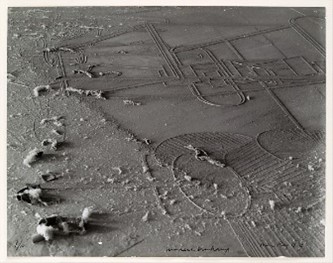
Man Ray photographed the large glass sheet in Duchamp’s studio after a years’ worth of dust, using a two-hour exposure to capture the texture and variety of debris on the glass surface. Company tells us that Man Ray cropped the original image down, removing the detail from the contextual details in the background. Company describes it as bearing “little resemblance to the functional photography” and that it was first published in the French surrealist journal Literature, possibly making it the first surrealist photograph (Company, 2005:48).

Man Ray initially titled it “View from an aeroplane,” adding to its ambiguity. As the titles give us information, probably the later title “Dust Breeding” is more informative. Company points put that whether viewed as a macro or micro it looks like a wasteland and his later image Terrain Vague (1929), along with many other images. The subject was eventually set in varnish and sandwiched between glass plates as “The Large Glass.” Apparently, Duchamp wanted it to retain ambiguity with accompanying text as indefinite as possible. 

Company sets out that dust is a trace of what was before the camera, and that the photograph can photograph our attention on such transient things. In semiotics this is an “index” a sign caused by its object. He also suggests that a photograph is an index as it is an indication of the presence of a camera.

Ultimately Company uses the image Dust Breeding as an example that photography has two roles in art, as an art form and as and functional way to document and publicise art forms.

I have always been fascinated by this photograph, so it was good to take the opportunity to study it more closely. Most interesting to me is Company pointing out that I can view an image as a macro or a micro, which I’d not thought of.

References:

Man Ray (1920) Dust breeding At: https://www.metmuseum.org/art/collection/search/271420 (Accessed 07/09/2022).

Campany, D. (2005) ‘Dust Breeding 1920’ In: Howarth, S. (ed.) Singular Images: Essays on Remarkable Photographs. London: Tate Publishing. pp.47–53.

Man Ray. (1929) Terrain vague. At: https://www.centrepompidou.fr/en/ressources/oeuvre/cKL8o8 (Accessed 07/09/2022).

INSIDE THE OUTSIDE COLLECTIVE

This is a landscape photography collective who mediate the liminal space between the world before us and within. The founding members are Al Brydon, Joseph Wright, Rob Hudson and Stephen Segasby, the members explore place making personal representations of landscape, expressing their inner selves and their relationship with the land. Their name was taken from a naturalist and founder of the American national parks’ movement John Muir, who said, “I found that going out was really going in.” (Hudson, 2016).

They use a combination of narrative, metaphor, and investigation, believing that “there’s a big difference between a photograph of something and a photograph about something” (Hudson, 2016).

They are both in the landscape and representing the landscape, so inhabiting two worlds, “the one before us and the one inside us. And when those two worlds collide and intermingle the result can often surprise” commenting on the transformative effect of this combination (ITO, 2016). Referring to a 2016 exhibition by the collective, Hudson says the intention of the photographs often is to make the abstract worlds of thoughts and feelings more concrete through the representation of the physical world around us.

I have been particularly inspired by the work of several of the members, which I now detail below.

References:

ITO (2016) Inside The Outside Collective At: https://www.inside-the-outside.com/about/ (Accessed 08/09/2022).

Hudson, R. (2016) Inside the Outside. At: https://www.onlandscape.co.uk/2016/10/inside-outside-exhibition-photography/ (Accessed 08/09/2022).

ROB HUDSON

Describes himself as a conceptual landscape photographer who uses metaphor and narrative and is often influenced by poetry. He says that landscapes are dependent on how they are imagined through our “intellect”. In photographing them we are representing a physical reality, what we knew before and what we know after being in the landscape and express something of our inner selves.

Hudson explains two ways that we experience the landscape “One is lived, illiterate and unconscious, the other learned, literate and conscious.” (Hudson, 2016).

Talking about his projects he says he has three premises; they are personal, “restrictive” maybe by subject, area, style and or theme and he is passionate about them. To work he develops a backstory to find what he’s trying to convey so he is not overwhelmed when in the landscape. He also shares that contrastingly images can be the start of informing your ideas, though he generally uses words to generate more clarity and more depth about how he feels and what he wants to represent in a project. His preparation method he outlines is similar to my own:

  • Make lists of keywords about my feelings, history, and my associations with the place.
  • Look at previous work by others
  • make a quick list of images to avoid- this I don’t do but it’s a good tip.

He says this means we produce work that is different, think creatively and look inside ourselves to find a way of expressing our ideas.

Hudson is keen on using series of images to strengthen what a photographer is as this allows viewers to make links and engage their minds. Interestingly he shares that he’s interested in John Berger’s ideas about seeing images in series, “how the force of multiples reinforces the potency of individual images…a series of refrains” (Hudson, 2016). I agree with this.

He also talks of trees saying that trees aren’t in competition with one another, but instead exist in a complex web of interconnecting roots and fungi, exactly as I have talked of. His work ‘The Secret Language of Trees‘ is his search for “visual clues to that connectivity and mutual nurturing” Hudson, 2022). He knows this is not documentary, it is subjective and has multiple layers of visual influences.

    The Secret Language of Trees (Hudson, 2022)

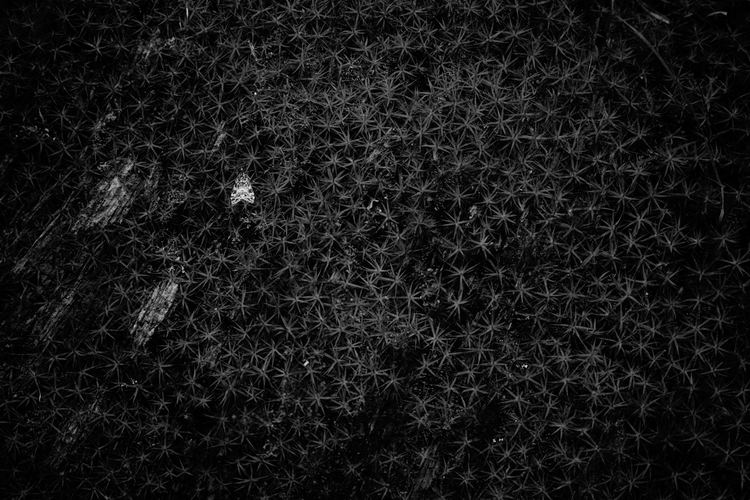
His work Mametz Wood, not taken in that actual wood, but based on a poem about the WW1 of the Royal Welch Fusiliers in in the battle of Mametz Wood, a futile fight for just one square mile of woodland in northern France. This was his starting point to explore the effects of war on the mind, Post Traumatic Stress Disorder in particular. Here he used double exposures to “both disturb reality and create a strange, surreal landscape that explores the experience of, or what was then known as shell shock”, saying that it is not obvious what is real and imagined, just as the victim’s experience (Hudson, 2022).

     (Mametz Woods (Hudson, 2022)

Reflection:

Many aspects of Hudson’s work interest me: His preparation for photographing, photographic intention, his thoughts on working in series, his philosophy and of course his images.

References:

Hudson, R. (2022) Rob Hudson. At: http://www.robhudsonlandscape.net/about (Accessed 08/09/2022).

Hudson, R. (2011) The Skirrid Hill Project: taking ‘thinking like a poet’ to its logical conclusion?. At: https://www.onlandscape.co.uk/2011/04/the-skirrid-hill-project-taking-thinking-like-a-poet-to-its-logical-conclusion/ (Accessed 08/09/2022).

Hudson, R. (2016) Inside the Outside An exhibition of photography. At: https://www.onlandscape.co.uk/2016/10/inside-outside-exhibition-photography/ (Accessed 08/09/2022).

STEPHEN SEAGASBY

Responds to the landscape on a physical, mental, and emotional level, using metaphor, impressionism, abstract expressionism, and his emotional response is important. He believes sequences are important and that too many questions that are left unanswered in a single image, where a group of images offers the viewer greater insight into the story or the photographer’s work.

In May 2015 he spent time alone in the Forest of Dean, describing this as the most important of his work, in developing a concept and outcome that was unexpected. When he developed his films, he found most images scattered with dark shadows creeping and oozing across the landscape. The more he looked the more he “began to ‘see’ the very essence of the forest as I had perceived it” (Fotofilmic, 2016).  He then printed the images quite small, to draw the viewer in for a personal experience and felt it was most successful as a group of images whilst each one has a narrative of its own.

  Malevolence (ITO, 2018)

His work ‘A Process of Reclamation’ was a long-term series developed around the feeling of walking in the footsteps of those who created the slate quarries. It shows the healing of scars in a post-industrial landscape and depicts a landscape’s journey through time and the change abandonment and natural decay bring to bear. However, it also hints at the healing of our inner scars (Hudson, 2016).

Reflection:

Like Hudson he talks of the importance of value of working in a series, uses metaphor in his work, but also shows how unintended outcomes can be used for a good outcome.     

References:

Colwyn, O. (2019) Inside the Outside – Out of the woods of thought. At: http://orielcolwyn.org/inside-the-outside/ (Accessed 09/09/2022).

Fotofilmic (2016) Stephen Segasby. At: https://fotofilmic.com/portfolio/stephen-segasby-kings-lynn-uk-2/ (Accessed 09/09/2022).

ITO (2018) Out of the woods of thought. At: https://www.inside-the-outside.com/publications/2018-exhibition-book/ (Accessed 30/09/2022).

Parkin, C. (2019) Stephen Segasby. At: https://www.onlandscape.co.uk/2019/10/stephen-segasby/ (Accessed 09/09/2022).

TOM WILKINSON

Tom Wilkinson’s work explores identities of place and of self. He finds he then discovers “something about the nature of how the photograph functions within them and about the nature of the moment of experience” and gains a sense of belonging (ITO, 2016). He says that in photographing landscape you are giving an opinion of it, and so it says as much about the photographer as it does the land.

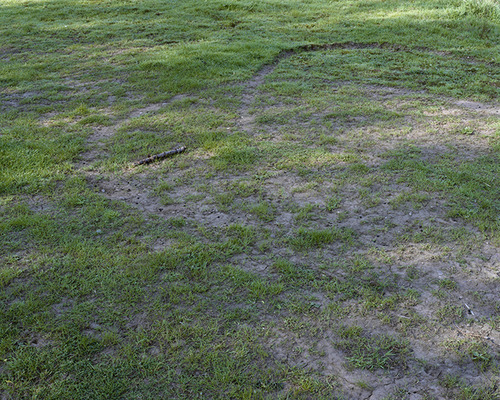
Talking of his work Nothing remains, says the work suggests the presence of an absence, of something that has been before now only seen within the present, describing it as “both visual and a philosophical enquiry into the way memory and identity function with regard to a sense of place(Wilkinson, 2022). He says we have a consciousness of the past within the present, and therefore that if the photograph is memory, a displaced moment in time, then our sense of being-in-the-world is also this way. The series is an attempt to connect this area to the landscapes of his past and to question his identity within it.

    Nothing remains (Wilkinson, 2022)

Reflection:

I like his description of the past within the present and photograph as memory displaced in time.

References:

ITO (2016) THE ITO EXHIBITION (2016) | A virtual tour and review by Tom Wilkinson Nov 6, 2016. At: https://www.inside-the-outside.com/ito-exhibition-review-tom-wilkinson/ (Accessed 09/09/2022).

Wilkinson, T (2022) Nothing Remains. At: https://anotherplacemag.tumblr.com/post/102616659632/nothing-remains-tom-wilkinson (Accessed 09/09/2022).

Wilkinson, T. (2022) Tom Wilkinson Art Photography. At: http://www.i-m.mx/tomwilkinson/ArtPhotography/about (Accessed 09/09/2022).

J M GOLDING

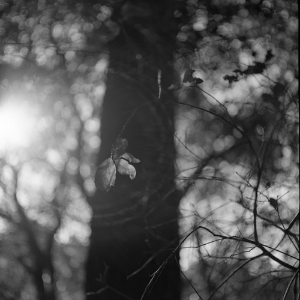
She uses a variety of cameras and techniques, vintage film camera, pinhole, a plastic Holga or Diana, alternating between single and multiple exposures, to explore and transform her experiences with the world. Golding describes a flow state, an almost automatic, yet highly absorbed state of consciousness, and finds, alters, and creates metaphors to share her subjective experience. She says there is “something compelling about the ways photography can be used to transform “objective” reality” and talks of transcending the literal appearances of subjects to metaphors for internal experience, and share personal meaning (Golding, 2022).

Her images have transformed reality in ways that can be quite surprising to her conscious self. In her work Before there were words, is about proverbial experience that we retain, have in our unconscious minds, and might not share through words. The photographs speak of pure actuality, that moment before verbal labels rush in to change experience (Benbow, 2016).
(Golding, 2022) 

My reflection:

I was interested in the way she describes the “flow state” that she works in when self-absorbed. I can align with Golding’s photographic philosophy, particularly her description of “transcending the literal appearances of subjects to metaphors for internal experience” (Golding, 2022). Also, her view that the world illuminates what’s in our subconscious and brings it to the fore.

References:

Benbow, C. (2016) Interview with photographer J.M. Golding. At: https://www.fstopmagazine.com/blog/2016/interview-with-photographer-j-m-golding/ (Accessed 09/09/2022).

Golding, J.M. (2022) At: https://www.jmgolding.com/before-there-were-words/wigdebnrfagnyp1cf1wr96rfxg7jll (Accessed 09/09/2022).

Golding, J. M. and LensCulture (2022) Falling Through the Lens – Interview with JM Golding. At: https://www.lensculture.com/articles/jm-golding-falling-through-the-lens (Accessed 09/09/2022).

Next post: https://nkssite6.photo.blog/category/body-of-work/bow-assignments/bow-assignment-3/bow-a3-learning-log/

BODY OF WORK COURSEWORK: PART THREE SHOWING NOT TELLING

My notes:

Different levels of meaning: literal (Communication/facts/information), metaphor (beyond the first level of meaning: metonym, rhetoric, symbol, connotation, innuendo, euphemism).

  • Interesting that coursework says that showing something that cannot be seen is difficult to accomplish.
  • Note the suggestion that a reader is hoping for their imagination to be sparked and to be able to bring their personal interpretation to the work.
  • Also that joint input from author and reader is most satisfying.

Showing not telling helps to achieve this.

Editing ask yourself:

  • Will the image stand as a visual piece on its own?
  • Is the image adding anything new or emphasising the point I want it to?
  • Is it detracting or contradicting from the rest of the series?
  • Am I overlooking any less striking work because of aesthetic concerns that may be secondary to the impact the piece will have on final reading?

Sequencing consider:

  • Consider heightened suspense, change in direction or narrative and how the sequencing guides the viewers response

Image and text:

  • Barthes- anchor: the text is there to fix the meaning of an image, with little room for negotiation.
  • Barthes – relay: equal weighting to text and image

Q: How might I use some of these techniques to help convey my ideas to viewers? Showing not telling is essential to my BOW project, metaphor, rhetoric, symbol, and connotation are central to my work.

Q: Have you considered how you will use text in your project? Will this be through individual captions or are you planning a more extensive textual element? I will need to signpost the work for my viewers and will do so this times with simple with captions which will be antonyms to intrigue the viewer and allow for personal interpretation.

Next post: https://nkssite6.photo.blog/category/reflective-journal/personal-reflections/bow-reflections/bow-3-reflections-prior-to-starting/

BODY OF WORK COURSEWORK: PART TWO CHANCE

“Letting a thing come, rather than creating it … in order to gain access to all that is genuine, richer, more alive: to what is beyond my understanding.” (Gerhard Richter 1985, cited in Iversen (ed.), 2010:158). Trusting that not having a fixed plan can lead to greater discoveries.

The course work took me through street photography again but having learned much about this previously, I took the signposting to the “chance involved” but moved on.

Likewise, the course manual represented found photography which I have already research a few times so used it as an opportunity to refresh myself, and the highlighted point that mistakes can lead you forwards.

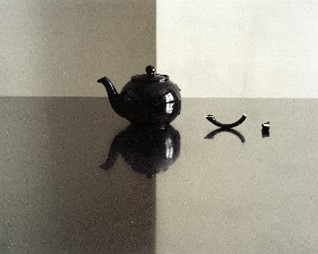
I was most interested in the section on accidental slips, in particular the work of David Bate “Bungled Memories”. Here using still life Bate captures broken domestic items, he signposts the unconscious messages given in the work through his captions:

                               The wrong idea A badly handled thought (Bate, 2022)

His work Broken society similarly uses the captions to anchor meaning in his work:

A selfishness of a cooking dish               An glass without discipline glass (Bate, 2022)

As I am using text to signpost my current work I took a good look at his work and found that sometimes he signposts the unobvious representation in his work and sometimes just captions the obvious.

Questions are posed in the coursebook:

Are the artists using their creativity to make art out of worst-case scenarios? In many cases we won’t know if it was a worst-case scenario or simply a chance scenario. Paul Graham in his series American night admitted that his first image was overexposed was a mistake and he then reconceptualised it this is a positive use of a” mistake”. But mistakes are often just a by-product of experimentation. Alec Soth in an interview for the release of his online course Photographic Storytelling, talks about the importance of learning through experience and, acknowledging and overcoming the mistakes, that inevitably occur when photographing career. He shares specific examples of technical errors with Schuman:

(Schuman, 2019)

Soth says “Sometimes imperfections make something even better – which is one of the reasons why I still enjoy shooting on film”

(Schuman, 2019)

Of this photo he says “This is my favourite photo from the last five years. The way the subject and the reflections work together felt like magic”. He is honest in reflecting on the difficulties of accepting making mistakes, as well the positive aspects that this may bring.

Are they cheating? No just using opportunity and creativity if the chance outcome is not hidden from the viewers.

If these works are based on manipulations, do you think that conceptualisation happens to the same extent when the artists are upfront about the ‘mistakes’? Again, I take issue with the term mistakes, which I think is a “red herring”. But yes conceptualisation does take place when artists are deliberate and signpost them. Stephen Gill is a photographer adept at letting your curiosity lead you and finding ways of allowing chance and intention to work together- relinquishing authorship in some way. His work Buried (2005-6) was a collaboration between himself and the place and stepping back as the author. Gill took photographs of Hackney Wick and then buried them beneath the ground:

  • Would you be comfortable with covering up a technical fault in order to make the work have more impact or to give it more conceptual rigour? Yes, as other artists have shown the best work is often made from something that was not produced to plan or didn’t have a plan.

As I move into assignment 3 I will ask myself as suggested:

  • Is my work taking on a direction of its own? Am I ready to go with it?
  • Is the strategy I am currently developing the kind which is most suitable for the work?
  • Am I resisting a certain direction due to effort, a closed mind, or another reason?
  • Has chance intervened in your work to date and how might you allow for it a bit more?

References:

Bate, D. (2022) Bungled Memories. At: https://www.davidbate.net/bungled-memories (Accessed 08/09/2022).

Bate, D. (2022) Broken Society. At: https://www.davidbate.net/broken-society (Accessed 08/09/2022).

Boothroyd, S (2020) Body of Work. Barnsley: Open College of the Arts.

Gill, S. (2022) portfolio » Portfolio. At: https://www.stephengill.co.uk/portfolio/portfolio/nggallery/album-1-2/buried (Accessed 08/09/2022).

Schuman, A. (2019) Alec Soth on Learning From Failure • Magnum Photos. At: https://www.magnumphotos.com/theory-and-practice/alec-soth-learning-from-failure/ (Accessed 08/09/2022)

Nextpost: https://nkssite6.photo.blog/category/body-of-work/coursework-body-of-work/part-three-showing-not-telling/coursework-notes/

BODY OF WORK COURSEWORK: PART ONE GENRES

GENRES OVERVIEW AND GENRE HOPPING

We are asked in the coursebook to reflect on the significance of genre as a photographic concept.

Bate writes that genre was introduced in film theory to introduce more systematic thinking and to “encourage the question of the social and cultural function that genres perform”, the use of conventions for structuring (Neale, 1990:3). He explains that ascribing a genre to work in photography creates an expectation for the meanings to be derived from them though they are “promiscuous” as in they are not mutually exclusive.

The question was posed in the coursebook about genre “if the boundaries between genres are blurred, how useful is genre as a concept?” (Boothroyd,2020 :42). I would say that genres are useful as a way of sharing expectations and meanings, however in turn they may be limiting to both the photographer and the viewer if they are accepted rigidly. What I have learned from my revisiting of some genres here, is that there are elements of overlap and indeed elements of some genres which can be taken across to other genres deliberately – and I may try this.

References:

Bate, D. (2009) Photography: The Key Concepts. New York: Berg publishers.

Boothroyd, S (2020) Photography 3: Body of work coursebook. Open College of the Arts. Barnsley.

Neale, S (1990) Questions of Genre, Screen (Oxford university press, volume 31, number 1, spring 1990, p45) cited in: Bate, D. (2009) Photography: The Key Concepts. New York: Berg publishers.

Next post: https://nkssite6.photo.blog/category/body-of-work/bow-assignments/assignment-1/a1-learning-log/

BODY OF WORK COURSEWORK: PART ONE GENRES

RESEARCH POINT: CONCEPTUAL PHOTOGRAPHY

John Hilliard talks about being known as a conceptual artist in the 1960s and 70s. Hilliard is still taking photographs today. Watch the video What is Conceptual Photography? (SOURCE Photographic Review, 2012) and then write a paragraph explaining what you understand by the term ‘conceptual photography’. Provide some examples of recent work that you believe falls into this category. (Boothroyd, 2020:41).

My response:

The video discussed conceptual photography predominantly in relation to the art movement of the late 60s. It was suggested that though the term “Concept” is important for understanding modern work, artists don’t use the term it is more commonly applied by others. In the late 60s artists were working in many ways that were difficult to categorise or even talk about, and the term conceptual art seemed to give a greater rationale for talking about the work. It was also suggested that as Modern art was different from what viewers were used to, the work is more dependent on documentation. It was suggested that some conceptual photographers claimed not to be interested in fine art or outstanding examples of photography.

Hilliard calls conceptual photography a prescriptive activity, such as when he drafts out the idea before taking a photograph. This becomes a “nameable” a set of ideas which you can speak about; and if the purpose is to embed the ideas in the image, then they are in turn intended to be retrievable. Hillard explained that his conceptual art must be contextualised by what is around it, as different contexts can give it quite different readings.

Additional research to illustrate this:

During the 60s and 70s photography became used by conceptual artists to record their ideas and projects. Liz Wells (2015) writes that where Modernist theory had focused on the medium of photography, Conceptual art focuses on ideas rather than objects; with artists concentrating on the way they have expressed themselves an as Hilliard suggested the contexts of interpretation, as well as the influence of the situation to which a viewer might respond.

Photography can be a useful bridge between conceptual art and the gallery. It doesn’t have to have traditional aesthetics, “its beauty could emerge in the clarity of ideas” (Company, 2012:17). Some say that form in photography is not important to conceptual artists, however once photography was accepted into conceptual art, importance was given to its form.

(MoMA, 2021)

Douglas Huebler a pioneer of conceptual art, used his work to challenge photography’s documentary abilities. From 1970 he made a series of “Duration Pieces”, “Variable Pieces”, and “Location Pieces”, documenting everyday activities with photographs, drawings, maps, and text. He experimented by shooting at intervals of 5 miles, 5 yards, or 5 feet, where it was the information, not the technique, the composition, or the material that mattered. He said he only aimed to state the existence of objects in the world.

(Mutual art 2021)

Within the document above he shares that several photographs were made to document various aspects of “everyone alive”, and one was chosen to represent “At least one person who is most probably more interesting than the artist” (Huebler, 1971). I find his concepts perplexing, but this is one of the purposes of conceptual art, provoking thought.

The conceptual artist Keith Arnatt made a series of images “Self-burial” and broadcast them on television over several days, intriguing viewers. His work plays with themes of trace and an artist’s presence in the landscape. He didn’t consider himself an artist but used photography to document his concepts, such as the notion of the invisibility of the artist.


Conceptual art interests me more than it used to. It is photography that illustrates an idea, but I would say and abstract idea. In this way to me it has some things in common with theatrical/cinematic photography: construction, layering and ultimately ambiguity. I am surprised to find after revisiting conceptual photography that it may have some influence on my photographic project, and I do have other conceptual photographers that I am holding off sharing my research on for now.

References:

Boothroyd, S (2020) Photography 3: Body of work coursebook. Open College of the Arts. Barnsley.

Campany, D. (2012) Art and Photography. (s.l.): Phaidon Press.

MutualArt (2021) Douglas Huebler. At: https://www.mutualart.com/Artwork/VARIABLE-PIECE–70–IN-PROCESS-/7DCC8CAF45EE01F4 (Accessed 18/09/2021).

SOURCE Photographic Review (2012) What is Conceptual Photography? (Part 1). At: https://www.youtube.com/watch?v=Mc-BQZ8SvRw (Accessed 07/10/2021).
MoMA (2021) One and Three Chairs. At: https://www.moma.org/learn/moma_learning/joseph-kosuth-one-and-three-chairs-1965/ (Accessed 18/09/2021).

Sritharan, B. (2015) Keith Arnatt: the conceptual photographer who influenced a generation – 1854 Photography. At: https://www.1854.photography/2015/09/keith-arnatt-the-conceptual-photographer-who-influenced-a-generation/ (Accessed 19/09/2021).

Wells, L. (2015) Photography: A Critical Introduction. Abingdon: Routledge.

Next post: https://nkssite6.photo.blog/category/body-of-work/coursework-body-of-work/part-one-genres/genre-as-a-photographic-concept/

BODY OF WORK COURSEWORK: PART ONE GENRES

Research point: Psychogeography

Psychogeography can be described as, responding to a physical space in a literary or artistic manner, and recording and analysing the emotions, feelings, and ideas of being in these spaces. The person capturing this may be called a Flaneuse who drifts through a place responding to the environment.

I have encountered work like this with literacy outcomes when reading the work of Robert MacFarlane who has written various books such as Underland (Macfarlane, 2020) and the Wild Places (Macfarlane, 2007). When writing these he walks through landscapes and responds in prose to his experience, adding amongst other subjects discussions of his concerns on the relationship of man to his landscapes. Roger Deakin’s book Wildwood: A journey through trees (2008), is of particular interest to me; here he explores first by walking and then by writing mans relationship with trees.

I also listened to a very interesting podcast about the Flaneur (BBC, 2016) which led me to the work of Lauren Elkin and her book Flaneuse: Woman walk the city. (2021). If I am to go deeper into this genre, I will explore the writings of Charles Baudelaire and, more currently, Will Self, Iain Sinclair, and Ken Worpole.

I have briefly at this point, explored some work of suggested photographers working in this genre:

Francis Alÿs

Though he often explores cities on foot to inspire his work, his outcome is usually performative art exploring human engagement and the human impact on the environment, I find hard to relate currently to much that I have seen of his work. His work Seven Walks (1999-2005), where he walked the streets of London and represented it through a range of media including photography, leaves me wanting to understand his methodology (Artangel, 2021).

He uses poetic and allegorical methods to address various realities and “addresses anthropological and geopolitical concerns through observation of engagement with everyday life” (Zwirner, 2020), and much of his work is videos. In the work below 2004 in Jerusalem, he walked trailing green paint, along the armistice border, known as ‘the green line’, which had been pencilled on a map by Moshe Dayan at the end of the war between Israel and Jordan in 1948. Though bewildering to onlookers, apparently his action did bring back memories of the green line when the separation fence, was being constructed to the east of the green line. His action did cause discussion and reflection from Israel, Palestine, and other countries.  

antiAtlas (2013) Francis Alÿs – The Green Line

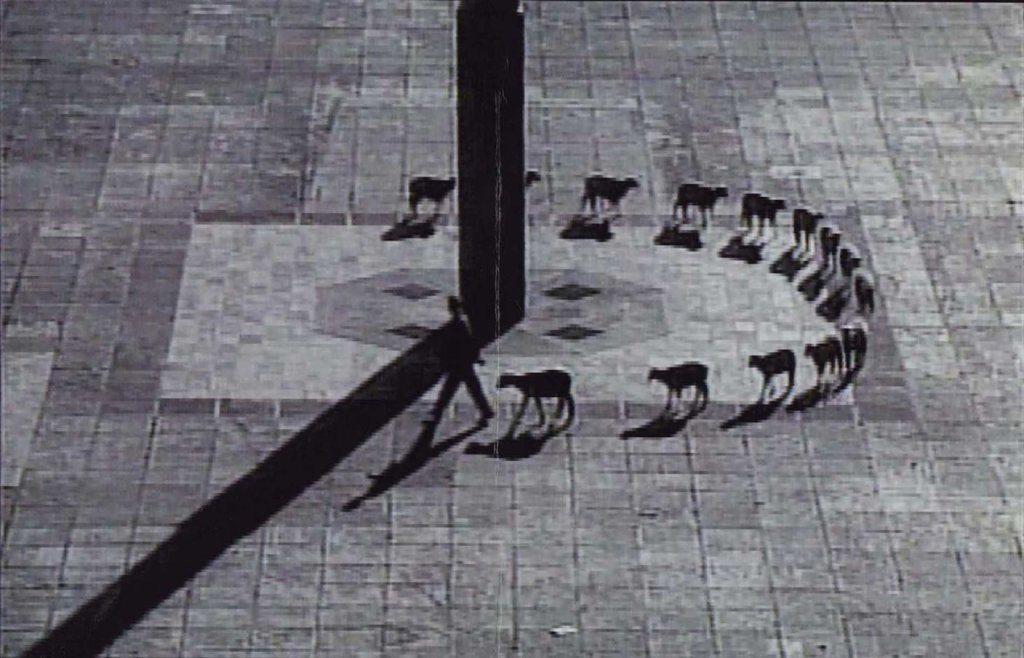
He uses land-based and social practices that examine individual memory and collective mythology, as well as shared cultural histories, urban engagement, and the human impact on the environment. One piece of his work that I can engage with is Patriotic Tales which documents the artist’s re-enactment of a moment in Mexico’s political history. Here Alÿs leads a flock of sheep in single file round a flagstaff in the ceremonial square in Mexico City. In this work he mirrors an event when civil servants were forced to congregate in the Zócalo to welcome the new government, and yet “bleated like sheep to mark their protest” (Francis Alÿs, 1997). Though this strikes me as conceptual work more than psychogeographic.

Francis Alÿs, Cuentos Patrioticos (Patriotic Tales), 1997 (still)

I do find interesting how he combines psycho-geography with conceptual art in my mind. I may return later to his work; and it does also illustrate another outcome as a response to place.

Stephen Gill

A conceptual artist used various unusual techniques to document Hackney to “encourage the spirit of the place to become trapped in the emulsion like amber creating a series of surreal interventions in the photographs” (Galerie, 2021). His techniques like inserting detritus into the camera body, and burying images, do not appeal to me but once again it demonstrates how broad a photographic response to a place can be.

(Stephen GILL, 2021)

Mark Power

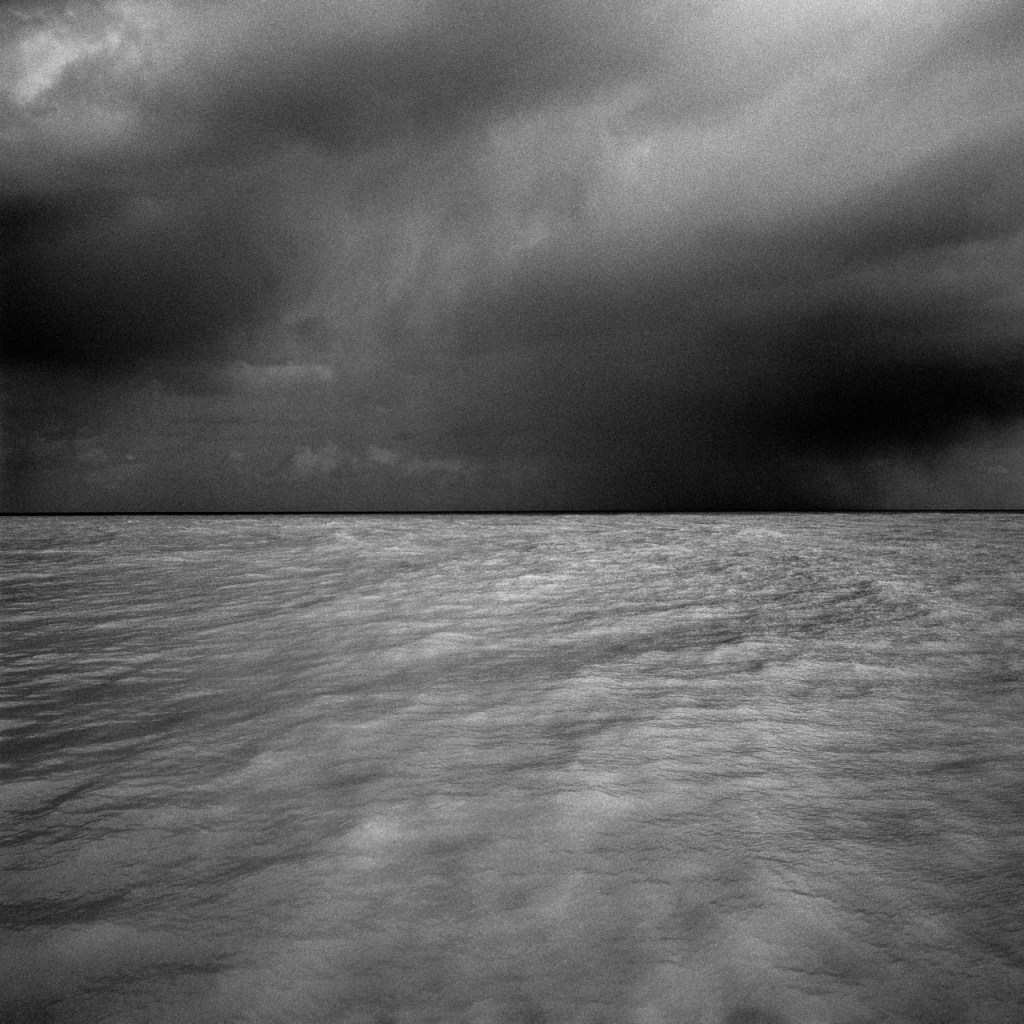
My foray into his works led me to 2 projects The Shipping Forecast (1993-1996) a poetic response to the language of the report “I was looking for pictures that were visual metaphors for the spoken words” (Magnum, 2018).

Mark Power WIGHT. Saturday 18 February 1995. North-westerly backing south-westerly 6 or 7, increasing gale 8 for a time. Showers then rain. Good becoming moderate or poor. © Mark Power | Magnum Photos (Magnum, 2018)

Mark Power BISCAY. Saturday 27 July 1996. Northerly 4 or 5 backing north-westerly 3. Mainly fair. Moderate with fog patches in north. © Mark Power | Magnum Photos (Magnum, 2018)

His other project that struck me was 26 different endings (2003-2006) where he photographed the places that fell off the edge of the London A-Z street atlas – a very interesting concept. I will definitely explore his work further to support me with my own ideas.

Debra Fabricius

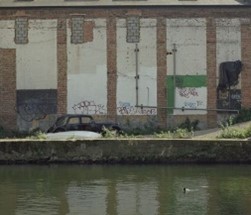
She is a self-confessed Flaneur who explores the spaces around her, it is unfortunate her web site is no longer accessible. However, I have found her MA work Urban drift on the University of Westminster website.  Urban drift focused around a 9 mile stretch of Regents canal with an “an archaeological way of seeing and the process of a journey within a city” (Hull, 2020) a fragmented and fragile space and how the social, cultural, domestic, and industrial have impacted on the space. I would have liked to be able to see more of her work.

(Hull, 2020)

I am particularly interested in how she infuses her images with the feelings that she absorbs as a Flaneur and how they “create a platform for a story to be told” (Boothroyd,2020:39) and this is what I would like to do with my work, infuse images with feelings and tell a story.

What I take away from my initial research on psychogeography photography:

This genre could be an interesting starting point for my assignment 1 as I ultimately hope to infuse images with the feeling and spirit of a place whilst telling a story. My research has also opened my perspective on ways to respond and represent my experience of place. I will explore further some of these photographer’s work.

I am asked to answer the question: In terms of psychogeography, do you think it’s possible to produce an objective depiction of a place or will the outcome always be influenced by the artist? Does this even matter? Feel free to answer this with reference to the artists discussed in this section – or any others you’ve come across. (Boothroyd,2020:40).

My response:

It seems unrealistic to expect a flaneur to produce an objective representation of a place, as it is accepted that the purpose of a Flaneur is to absorb and express the spirit of a place. So no, as outlined in my research above, the value of the work of such photographers is in their ability to communicate what they see/feel about a location or journey.

References:

AntiAtlas (2013) Francis Alÿs – The Green Line – antiAtlas of borders. At: https://www.antiatlas.net/francis-alys-the-green-line-en/ (Accessed 06/10/2021).

Artangel (2021) Pebble Walk At: https://www.artangel.org.uk/artwork/pebble-walk/ (Accessed 12/09/2021).

BBC (2016) The Flaneur – Walking in the City (2 May2016) In: BBC 2 May 2016 At: https://www.bbc.co.uk/programmes/b0787dmb (Accessed 12/09/2021).

Boothroyd, S (2020) Photography 3: Body of work coursebook. Open College of the Arts. Barnsley.

Deakin, R. (2008) Wildwood: A Journey Through Trees. (2008): Penguin UK.

Galerie, C. G. (2021) Stephen Gill. At: https://christopheguye.com/artists/stephen-gill/biography (Accessed 12/09/2021).

Hull, S. (2020) Graduate Photography Online 2010: University of Westminster MA Photographic studies. Debra Fabricius. At: https://www.source.ie/graduate/2010/westunivma/westunivma_folder/westunivma_student_folder_09_59_22_26-04-10/westunivma_student_details_09_59_22_26-04-10.xml (Accessed 12/09/2021).

Macfarlane, R. (2018) The Wild Places. (2018): Granta Books.

Macfarlane, R. (2020) Underland: A Deep Time Journey. (s.l.): Penguin Books, Limited.

Magnum (2018) The Shipping Forecast. At: https://www.magnumphotos.com/arts-culture/society-arts-culture/mark-power-the-shipping-forecast/ (Accessed 12/09/2021).

MoMA (2011) Francis Alÿs: A Story of Deception. At: https://www.moma.org/calendar/exhibitions/1091 (Accessed 08/05/2011).

Power, M. (2021) 26 DIFFERENT ENDINGS. At: https://www.markpower.co.uk/projects/26-different-endings (Accessed 12/09/2021).

Stephen GILL (*1971, Great Britain) and Stephen GILL (*1971, Great Britain) (2013) Stephen Gill. At: https://christopheguye.com/artists/stephen-gill/selected-works (Accessed 06/10/2021).

Zabludowicz Collection (2021) Francis Alyss. At: https://www.zabludowiczcollection.com/collection/artists/view/francis-alys (Accessed 06/10/2021).

Zwirner, D. (2020) Francis Alÿs – Artworks & Biography. At: https://www.davidzwirner.com/artists/francis-alys (Accessed 15/06/2020).

Next post: https://nkssite6.photo.blog/category/body-of-work/coursework-body-of-work/part-one-genres/research-point-conceptual-photography/

BODY OF WORK COURSEWORK: PART ONES GENRES

RESPONDING TO THE ARCHIVE

Reading an archive: Allan Sekula

At a time when we are inundated with people taking photographs it has become increasingly commonplace to look back at photographs that would otherwise be lost to history. Thinking about photographs and creating stories, re-contextualising them for a contemporary audience, are important considerations for practitioners working in this genre.

Please refer to Sekula, A. (1999) ‘ Reading an Archive: Photography between Labour and Capital ‘ In: Evans, J.H. (ed.) Visual culture: The Reader. London: SAGE. pp.181–192. (Boothroyd, 2020:30)

Post:

This essay Sekula uses the example of an archive of Mining photographs in the Cape Breton region between 1948 and 1968 made by a commercial photographer Leslie Shedden; these were for the coal company and the coal miners. Sekula says that his aim is to understand the relationship between photographic culture and economic life, “How does photography serve to legitimise and normalise existing power relationships?…how is social memory and historical memory preserved, transformed, restricted and obliterated by photograph?” (Sekula, 1999, p 182).

He explores what photographic archives are: Commercial, corporate, government, museum, historical, collectors for instance. All of which are the property of individuals and defined by their ownership which he calls a “territory of images”. He points out that unusually photograph are often in archives that are not owned or controlled by the author. This means that their meanings may be reinterpreted. He is right to point out that whilst photographs used to be thought as absolute truths “meaning is always directed by layout, captions, text, site and mode of presentation” (Sekula, 1999:194).  So, archives are never neutral, and rely on institutions for their authority, and though it is today accepted that the truth in an image is an interpretation, sitting in an archive influences their reading. 

Sekula also considers the effect of an archive if we simply treat photographs as artworks. He concludes that then the archive becomes an inventory of aesthetic achievement, but then concludes that to consider the collector as an artist themselves is a romantic indulgence.

Photography is both an art and science, though a subjective experience and not as objective as science. Returning towards the end of his essay to the archive of mining images, he points out that this is a mixture of official pictures, private pictures, and personal pictures which are not mutually exclusive categories. This of course may not be so in other archives.

When viewing an archive readers need to be well aware, just as they should be in curated exhibitions, that the meanings and purposes of the photographs may be supplanted by the change of context caused by how they have been collected/arranged. Meaning in photography is most affected by context, and as Sekula points out the archive can never be neutral. Furthermore, I would suggest that if a photographer is to use and archive for their work you then have the possibility of a further mutation of meaning.

References:

Boothroyd, S (2020) Photography 3: Body of work coursebook. Open College of the Arts. Barnsley.

Sekula, A. (1999) ‘ Reading an Archive: Photography between Labour and Capital ‘ In: Evans, J.H. (ed.) Visual culture: The Reader. London: SAGE. pp.181–192.

Next post: https://nkssite6.photo.blog/category/body-of-work/coursework-body-of-work/part-one-genres/psychogeography/

BODY OF WORK COURSEWORK: PART ONE GENRES

Tableaux

Research point: Gregory Crewdson and theatricality in art.

Gregory Crewdson is a photographer who operates with strong directorial control in his image- making. His photographs function like film stills to the point where there is arguably not much ‘reality’ left in the scene”.

Do some research into Gregory Crewdson online and for a broader discussion on theatricality in art try to find a copy of Fried (2008) ‘Why Photography Matters in Art as Never Before’ at your nearest large library (Boothroyd, 2020:22).

I visited an exhibition of Crewdson’s work Cathedral of the Pines (2013-14) at the Photographer’s gallery in 2017.  I then described each of his images as elaborately constructed melodrama “every shot is crafted to the tiniest detail and contains a multitude of layers –narrative, photographic and psychological” (Plowright, 2017).  Crewdson “discovered an ability to read and understand a still image, to analyse the way an artist had framed, lit and composed a subject, as a child” he says that “It came very naturally to me…I grasped how a photograph is connected to our actuality, but also has way of fictionalising our realities as well.” (British Journal of Photography, 2017).

This series evidences his strong directorial control. To complete the work, he staged 3 productions with crews over 2 years; with an image in mind, he formed scripts so that the actors knew exactly where to stand, and he describes the carefully selected actors as empty vessels. Lighting is important in all photography but is the very essence of Crewdson’s images; in thus series he worked with quieter less substantial lighting than usual, making the most of ambient light usually if set inside, with daylight entering from outside through doors and windows; he uses window frames frequently in these images, supposedly to reference the act of looking through the window at another world.  The images are strongly cinematic whether shot in or outside. His work is never a single image but is collaged from different shots.

Crewdson considers himself a storyteller but his photographs unlike other narrative forms have no beginning and end, are condensed, and remain mysterious:

“It’s important to me that the setting for my pictures feels familiar. The settings, the props, the costumes, the subjects, they are supposed to feel ordinary, but then I use light and color and mood and atmosphere to charge it in some way.” (Time.com, 2017).

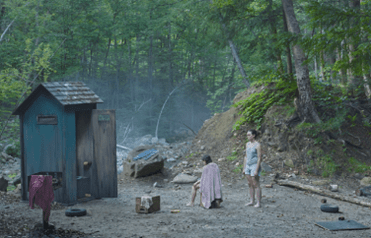
The images concentrate on one, to three figures, involved in an enigma or caught in a blank or reflective state, hinting at invisible challenges, though what these challenges are, and what fate awaits these blank figures, are left to our imagination. In The Haircut (2014) Crewdson places the characters in the heart of the forest as with many of the images:

(Thephotographersgallery.org.uk, 2017b)

The broken shed/toilet behind them appears in several of his shots. The two teenagers, one seated after a haircut stare passively, as is usual in these images. Why is there a bicycle on the floor? Does it connect him to his childhood? The dirty blankets are there again, but why is the tyre on the floor? As a viewer I know that everything is there for a reason. In the middle of this forest their actions are suburban which provides the uncanny element and an open-ended narrative.

As in Woman in parked car (2014):

(Trendland, 2017)

He often shoots in the twilight of dusk, although the mist may be added for effect. A woman apparently in only her underwear sits in the cab of a car, whilst a man stands inside at the sink also staring into space. The driver’s door is open, why? The cabin door is open as many of the doors in his images are.

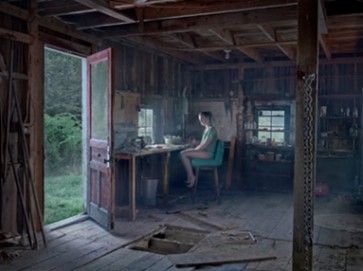
Crewdson achieves the look of the surreal by placing characters in uncomfortable situations, though often you have to look harder for the uncanny elements. In The Barn (2013):

(My Favorite Arts, 2021)

A girl with a non-expression staring at dead flowers on a bench, sits in a dilapidated barn with the door open. Look closely and where the floorboards are up, suggesting a hiding place, and dead birds lay on a shoe box lid, next to the void. As a viewer I am beset with questions that I have no answers to.

This series is produced in the same way as most of his work, with huge production teams, lighting plans, purpose-built sets, and strong direction- he has control of everything. Crewdson adopts the mechanics of the cinema to stunning effect; his images remind me of stills from a dream. There is plenty of narrative in his work, but unlike most theatre there is no beginning or end to his series. Ambiguity is key in his work and usually incorporates psychological tension. Whilst he creates stories from the ordinary, the cinematic scale of his work turns the ordinary into hyperreality I think. 

Further research on Tableaux:

In Tableaux photography pictorial narrative is concentrated into a single image. Tableaux’s roots were in pre photographic art and particularly the figurative painting of the 18th 19th century; the compositional devices are often used which are “similar to renaissance painting, the angles and objects …directing us through the picture and leading our understanding of the action and narrative” (Cotton, 2015, p50). Tableaux images are of “something that we know is significant because of the way it’s set up in the photograph, but whose meaning is reliant on our investing the image with our own trains of narrative and psychological thought” (Cotton, 2015, p49).

The set of the image has the look of a theatre set viewed from on stage, and the use of actors and crew redefines the photographer as a conductor or film director. The dramatic use of cinematic lighting supports the idea that it is a theatrical blend of reality and storytelling, whilst ambiguous drama adds to the viewer’s narrative.

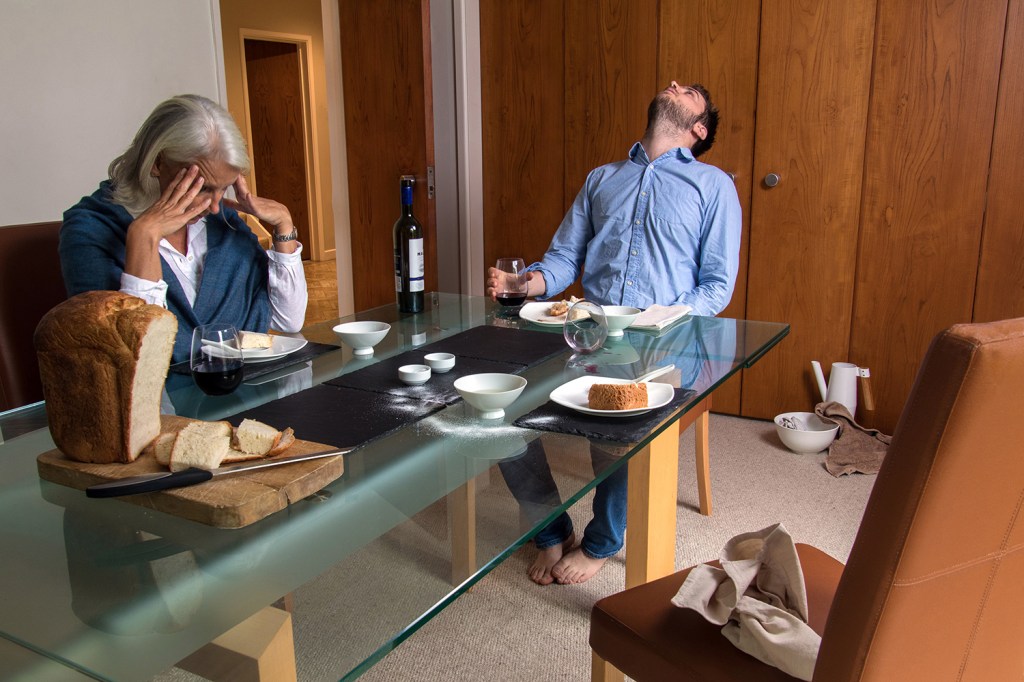
I experimented with Tableaux in my own work during my context and narrative course for assignment 5 “making it up” (South, 2017). I constructed it to express a personal reflection on stressful mealtimes, following a spoiled meal I often resolve never again to cook a special meal, thus the title “The Last Supper” came to mind. I researched Da Vinci’s version of painting, along with other’s and thought it would be interesting to borrow some of its visual symbolism, motifs, and choreography to add interest and emphasis to my modern tableaux- vivant.

(South, 2017)

For this constructed reality I wanted to achieve the look of a fabricated theatre stage, but with a rich seductive aesthetic, despite some disturbing detail. It is a narrative of memories, reshaped and refabricated to the minutest detail, as. The props are the clues to the implied disturbance – the punctum. I want the reader to notice the deliberate way the photograph is set up and realise their significance. 

Tom Hunter’s classically inspired modern scenes helped me to continue with my own fabrication of the last supper. Hunter often constructs his work around stories in the local newspapers such as his series Living in Hell, are carefully constructed tableaux re-enacting incidents reported his local paper the Hackney Gazette is a homage to the pre-Raphaelites. “Living in hell” references Gauguin, the Le Nain Brothers, Constable, and Ingres (Adage.com, 2021). This image was inspired by Vermeer’s “Girl reading a letter”, except that this girl he is a squatter reading a possession order (Pulver, 2021):

(Telegraph.co.uk, 2021)

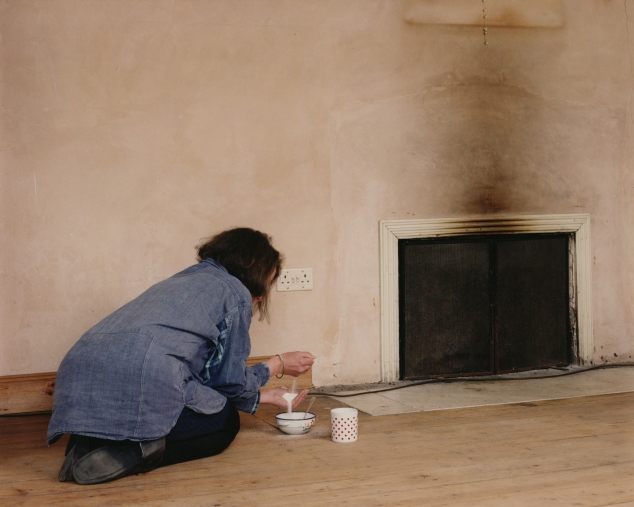
The work of Frances Kearney and Hannah Starkey offered me the notion of obscuring faces to increase ambiguity. Frances Kearney’s work “Five people all thinking the same thing” (1998) is concerned with the passing of time in a domestic setting, the subjects are often absorbed in what Kearney has described as “lost time” (Collections.vam.ac.uk, 2021). The ambiguity in the images leaves the viewer to draw their own conclusions about the characters, their lives and possible meanings of the props and locations.

(Frances Kearney, 2021)

Hannah Starkey also uses the device of faces turned away to add ambiguity to the characters. Her work reconstructs everyday life in careful settings, captured with a sense of detachment, “with the concentrated stylisation of film” (Gallery, 2021). It has been suggested that by adopting filmography, Starkey’s images are intensified with voyeuristic intrusion, offering these private moments to the public. 

In an interview Starkey is asked about the staged and cinematic and their centrality to her work.    She replied that she doesn’t think of herself as a staged photographer, but composes instinctively, storing up observations and visual influences and then communicating it in a burst of photography. She says “I prefer the term ‘constructed photograph’ because it describes the reconstruction of the real as an act of redefining the real to reveal a psychological truth. Constructing the elements of the narrative into the frame of a photograph is second nature within photography” (Elephant, 2021).

Starkey explains that the “obstructions” in her work, are layering that makes the eye work harder because the obstructions block the viewers gaze and slow down the deciphering of the picture “I think of myself as a storyteller and good stories have multiple layers of meaning. By incorporating windows, mirrors, and reflective surfaces into my work I can take the eye on a visual journey to the heart of the narrative in the photograph and then back out” (Elephant, 2021).

(Maureenpaley.com, 2021).

I was inspired by Jeff Wall’s realistic set constructions, and subtly dramatic rather than cinematic lighting, to encourage acceptance of “tableau photography as an imaginative blending of fact and fiction, of a subject and its allegorical and psychological significance” (Cotton, 2015 p52). Wall describes this as just a way of reassembling details after an event, as the pictures are made from his experience. Wall’s cinematographic technique is described as “near documentary”, and near photography is also the way Wall describes his work as recreations of moments made afterwards, enabling him to capture them carefully.

Approach 2014 (O’Hagan, 2015)

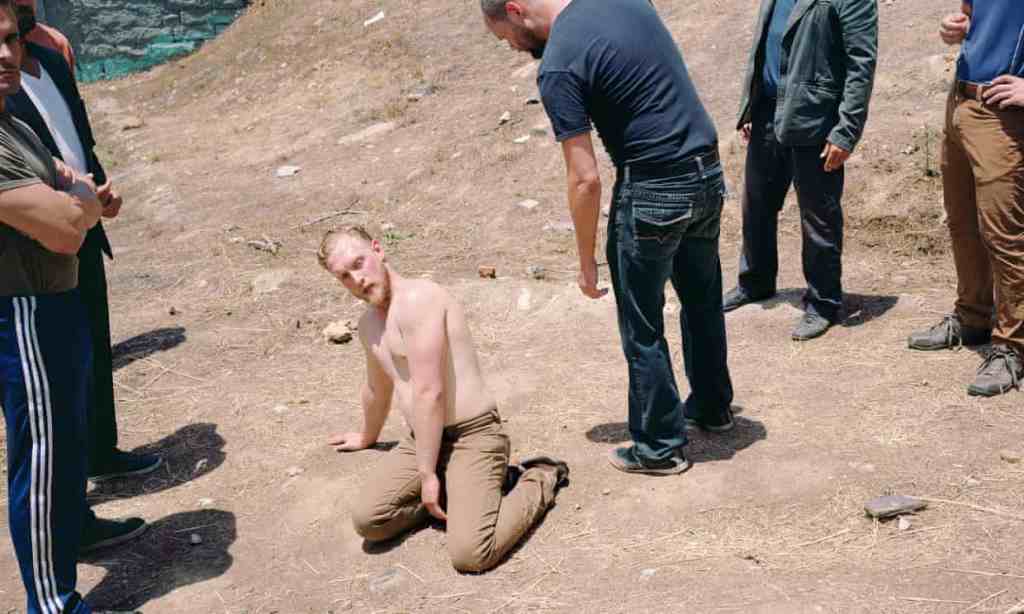
His work can be contentious such as Approach (2014) above shows a homeless woman standing by cardboard shelter, it’s contentious as he admits that this took a month to recreate but not whether the woman was an actor or not. Likewise, Listener (2015) shows a kneeling, shirtless man speaking to the leader of a group gathered around him in a bleak, harshly sunlit place. Wall describes this as something you could see in reportage but omits to tell whether it is actually a moment that he’s seen previously. I would prefer it if he was transparent about the basis of an image.

listener 2015 (O’Hagan, 2015)

I was also affected by the work of Lottie Davies, whose work Memories and Nightmares (2008-2009), is around stories, personal histories, and identity; she says, “What counts for us in the memory…is ultimately not its reference to the ‘objective facts’ of a particular moment but its capacity to act as a founding myth” (Lottiedavies.com, 2021)

(Lottiedavies.com, 2021)

I was surprised how much research I have done previously on Tableaux photography previously – It was useful to revisit it now I have more experience in both research and photography.

My learning points on Tableaux photography and the use of theatricality in art:

  • In Tableaux the photographer is a conductor or film director. Working as Crewdson does as a director with large production teams, lighting plans, purpose-built sets, and actors- you basically have control of everything.
  • The dramatic use of cinematic lighting enhances the idea that it is a theatrical blend of reality and storytelling,
  • Theatrically produced photographs are often like stills from dreams.
  • These images usually contain a lot of ambiguity which adds to the viewers narrative.
  • The cinematic scale of this work helps to turns the ordinary into hyperreality.
  • Concentrating pictorial narrative into a single image culminates in a constructed reality. It leads viewers to believe there must be something of significance in the image because it’s deliberately constructed.
  • Clarity and depth of field are needed to help viewers to be able to read the detail in an image.
  • Tableaux images encourage slow looking so that viewers work hard to decipher content and meaning.
  • Some tableau photography like Starkey’s images seem voyeuristic.

I have learnt a lot by revisiting tableaux. Whilst it is unlikely that I will wholly use this genre, it has made me think about things that I could incorporate to my work, like both clarity and depth of field, construction, and devices to encourage slow looking.

References:

Adage.com. (2021). PHOTOGRAPHY: Tom Hunter’s “Living in Hell and Other Stories”. [online] Available at: http://adage.com/article/printdesign-events/photography-tom-hunter-s-living-hell-stories/107702/ [Accessed 23 Sept 2021].

Boothroyd, S (2020) Photography 3: Body of work coursebook. Open College of the Arts. Barnsley.

British Journal of Photography (2021). Gregory Crewdson’s Cathedral of the Pines. [online] Available at: http://www.bjp-online.com/2017/06/crewdson-cathedral/ [Accessed 6 Sept 2021].

Collections.vam.ac.uk. (2021). Five People Thinking the Same Thing III | Kearney, Frances | V&A Search the Collections. [online] Available at: http://collections.vam.ac.uk/item/O83971/five-people-thinking-the-same-photograph-kearney-frances/ [Accessed 26 Sept. 2021].

Cotton, C. (2015). The photograph as contemporary art. London: Thames & Hudson.

Elephant. (2021). 5 Questions with Hannah Starkey – ELEPHANT. [online] Available at: https://elephantmag.com/5-questions-with-hannah-starkey/ [Accessed 26 Sept 2021].

Frances Kearney. (2021). Five People Thinking the Same Thing. [online] Available at: http://www.franceskearney.com/five-people-thinking-the-same-thing/ [Accessed 26 Sept. 2021].

Gallery, S. (2021). Anne Hardy – Artist’s Profile – The Saatchi Gallery. [online] Saatchigallery.com. Available at: http://www.saatchigallery.com/artists/anne_hardy.htm [Accessed 26 Sept. 2021].

Lottiedavies.com. (2021). Lottie Davies [online] Available at: https://www.lottiedavies.com/PROJECTS/Memories-and-Nightmares/2 [Accessed 8 Sept 2021].

Maureenpaley.com. (2021). Maureen Paley | Hannah Starkey. [online] Available at: http://www.maureenpaley.com/artists/hannah-starkey?image=5 [Accessed 26 Sept 2021]

My Favorite Arts. (2021). The Barn by Gregory Crewdson. [online] Available at: https://theartstack.com/artist/gregory-crewdson/barn-17 [Accessed Sept 2021].

O’Hagan, S. (2015) ‘Jeff Wall: ‘I’m haunted by the idea that my photography was all a big mistake’’ In: The Guardian 03/11/2015 At: http://www.theguardian.com/artanddesign/2015/nov/03/jeff-wall-photography-marian-goodman-gallery-show [Accessed September 8, 2021].

Plowright, N. (2017). Loose associations vo.3. issue ii summer 2017. London: Loose associations.

Pulver, A. (2021). Photographer Tom Hunter’s best shot. [online] the Guardian. Available at: https://www.theguardian.com/artanddesign/2009/nov/04/photography-tom-hunter-best-shot [Accessed 23 Sept 2021].

South, N. (2017) A5 Submission – Photography 1: Context and Narrative: Making it up. At: https://nkssite2.wordpress.com/category/a5-submission/ [Accessed Sept 7, 2021].

Telegraph.co.uk. (2021). Tom Hunter. [online] Available at: http://www.telegraph.co.uk/culture/photography/7994873/Tom-Hunter.html [Accessed 23 Sept. 2021].

The Photographers Gallery.org.uk. (2021). Gregory Crewdson: Cathedral of the Pines | The Photographers’ Gallery. [online] Available at: http://thephotographersgallery.org.uk/content/gregory-crewdson-cathedral-pines [Accessed 6 Sept 2021].

Time.com. (2017). Discover Gregory Crewdson’s New Surreal Photographs. [online] Available at: http://time.com/4166380/discover-gregory-crewdsons-new-surreal-photographs/ [Accessed 6 Sept 2021].

Trendland. (2017). Cathedral of the Pines. [online] Available at: http://trendland.com/cathedral-of-the-pines/ [Accessed 5 Sept 2021].

Next post: https://nkssite6.photo.blog/category/body-of-work/coursework-body-of-work/part-one-genres/responding-to-the-archive/

BODY OF WORK: INTRODUCTORY UNIT

Exercise 1: What are your expectations of level 3 study?

We are asked to identify what we want for the course. This is my response for Body of Work:

  • Support in translating my concepts and abstract ideas from contextual studies into visual work
  • Improving my critiquing and evaluative skills
  • Broaden my research techniques so that I can add context to my visual work
  • Learning a variety of ways that I might share my work publicly
  • Opportunity to work on my own project from start to finish

We were also asked to highlight what we’re bringing to the course unit:

  • A passion for seeing “slowly”, close observation, and absorbing my environment.
  • An interest in taking abstract concepts, and representing them visually to cause reflection in the viewer.
  • A love of learning and reading.
  • A desire to experiment with different photographic techniques.
  • A fascination with the layers of truth in images.

Next post: https://nkssite6.photo.blog/category/body-of-work/coursework-body-of-work/part-one-genres/research-point-crewdson-theatricality-in-art/