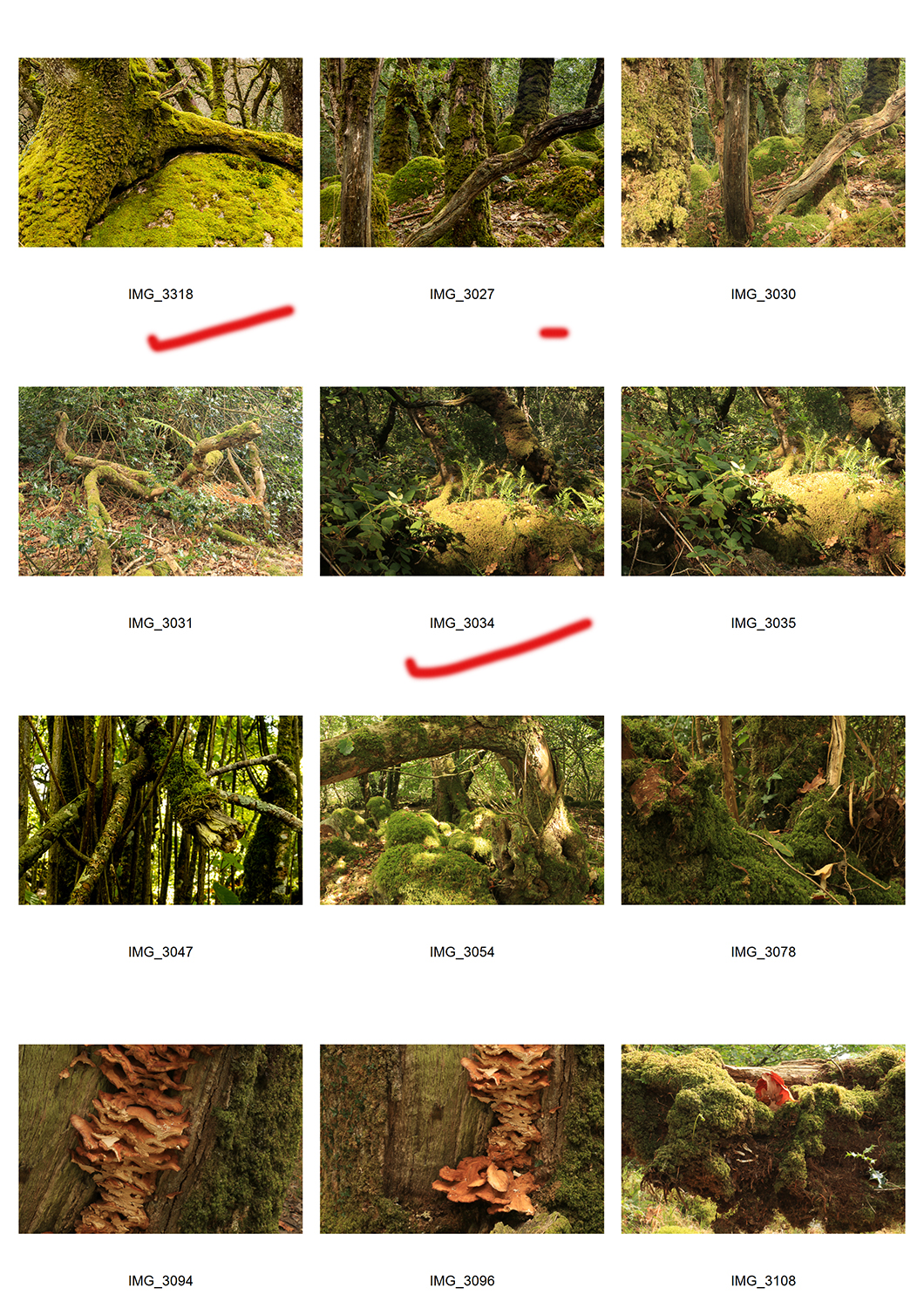
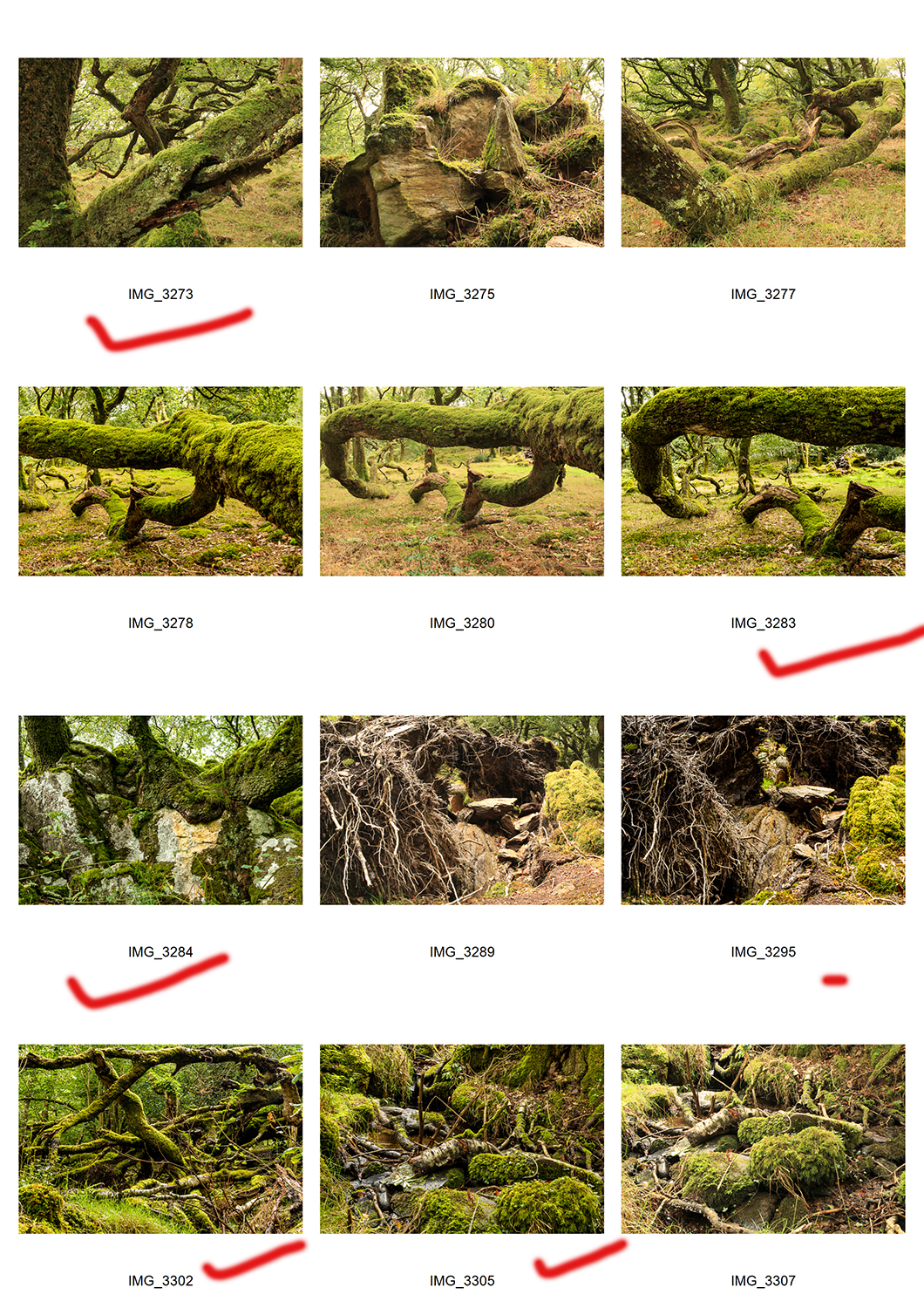
Final choice contacts

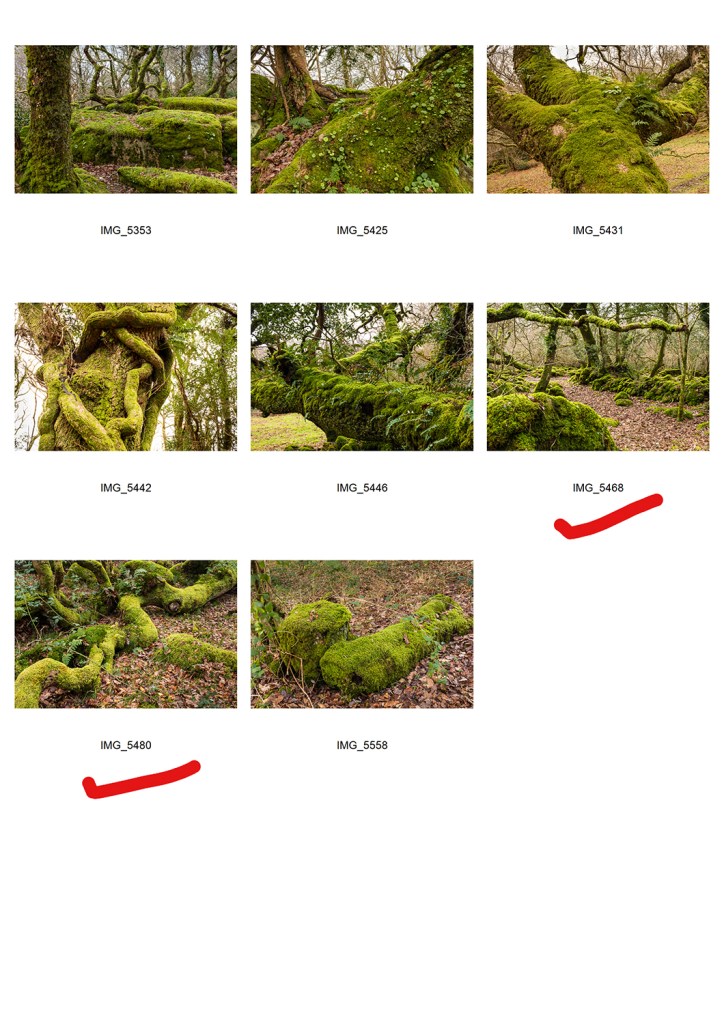
previous selection eliminated


My intention at the outset of this series was to shoot at longer range images that show the harmony and varied components living peacefully together; and possibly to combine this with signposting related to the musical concept of harmony.
What I hadn’t factored in was the time of year. In December when I began scouting to shoot I should not have been surprised to find that vegetation was sparse in the ancient woodlands, apart from moss. Even when the woodlands were not sprinkled with frost, ice and snow, there was very little sign of life beneath the earth, bark and moss. But the moss was abundant, carpeting many elements of the sleeping woodland, rocks, bark, fungi, trees, logs, and earth.
I revisited my earlier research on moss. Moss protects, nourishes, stabilises, and filters the woodland environment. It is a great showcase of just one of the woodland plant species that thrives and enables other species to thrive…it does not thrive at anyone else’s expense, and in the winter is most obvious because most other species are visually in hibernation.
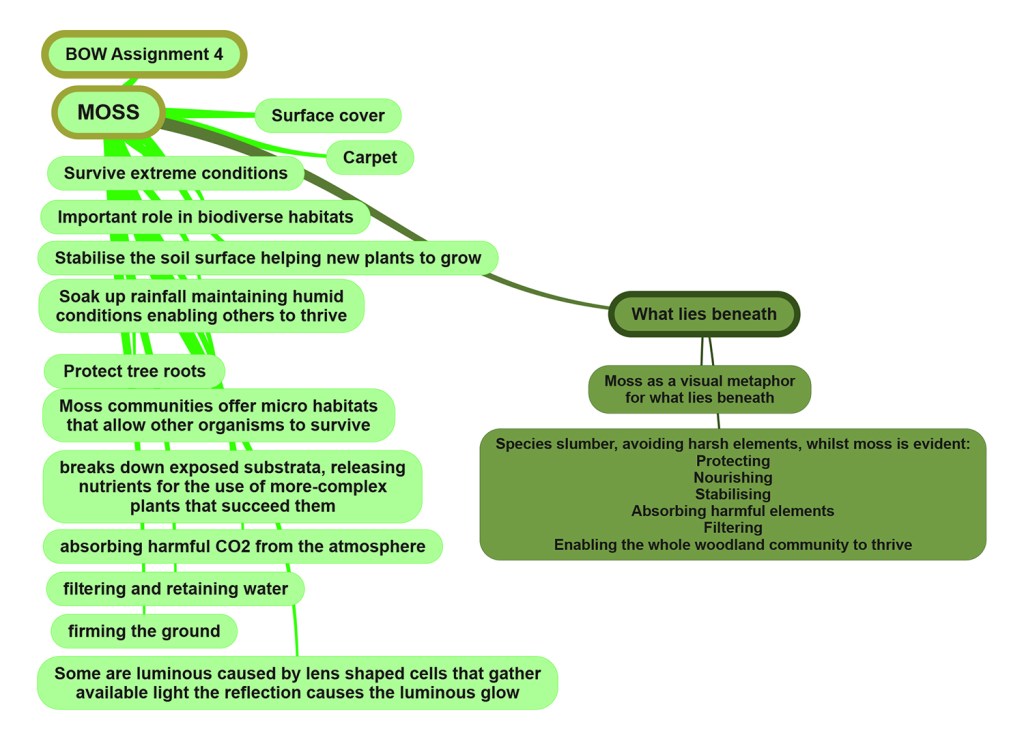
I reflected on how this compares to the local human community nearby. Although it is winter and much goes on behind closed doors, what is being shared behind those doors occasionally escapes. Despite the low number of tourists (a common thing for some locals to snipe at), tension still surfaces between “locals” (those born and bred locally), and incomers (those who live locally) and especially those with second homes (who visit periodically).
At its worst it could be called xenophobia. Spiteful comments, by word and mouth, and on social media continue to be shared but more anonymously than in the tourist season. This saddens me when the majority of the community works well together, enjoys the relative peace in the winter and the “incomers” do much to support the local community, in fact in my opinion they are the backbone of the community support. It is a shame that prejudice and resentment from a minority who can’t cope with diversity and evolution, spoil the peace, and cause disharmony in the community.

So, I revisited my visual intention. I would focus on the moss in the woodlands as an example of a nurturer and protector, a reflection on the harmony which is possible in diverse communities and a visual antithesis of some harmful elements in the disharmonious local human community.
Shooting
How would I achieve this? For me it is about showcasing the moss as a protective blanket, covering, and combining other species, a positive reflection on “what lies beneath.” Sometimes we can’t be sure what lies hidden beneath, but in the woodland setting it appears peaceful.

First shoot
I shot with my prime lens and aimed to shoot mainly at more of a distance. I composed so that I could to crop afterwards 5:4 ratio, this was a first for myself, normally I crop as I compose in camera. Visually I looked for subjects within the woodland covered in most and as luminous green as possible. The keywords and phrases I associated with as I shot were carpeted with moss, green, protective blanket, softness, peaceful, stabile, togetherness. I remembered my research on poetry and tried to think, feel and shoot like a poet.
The practical issues I had was with weather shooting conditions. There were a couple of weeks where the ground was snow laden which covered much of the moss, and between those were mainly days of persistent rain. On the literally few days that it was dry over a month I made sure I was in the woodland. Harsh light was a problem due to the time of year, low sun, short days, and lack of vegetation.
As shooting progressed I strayed away from just long/medium range shots and just worked into what showcased the moss the best. I found that I gravitated towards trees as a habit and had to remind myself that moss was the subject whatever it was covering, rocks, earth, logs etc. I looked especially for subjects that were predominantly moss covered, whether that be as a whole, difficult to capture due to their size, or by shooting parts of large trees, and not always large areas from a distance.
Editing
As I edited I returned again and again to my intention to use the woodland community to example harmony, the anthesis of the local human community. In particular this series showcasing moss as a selfless protector and nurturer of the community, homogenising and integrating the diverse species below it’s carpet.
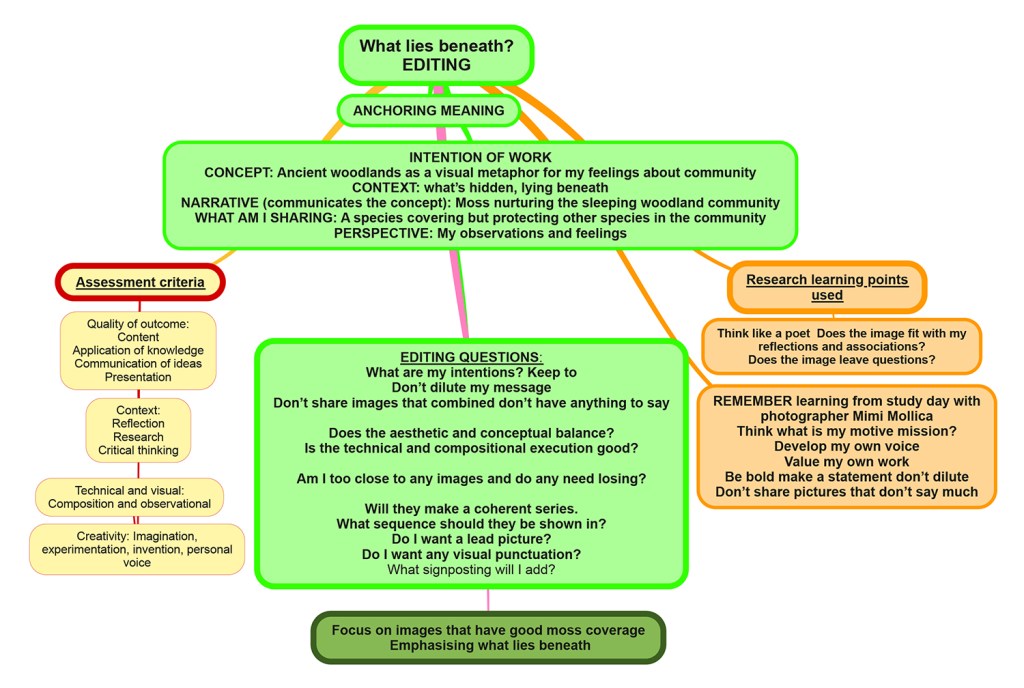
My working title began as “what lies beneath”, but maybe it should be combining and accepting? Both work whilst I am editing. I chose images that emphasis moss covering what lies beneath.
I quickly excluded, images 5271 & 5442 .I liked the subjects and their message but was hampered technically as to shoot these as I wanted I could only do so with harsh light behind them, I had tried on various occasions to avoid this, but it had not proved possible.
I dropped 5266 as it wasn’t so lushly covered with moss. Whilst I dropped 5316 &5236 as I preferred others.
I then looked at similar images and chose 5345 over 5353, and 5480 over 5558, and 5350 over 5292, and 5329 over 5431 & 5446. I later dropped 5350.
Of the eight remaining, I asked myself the questions:
To reduce these to 6 images I asked:
How do I order them? This may depend on my signposting- my message is more important than my aesthetics. So, what signposting will I add?
Presenting and signposting
My research led me to the possibility of poetry, see link to poetry research: https://nkssite6.photo.blog/2023/01/21/bow-assignment-4-research/
My learning led me to think like a poet when shooting. I took onboard that poetry like photography can mean something other than the subject. This time when shooting I was conscious of word associations, and compact messages like poetry. I was unsure how or if I would combine my photographs with poetry.
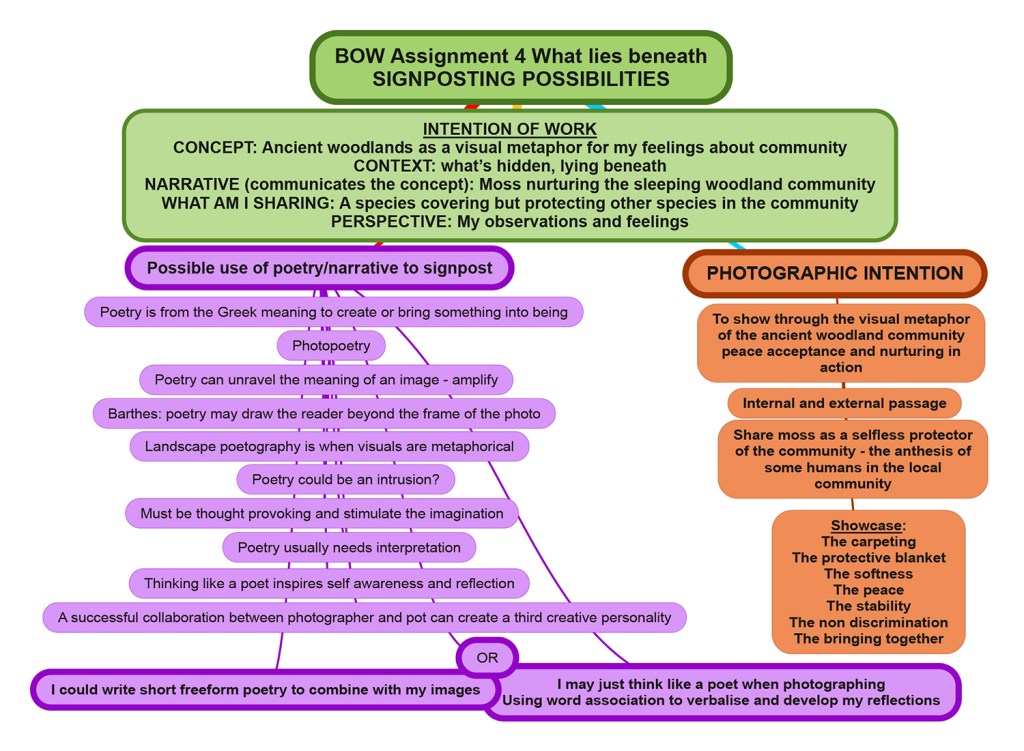
Having edited my images down to eight, I set about experimenting with poetry to combine with them. Could I create third personalities by combining them? I experimented and settled on a form playing around with word choices for some time.
I reflected on the eight images again, and dropped 2 images to form a tighter series of 6.
I then experimented with poetry, combining poetry and images until I matched poetry and images.
“Poetry” is derived from a Greek word meaning to create or to bring something into being. This is close to that of the word “art,” derived from a Latin word referring also to items brought into being by human skill.
Photographer Guy Tal asserts that in writing, poets don’t try to assert their own style as the only valid form of writing. Where he suggests that in photography, expressing meaning poetically, rather than from objective representation, is often criticised. Tal says this shows that photography still has a way to go as an art form, if only just to catch up to where other media already are.
Landscape photographer John Hardiman says “I came to the conclusion that photographs, on the whole, have little to do with photography at all. They represent something else” (Hardiman, 2022). He believes that it’s not the photograph which captures life in a picture, we draw these connections ourselves; to capture them we need to feel them. “With a careful touch of colour and tonality, flavoured to taste in just the right way, we can create our own visual poetry, which I’ll call “landscape poetography”. He likens this to poetry, as the way words flow from one line to another in poetry can be as the lines, colour, tone, and layout in photography. Deliberate changes can throw the reader off surprisingly or make them feel uneasy, I would call this punctum. Words, colours or tones can be used to make us comfortable or mixed to cause questions and ambiguity. He proposes that “Photographs and poems can both be metaphorical, drawing on the visuals but meaning something else”.
Landscape photographer David Ward suggests that photographic description alone is not inspirational, as the exact meaning is elusive as viewers interpret in different ways. He says that images are full of visual nouns, but to signify emotions we need adjectives or adverbs.
Rob Hudson, conceptual landscape photographer, says when exploring how he relates to the landscape, he often resorts to words for clarity and more depth about how he feels and what he wants to represent in a given project; starting by making lists of keywords about feelings, and associations with place. For a project to work he says they must have three key features, be personal, restrictive either through subject, area, style and or theme and that he can be passionate about them.
Describing how thinking like a poet can be inspiring for photography Hudson says artistic expression is about being self-aware, and spending time thinking about our feelings, where we are in the world and so on. He suggests that thinking like a poet in “prose, sometimes poetry and sometimes a simple “self-examination” in words”(Hudson, 2010) is useful. Not that this is poetry but that the processes involved are similar and words can develop and define ideas, which can feed into photography. He describes this photography, experiences of place feeding back into the words creating a “virtuous loop”.
Hardiman, J. (2022) Landscape Poetography commentary on our inner world. At: https://www.onlandscape.co.uk/2022/04/landscape-poetography/ (Accessed 08/01/2023).
Hudson, R. (2011) Rob Hudson. At: https://www.onlandscape.co.uk/2011/04/the-skirrid-hill-project-taking-thinking-like-a-poet-to-its-logical-conclusion/ (Accessed 08/09/2022).
Hudson, R. (2010) Creativity. At: https://www.onlandscape.co.uk/2010/11/how-thinking-like-a-poet-can-inspire-creativity-in-landscape-photography/ (Accessed 08/01/2023).
Ward, D. (2012) David Ward on Meaning in Photography – On Landscape. At: https://www.onlandscape.co.uk/2012/02/on-meaning-in-photography/ (Accessed 08/01/2023).
Tal, G. (2021) Colour as Form: Transforming without deforming: Toward subjective expression and away from objective realism. In: On Landscape 254 pp.41–66. At: https://www.onlandscape.co.uk/2022/04/colour-as-form/ (Accessed 27/08/2022).
Not defined in the oxford English dictionary, the first use of the term was 1936 with pairings of both by Constance Phillips. Boulestreau used the term to describe the poems and photographs in Facile (1935) saying “meaning progresses in accordance with the reciprocity of writing and figures: reading becomes interwoven through alternation restitching of the signifier into text and image” (1982).
Photopoetry: A manifesto (Crawford and Mcneath, 2016) suggests that photopoetry should be:
Nott talks about a working practice between poet and photographer. Each are usually wholes when separate. The poetry can be prose, captions, poetic prose or other. He suggests that the best photopoetry retains the independence of both but creates something new when they are interdependent. He outlines that Retrospective photopoetry is when photographers provide images to already written poems. Collaborative is mutually conceived, whilst self-collaborative is less common. However, Nott argues that captions tend to describe images, and that photopoetry is not reductive and places the reader at the centre of their work.
Fuller says both poetry and photography are concerned with images and that poetry can unravel the image. Poems are “gradually constructed in words and images that has to pass muster as an alternative reality. But the photographer is exploiting reality itself, almost directly.” (Fuller and Hurn, 2010:8) They can “ blend, clash, contradict, embolden, evoke…” creating photopoetic images that encourage” serendipity” and “obliquity”. “gradually constructed in words and images that has to pass muster as an alternative reality. But the photographer is exploiting reality itself, almost directly.”
Barthes (2000) talks of when the undevelopable poems and photographs engage in dialogue, saying that the poem may draw the reader beyond the frame of the photograph, or challenge or conform the viewers impression of the photo.
Barthes, R. (2000) Camera Lucida: Reflections on Photography. Translated by Howard, R. London: Vintage books. loc 325
Boulestreau, N. (1982) in “le Photopoem facile ». Meisine. Lausanne. Cited in Nott, M. (2022) Photopoetry 1845–2015, a Critical History. London: Bloomsbury. pp264.
Crawford, R and Mcbeath, N (2016) Manifesto in Chinese Makar. Edinburgh. Easel press.
Fuller, J and Hurn (2010) “A conversation by way of introduction” in Writing the picture. Bridgend. Seren.
Nott, M. (2022) Photopoetry 1845–2015, a Critical History. London: Bloomsbury.
The Photographers Gallery has an interesting page on the above (The Photographer’s Gallery. 2023), it describes that:
“As forms of artistic expression, both poetry and photography can convey a narrative or story without certainty or being merely descriptive. However, both the poetic or photographic act are often still perceived as solitary pursuits, occurring in isolation from other creative acts. Notions of composition, language, light, sound, space, printing, narrative and writing reveal themselves as fundamental to both arts, from collaborations between the media.
This led me to the work below Writing The Picture by David Hurn and John Fuller, and the photo haikus of Ann Attwood.
This book is a collaboration between a leading photographer and poet, where the poet responds to the images and draws out their meaning.
Their conversation in the book’s introduction is illuminating. Fuller describes the photograph as instant, exploiting reality, whilst a poem unravels overtime and is a constructed reality which the reader creates their own picture for them. Hurn believes that the best photographs share the unseen as well as the visible, and Fuller describes how they can “give voice to the photographer’s intensity of silence”, the implicit meaning. Fuller says that to be suitable for an accompanying poem a photograph must be thought provoking and stimulate the imagination, but there is a danger that an accompanying poem can be an intrusion. He generously suggests that the poem may only supply a memory to the photograph and has no life of their own. Fuller emphasises that a caption is quite different to a poem, which is more of a “title”.
I like the description by Fuller that a successful collaboration between photographer and poet can create a third creative personality.
She says that Haiku is the most verse form like art, and that many of the techniques can be used when making images; the writer must search for just the right word, limited by seventeen syllables, must be evocative. Haiku means beginning, it is begun by the writer and completed by the reader – it must allow a full spectrum of response. She describes the writer’s role as a painter evoking but not describing a scene. It can though take a reader from a closeup scene to a wider picture. She asks can applying Haiku principles help to see “inside out”.
Through dripping branches

The woods and I are one
In the eyes of the rain (Attwood, 1971:31)
Personally, I don’t enjoy her images and haiku however her suggestion of applying the principles of Haiku, careful word selection for evocation rather than description is interesting. Also, the possibility of using poetry to take the reader from one view to a wider context.
Attwood, A. (1971) Haiku The mood of earth. New York: Charles Scirbner & sons.
Hurn, D. and Fuller, J. (2010) Writing the Picture. Bridgend Wales: Seren.
The Photographers Gallery (2023) Photography and Poetry At: https://thephotographersgallery.org.uk/photography-culture/photography/photography-and-poetry (Accessed 21/01/2023).
It also led me to this article:
Steven J Fowler a writer and artist, lead the course The Written Eye: Poetry & Photography at The Photographers’ Gallery in spring 2018. He says that language, the tool of a poet, is usually short and concentrated. This is not to say that poetry should not make sense, but it does go beyond documentation. He says that it doesn’t tell us what to think, just like other art, usually needing interpretation, “a celebration of paradox, of using the communicative tool to go beyond mere communication”, and is usually a metaphor for other things.
A Few Words (2018) At: https://thephotographersgallery.org.uk/photography-culture/few-words (Accessed 08/01/2023).
This article describes and experiment where photographers were asked to read poems and then photograph how they inspire them to photograph. One thing that came out of it was how the poetry led them to want to make images with the same level of intimacy that the poems inspired in them. I was struck by how several described that they tried to hold onto their feelings about the poetry as they wandered and photographed. This is what I do when photographing the woodlands- hold on to my feelings about both the woodlands and human community.
One photographer Todd Heisler describes poetry as “what is right in front of you every day that you fail to see” (MacDonald and MacCarthy, 2018), adding that photography amplifies internal dialogue which is often diluted by outside distractions. He suggests that lyrical poetry is often hindered by too much thought.
MacDonald, K. and McCarthy, M. (2018) ‘Turning Poetry Into Photos’ In: The New York Times 17/08/2018 At: https://www.nytimes.com/2018/08/17/us/how-poems-inspire-pictures.html (Accessed 21/01/2023).
Sabine Thoele is a self-taught photographer who started out in street photography and has since moved on to event and Fine Art photography. Over the course of one year Sabine Thoele observed the floating world on the surface of a pond in her local park. Her photographs document the traces of nature which gusts of wind left behind: floating leaves, flowers, seeds, roots, feathers and insects – a mirror of the changing seasons. Held temporarily afloat by surface tension the camera captures them just before they will completely vanish, a last celebration of their being. The eternal cycle of life and death played out in a small manmade pond. A meditation on what has been and what we will remember.
Adrift
Invisible walls of loss
The world a rectangle
measured by your paces
A craving for solitude
brought you here
where still waters promise nothing
Bird less flights dropped their cargo
Drifting anchors for your searching grief
Tomorrow was expected
Memories took its place instead
You wish you had …

Unfortunately, I have been unable to find and other work of hers like this.
Reference:
Sabine Thoele: Adrift (2019) At: https://thephotographersgallery.org.uk/photography-culture/sabine-thoele-adrift (Accessed 08/01/2023).
These explorations were to help me to understand how poetry and photography might work together.
I can see the similarity between poetry and photography and understands Hardiman’s proposal for the term landscape poetography where visuals can be metaphorical, meaning something other than the subject. I can see that photographs may be amplified by adding adjectives and adverbs as well as visual nouns as Ward suggests. I identify with Hudson’s description of using words for clarity, by drawing up key words about place (feelings and associations) to help explore the landscape.He also writes that prose or poetry can bring self-examination in words This may be as far as I go with combining my photographs with poetry – using word association to verbalise and develop my reflections.
I need also to consider whether combining my images with poetry may be a way to unravel my images and add context beyond the image. Hurn suggests that accompanying images with poetry may be intrusive, whilst Fowler holds that poetry doesn’t tell us what to think and needs interpretation. However Fuller believes that when they are a successful collaboration they can create a third personality. Barthes in Camera Lucinda also talks of the poem drawing the reader “beyond the frame if the photograph (Barthes, 2020)I will have to experiment.
How I will do this I don’t know yet. I feel it should be with my own poetry, but I am not a poet. I have also looked at forms of poetry to help me such as Haiku and Koans, but I feel if I am able to write anything it will be freeform, most probably nearer prose than poetry; but then poetry can be in any form apparently…
Nicola South Student number:514516
LO1 produce convincing visual products that communicate your intentions, using accomplished techniques in complex and unfamiliar environments, with minimal supervision from your tutor.
LO2 demonstrate comprehensive knowledge of your area of specialisation and be able to situate your own work within a larger context of practice in your field.
LO3 transform abstract concepts and ideas into rich narratives and integrate them in your images.
LO4 critically review your own work and evaluate it against desired outcomes.
Next post: https://nkssite6.photo.blog/2022/11/16/bow-assignment-three-submission/
Nicola South Student number: 514516
BODY OF WORK ASSIGNMENT THREE : SHOW AND TELL
Brief: As you work through Part Three, carry on developing your major body of work. Continue to shoot and reflect on your work so far and build a set of images to submit to your tutor.
Remember that the point of these assignments is to get tutor feedback on the project as a whole so come with your questions on how to move forward and ask for your tutor’s opinion on how the project is working so far.
Submit your work in progress together with a reflective commentary. Your reflection may consider some of the material in Part Three if it has been relevant to your practice. You may also wish to consider how genres are continuing to influence you and how you’re relating what you’re doing in Contextual Studies to your practice on this course.
My body of work is about internal and external passage. When I “go out” to the ancient woodlands, I am really “going in”. My visual representation explores my feelings of discomfort about the tension in my local community, this as a contrast to the successful assimilation of diversity in the woodlands.
This series is an exploration of whether diversity necessarily results in tension and chaos, or whether these differences can be harmonious.
_________
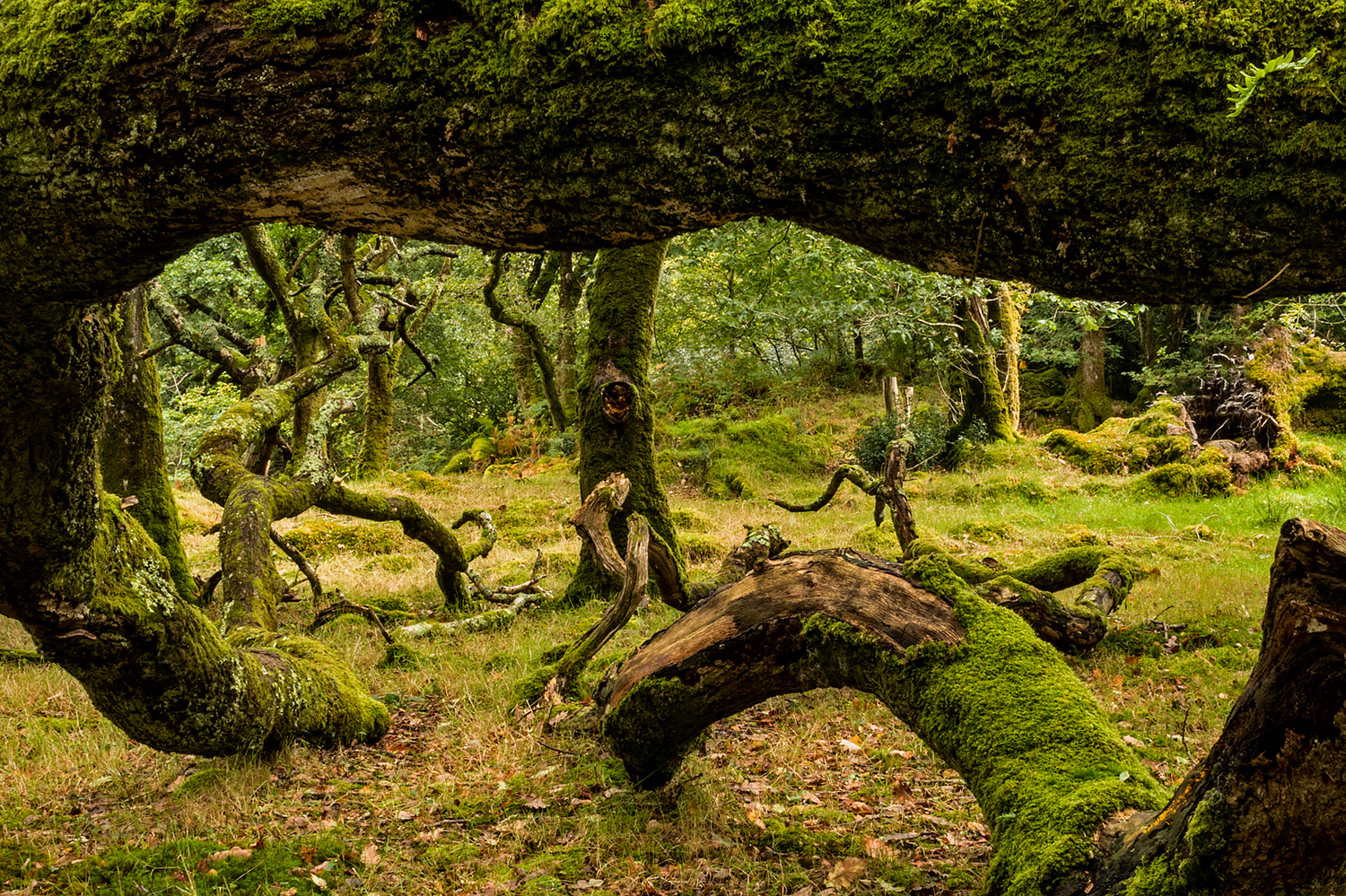
#Chaos… or Adaptation
_________
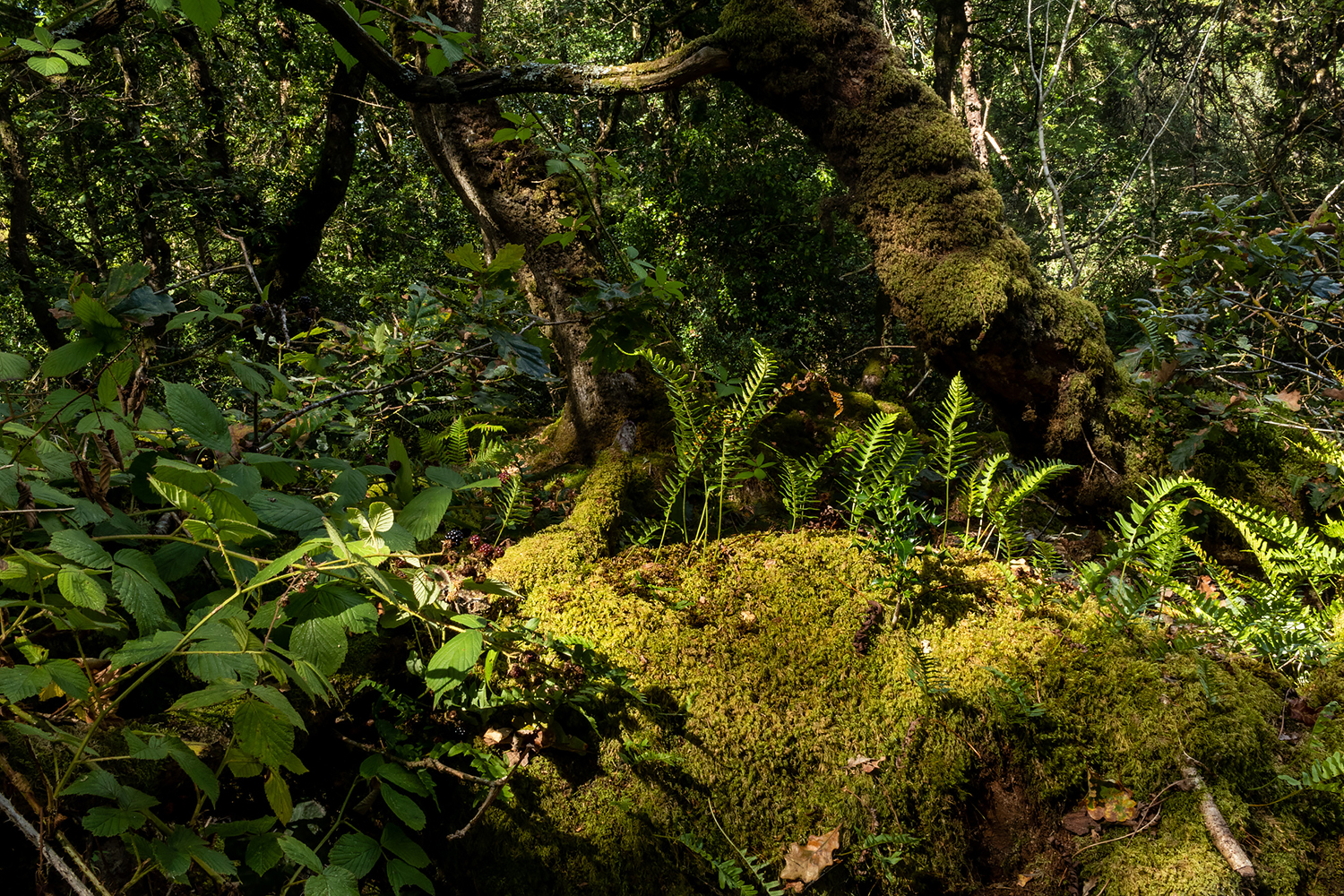
#Discord… or Diversity
_________

#Mayhem… or Cooperation
_________
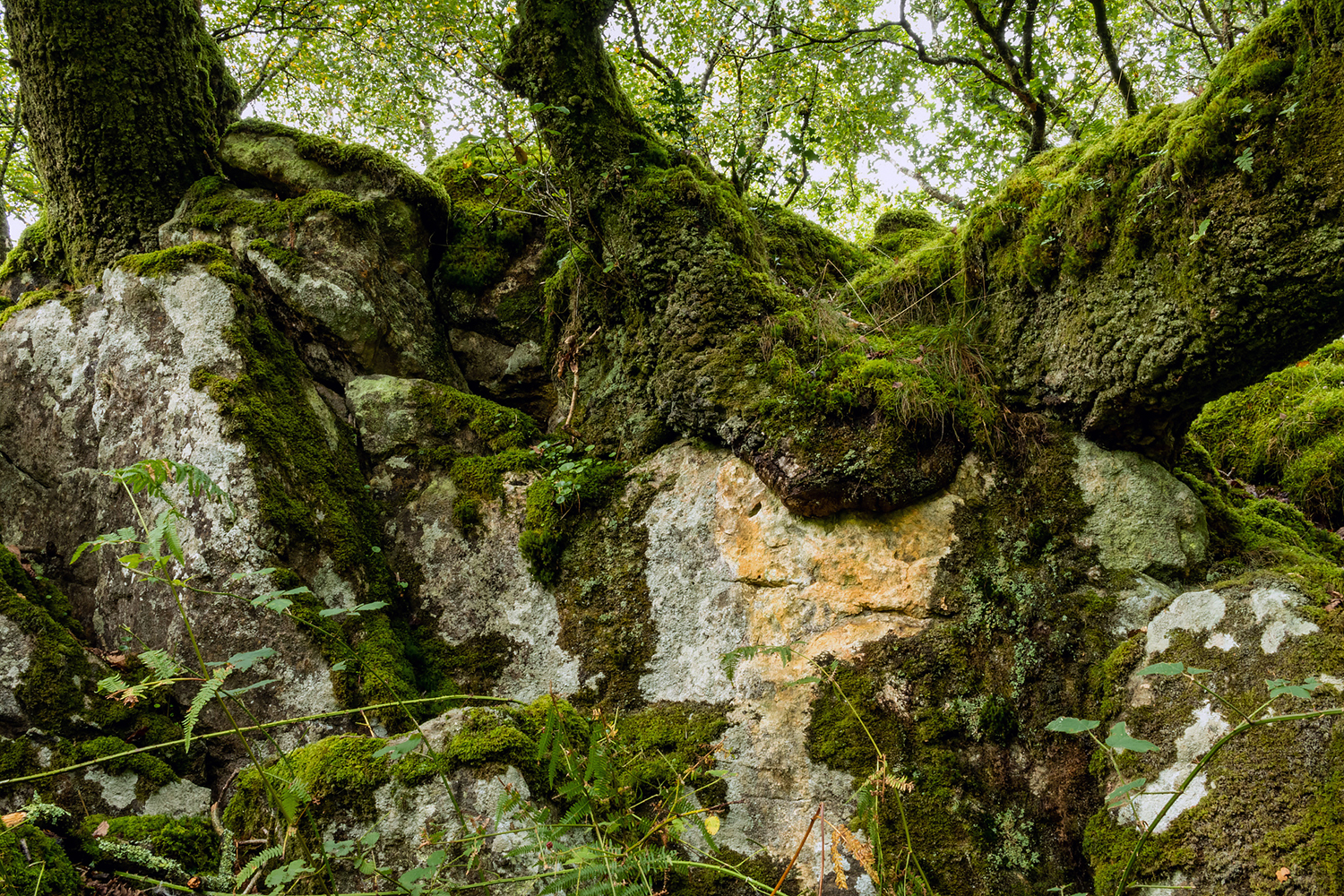
#Partnerships… or Anarchy
_________
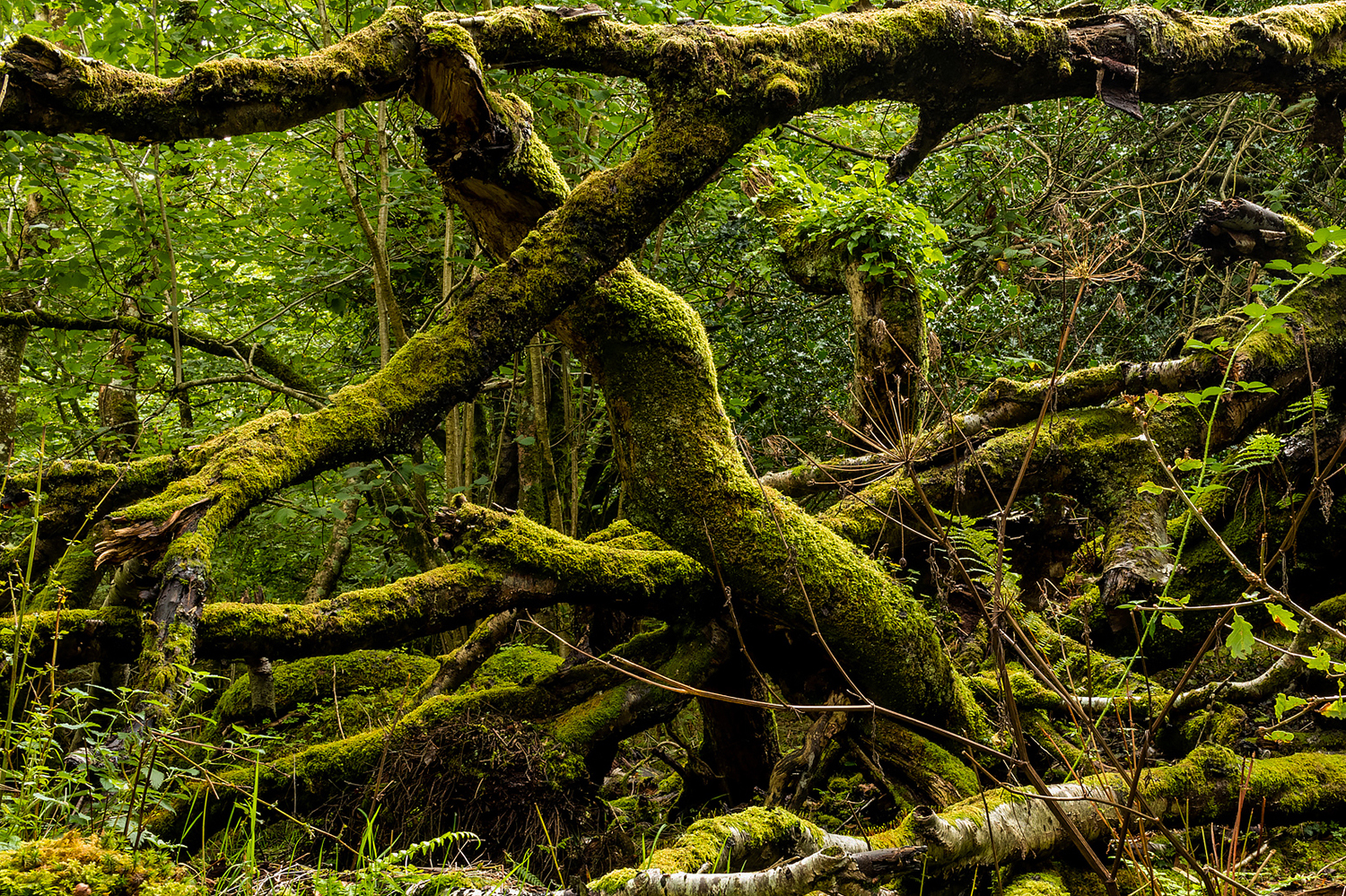
#Peace… or Disorder
_________

#Muddle… or Balance
_________

#Collaboration… or Disarray
_________

#Confusion… or Harmony
_________
Reflective commentary
This series develops my previous work which positions the ancient woodlands as a visual metaphor for a harmonious community. The motivation for the concept are my observations of the local community who are often disharmonious, driven by difference. The concept is stimulated by humans, though they are not evident in my work.
This approach runs parallel to my contextual studies work on affect (expressing what is in a photographer’s mind) and effect (the reality) in landscape photography. In essence this is the difference between photographing a subject for itself and photographing a subject to give a message about something else. Photographers such as Minor White present images as metaphors for something beyond the subject being photographed.
In this assignment, I want to explore further my ability to transform the abstract ideas in my head, my subconscious, into something concrete, via a physical representation of another subject. Many landscape photographers I have researched talk of combining the world within us and the world outside us, some say that that going out is really going in. Radonjič, (Metascapes,2016) calls this transforming our subconscious into “metascapes”, our personal landscapes, as the real landscape is inside your head. Tom Wilkinson (Wilkinson, 2022) suggests that photography is as much about the photographer as the landscape. I am aware through my previous practice that combining the world within my head with the one in front of me can be cathartic as well as produce intriguing photographs. My concept fits well with the theme of part 3 course work “Showing not telling”, Golding calls this using photography “to transform objective reality” (Golding 2022).
Prior to producing this particular series of images, disharmony in the local community had increased; partly due to the influx of summer tourists. Walking in the woodlands I was struck that there are many different species and great diversity, yet they coexist successfully, adapting to accommodate each other’s needs. Moreover, when I observed closely I saw that although this diversity first appears chaotic, messy, muddled, and disorderly, it is an organised chaos that works successfully. I resolved to to express my discomfort with the discord caused by the differences within the local community, by contrasting this with the harmony that exists in the diverse woodland community, where various elements accommodate each other to mutual benefit.
My intention when photographing was to seek out the visually chaotic, muddled and disordered to focus viewers on this aspect of the woodland community. Radonjic describes this as “visually intertwined living space” (Wesche, 2022). Viewers will need to observe hard just to make sense of what is present in such images, without any distortion by the photographer, and this fits well with another of my intentions that viewers should look closely to find meaning in the images.
I then edited to form a series of images that would communicate my message. My intention is to invite viewers thoughts as to whether what is presented is in fact harmony, or chaos. The images I chose demonstrate disorder and some randomness, but I believe they also have a quality of tranquility. I have signposted the work simply with its title “Harmony or Chaos?” and by each image having a caption denoting antonyms of these. In a way I am asking viewers to consider if chaos and differences are necessarily inharmonious. For myself, the first author of this work I am suggesting that differences and diversity can lead to adaptation, balance, and harmony.
I challenged myself in my last assignment to put something of myself in the landscape without intervening in it, and believe that my voice, my subconscious, is in these images. The viewers must decide for themselves what meaning they take from the images.
“To create a vision of the harmony of the unequal, balance the infinite variety, the chaotic, the contradictions in a unity”. (Hans Richter, German Dada painter, and modern art historian cited at: The painters keys, 2022)
References:
Golding, J.M. (2022) At: https://www.jmgolding.com/before-there-were-words/wigdebnrfagnyp1cf1wr96rfxg7jll (Accessed 09/09/2022).
Radonjič, G. (2016) Metascapes. At: https://gregorradonjic.wordpress.com/metascapes/ (Accessed 30/08/2022).
The painters’ keys (2022) Hans Richter quotes – Art Quotes. At: http://www.art-quotes.com/auth_search.php?authid=3048 (Accessed 25/09/2022).
Wesche, A. (2022) ‘An Interview with Gregor Radonjič’ In: On Landscape (250). Ed. Tim Parkin. pp.97–118. Found at: https://www.onlandscape.co.uk/2022/02/interview-with-gregor-radonjic/ [accessed 30.7.22)
Wilkinson, T. (2022) Tom Wilkinson Art Photography. At: http://www.i-m.mx/tomwilkinson/ArtPhotography/about (Accessed 09/09/2022).
Nicola South Student number 514516



My intention to use the Ancient woodland as visual metaphor for harmonious community is currently subverted in my mind. At the moment feel that the community that I live in is more disharmonious than ever as a consequence of summer tourists as well as political and economic threats; it seems to have brought out the worst in some of the local community. I know that this is the opposite to that found in the woodlands. Could my next assignment be a contrast between harmony in the woodlands and dissonance elsewhere?
As I reflected I realised that what I see in the woodlands may not at first appearance seem harmonious and yet in reality it is, as all the different elements work together to achieve a workable balance…unlike my local community.
Walking the woodlands I recognised that much first appears chaotic and yet when you look deeper it’s organised chaos, and it can have an underlying order.
Harmony:
Definition: “the situation in which people live or work happily together without and big problems…
a situation in which people are peaceful and agree with each other, or when things seem right or suitable together…Harmony is the combination of separate but related parts in a way that uses their similarities to bring unity ” (Cambridge Dictionary, 2022).
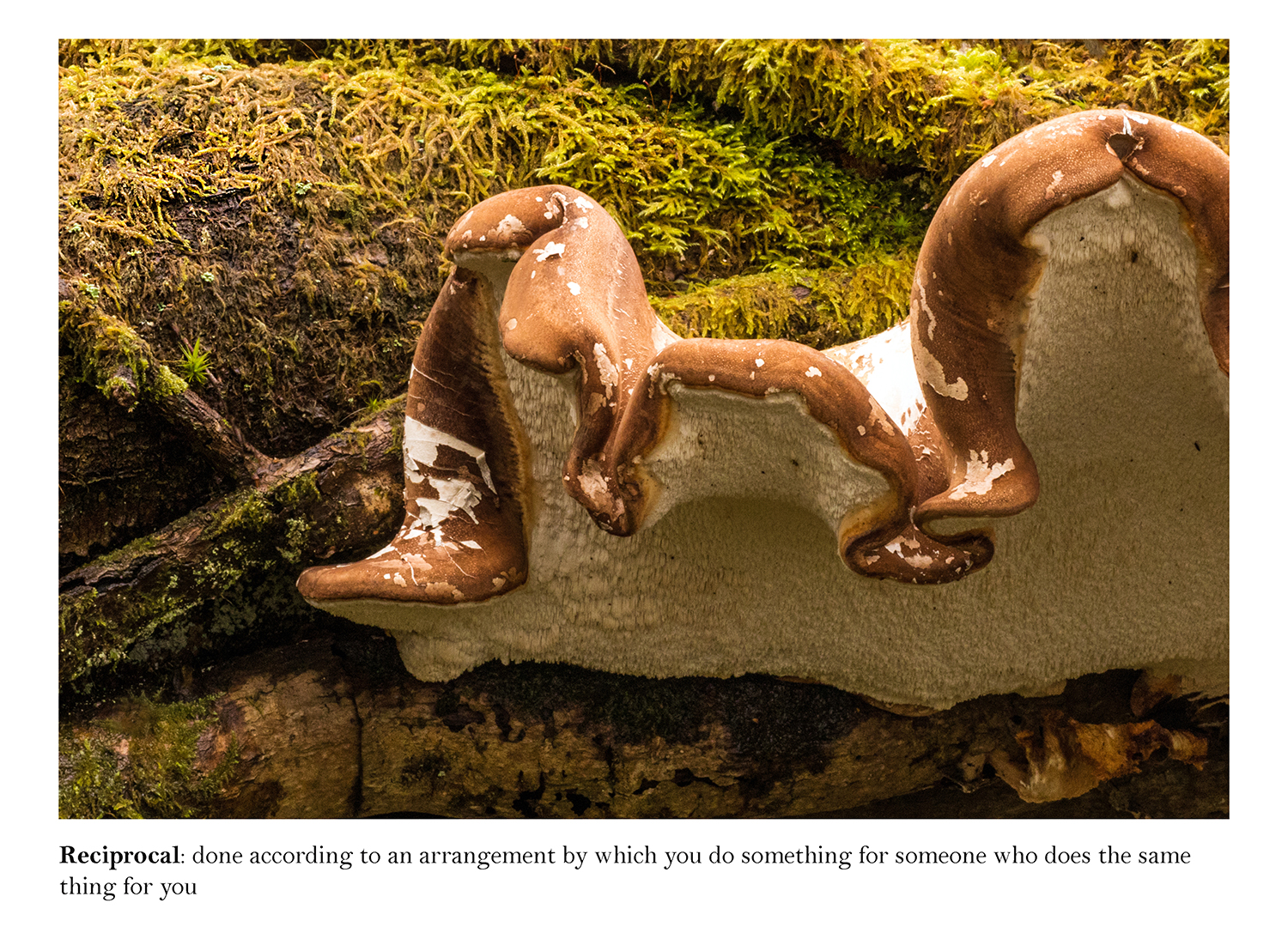
Synonyms: Collaboration, teamwork, consensus, cooperation, peace, tranquillity, understanding, unity, accord, amicability, compatibility, concord, empathy, sympathy, corporation, nurture, support, mutuality, alliance, co-dependency, partnerships, reciprocal.
Chaos:
Definition: “ a state of total confusion with no order…a state of disorder and confusion ” (Cambridge Dictionary, 2022).
Synonyms: Messy, confused, madness, turmoil, disarranged, disordered, shambolic, bedlam, disarray, mayhem, turmoil, destruction, disaster, random, anarchy, discord, disorder, pandemonium
Turmoil, bedlam, muddle, topsy-turviness, bedlam, disturbed, havoc, maelstrom.
Organised chaos:
Definitions: “a situation in which there seems to be a lot of confusion and no organisation, which makes you surprised that the results are good”. (Cambridge dictionary).
“a complex situation or process that appears chaotic while having enough order to achieve progress or goals” (Burnell, 2022)
REFLECTION: I return to my earlier thought that harmony doesn’t depend on homogenous components, and there is scope for a variety of beings to coexist harmoniously. The many elements of woodlands may at first appear chaotic, but in reality it is a peaceful community.
I will continue with my theme as the woods as a visual metaphor for a harmonious community. However in my photography reflect my current feelings about disharmony in my local community by showing that a community of many varied parts can coexist in harmony.
These confirmed maintaining my original approach for my BOW “internal and external passage:
Mindmap BOW Assignment 3 Brainstorm:
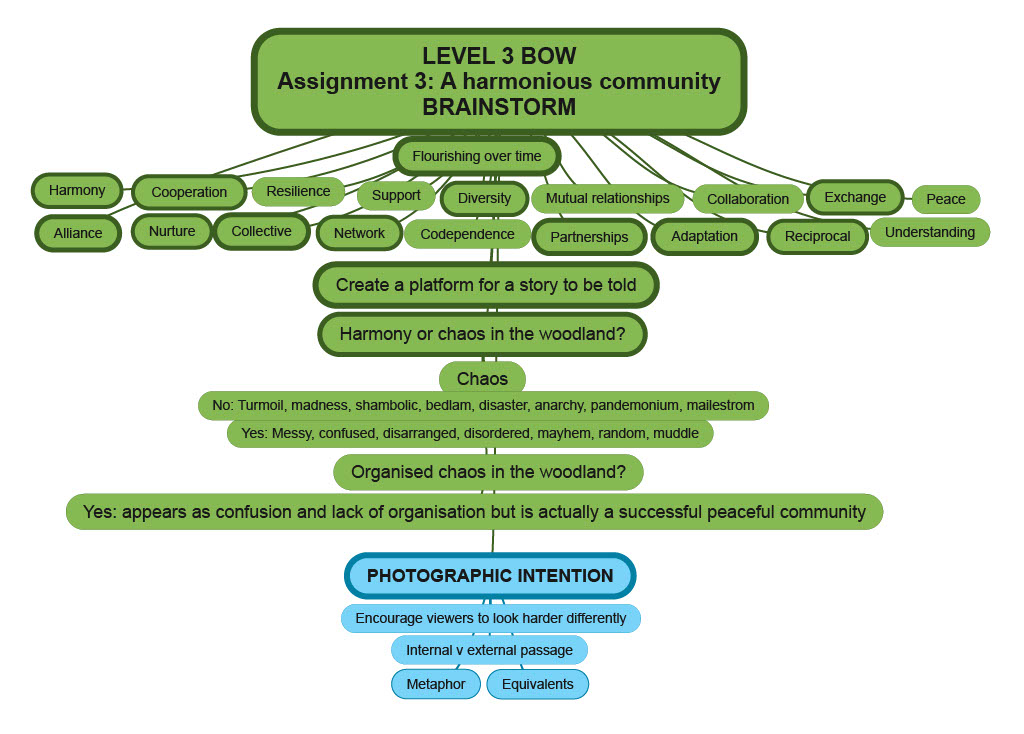
Whilst walking forefront of my mind was the disharmony in my local community and the contrasting harmony in the woodlands. When shooting in the woodlands I was open to scenes that would share visually what a chaotic and complex community it is, and yet illustrate that this “organised chaos” is actually successful and peaceful- diversity is absolutely fine.
My first day of shooting was an unusually sunny day and as the woodlands are shady it seemed visually pleasing, however on reviewing the images I returned on an cloudy day and obtained better results. I returned several times until I had plenty of images that I was happy with.
Mindmap BOW Assignment 3 Shooting:

When editing foremost in my mind was my intention to share the chaotic but peaceful harmony in the woodland community. Backstory – Harmony or chaos?
I chose images that shouted: mess, muddle, random, confusion, disorder, but that also looked tranquil. I sought images that were complex and would cause viewers to look closely to find the meaning.
I also considered my use of colour in the light of my research, should I keep the colour true or use it to express my intention? It was obvious to me that the true rich greenness of the woodlands expresses my intention perfectly, so I simply retained the true colour as seen and captured.
I gave time to the editing and once I’d narrowed down to possible images, I started working on which would fit in a series.
I dropped some weaker images such as:
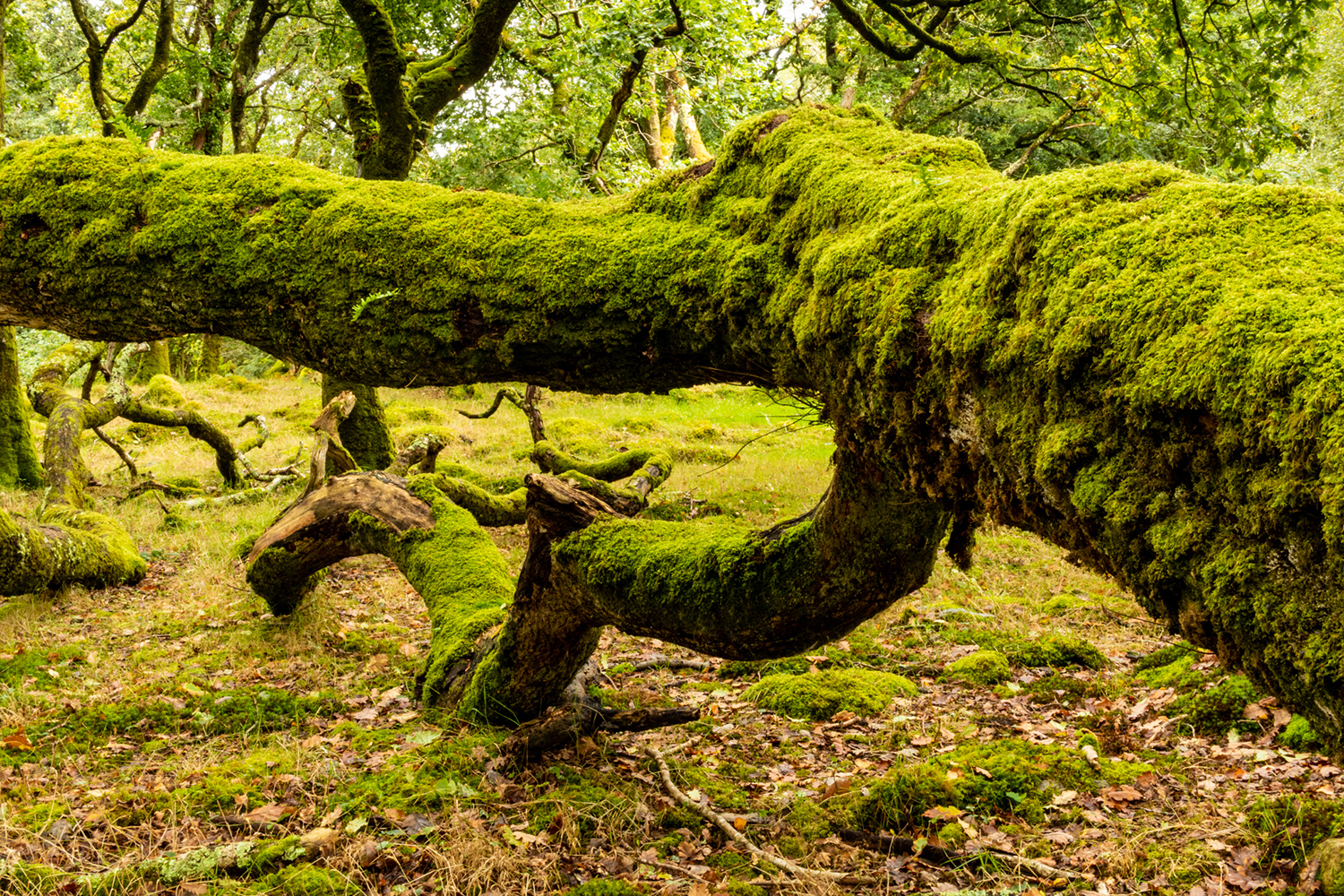
I asked which images fitted in a series? The form of these didn’t:
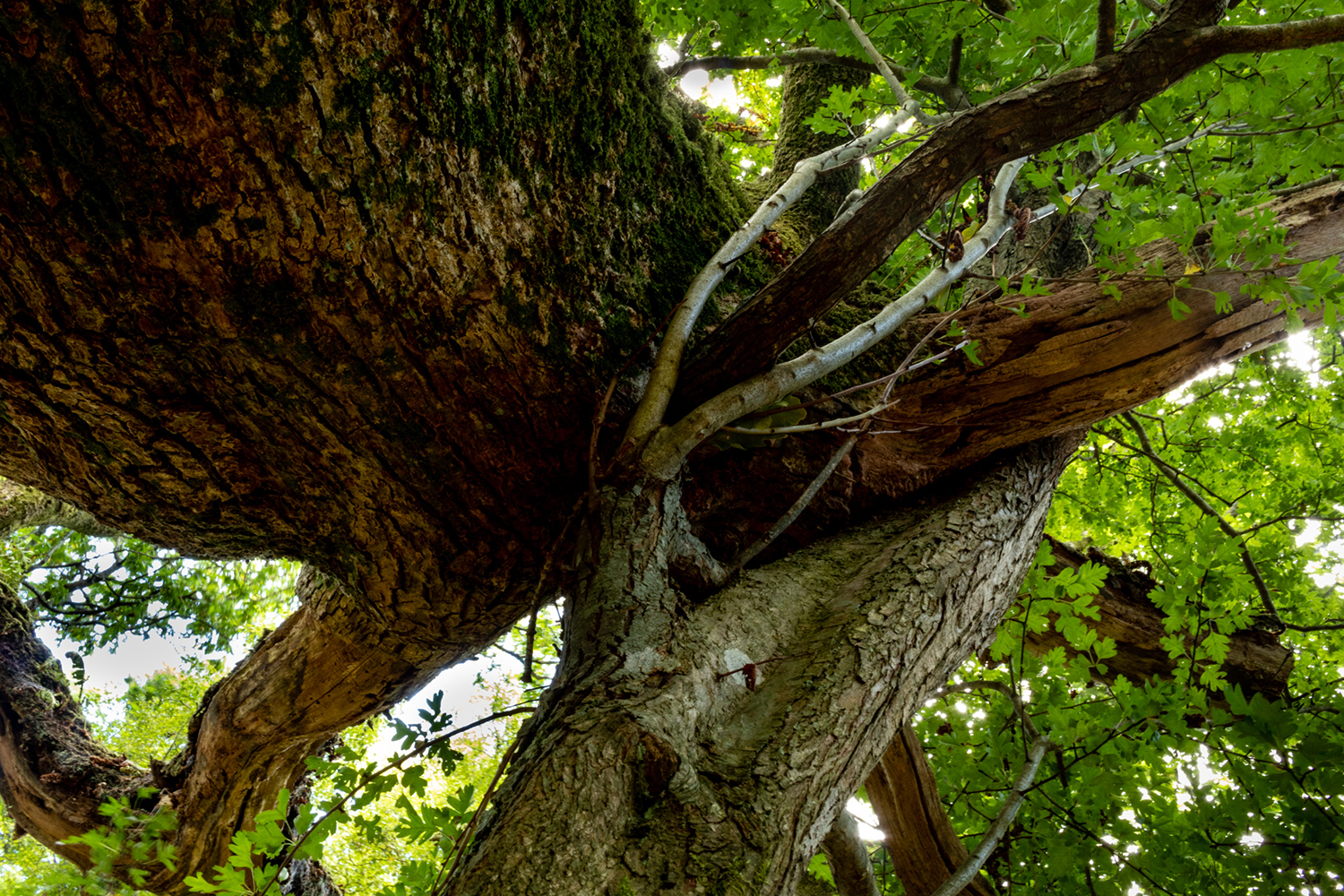
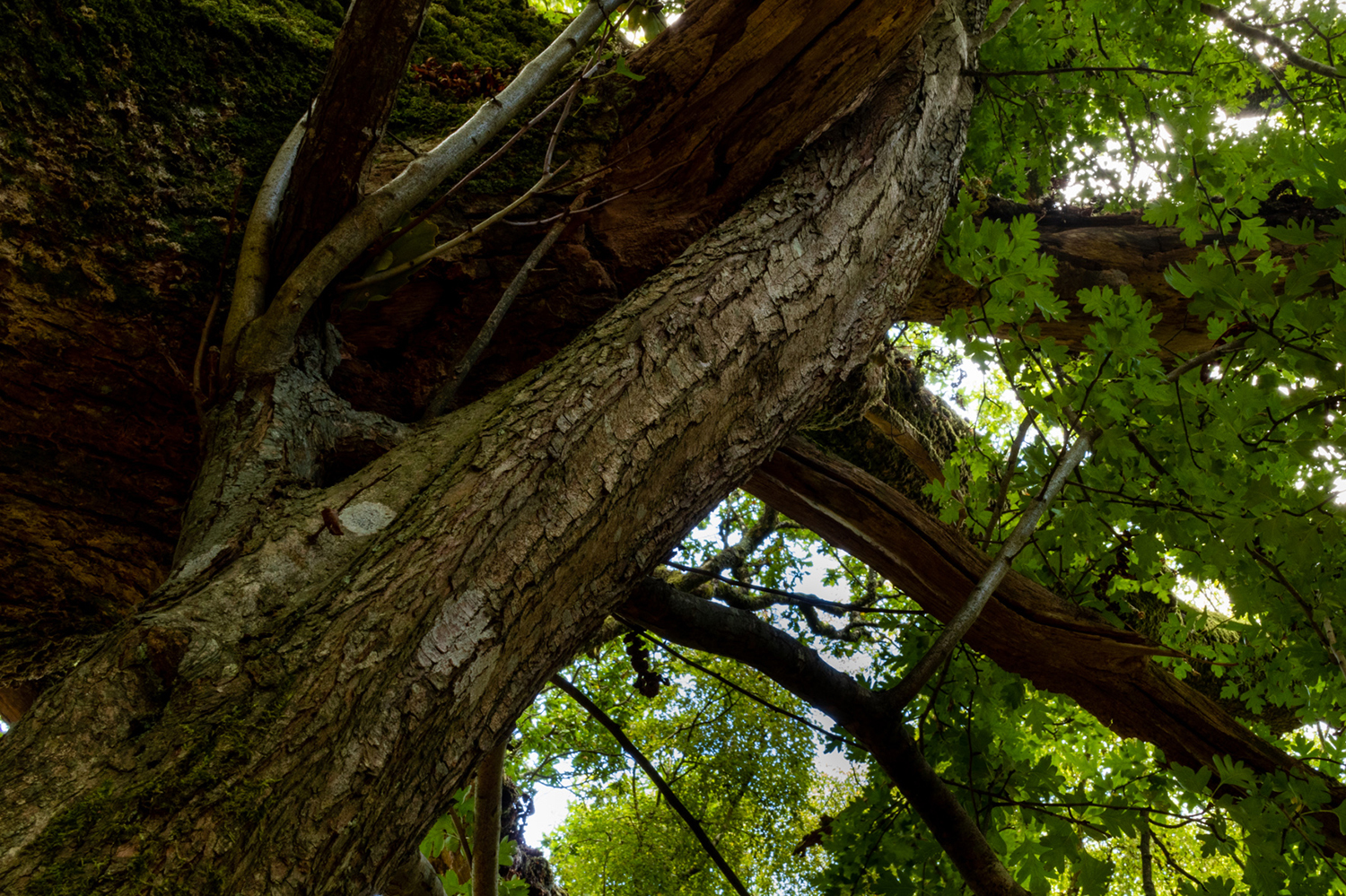
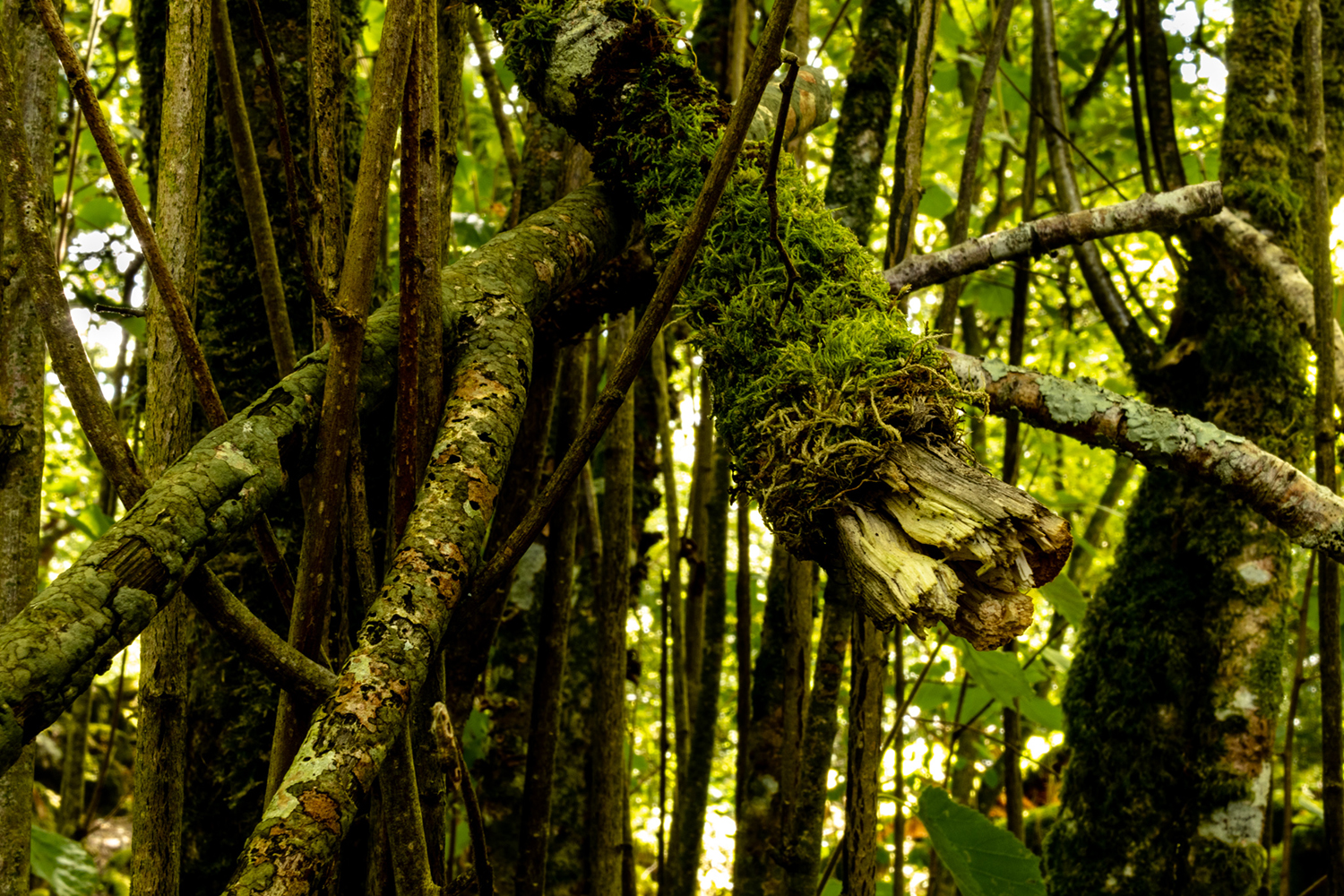


Images : 3047 3254 3295
I asked which images strengthen my ideas or voice and which images slowed the narrative down or weakened my narrative? I dropped:

I looked closely at those I was left with. For instance I vacillated between:
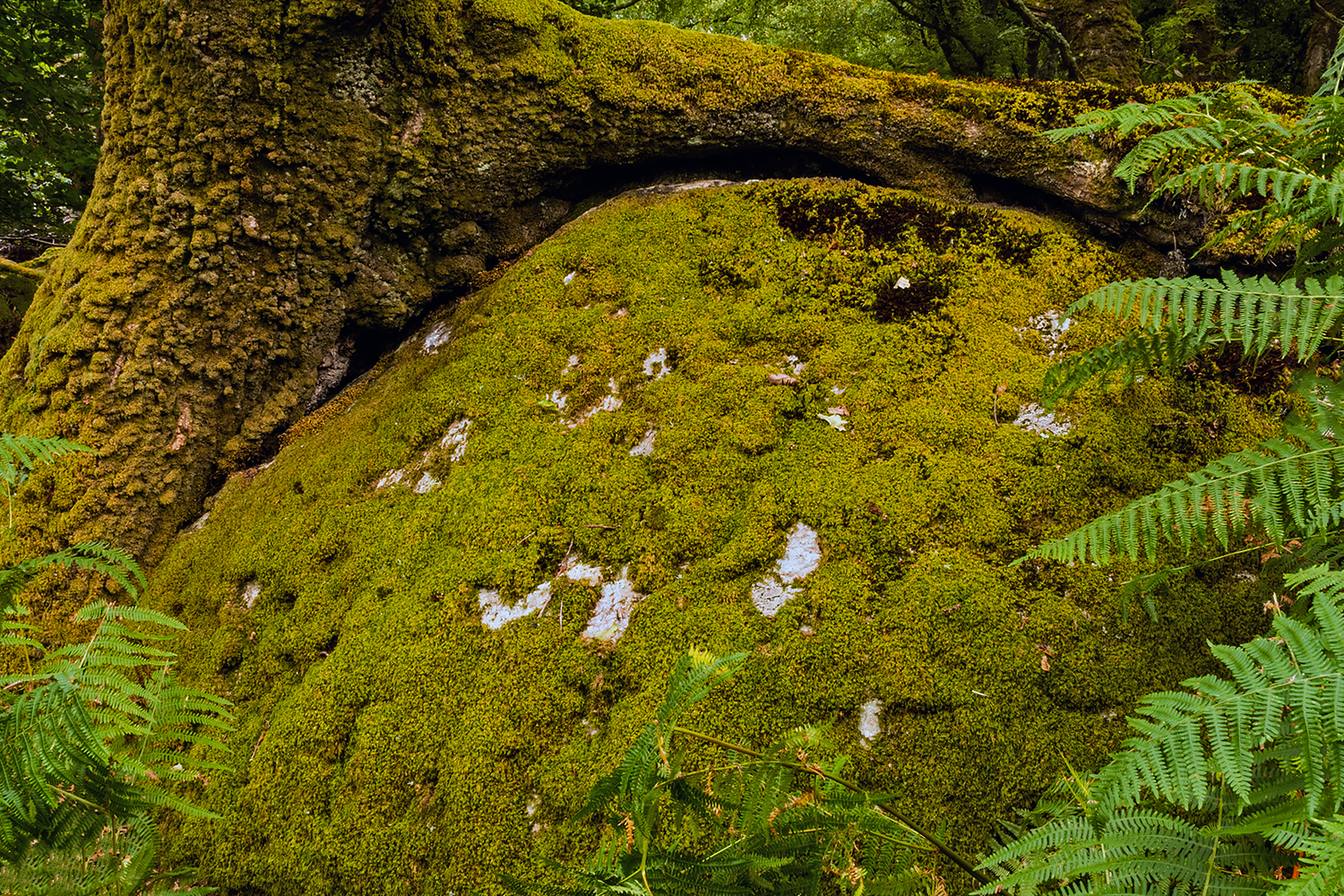
And dropped the 3247 as although it gave more context this diluted the message
I reluctantly dropped one of my “babies” which Id spent much time on as though it clear to me it was a tree lying on its side when I shouldn’t naturally be, it might not be obvious to others and it didn’t fit in the series as well
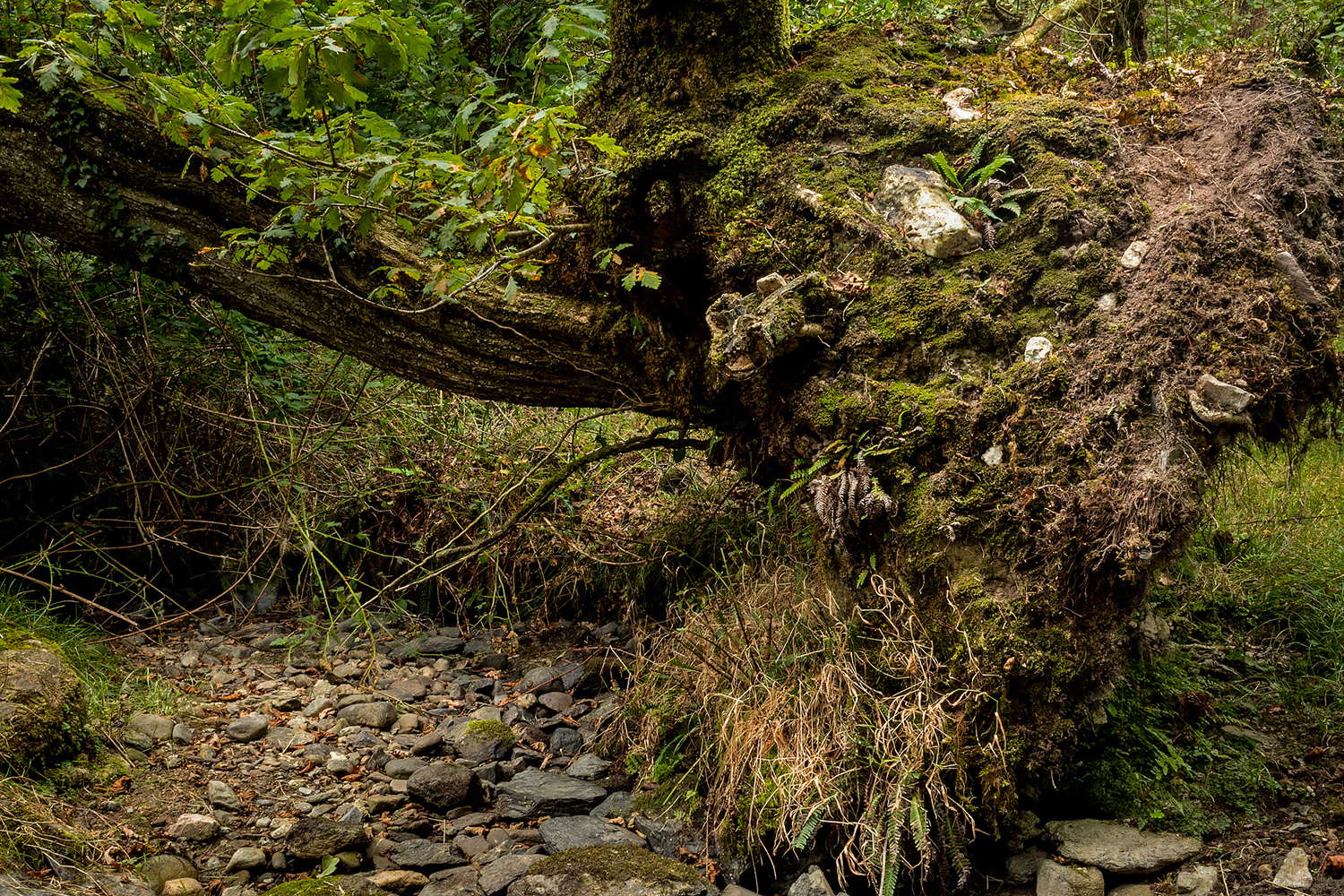
Then this image was dropped to get the series to a cohesive flowing set of 8
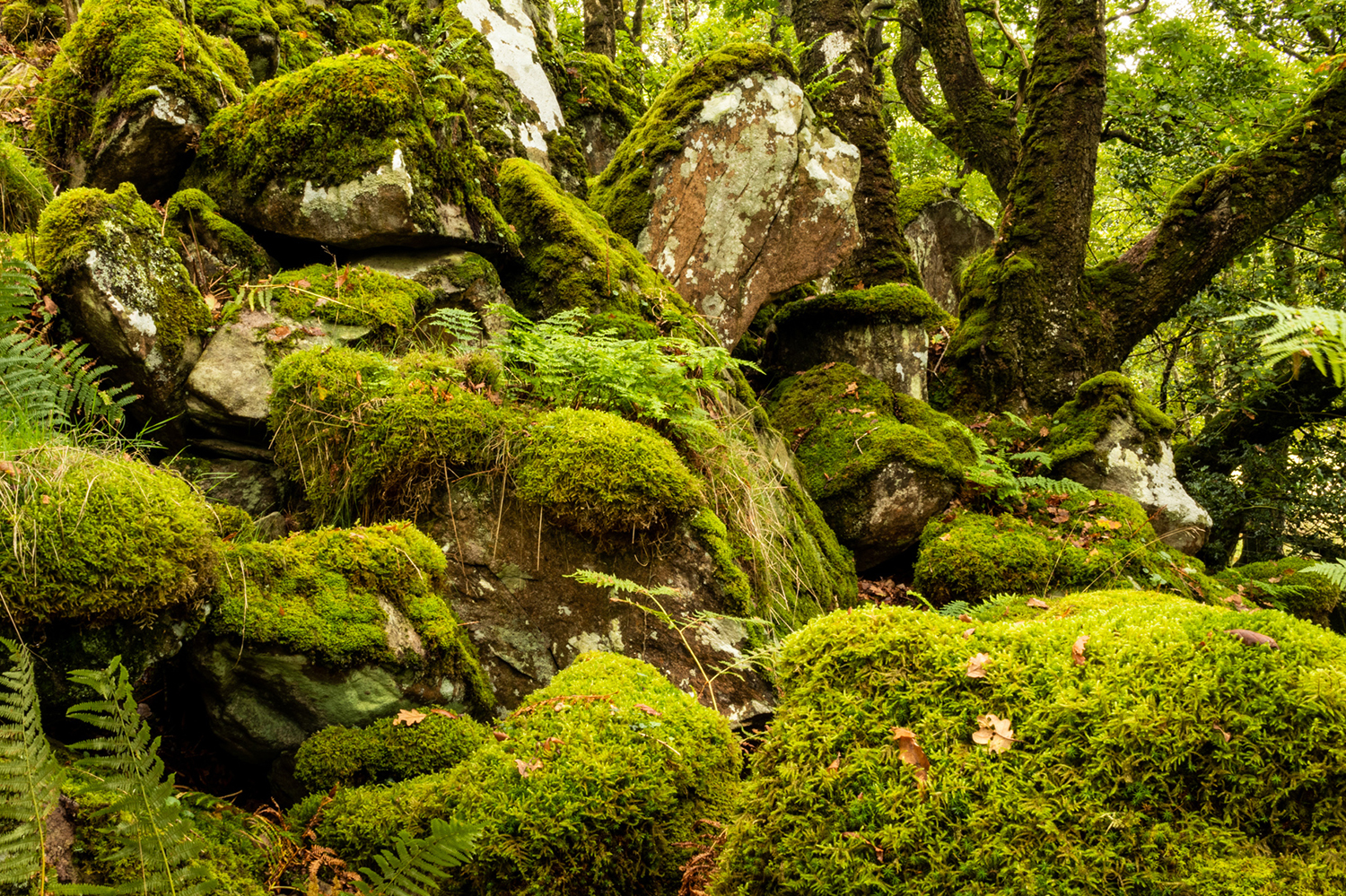
Finally I checked myself by answering as suggested in the coursework:
• Will the image stand as a visual piece on its own?
• Is the image adding anything new or emphasising the point I want it to?
• Is it detracting or contradicting from the rest of the series?
• Am I overlooking any less striking work because of aesthetic concerns that may be secondary to the impact the piece will have on final reading?
I am satisfied with my choice of images in the light of these challenges.
Mindmap BOW Assignment 3 Editing:

When sequencing I tried to provide for a flowing narrative from one image to another and increasing the viewers response.
Aware that I need to signpost the work for my viewers I decided for this work to do so simple with captions. Each image to be captioned with a harmonious and chaotic synonym. I matched the words with the images as I best thought.
20.8.22
I have taken some time to complete CS assignment 2 and have been reading a researching widely. I am now ready to re immerse myself in BOW. To do this I have been re-reading my BOW to date. The following notes are to help me proceed with BOW assignment 3:
On Assignment 1:
On preparing for assignment 2:
Note I mentioned in my learning log: Rob Hudson Stephen Segasby, Guy Dickenson, Tom Wilkinson and JM Golding. Also Alfred Stieglitz and Minor White: https://nkssite6.photo.blog/category/body-of-work/bow-assignments/assignment-1/a1-learning-log/ (may need to protect v self-plagiarism in CS Dissertation)
On Assignment 2:
Before assignment 3:
Reread woodland research – https://nkssite6.photo.blog/category/research/reading/woodland-reading/ lead to reminders:
Further reading/research on mushrooms that I’ve scan read but have yet to complete:
And on trees: Takeaways: symbiotic/mutual relationships
Have re-read work of other practitioners https://nkssite6.photo.blog/category/research/bow-research/other-photographers-same-material/ Takeaways: value of finding ways to encourage viewers to look hard/differently at the subject.
Tutor suggested reading:
Next post: https://nkssite6.photo.blog/category/research/bow-research/bow-research-part-3/
Nicola South Student number: 514516
Brief: Spend some time reviewing your personal reflection and your tutor feedback. Develop a series of carefully considered images that moves your idea forward. Hand in this series to your tutor together with a new reflective commentary setting out where you plan to go from here.
These images follow on from my first genre shoot developing my exploration of my concept, the ancient woodlands, as a visual metaphor for my theme of community. I was encouraged after my last assignment, to get to the knub of my idea and form a working title; I have decided on “A harmonious community”. The how and why of sharing my concept is still developing.
I reread and found new material on woodland species I photographed, trees, lichen, moss, ferns, and fungi. This increased my respect for them as individual subjects and enhanced my understanding of how they work together to create this harmonious woodland community. Sheldrake’s quote about lichens being undividable “They flicker between “wholes and “collections of parts”” (Wildlife Trusts, 2021), could equally apply to all these woodland species. This time as I photographed, I shuttled between the perspectives of the whole and the parts, but increasingly focused on individual woodland species. When I reflected on my images it became obvious that it is almost impossible to separate these parts from the whole, as the woodlands are all about the collective working together.
Photographing these species was a process I needed to go through to understand the parts that make the whole harmonious community. I tried different ways of looking and using unusual perspectives but returned to simply showing the close relationships the species have with each other. I considered various text to signpost my intention, settling on simply adding a border combined with a dictionary definition to add definition to the images. Interestingly these definitions of words that relating to a harmonious community, mostly refer to people or persons. My concept is inspired by humans, they are not evident in my images, although they are the stimulus to my intention and observations, they do not need to be visually evident, I am sure of that.
These images were not inspired by the photographers I researched, however returning to this research, when reflecting on my outcomes, helped me to consider on ways forward now. Of those, I identify with the work of Ellie Davies, particularly her practice where she “walks, thinks, sits, listens then creates” (Davies, 2018). Although her outcomes are created by intervention and construction in the woodlands which I don’t lean towards, I share her desire to photograph to explain the landscape’s effect on the photographer; this is something I will focus on going forwards- an intention to communicate the woodland’s exceptional quality of harmony and mutual relationships. Can I put something of myself in the space as Davies does without intervening in the landscape?
After this close focus on interrelationships in the ancient woodlands, I now want to return to a wider view of the moss-covered landscape to express my feelings about this community. I may try like Thomas Struth’s work in forests and jungles to present so much information that viewers will surrender to just looking. I have a thought to try mixing into each image, both the “whole” and the “parts”.
Wildlife Trusts (2021) Look at a lichen At: https://www.wildlifetrusts.org/blog/guest/look-lichen (Accessed 07/03/2022).
Davies, E. (2016) Ellie Davies. At: https://elliedavies.co.uk/statement/ (Accessed 07/02/2022).

___

___

___

___

___

___
___

___
This was video Feedback
I outlined my BOW ass 2, in particular my intention to use my thoughts and experiences of the local community as a stimulus only, not featuring humans in it, in my work on the woodland community.
Since assignment 1, I have honed the knub of my idea for my BOW to “a harmonious community”. I have stayed with my original intention of using the woodland as a visual metaphor for community, and a way of expressing my inner thoughts and emotions as well as my response to place.
I explained that I am inspired by the photographers of the Inside the Outside, landscape photography collective, as well as the work of Minor White and John Blakemore. Also that I want to put myself in the landscape without intervening in it like conceptual photographers such as Ellie Davies. In discussion we drew out that this work is about close up scrutiny of parts of a community, though moving on I will be sharing both the macro and the micro. We talked about looking at the patterns and relationships that emerge from this, as well as considering possible poetic elements to the work.
• She liked my approach using dictionary definitions juxtaposed by images of close-up parts of the woodland, which communicates my inferred reflection of the woodland community to human communities.
• The type face I used is effective, though it was suggested that I could make the definitions more authentic by ensuring that they consistently using verb or nouns and by using the same respected source such as the Oxford English Dictionary. This is not something I need to do now, but that I could do before my final submission.
• She suggested that I continue to dig down into my theme of harmonious community that is at the centre of my work
• In the future I could use the separate parts of the woodland community that I’ve photographed this time, somewhere in my final work- possibly in an appendix, inserts or overlays.
• To experiment with my idea to represent the macro and the micro, we talked about using digital or physical overlays.
• My tutor suggested that I might think about patterns and settlements also to combine with my woodland images.
• I should check out the writings of Edward Weston.
• Ensure my images are of the correct quality to stand enlarged printing if required.
My tutor was encouraging about the work and the developing concept, saying that I am showing that I am open to development and open to inspiration. I should not be afraid to present aesthetically pleasing images, and not look for an alternative way of presenting just to show a point of difference; just to find one that communicates my message. She described my work as slightly poetic, and that I should continue with my photographing, whilst experimenting with methods of communicating the parallels of the woodland community to the human community.
She suggested I should look at:
• Man Ray’s Dust Breeding. David company essay on: https://davidcampany.com/dust-breeding-man-ray-1920/
• Giles Perez conversation with Gerhard Steidl where he talks about text and images and the new meaning that forms beyond the two: https://thephotographersgallery.org.uk/dbpfp22-gilles-peress
Next post: https://nkssite6.photo.blog/2022/06/04/body-of-work-assignment-two-submission-genre-development/
 NIKI SOUTH