LEARNING LOG ASSIGNMENT 4
Planning
My intention at the outset of this series was to shoot at longer range images that show the harmony and varied components living peacefully together; and possibly to combine this with signposting related to the musical concept of harmony.
What I hadn’t factored in was the time of year. In December when I began scouting to shoot I should not have been surprised to find that vegetation was sparse in the ancient woodlands, apart from moss. Even when the woodlands were not sprinkled with frost, ice and snow, there was very little sign of life beneath the earth, bark and moss. But the moss was abundant, carpeting many elements of the sleeping woodland, rocks, bark, fungi, trees, logs, and earth.
I revisited my earlier research on moss. Moss protects, nourishes, stabilises, and filters the woodland environment. It is a great showcase of just one of the woodland plant species that thrives and enables other species to thrive…it does not thrive at anyone else’s expense, and in the winter is most obvious because most other species are visually in hibernation.
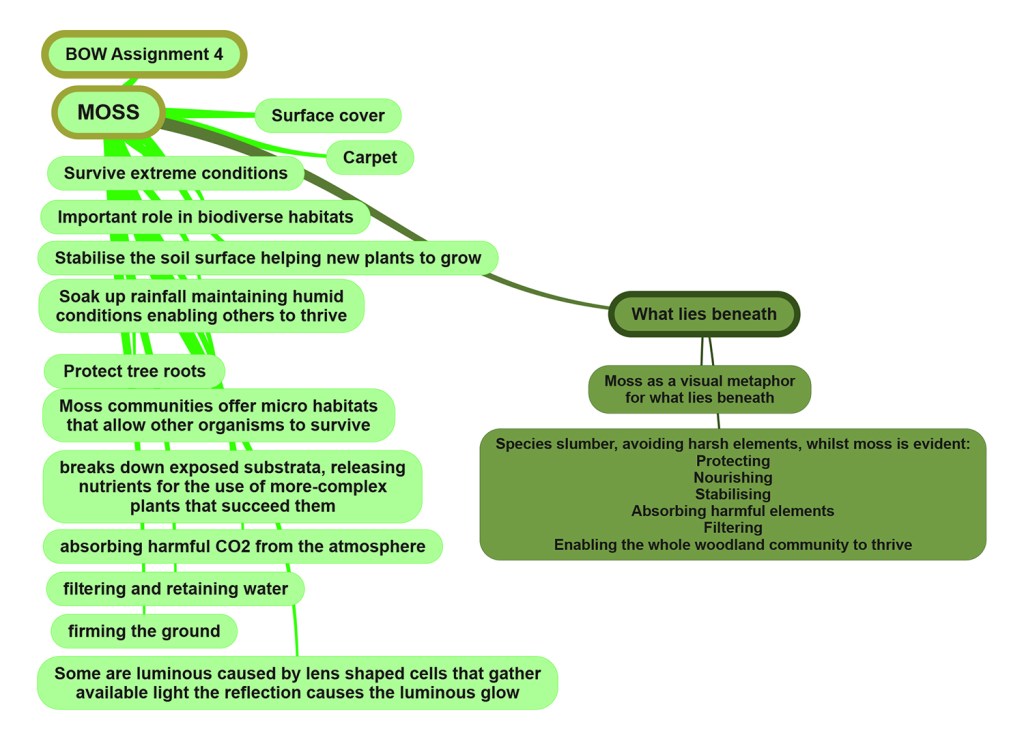
I reflected on how this compares to the local human community nearby. Although it is winter and much goes on behind closed doors, what is being shared behind those doors occasionally escapes. Despite the low number of tourists (a common thing for some locals to snipe at), tension still surfaces between “locals” (those born and bred locally), and incomers (those who live locally) and especially those with second homes (who visit periodically).
At its worst it could be called xenophobia. Spiteful comments, by word and mouth, and on social media continue to be shared but more anonymously than in the tourist season. This saddens me when the majority of the community works well together, enjoys the relative peace in the winter and the “incomers” do much to support the local community, in fact in my opinion they are the backbone of the community support. It is a shame that prejudice and resentment from a minority who can’t cope with diversity and evolution, spoil the peace, and cause disharmony in the community.

So, I revisited my visual intention. I would focus on the moss in the woodlands as an example of a nurturer and protector, a reflection on the harmony which is possible in diverse communities and a visual antithesis of some harmful elements in the disharmonious local human community.
Shooting
How would I achieve this? For me it is about showcasing the moss as a protective blanket, covering, and combining other species, a positive reflection on “what lies beneath.” Sometimes we can’t be sure what lies hidden beneath, but in the woodland setting it appears peaceful.

First shoot
I shot with my prime lens and aimed to shoot mainly at more of a distance. I composed so that I could to crop afterwards 5:4 ratio, this was a first for myself, normally I crop as I compose in camera. Visually I looked for subjects within the woodland covered in most and as luminous green as possible. The keywords and phrases I associated with as I shot were carpeted with moss, green, protective blanket, softness, peaceful, stabile, togetherness. I remembered my research on poetry and tried to think, feel and shoot like a poet.
The practical issues I had was with weather shooting conditions. There were a couple of weeks where the ground was snow laden which covered much of the moss, and between those were mainly days of persistent rain. On the literally few days that it was dry over a month I made sure I was in the woodland. Harsh light was a problem due to the time of year, low sun, short days, and lack of vegetation.
As shooting progressed I strayed away from just long/medium range shots and just worked into what showcased the moss the best. I found that I gravitated towards trees as a habit and had to remind myself that moss was the subject whatever it was covering, rocks, earth, logs etc. I looked especially for subjects that were predominantly moss covered, whether that be as a whole, difficult to capture due to their size, or by shooting parts of large trees, and not always large areas from a distance.
Editing
As I edited I returned again and again to my intention to use the woodland community to example harmony, the anthesis of the local human community. In particular this series showcasing moss as a selfless protector and nurturer of the community, homogenising and integrating the diverse species below it’s carpet.
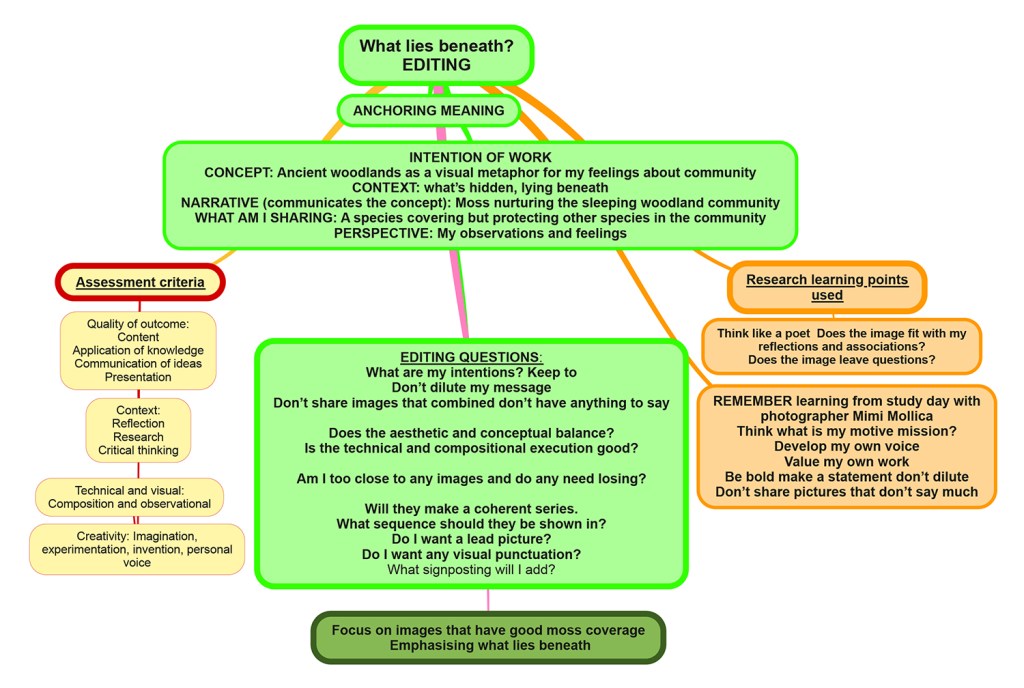
My working title began as “what lies beneath”, but maybe it should be combining and accepting? Both work whilst I am editing. I chose images that emphasis moss covering what lies beneath.
I then put my final 20 images on a padlet as my tutor had suggested and edited further from there. Link: https://oca.padlet.org/nicola514516/xn4o1dhm1j82w7ny
I quickly excluded, images 5271 & 5442 .I liked the subjects and their message but was hampered technically as to shoot these as I wanted I could only do so with harsh light behind them, I had tried on various occasions to avoid this, but it had not proved possible.
I dropped 5266 as it wasn’t so lushly covered with moss. Whilst I dropped 5316 &5236 as I preferred others.
I then looked at similar images and chose 5345 over 5353, and 5480 over 5558, and 5350 over 5292, and 5329 over 5431 & 5446. I later dropped 5350.
Of the eight remaining, I asked myself the questions:
- Are they keeping to my intended message, protecting what’s lying beneath?
- Do any of them dilute my message?
- Do the images on their own say anything? I don’t think any of them have a message on their own.
To reduce these to 6 images I asked:
- Do the images together say anything?
- Do they make a coherent series?
How do I order them? This may depend on my signposting- my message is more important than my aesthetics. So, what signposting will I add?
Presenting and signposting
My research led me to the possibility of poetry, see link to poetry research: https://nkssite6.photo.blog/2023/01/21/bow-assignment-4-research/
My learning led me to think like a poet when shooting. I took onboard that poetry like photography can mean something other than the subject. This time when shooting I was conscious of word associations, and compact messages like poetry. I was unsure how or if I would combine my photographs with poetry.
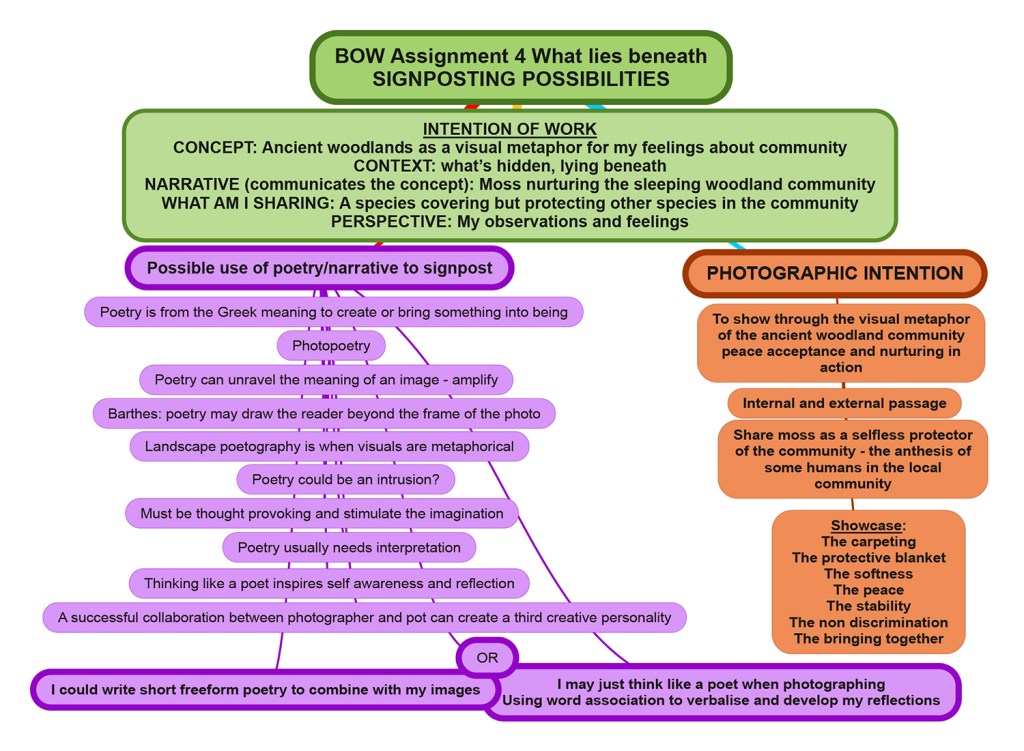
Having edited my images down to eight, I set about experimenting with poetry to combine with them. Could I create third personalities by combining them? I experimented and settled on a form playing around with word choices for some time.
I reflected on the eight images again, and dropped 2 images to form a tighter series of 6.
I then experimented with poetry, combining poetry and images until I matched poetry and images.
 NIKI SOUTH