LO1 produce convincing visual products that communicate your intentions, using accomplished techniques in complex and unfamiliar environments, with minimal supervision from your tutor.
I believe I have communicated my intentions both in the images and in the accompanying reflection, that this is about place and self.
My images support these intentions to use the woodlands as a metaphor for a harmonious community, the transformation of subject and object. However, there is ambiguity and room for the viewer to interpret.
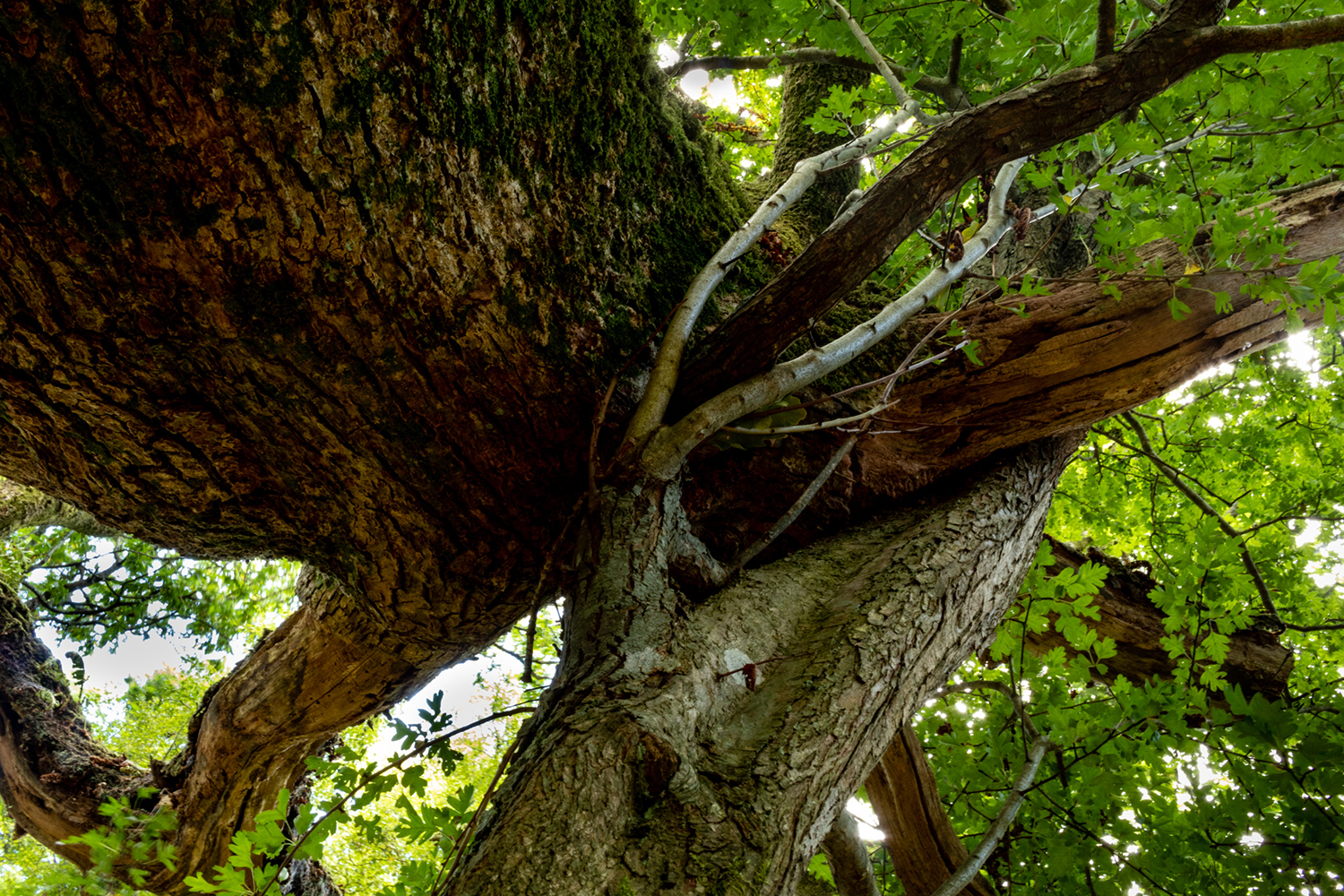
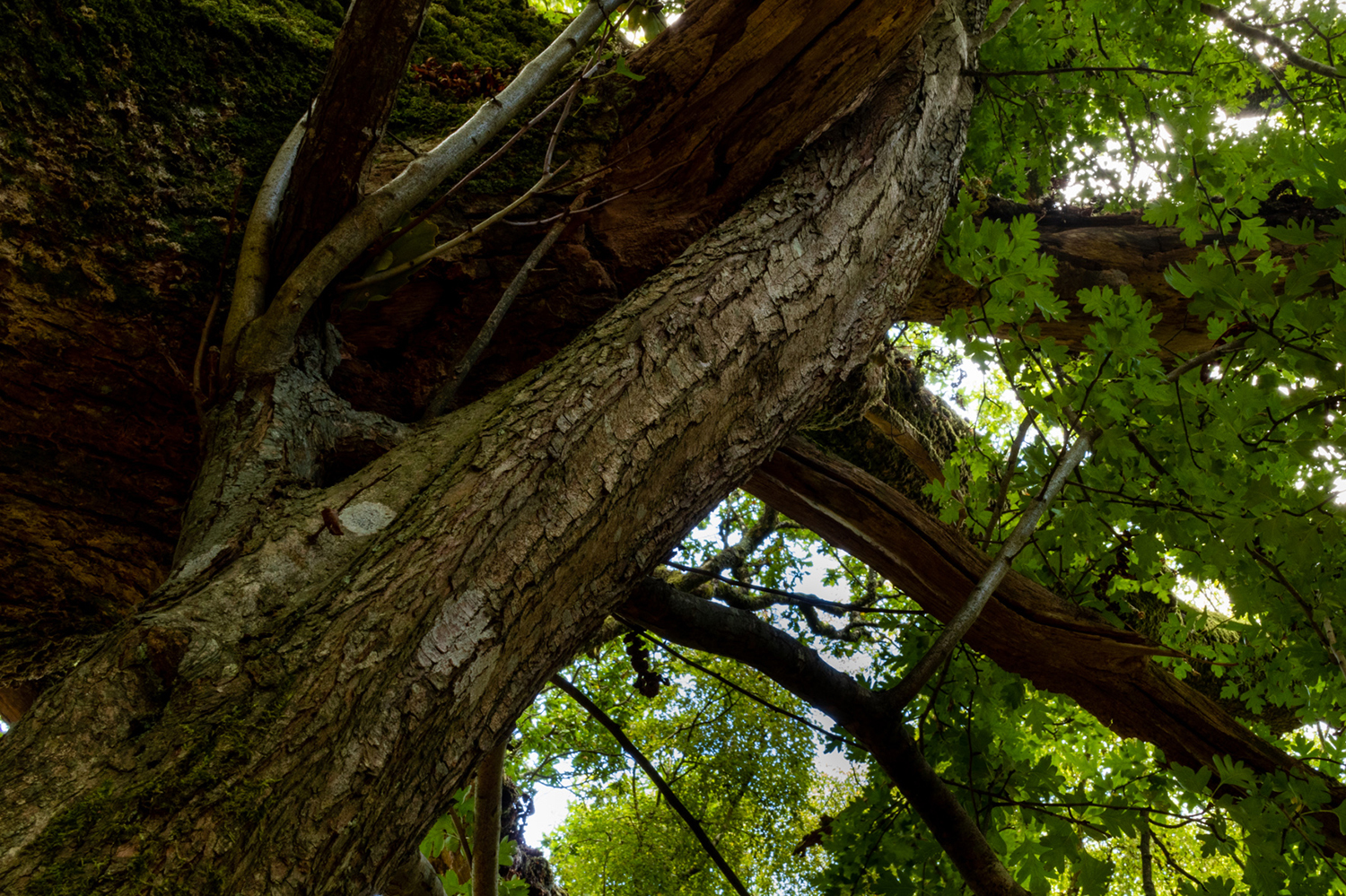
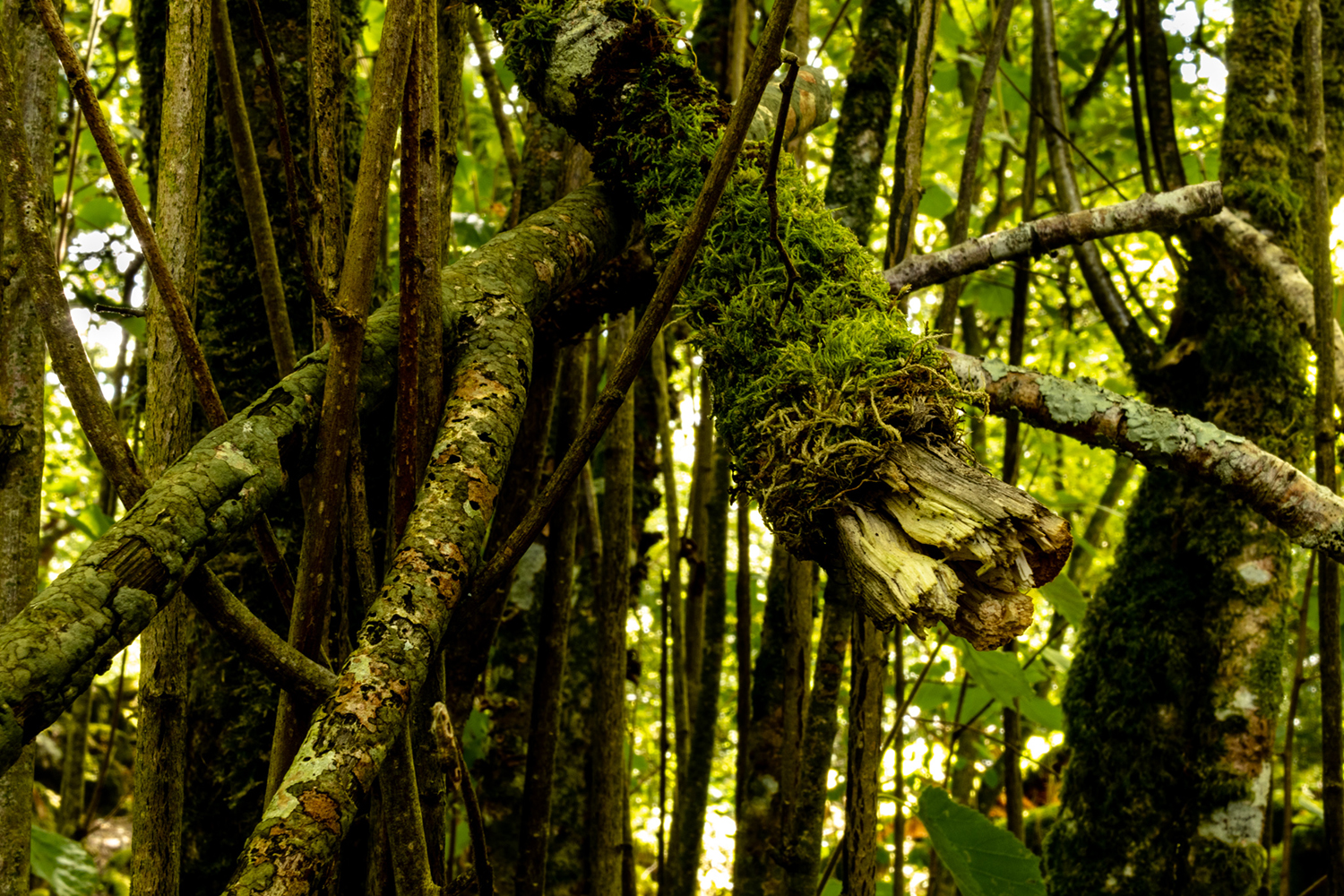
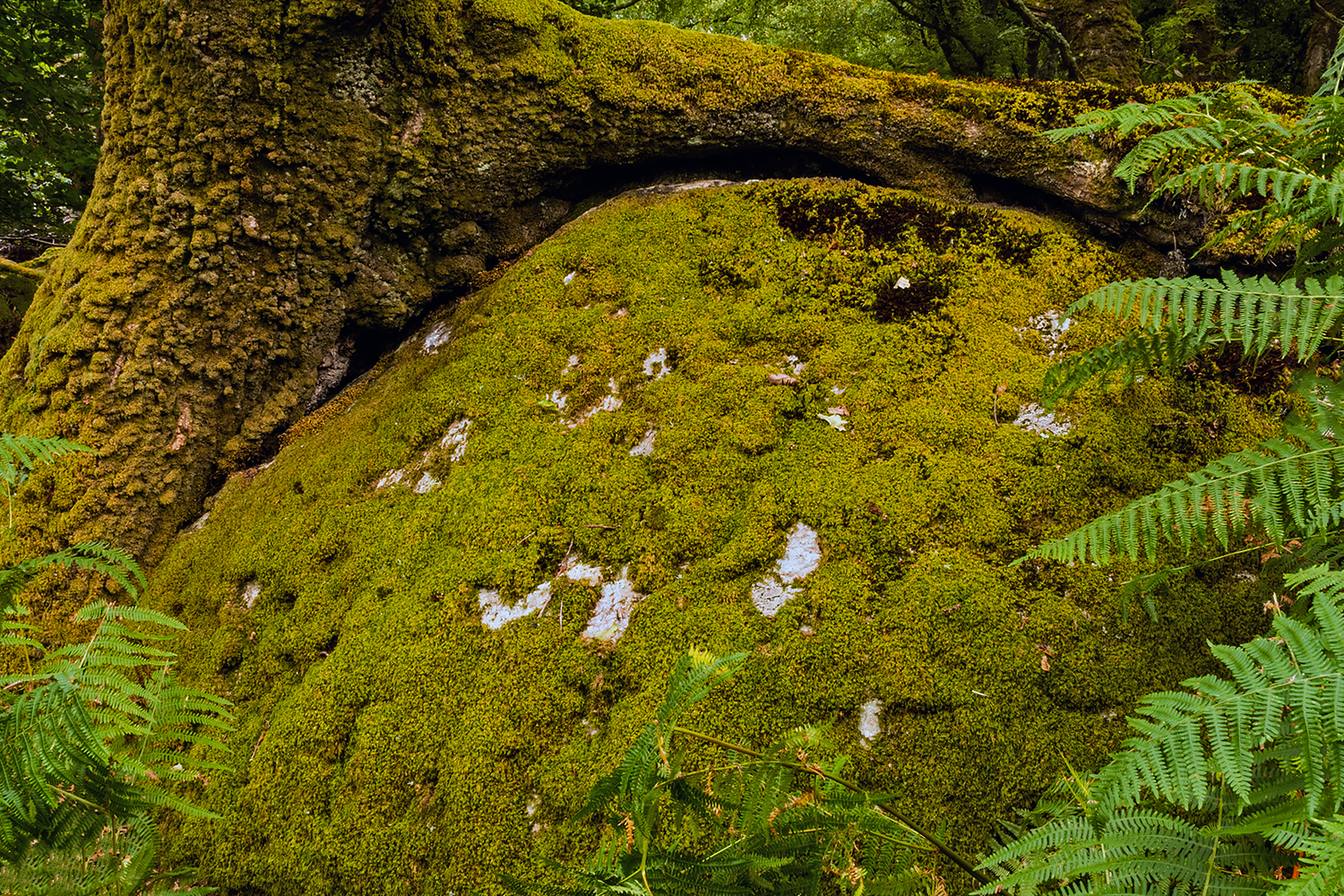
The subjects chosen for this series I believe give the overriding presentation of harmony and yet there is a twist, as on first look they may appear chaotic. Chaos in the woodlands caused by diversity is a complex situation as the place remains highly successful
The techniques used may appear simple, it is through the straightforward use of a digital camera, with little postproduction work; the colours are as shot and I have rarely cropped, I prefer to create in camera.
The environment is becoming very familiar to me and yet it changes daily with the ever-changing weather and seasons.
LO2 demonstrate comprehensive knowledge of your area of specialisation and be able to situate your own work within a larger context of practice in your field.
My study for Contextual Studies is deepening my understanding of “affect” and expression in landscape photography both conscious and sub-conscious. This detailed CS reading is not literally evident in my BOW as the research I present is that for my BOW, but I hope that my photographic and reflective progress demonstrates that there is increasing understanding of Semiotics, indexical relationships (sharing the idea of an object/subject) without a physical likeness, transient meaning, and the existence of both affect and effect in photographs.
The background reading and research into photographers both in the field of landscape and using landscape to share internal and external passage is feeding a belief in what I am trying tom achieve and offering me new ideas to try. Their ideas on personal landscapes, and literal appearances as metaphors for internal experience are central to my work.
I have increasing knowledge in these areas which is explicit in my Contextual Studies, however do I need to make it more explicit in my Body of Work commentaries?
LO3 transform abstract concepts and ideas into rich narratives and integrate them in your images.
I have demonstrated that I can transform abstract concepts into a narrative, that diversity can be harmonious, and I think that narrative is in each image and reinforced by the images as a series. However, it is subjective expressionism.
I believe working in a series has strengthened the message I am sharing as I was very careful during editing to ask myself the question of each image: does the image detract or contradict from the rest of the series? or even better does it emphasise and add impact to my message?
I have signposted meaning for the viewers with my title and captions but hope that it is sufficiently open for them to interpret my and their own meaning also.
LO4 critically review your own work and evaluate it against desired outcomes.
I have reviewed this work against the course learning objectives as well as against my personal intentions.
Brief: As you work through Part Three, carry on developing your major body of work. Continue to shoot and reflect on your work so far and build a set of images to submit to your tutor.
Remember that the point of these assignments is to get tutor feedback on the project as a whole so come with your questions on how to move forward and ask for your tutor’s opinion on how the project is working so far.
Submit your work in progress together with a reflective commentary. Your reflection may consider some of the material in Part Three if it has been relevant to your practice. You may also wish to consider how genres are continuing to influence you and how you’re relating what you’re doing in Contextual Studies to your practice on this course.
ARTIST STATEMENT:
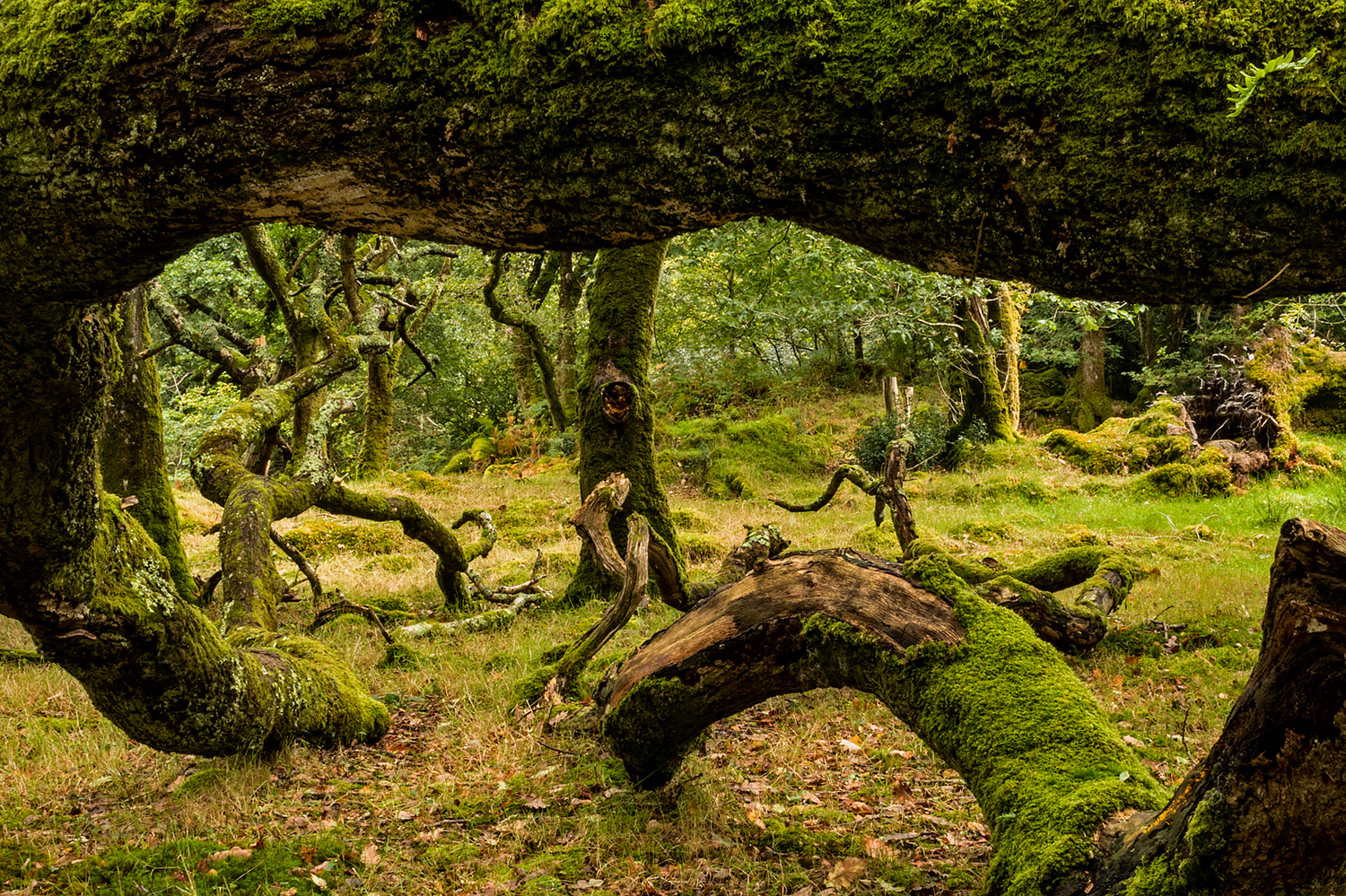
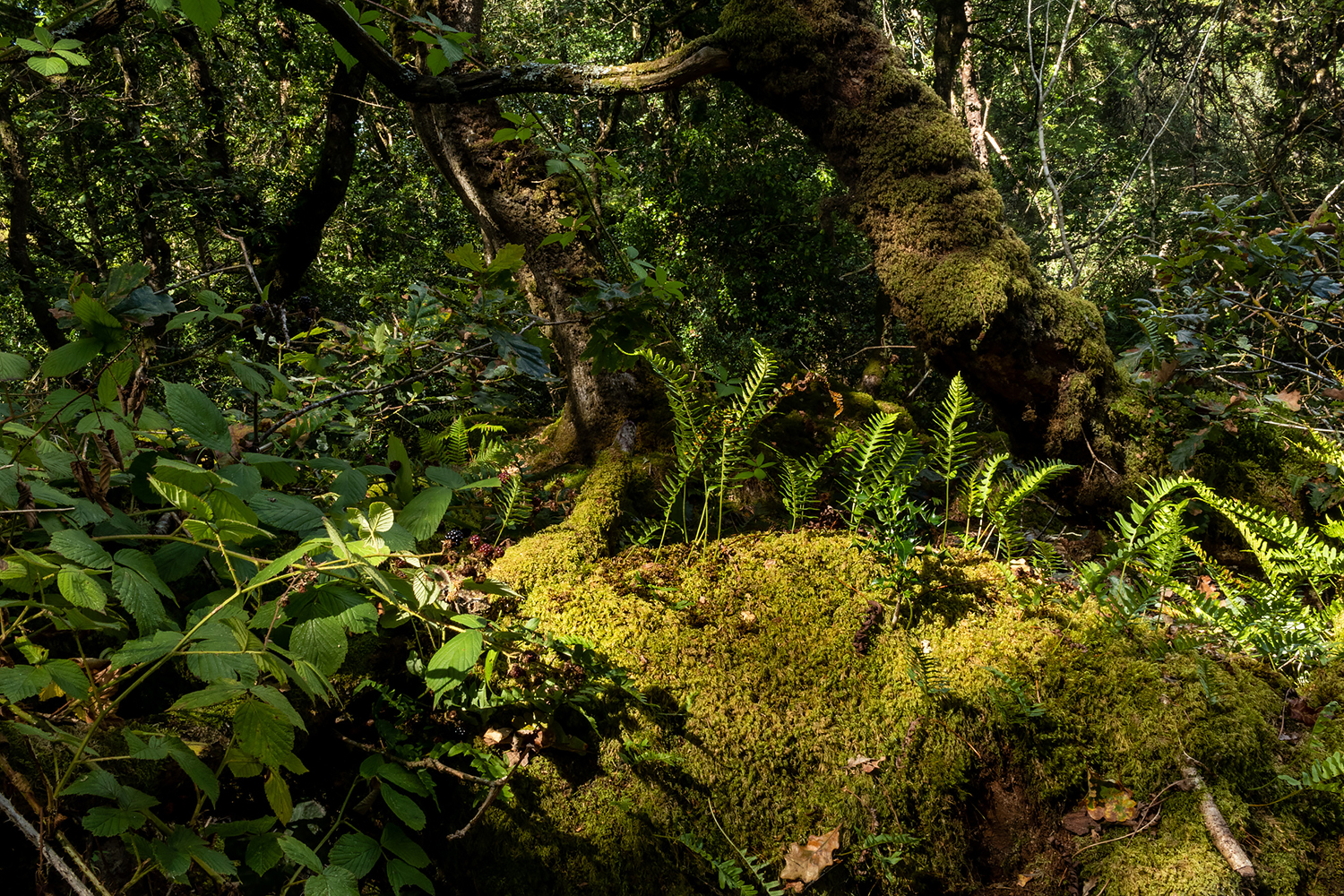
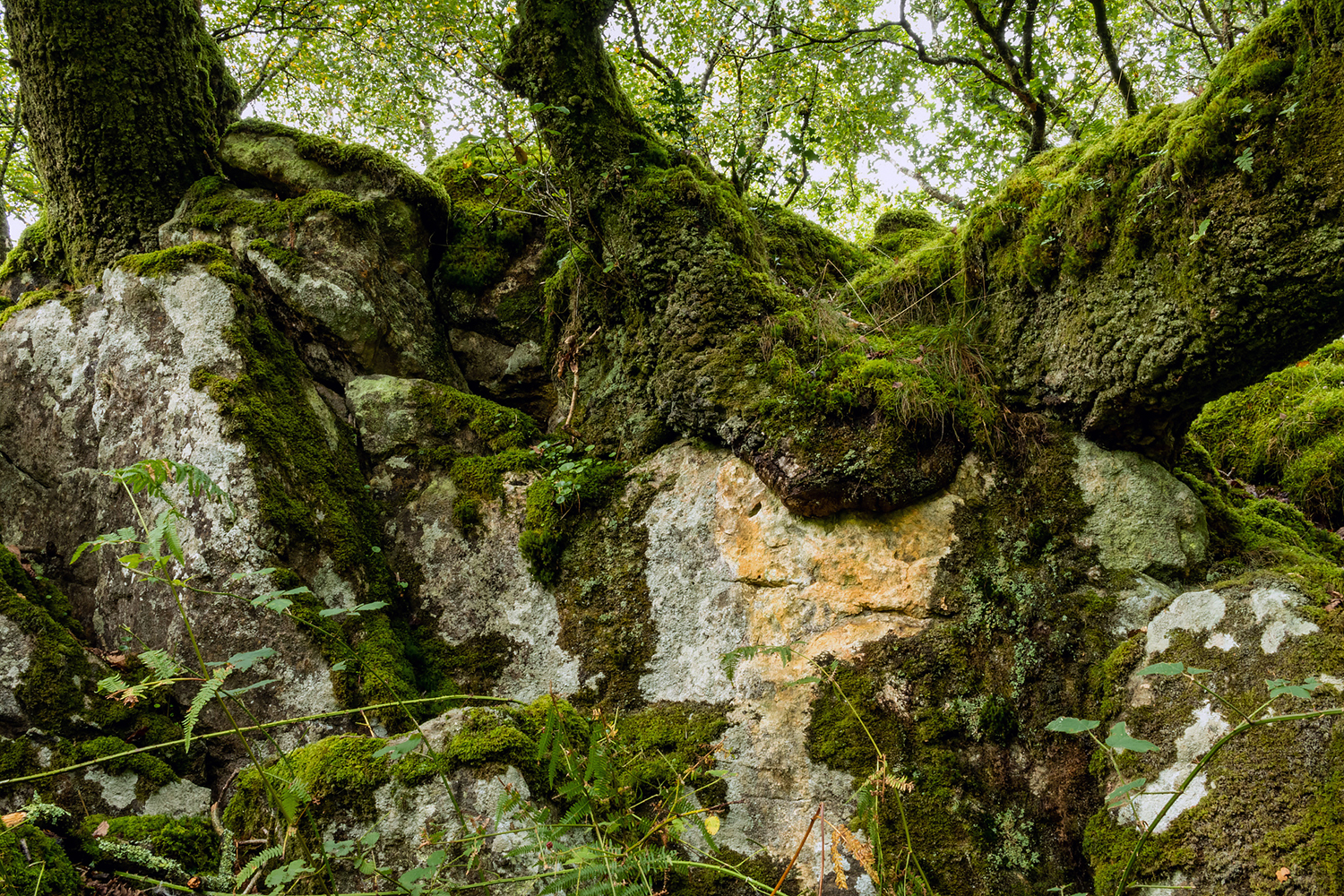
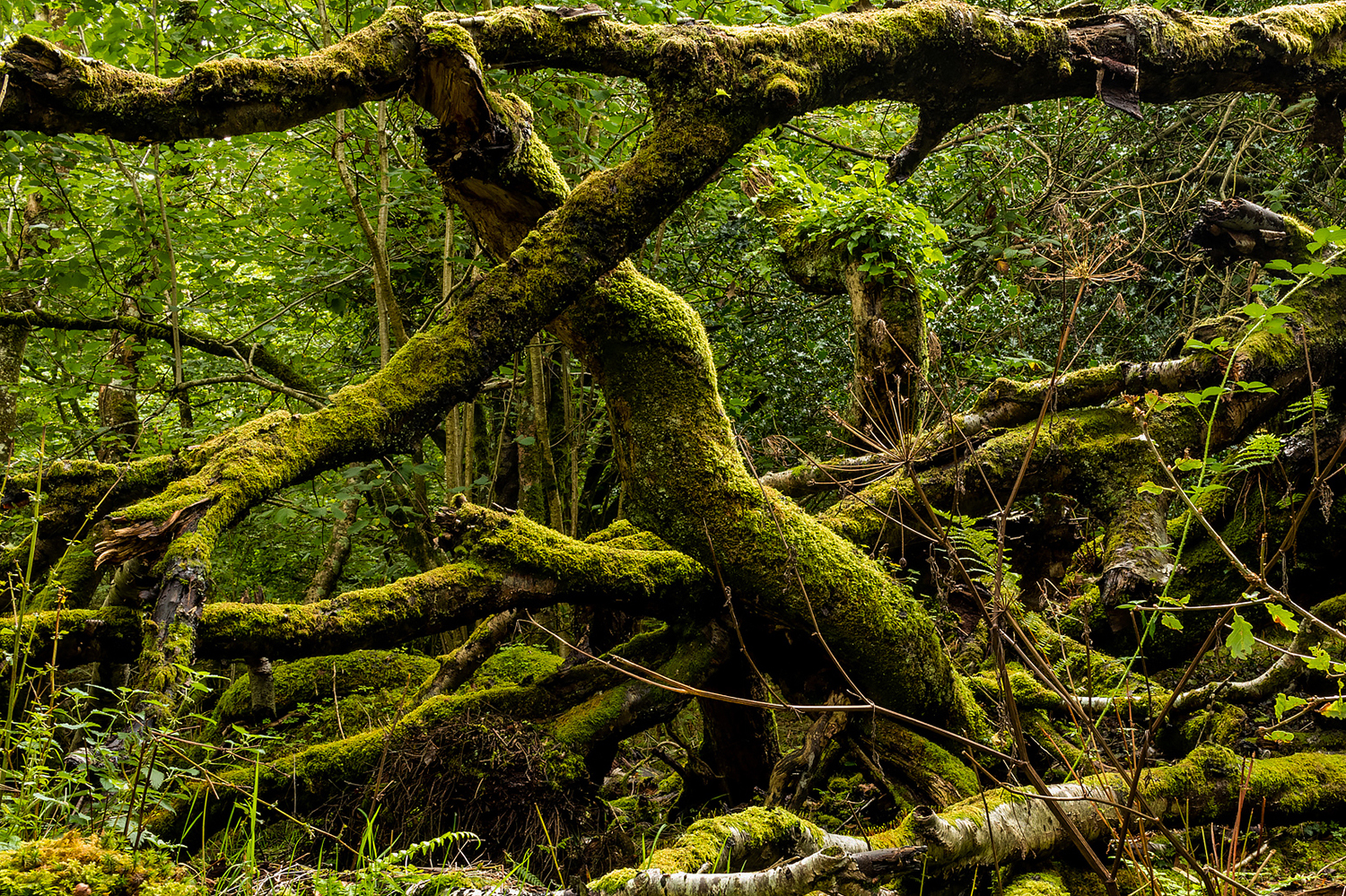
My body of work is about internal and external passage. When I “go out” to the ancient woodlands, I am really “going in”. My visual representation explores my feelings of discomfort about the tension in my local community, this as a contrast to the successful assimilation of diversity in the woodlands.
This series is an exploration of whether diversity necessarily results in tension and chaos, or whether these differences can be harmonious.
IMAGES
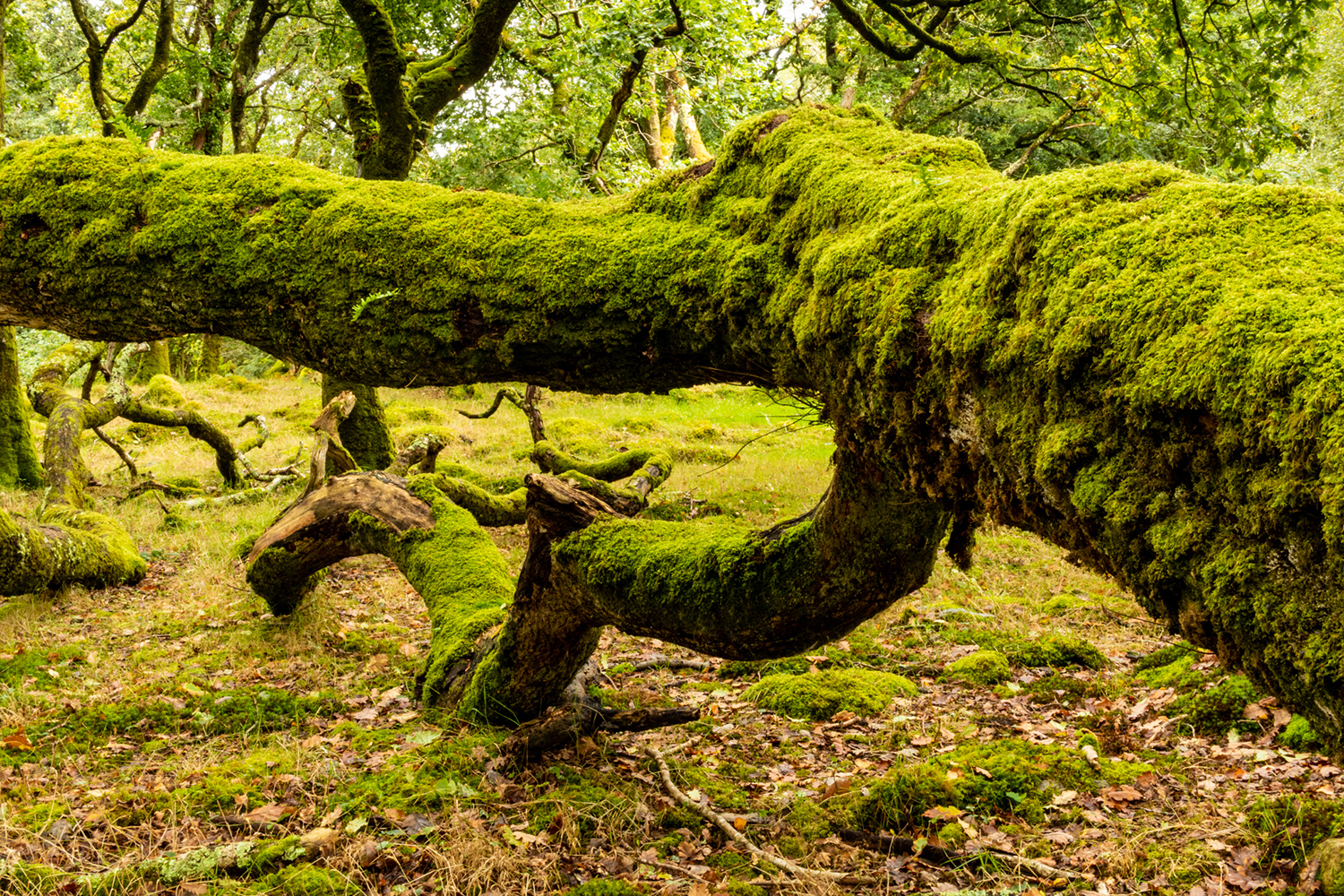
Harmony or Chaos?
_________
#Chaos… or Adaptation
_________
#Discord… or Diversity
_________
#Mayhem… or Cooperation
_________
#Partnerships… or Anarchy
_________
#Peace… or Disorder
_________
#Muddle… or Balance
_________
#Collaboration… or Disarray
_________
#Confusion… or Harmony
_________
Reflective commentary
This series develops my previous work which positions the ancient woodlands as a visual metaphor for a harmonious community. The motivation for the concept are my observations of the local community who are often disharmonious, driven by difference. The concept is stimulated by humans, though they are not evident in my work.
This approach runs parallel to my contextual studies work on affect (expressing what is in a photographer’s mind) and effect (the reality) in landscape photography. In essence this is the difference between photographing a subject for itself and photographing a subject to give a message about something else. Photographers such as Minor White present images as metaphors for something beyond the subject being photographed.
In this assignment, I want to explore further my ability to transform the abstract ideas in my head, my subconscious, into something concrete, via a physical representation of another subject. Many landscape photographers I have researched talk of combining the world within us and the world outside us, some say that that going out is really going in. Radonjič, (Metascapes,2016) calls this transforming our subconscious into “metascapes”, our personal landscapes, as the real landscape is inside your head. Tom Wilkinson (Wilkinson, 2022) suggests that photography is as much about the photographer as the landscape. I am aware through my previous practice that combining the world within my head with the one in front of me can be cathartic as well as produce intriguing photographs. My concept fits well with the theme of part 3 course work “Showing not telling”, Golding calls this using photography “to transform objective reality” (Golding 2022).
Prior to producing this particular series of images, disharmony in the local community had increased; partly due to the influx of summer tourists. Walking in the woodlands I was struck that there are many different species and great diversity, yet they coexist successfully, adapting to accommodate each other’s needs. Moreover, when I observed closely I saw that although this diversity first appears chaotic, messy, muddled, and disorderly, it is an organised chaos that works successfully. I resolved to to express my discomfort with the discord caused by the differences within the local community, by contrasting this with the harmony that exists in the diverse woodland community, where various elements accommodate each other to mutual benefit.
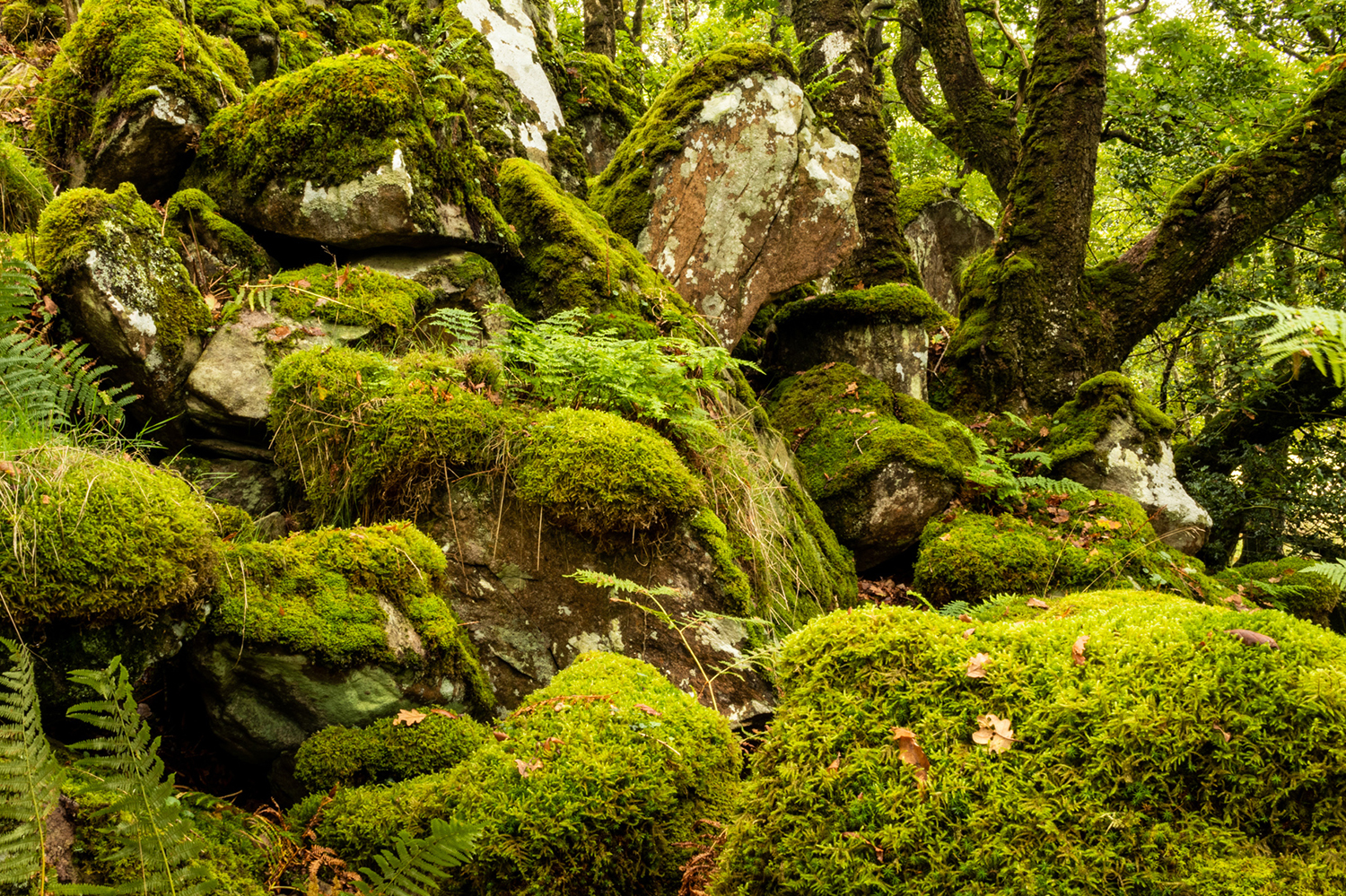
My intention when photographing was to seek out the visually chaotic, muddled and disordered to focus viewers on this aspect of the woodland community. Radonjic describes this as “visually intertwined living space” (Wesche, 2022). Viewers will need to observe hard just to make sense of what is present in such images, without any distortion by the photographer, and this fits well with another of my intentions that viewers should look closely to find meaning in the images.
I then edited to form a series of images that would communicate my message. My intention is to invite viewers thoughts as to whether what is presented is in fact harmony, or chaos. The images I chose demonstrate disorder and some randomness, but I believe they also have a quality of tranquility. I have signposted the work simply with its title “Harmony or Chaos?” and by each image having a caption denoting antonyms of these. In a way I am asking viewers to consider if chaos and differences are necessarily inharmonious. For myself, the first author of this work I am suggesting that differences and diversity can lead to adaptation, balance, and harmony.
I challenged myself in my last assignment to put something of myself in the landscape without intervening in it, and believe that my voice, my subconscious, is in these images. The viewers must decide for themselves what meaning they take from the images.
“To create a vision of the harmony of the unequal, balance the infinite variety, the chaotic, the contradictions in a unity”. (Hans Richter, German Dada painter, and modern art historian cited at: The painters keys, 2022)
My intention to use the Ancient woodland as visual metaphor for harmonious community is currently subverted in my mind. At the moment feel that the community that I live in is more disharmonious than ever as a consequence of summer tourists as well as political and economic threats; it seems to have brought out the worst in some of the local community. I know that this is the opposite to that found in the woodlands. Could my next assignment be a contrast between harmony in the woodlands and dissonance elsewhere?
As I reflected I realised that what I see in the woodlands may not at first appearance seem harmonious and yet in reality it is, as all the different elements work together to achieve a workable balance…unlike my local community.
Walking the woodlands I recognised that much first appears chaotic and yet when you look deeper it’s organised chaos, and it can have an underlying order.
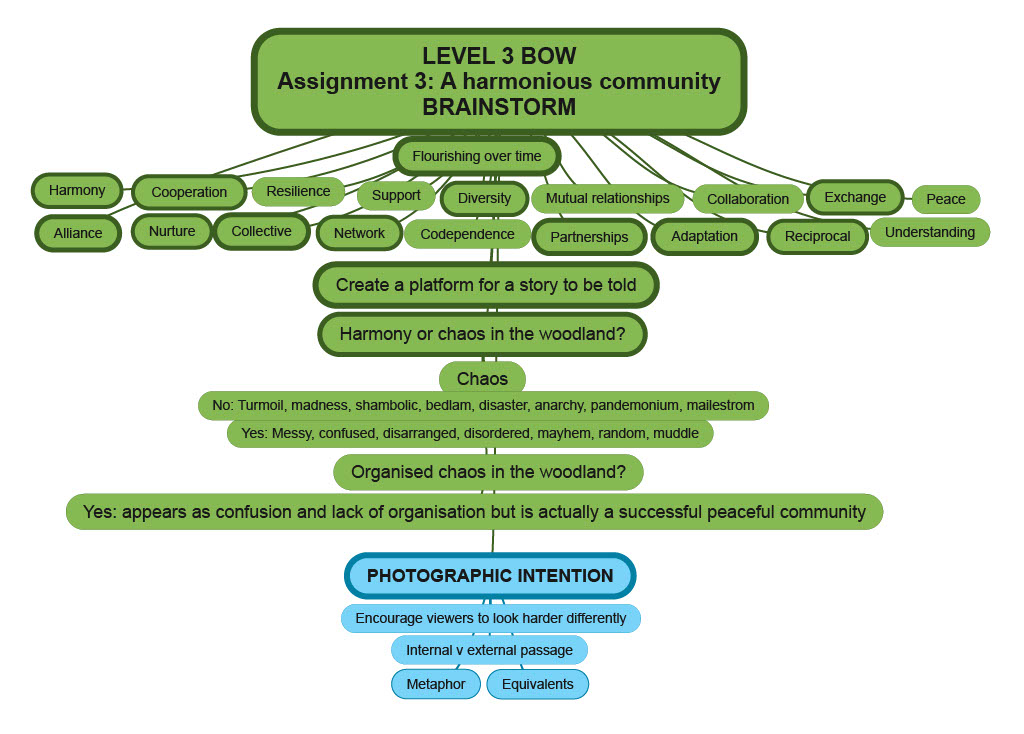
Definitions and synonyms of concepts
Harmony:
Definition: “the situation in which people live or work happily together without and big problems…
a situation in which people are peaceful and agree with each other, or when things seem right or suitable together…Harmony is the combination of separate but related parts in a way that uses their similarities to bring unity ” (Cambridge Dictionary, 2022).
Definitions: “a situation in which there seems to be a lot of confusion and no organisation, which makes you surprised that the results are good”. (Cambridge dictionary).
“a complex situation or process that appears chaotic while having enough order to achieve progress or goals” (Burnell, 2022)
REFLECTION: I return to my earlier thought that harmony doesn’t depend on homogenous components, and there is scope for a variety of beings to coexist harmoniously. The many elements of woodlands may at first appear chaotic, but in reality it is a peaceful community.
I will continue with my theme as the woods as a visual metaphor for a harmonious community. However in my photography reflect my current feelings about disharmony in my local community by showing that a community of many varied parts can coexist in harmony.
INFLUENCES FROM RESEARCH
These confirmed maintaining my original approach for my BOW “internal and external passage:
Gregor Radonjic: Metascapes Transforming and representing what in our subconscious – personal landscapes – distorted reality – artworks between fiction a and reality- the real landscape is in your head
Inside the Outside landscape collective: Going out was really going in- narrative, metaphor, investigation
Stephen Seagasby: Physical mental and emotional level using metaphor
Rob Hudson: making abstract thoughts more concrete through rep of the world around us (ITO 2016), Landscape dependant on how our intellect views them (Hudson, 2016), Photography can transform objective reality
J.M. Golding: Lived and unconscious v learned and conscious Wilkinson: a photograph says as much about the photographer as the landscape, Literal appearances of subjects to metaphors for internal experience (G 2022)
Mindmap BOW Assignment 3 Brainstorm:
SHOOTING
Whilst walking forefront of my mind was the disharmony in my local community and the contrasting harmony in the woodlands. When shooting in the woodlands I was open to scenes that would share visually what a chaotic and complex community it is, and yet illustrate that this “organised chaos” is actually successful and peaceful- diversity is absolutely fine.
My first day of shooting was an unusually sunny day and as the woodlands are shady it seemed visually pleasing, however on reviewing the images I returned on an cloudy day and obtained better results. I returned several times until I had plenty of images that I was happy with.
Mindmap BOW Assignment 3 Shooting:
EDITING
When editing foremost in my mind was my intention to share the chaotic but peaceful harmony in the woodland community. Backstory – Harmony or chaos?
I chose images that shouted: mess, muddle, random, confusion, disorder, but that also looked tranquil. I sought images that were complex and would cause viewers to look closely to find the meaning.
I also considered my use of colour in the light of my research, should I keep the colour true or use it to express my intention? It was obvious to me that the true rich greenness of the woodlands expresses my intention perfectly, so I simply retained the true colour as seen and captured.
I gave time to the editing and once I’d narrowed down to possible images, I started working on which would fit in a series.
I dropped some weaker images such as:
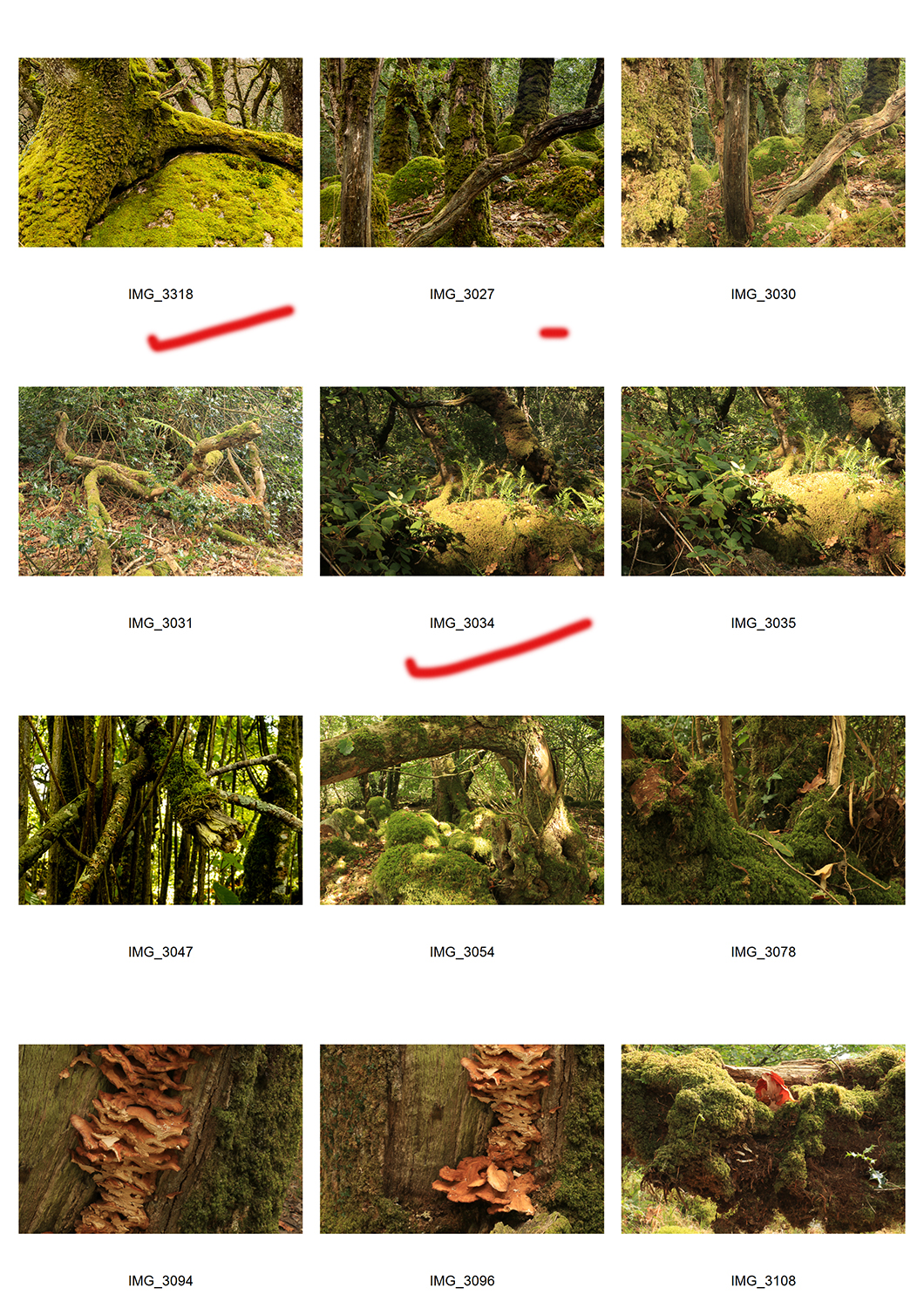
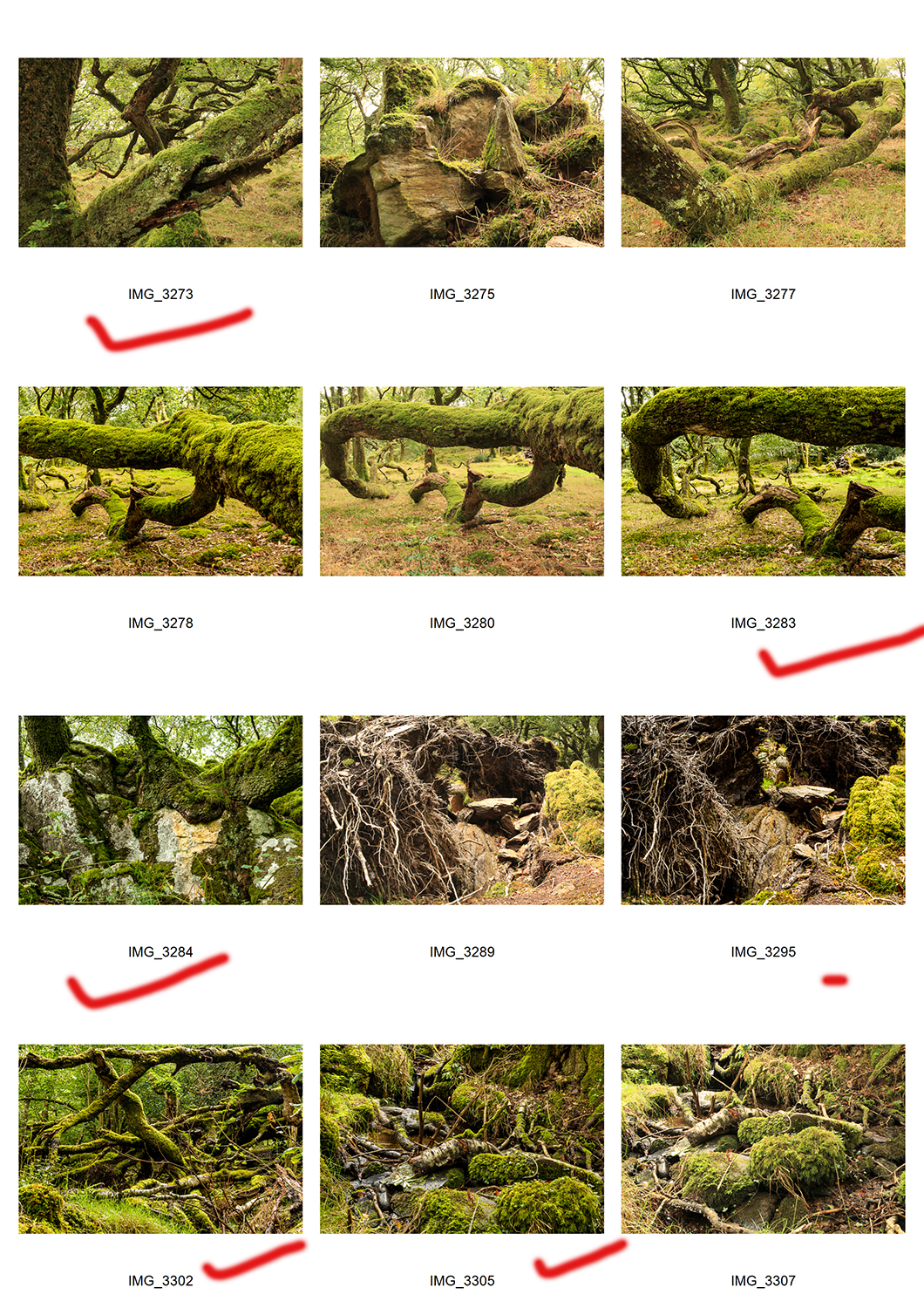
Image: 3278
I asked which images fitted in a series? The form of these didn’t:
Image 3130 Image 3131
Images : 3047 3254 3295
I asked which images strengthen my ideas or voice and which images slowed the narrative down or weakened my narrative? I dropped:
Image 3027
I looked closely at those I was left with. For instance I vacillated between:
Images 3247 and 3318
And dropped the 3247 as although it gave more context this diluted the message
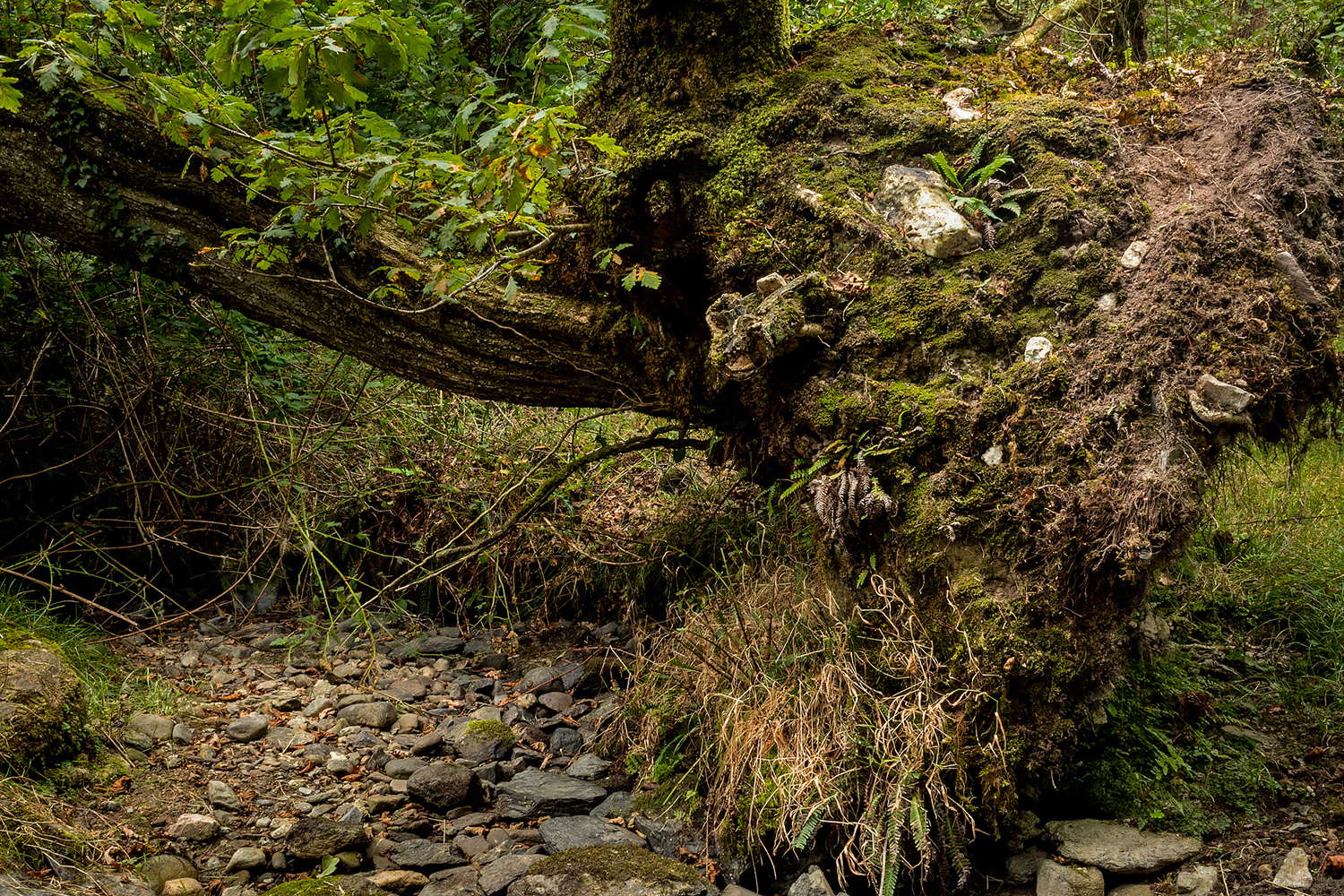
I reluctantly dropped one of my “babies” which Id spent much time on as though it clear to me it was a tree lying on its side when I shouldn’t naturally be, it might not be obvious to others and it didn’t fit in the series as well
Image 3162
Then this image was dropped to get the series to a cohesive flowing set of 8
Image 3256
Finally I checked myself by answering as suggested in the coursework:
• Will the image stand as a visual piece on its own?
• Is the image adding anything new or emphasising the point I want it to?
• Is it detracting or contradicting from the rest of the series?
• Am I overlooking any less striking work because of aesthetic concerns that may be secondary to the impact the piece will have on final reading?
I am satisfied with my choice of images in the light of these challenges.
Mindmap BOW Assignment 3 Editing:
Presenting
When sequencing I tried to provide for a flowing narrative from one image to another and increasing the viewers response.
Aware that I need to signpost the work for my viewers I decided for this work to do so simple with captions. Each image to be captioned with a harmonious and chaotic synonym. I matched the words with the images as I best thought.
I have taken some time to complete CS assignment 2 and have been reading a researching widely. I am now ready to re immerse myself in BOW. To do this I have been re-reading my BOW to date. The following notes are to help me proceed with BOW assignment 3:
On Assignment 1:
My theme began as community
Influenced in my way of seeing by practitioners mentioned below.
Used prime and macro 1:1 lens
Used scale or perspective to distort
Researched how other have presented
Represented images of using: psychogeography, landscape, Abstract, and close up.
On preparing for assignment 2:
Thought I might move from colour to black and white but decided the greenness is vital.
Advised to give entry point so viewers can access through signposting what I’m representing.
Used text for signposting – might change text to consistently verbs/nouns and use one dictionary source for submission?
Collection of a typology of woodland species: Moss, lichen, fungi, trees, ferns – might combine this with other work later
Concepts inspired by humans but they are not evident in my work.
A selection of learning log entries with a related selection of assignment outcomes is advised. This ties in with the advice from Ariadne in the L3 study group.
And on trees: Takeaways: symbiotic/mutual relationships
Beresford-Kroeger, D. (2019) To Speak for the Trees: My Life’s Journey from Ancient Celtic Wisdom to a Healing Vision of the Forest. (s.l.): Random House of Canada.
Deacon, A., and V. D. A. (2020) For the Love of Trees.(s.l.): Black and White Publishing Limited.
Deakin, R. (2008) Wildwood: A Journey Through Trees.(s.l.): Penguin UK.










 NIKI SOUTH