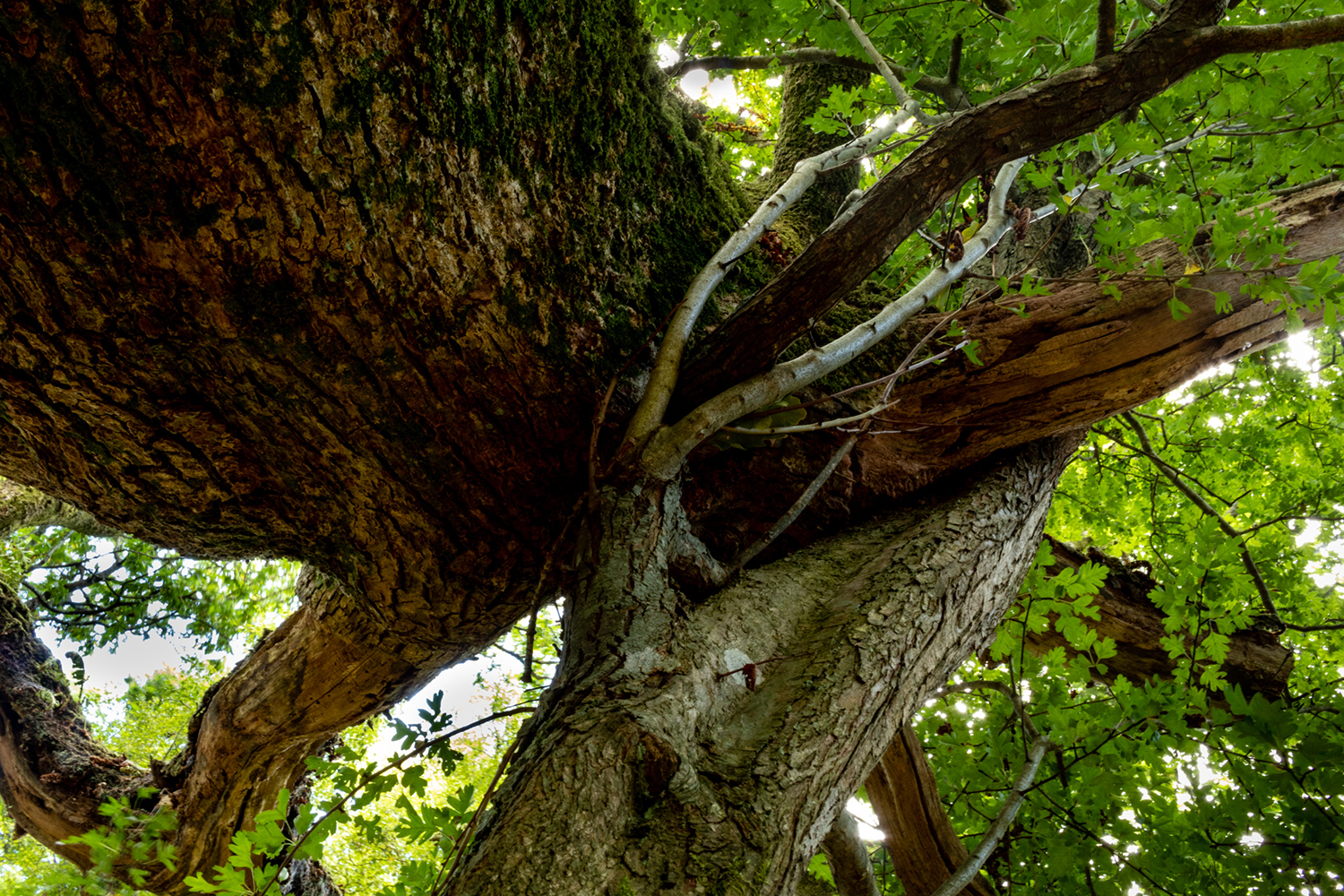
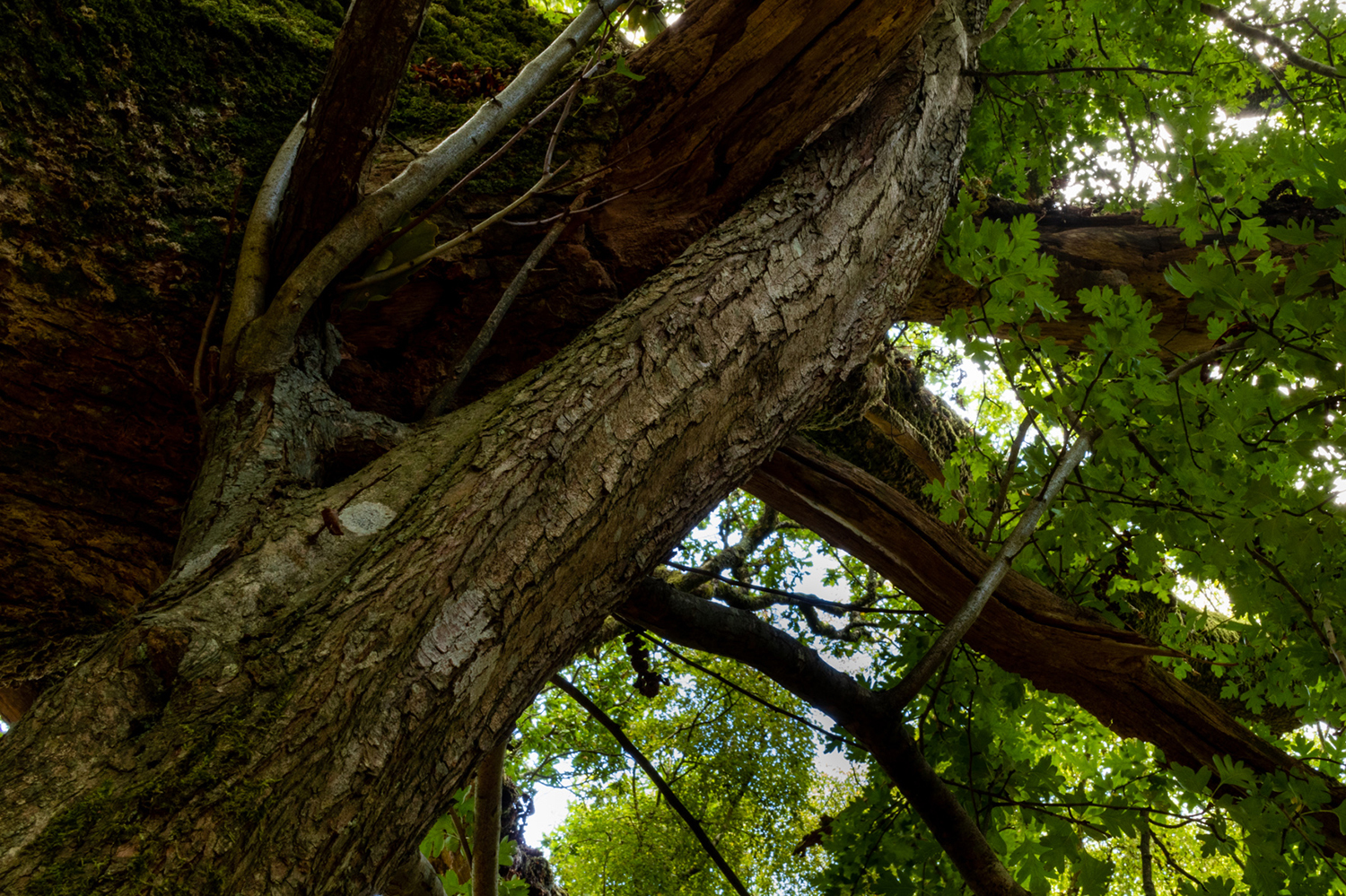
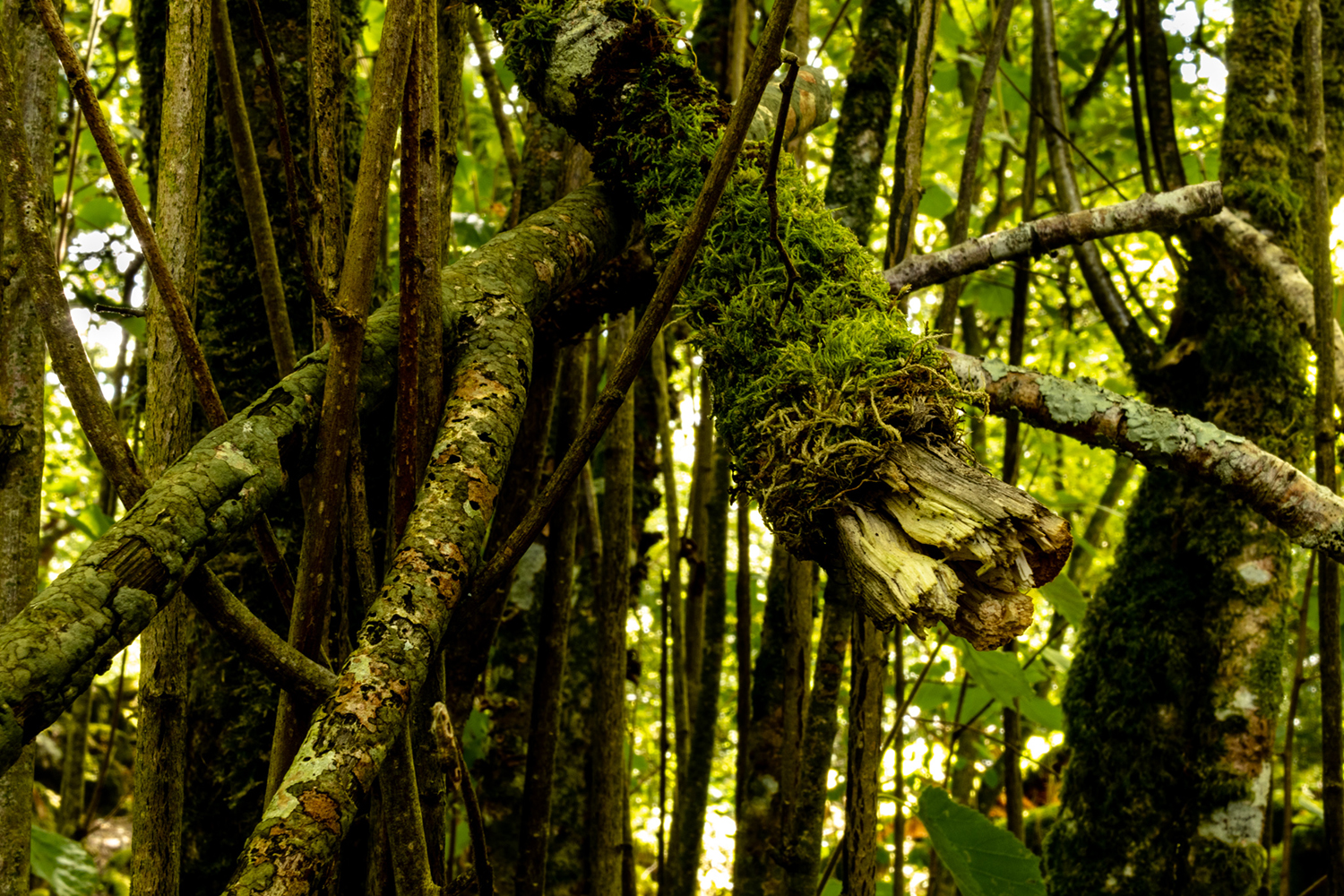
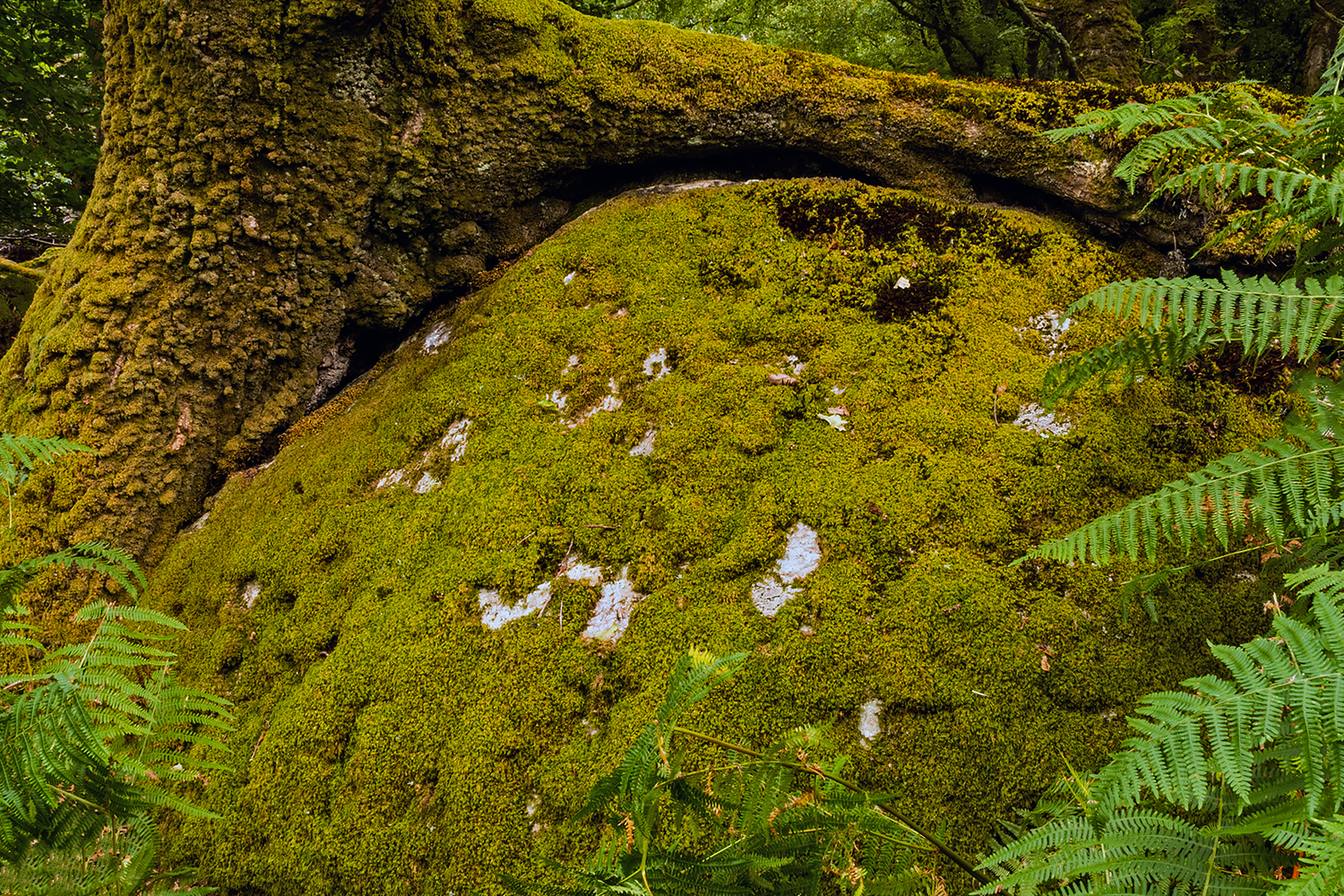
CONTEXTUAL STUDIES SOUNDBITES FROM TUTOR LED HANGOUTS

L3 Study group with Ariadne Xenou 31/5/22

How does the literature review relate to the dissertation?

  • Articulation of process
  • Reflections are important
  • A snapshot of the discourse
  • In depth summary of no more than 20 sources
  • Not going too far down  a road, the dissertation is for detail.
  • Question anything no longer relevant when you write your dissertation

Writing:

  • Articulating means we own it & articulation is discovery
  • The importance of resources will change as we write- flexibility is important
  • Dissertation for balance can put the research method/ methodology at the beginning, but only what the reader needs to know.
  • Footnotes for not required but interesting

Audiences: Tutor- Academics/peers/other photographers -Authors of the sources – imagine internal dialogues with them

Copyright and use of images: If they are part of the public domain you don’t need to get permission to use them on your blog.

L3 Study group with Ariadne Xenou 26/6/22

Ideas from Anna Sellen: http://www.annanas.co.uk/

Padlet use for keeping track of work, thoughts and research

Chop up written dissertation to edit as we do with photo sequencing

Ideas from Helen Rosemier: https://helenrosemierphotography.co.uk/

Showed how her work I CS followed into BOW, allowing an intellectual connection with BOW

L3 Study group with Ariadne Xenou 25/7/22

Learning objectives: Use to stay on track, or change track as the evidence changes, or find the missing bits of evidence. See post

L3 Study group 29/8/22

How to turn Los into questions to work with.

L3 Study group 26/9/22 – lost notes!

L3 Study group 31/10/22

We discussed how to mesh BOW and CS. I explained that I find it difficult to work on them both concurrently however They are both in my minds when working practically on either. My BOW is an exploration of ideas that I have arrived at through my CS study, research and writing, whilst my CS is fed by my photographic exploration of CS methodologies.

Ariadne pointed out that they don’t need to mirror each other , they contextualise and offer support to each other. But they should stand on their own.

Next post: https://nkssite6.photo.blog/category/contextual-studies/c-s-assignments/cs-assignment-3/cs-ass-3-learning-log/

TUTOR LED GROUPWORK ONLINE: ARIADNE XENOU

CONTEXTUAL STUDIES AND BODY OF WORK

31.10.22

Q: How do you mesh BOW and CS? we concluded that most of us began working them together but later tended to work them at separate periods.

CS doesnt have to mirror BOW. They contextualise each other offering context and support. You shouldn’t have to read them together to understand them individually.

29.8.22

We shared how we had turned the learning outcomes into questions. These are mine:

CS: Learning outcomes Turned into questions

LO1 undertaken research and study demonstrating comprehensive knowledge of your area of specialisation and built a theoretical framework for your creative practice.

Q: Have I researched and studied my specialisation and demonstrated a comprehensive knowledge?

Q: Have I built a theoretical framework for my creative practice?

LO2 synthesised and articulated your critical, contextual and conceptual knowledge and understanding into a coherent critique of advanced academic standard.

Q: Have I pulled together research and written using evidence?

Q: Have I referred to my BOW contextualising practise and theory?

Q: Have I evidenced in writing my concept thoroughly and how broader concepts have fed into this?

LO3 applied your own criteria of judgement, reviewed, criticised and taken responsibility for your own work with minimum guidance.

Q: Have I reviewed, judged, and critiqued myself?

LO4 selected and applied information management skills and used appropriate technology in the production of an accomplished critique with minimal supervision.

Q: Have I used information management skills and technology?

Q: Have I produced a good critique myself?

BOW: Learning outcomes

LO1 produce convincing visual products that communicate your intentions, using accomplished techniques in complex and unfamiliar environments, with minimal supervision from your tutor.

Q: Have I produced a convincing visual product?

Q: Have I communicated my intentions?

Q: Have I used accomplished techniques?

Q: the above in complex and unfamiliar environments?

LO2 demonstrate comprehensive knowledge of your area of specialisation and be able to situate your own work within a larger context of practice in your field.

Q: Have I shown comprehensive knowledge in my area?

Q: Have I placed my work in the context of practise in my field?

LO3 transform abstract concepts and ideas into rich narratives and integrate them in your images.

Q: Have I transformed abstract concepts and ideas?

Q: Have I created rich narratives? Are they integrated into my images?

LO4 critically review your own work and evaluate it against desired outcomes.

Q: Have I critically reviewed my work?

Q: Have I evaluated it against learning outcomes?

LO5 demonstrate management, leadership and communication skills and have deployed them during the negotiation and production of the final body of work with your tutor and third parties.

Q: Have I shown management, and communication skills.

Q: Have I used these when discussing with my Tutor, and others?

Alexander, J. (2013) Contextual Studies. Barnsley: Open College of the Arts.

25.7.22

Discussion on previous session which I missed which showcased Anna and Helen’s work – I must watch the recording.

Comments were particularly about the visual impact of the work and that their self-reflection was also presented visually which was good. Remember the assessors are visual as well.

Their work showed their commitment and how they entwined BOW and CS.

Learning Objectives:

Q: why do we have Los? Suggested to work against LO’s so that you stay on track and understand the expectations of the units

Engage with the level, context, and quality of the work at each stage every time you submit – this gives you the opportunity to achieve your best. It helps to keep you coming back to the bigger picture.

To find your research question you first need to decide on your subject (broad) which may change when you find evidence.

You need to be able to articulate your work in terms of LO’s. Articulate how you’re fulfilling the LO’s because it will change, and will help you to find evidence of how you have fulfilled the LO’s. 

LO’s force you to change perspective on your work – find your niche, find the missing bits and evidence

Makes you think how your project/research does this – do it regularly. Reflecting on LO’s enable you to undertake reflective learning and to write your self-reflection at the end.

Evidence in Research, essay, self reflection.

LO example: Synthesized and articulated your critical contextual and conceptual Knowledge and understanding into a critique of advanced academic standards. Coherent (in assessment criteria)

Key words:

  • Synthesise- pull together from research cross pollinated ideas- something that led me to write the dissertation but isn’t explicitly in it. So maybe in a reflective commentary, could photograph evidence in docs of evidence used. But need to be showing them process, so some elaboration is needed. Choose evidence that is straightforward then it’s evident
  • Articulate- shown by writing in order
  • Critical – forming judgement with evidence
  • Contextual Referring to BOW showing assessor how you’ve done it contextualising practise and theory
  • Conceptual- that you’ve fulfilled a broad idea and taken other concepts
  • Knowledge and understanding: anything above falls under understanding – so showcase the above and the rigour and thoroughness of your concept.

3 or 4 per LO but could do more Find in assessment and the module

Break them down and consider these learning outcomes as questions. Turn them into critical direct questions that you can pose to yourself. How have I? Ask How did I review critique…take responsibility for my work…undertake research that demonstrates…     Target your area of specialisation.

Theoretical framework is found in academic arguments and creative practice. How did I build a theoretical framework for my creative practise – showcase how my creative practise and my contextual topic relate BOW & CS.

NB. Proposals easier to write when you’ve finished a project

For next time:

Turn your Learning outcomes into direct questions. If they are cumbersome, break them down into more than one question.
Locate the keywords that allow you to turn abstract sentences into tangible guidance.
Consider how your topic and research relate to each learning outcome.
Articulate this as an answer to each of the questions (LOs).
Consider what evidence you could submit to prove your articulated answers.

31.5.22

Q: How to fit your literature review to your dissertation? Can adjust your literature review later or simply write a reflective piece explaining why the dissertation and literature review have ultimately differed. The importance of resources will change.

When writing articulation means that we own our thoughts, articulation is discovery.

When including research methodologies in the dissertation think about what the reader needs to know- how much or how little?

Audience needs to understand your work although the work is aimed at the theoretical audience the ultimate authors are the sources in your work. Have theoretical debates with your sources.

25.4.21

This was a general, Q&A session.

Q: How to decide what to cut out from your work to meet a word count.

  • Be concise- eradicate the imprecise
  • Take out repetition
  • Move some info to footnotes
  • Be especially precise in introductions and conclusions, Only 5-6 sentences each. The first and the  last sentences are particularly important and should echo each other

Remember the literature review can morph, as long as you explain your reasoning. Later Q: so how would I rewrite? Completely? Or as a comment on?

My question: How do I stop researching and write my literature review?

A: The literature review is the framework to form my argument – to form the context. In order to avoid self plagiarism need to reformulate later.

  • Ask what do I really need for this?
  • What would I need to include if explaining to someone else
  • Keep to the essentials – it is important to analysis to the full potential
  • Analyse the most important blocks I need – 4-5 sources only

My question: If the literature review is to form the theoretical framework for my argument do I only use theorists/philosophers?  Ie; not those who critique the work of my chosen photographers?

A:

  • Ask how important is their work to the topic?
  • Do they argue about the photographers work or the central arguments?
  • If semiology is important it would be daft not to include Barthes

Other tips on sources:

  • Download books to google books as PDFs.
  • Use google scholar
  • Get articles sent by local libraries????

28.3.22

Discussions on literature reviews

  • It’s an abstract concept which should not be rigid, it should allow you to change direction, it’s just a step in the research
  • Though it might not seem immediately relevant it is about the journey rather than the output
  • Treat it as a theoretical framework to return to
  • It is relevant to everything we do including BOW – could theoretically do one for BOW
  • Helps you to synthesis things that are relevant and not so relevant and to synthesis them
  • Helps you to find and make links in your own work

Q to those who’ve finished it: How has the lit review developed in your dissertation drafts?

  • It gives a structure
  • Keeps you on track

Q: How can you work out what is relevant in your research?

  • Tutor guidance – so I should seek this now
  • Look at potential sources
  • Abstracts, summaries, tables of contents, introductions

Best if the literature review has some uniformity:

  • Relate the sources to each other
  • Firstly, discuss them source by source but then connect them together to make a theoretical framework

How to open up more sources?

  • Find and make links in your work and research

Dissertation: 500 words inc quotes

  • Is for your interpretation of others theories, where you find links, to show your perspective.
  • Paraphrasing is better than quoting as you are then filtering and showing your understanding

Footnotes

  • Put in the text definitions, elaborations that our text cant do without
  • Put in footnotes that which isn’t intrinsic but could help a reader understand better- that which is helpful. Clarity and guidance that is beneficial but not needed, eg. recommending sources not embedded in our sources, to show wider reading.

Next time I should ask for support on finding texts, sources, libraries.

28.2.22

Much of this session was around being “stuck” and how to move on.

Learning points for me were:

  • Consider why what I am working on fascinates me?
  • Why does what I’m reading fascinate me?
  • Don’t be too focused on the outcome at the beginning
  • Follow the tracks (continuing on from the last tutorial on Ginsberg, before they grow cold, or you lose the trail
  • Ensure I’m keeping bibliography list – extract from paper pile
  • When reading think/visualise my practical work and when photographing think about my writing

Next time ask about theories of realisim? Garry interested in?

Can an artist represent something of themselves in a place?

31.1.22

We began with a Q & A session which was useful:

Matt Q: In the Lit review and dissertation proposal, what is the normal number of photographers to use? Ariadne: Less is more, with analysis, we are not here to provide lists but contextual analysis, ask how many do you need to contextualise your work? Think why are they there, and why have you chosen them, use 4-5 maximum. The Lit review should be a clear, in depth review of my literature, to contextualise my thoughts; but you will read more than you’ll summarise in your lit review. The lit review should be the backbone of my contextual framework, texts that my argument can’t do without, interrelationship, extrapolation – be brutal to get depth.

Sue Q: If you change track should you revise your lit review? Ariadne: moving away from the lit review will show development of research, so no. For final assessment interlink your lit review and your final thoughts explaining why you moved away from it. Or develop also a final lit review, but then you would need to cover in your presentation as the assessor may not have time to read it – a summary of the core lit underpinning my dissertation.

Lit review advice: https://advice.writing.utoronto.ca/types-of-writing/book-review/ and https://advice.writing.utoronto.ca/types-of-writing/literature-review/ These are very useful

Catherine Q: Referencing? Referencing a bibliography alphabetically doesn’t show which sources were the most important. Could we do a reflection on this bibliography as we don’t have many words?

Ariadne: Yes you could do a primary, secondary and tertiary sources bibliography in alphabetical order, but suggests avoid separating these types of sources.

Holly Q: A bibliography just helps you see where the reference sources have come from? What about footnotes? Ariadne: everything relevant about your argument should be in essay, that that informs your essay should be in footnotes, everything else should be omitted. Your bibliography may lead you elsewhere in he future.

Rob Q: How to narrow a topic down? Lynda says the reading, keep reading for your “ahha” moment. Ariadne agrees. Susan ahha moment came from the body of work.

Ariadne: Ahha moments come when you don’t expect them so have a notebook with you.

Ariadne says ask why are you photographing what you are in your BOW? You’re not trying to explain your BOW in your CS, but just contextualising it?

Ariadne set out before the session what we would cover, a discussion on methodologies; a topic suitable for all stages of research and all models of level 3. We were asked to watch the video interview below and to consider the notions of clues, evidence and hunters as well as the definition of microhistories in relation to a methodological approach to L3 theory and practice.

The Hunter’s Evidence: Carlo Ginzburg

Carlo Ginzburg & David Kutcher anthropologist

In “The Hunter’s Evidence” Carlo Ginzburg used the Stone Age hunter as his intellectual metaphor, He said the hunter could look for evidence as he wasn’t hindered by other things:

“Man has been a hunter for thousands of years. In the course of countless chases he learned to reconstruct the shapes and movements of his invisible prey from tracks on the ground, broken branches, excrement, tufts of hair, entangled feathers, stagnating odors. He learned to sniff out, record, interpret, and classify such infinitesimal traces as trails of spittle. He learned how to execute complex mental operations with lightning speed, in the depth of a forest or in a prairie with its hidden dangers…The hunter would have been the first ‘to tell a story because he alone was able to read, in the silent, nearly imperceptible tracks left by his prey, a coherent sequence of events…What may be the oldest act in the intellectual history of the human race [is] the hunter squatting on the ground, studying the tracks of his quarry”.

My notes and our discussion on the above:

Micro histories is the unfolding of small events into larger information clues, putting things under a microscope, and magnifying things in such detail that we see grand narrative. It is the analytical element, which is crucial. Ginzburg also relates micro histories as being about generalisations, but using analytical methods, a methodology to make sense of fragments of evidence. He also described it as a method for finding the relationship between the written and visual world.

This was described by Ariadne as “Grand narratives through small case studies”.

Ariadne: “Research is about sniffing out our prey, so that we can tell a compelling story, as researchers we have to be hunters”.

But where should we look for the best evidence, and reconfigure our scopes to find it? The ahha” moment which is unpredictable which can lead to something larger. However interesting a piece of evidence may be, we don’t know where the evidence will lead us. The larger relevance may not be immediately visible. Ariadne suggests even if it’s a tiny thing, collect it and it may make more sense later.

In Ginzburg’s essay “Clues,” in Myths, Emblems, Clues (1990), he gives 3 models of micro historians, Sherlock Holmes (detective), Sigmund Freud (uses semiotics in a medical sense) and Giovanni Morelli (19th Century art historian). The trick, as Freud put it, is to divine “secret and concealed things from unconsidered or unnoticed details, from the rubbish heap, as it were, of our observations.” He is thereby suggesting, detective, medical and historical methods of looking for minor details. Ginzburg says the skill is “the flexible and rigorous insight of a lover or a horse trader or a card shark.” To deduce from evidence he also gives analogies of the flexible and rigorous eye/experience of the lover (the relationship between two lovers), the card shark (eg the hesitation in a card game- a silence). I think he is talking about intuition.

What Ginzburg is teaching is a way of looking at the world right around us.

Ariadne pointed out not to assume your narrative is evident in the evidence, the fragments that you have pieced together.

References:

The Hunter’s Evidence: Carlo Ginzburg (2022) At: https://radioopensource.org/the-hunters-evidence-carlo-ginzburg/ (Accessed 31/01/2022).

Ginzburg, C. (1990) ‘Myths, Emblems, Clues, trans’ In: John and Anne C. Tedeschi, London: Hutchinson Radius

29.11.21

Old course model and new model: New is research unit 1st, then practical: 1 year each.

Course

Research and ideas for CS & BOW are different but may overlap. CS is not for explaining our visual work with the theory but the 2 do come together and the end result should be bigger than the sum of its parts.

Level 3 is about your passion and interests, must be sustainable.

  • Anna talked about changing her topic but Ariadne said it was only a “hange of prism”, where the research led her down a different route, and that this is the correct approach:

The wild goose chase is not about the goose, its about the chase” Ariadne

Consider-redefine- reconsider- redefine

  • We articulate better visually when we articulate in writing and vice versa, the two aid each other. Articulation is needed to open the next door.
  • Research helps you to work out where your work fits into the photographic world, and eventually you won’t differentiate between your practical and academic work.
  • Ariadne: Talk about your ideas, your methodology, challenges…
  • Ariadne: Pinpoint areas of academic areas that you need help with- vocalise on the forum.

I shared my experience about being hesitant to write, Ariadne did say get on with writing; ask why something interests me, what overlaps, document your journey. I should also diary key words and how one idea leads onto another.

Me: Landscape as a visual metaphor for community. Different ways of seeing, perception, and responding.

What is ontology in simple terms?

In brief, ontology, as a branch of philosophy, is the science of what is, of the kinds and structures of objects. In simple terms, ontology seeks the classification and explanation of entities. … Ontology concerns claims about the nature of being and existence.

Liminality ia state of transition between one stage and the next, especially between major stages in one’s life or during a rite of passage. … In a general sense, liminality is an in-between period, typically marked by uncertainty.

I am in a state of liminality!

31.1.22

We began with a Q & A session which was useful:

Matt Q: In the Lit review and dissertation proposal, what is the normal number of photographers to use? Ariadne: Less is more, with analysis, we are not here to provide lists but contextual analysis, ask how many do you need to contextualise your work? Think why are they there, and why have you chosen them, use 4-5 maximum. The Lit review should be a clear, in depth review of my literature, to contextualise my thoughts; but you will read more than you’ll summarise in your lit review. The lit review should be the backbone of my contextual framework, texts that my argument can’t do without, interrelationship, extrapolation – be brutal to get depth.

Sue Q: If you change track should you revise your lit review? Ariadne: moving away from the lit review will show development of research, so no. For final assessment interlink your lit review and your final thoughts explaining why you moved away from it. Or develop also a final lit review, but then you would need to cover in your presentation as the assessor may not have time to read it – a summary of the core lit underpinning my dissertation.

Lit review advice: https://advice.writing.utoronto.ca/types-of-writing/book-review/ and https://advice.writing.utoronto.ca/types-of-writing/literature-review/ These are very useful

Catherine Q: Referencing? Referencing a bibliography alphabetically doesn’t show which sources were the most important. Could we do a reflection on this bibliography as we don’t have many words?

Ariadne: Yes you could do a primary, secondary and tertiary sources bibliography in alphabetical order, but suggests avoid separating these types of sources.

Holly Q: A bibliography just helps you see where the reference sources have come from? What about footnotes? Ariadne: everything relevant about your argument should be in essay, that that informs your essay should be in footnotes, everything else should be omitted. Your bibliography may lead you elsewhere in he future.

Rob Q: How to narrow a topic down? Lynda says the reading, keep reading for your “ahha” moment. Ariadne agrees. Susan ahha moment came from the body of work.

Ariadne: Ahha moments come when you don’t expect them so have a notebook with you.

Ariadne says ask why are you photographing what you are in your BOW? You’re not trying to explain your BOW in your CS, but just contextualising it?

Ariadne set out before the session what we would cover, a discussion on methodologies; a topic suitable for all stages of research and all models of level 3. We were asked to watch the video interview below and to consider the notions of clues, evidence and hunters as well as the definition of microhistories in relation to a methodological approach to L3 theory and practice.

The Hunter’s Evidence: Carlo Ginzburg

Carlo Ginzburg & David Kutcher anthropologist

In “The Hunter’s Evidence” Carlo Ginzburg used the Stone Age hunter as his intellectual metaphor, He said the hunter could look for evidence as he wasn’t hindered by other things:

“Man has been a hunter for thousands of years. In the course of countless chases he learned to reconstruct the shapes and movements of his invisible prey from tracks on the ground, broken branches, excrement, tufts of hair, entangled feathers, stagnating odors. He learned to sniff out, record, interpret, and classify such infinitesimal traces as trails of spittle. He learned how to execute complex mental operations with lightning speed, in the depth of a forest or in a prairie with its hidden dangers…The hunter would have been the first ‘to tell a story because he alone was able to read, in the silent, nearly imperceptible tracks left by his prey, a coherent sequence of events…What may be the oldest act in the intellectual history of the human race [is] the hunter squatting on the ground, studying the tracks of his quarry”.

My notes and our discussion on the above:

Micro histories is the unfolding of small events into larger information clues, putting things under a microscope, and magnifying things in such detail that we see grand narrative. It is the analytical element, which is crucial. Ginzburg also relates micro histories as being about generalisations, but using analytical methods, a methodology to make sense of fragments of evidence. He also described it as a method for finding the relationship between the written and visual world.

This was described by Ariadne as “Grand narratives through small case studies”.

Ariadne: “Research is about sniffing out our prey, so that we can tell a compelling story, as researchers we have to be hunters”.

But where should we look for the best evidence, and reconfigure our scopes to find it? The ahha” moment which is unpredictable which can lead to something larger. However interesting a piece of evidence may be, we don’t know where the evidence will lead us. The larger relevance may not be immediately visible. Ariadne suggests even if it’s a tiny thing, collect it and it may make more sense later.

In Ginzburg’s essay “Clues,” in Myths, Emblems, Clues (1990), he gives 3 models of micro historians, Sherlock Holmes (detective), Sigmund Freud (uses semiotics in a medical sense) and Giovanni Morelli (19th Century art historian). The trick, as Freud put it, is to divine “secret and concealed things from unconsidered or unnoticed details, from the rubbish heap, as it were, of our observations.” He is thereby suggesting, detective, medical and historical methods of looking for minor details. Ginzburg says the skill is “the flexible and rigorous insight of a lover or a horse trader or a card shark.” To deduce from evidence he also gives analogies of the flexible and rigorous eye/experience of the lover (the relationship between two lovers), the card shark (eg the hesitation in a card game- a silence). I think he is talking about intuition.

What Ginzburg is teaching is a way of looking at the world right around us.

Ariadne pointed out not to assume your narrative is evident in the evidence, the fragments that you have pieced together.

References:

The Hunter’s Evidence: Carlo Ginzburg (2022) At: https://radioopensource.org/the-hunters-evidence-carlo-ginzburg/ (Accessed 31/01/2022).

Ginzburg, C. (1990) ‘Myths, Emblems, Clues, trans’ In: John and Anne C. Tedeschi, London: Hutchinson Radius

Next post: https://nkssite6.photo.blog/category/reflective-journal/hangouts/l2-l3-stundent-led-hangouts/
BOW A3 Reflections on formative feedback

Feedback Tutor meeting 4.11.22

I described how my BOW is stimulated by my current life experience- disharmony in the community I live in, this at several levels, currently particularly by my committee work. The BOW is a physical representation of an area of my subconscious in an ongoing way, using the woods as a visual metaphor for this work is a cathartic process for myself – a personal project.

Though separate entities I described how my CS research on affect and effect in landscape photography helps to feed my BOW.

Tutor’s suggestion to read Sophie Howarth’s The Mindful photographer

Tutor’s comments:

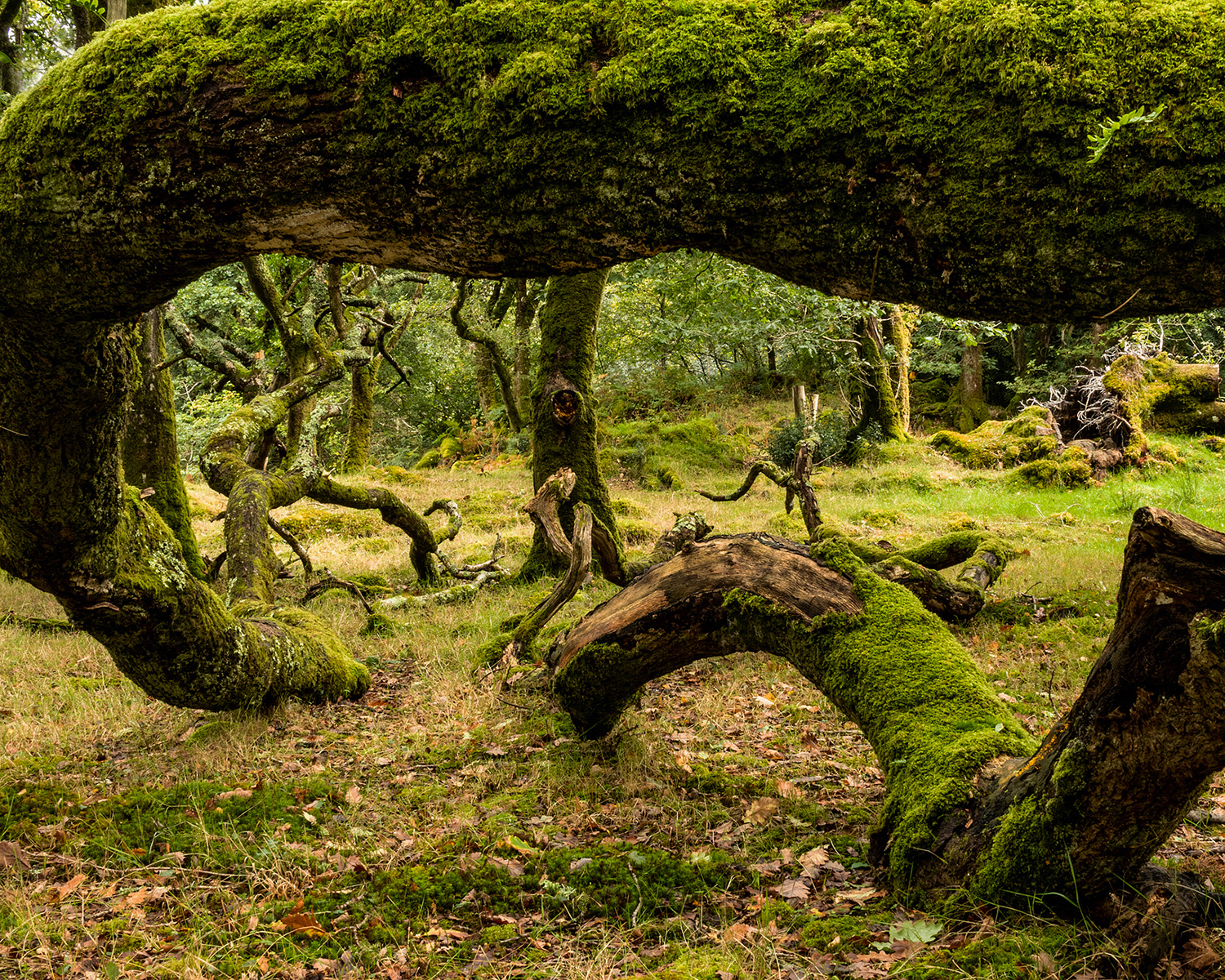
  • Images are good and speak of the harmony that I am meaning to convey
  • I could put them on a padlet to experiment when editing so that I can see them all together, and this would aid our discussion next time.
  • I should experiment cropping them to a 5:4 ratio to mimic a full format camera. I will try this with these images but as I crop I camera I may not be able to achieve the composition I would like with these images at 5:4 – I will see. I will photograph so I can crop to a 5:4 ration for my next series.
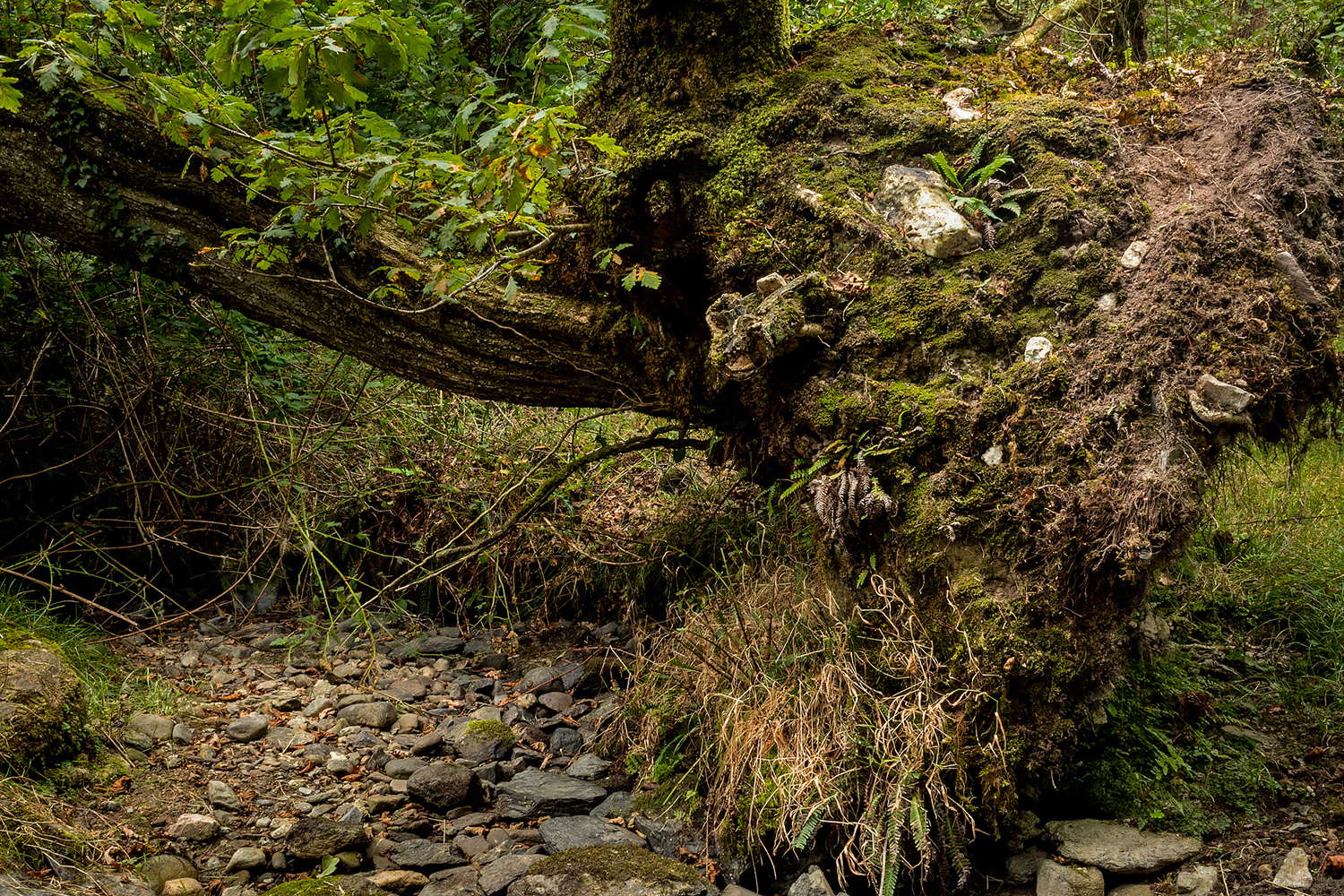
  • A suggestion I experiment with image 4: #Partnerships… or Anarchy, to see if it would be better or not with more context.
  • We discussed my captions, whether they are too binary and reductive, do they suggest there is an answer to the question is this harmony or chaos? I should reflect to see if there is an alternative signposting that supports my approach but is looser? I don’t think it was a directive to change the captions, but to reconsider them.
  • My Tutor pointed out that my eye has moved from macro to a wider view since my last work. I may want to take this further with the next series.
  • We discussed my idea for the next series where I intend to share the idea that harmony is a chorus made up of different parts. My tutor suggested I might look at the etymology of musical terms to support this.

I will be able to refer aspects of this work to the Learning Objectives when I have completed the actions from this feedback.

Actions

Now:

  • Try cropping to a 5:4 ratio- I did this and found the overall effect was much stronger. I was surprised that the images that I’d not shot envisaging to crop to a 5:4 ratio, worked so well. This ratio seems to draw the viewers eye in more centrally into the scene. SEE MY PADLET: https://oca.padlet.org/nicola514516/td51x6mcq2sijad0
  • After experimenting with image 4: #Partnerships… or Anarchy I was not able to give any more context with as the image wasn’t previously cropped and I don’t have a wider view image. I can only bear this in mind if I don’t want to be too ambiguous in future with an image.
  • I reconsidered my captions but have stayed with my originals which I am happy with’ But again I will take this onboard for future images.

Next assignment:

  • Use a padlet when editing photos
  • Consider sharing a wider view of the woodlands
  • Consider using musical terms if still working with the idea of harmony in another series.

Reference:

Howarth, S. (2022) The Mindful Photographer. London: Thames and Hudson.

Next assignment submission end Jan 2023.

Next post: https://nkssite6.photo.blog/category/reflective-journal/hangouts/tutor-led-group-work-online-all-sessions/

BOW ASSIGNMENT THREE SUBMISSION

SHOW AND TELL

ARTIST STATEMENT:

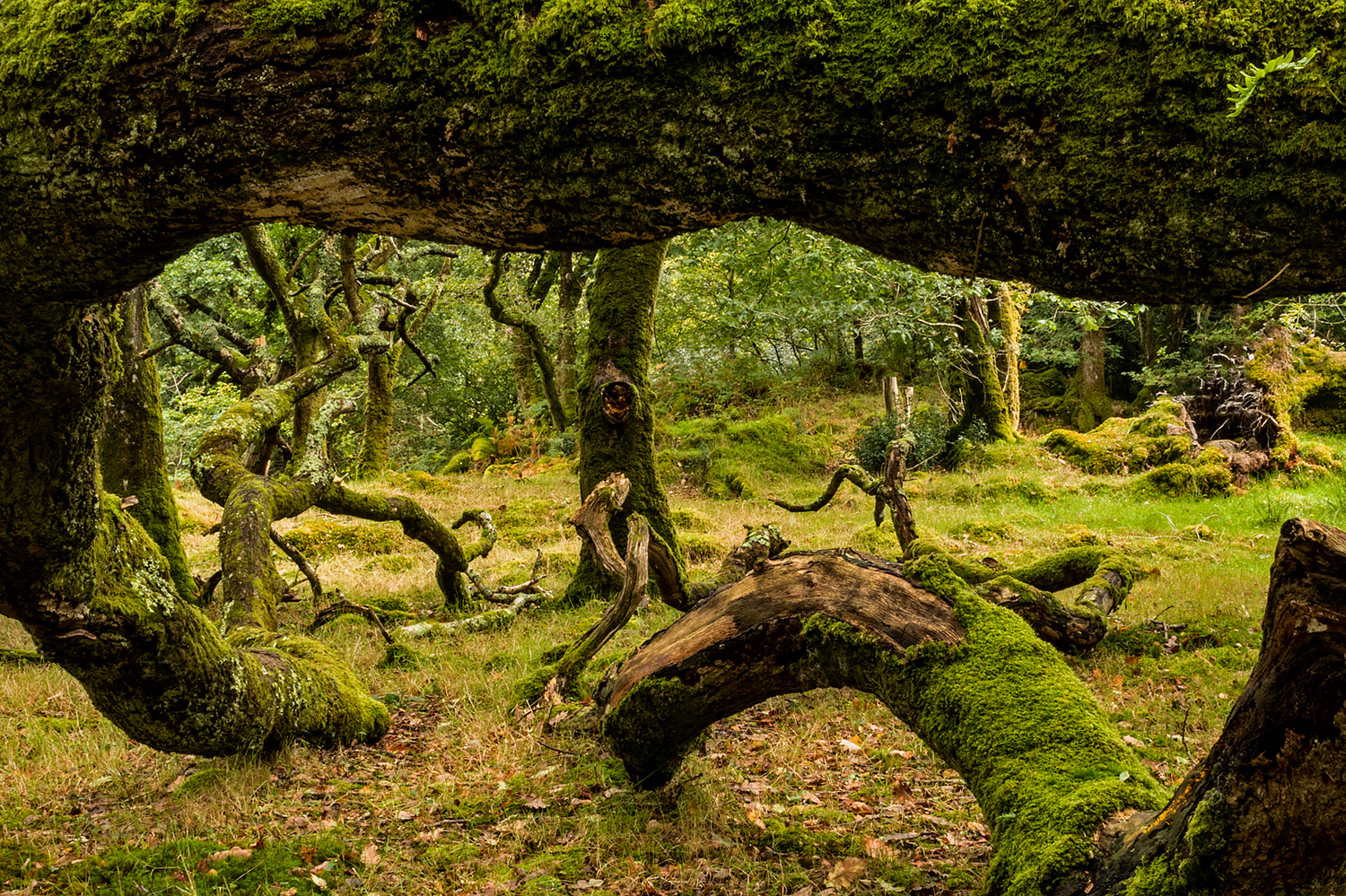
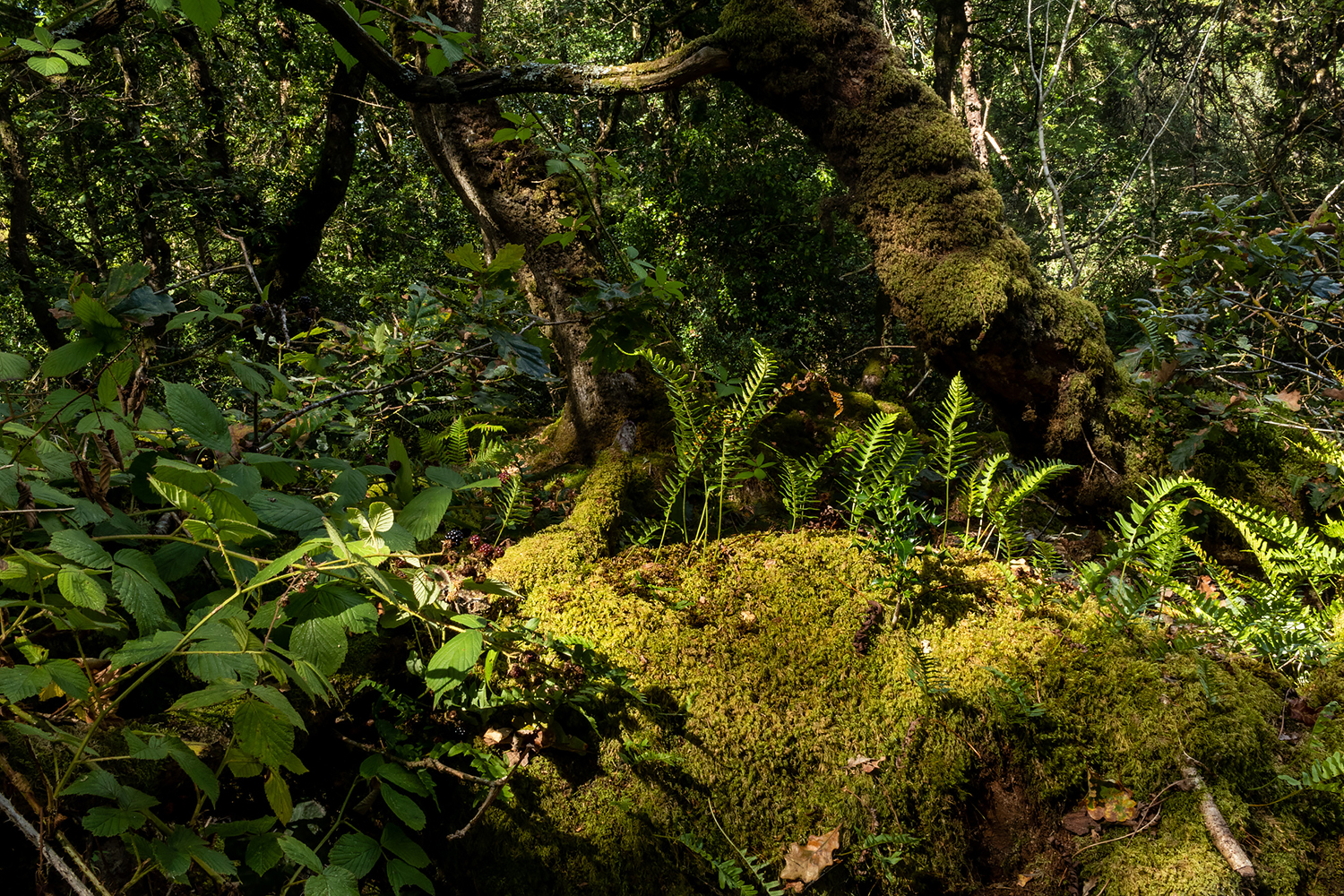
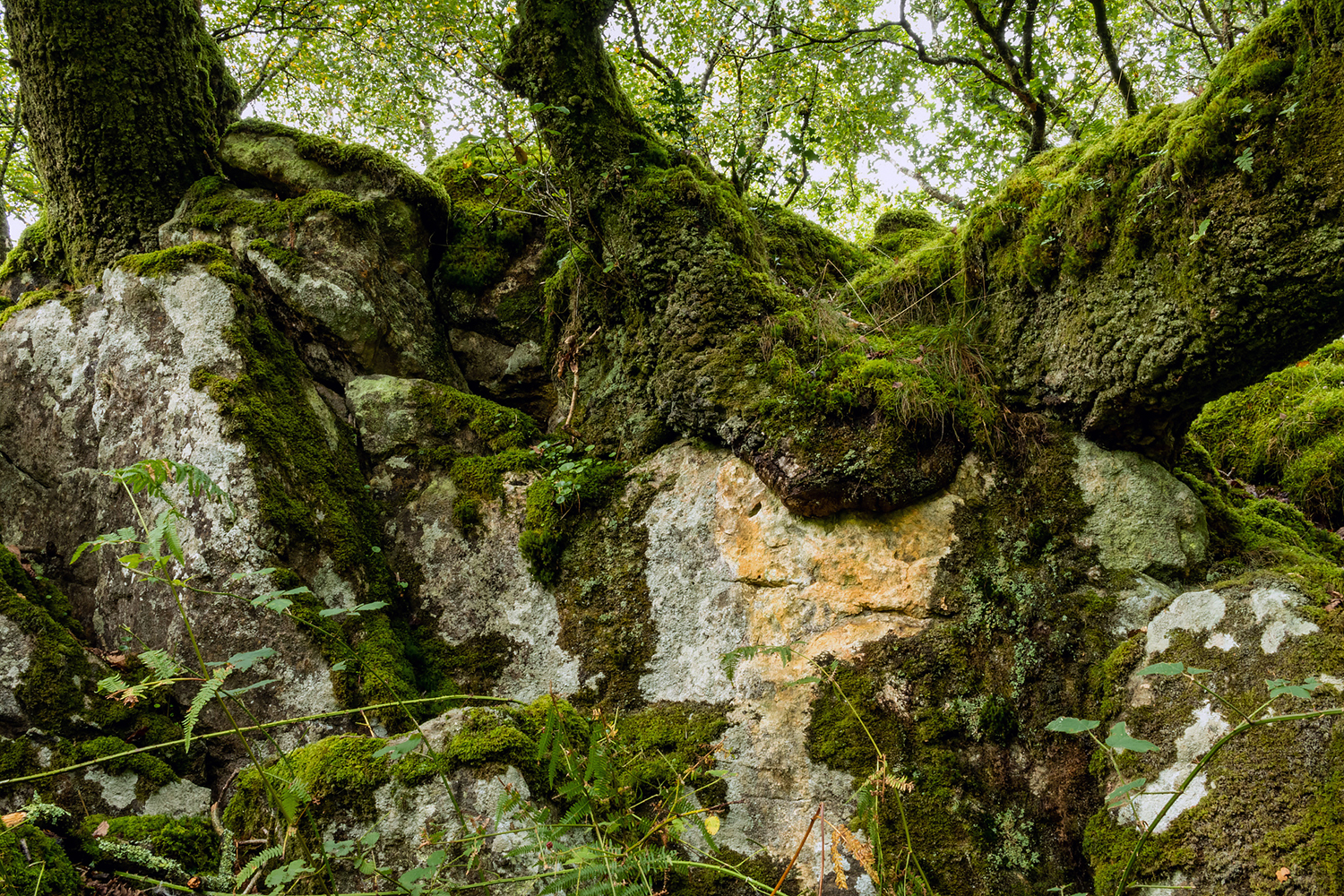
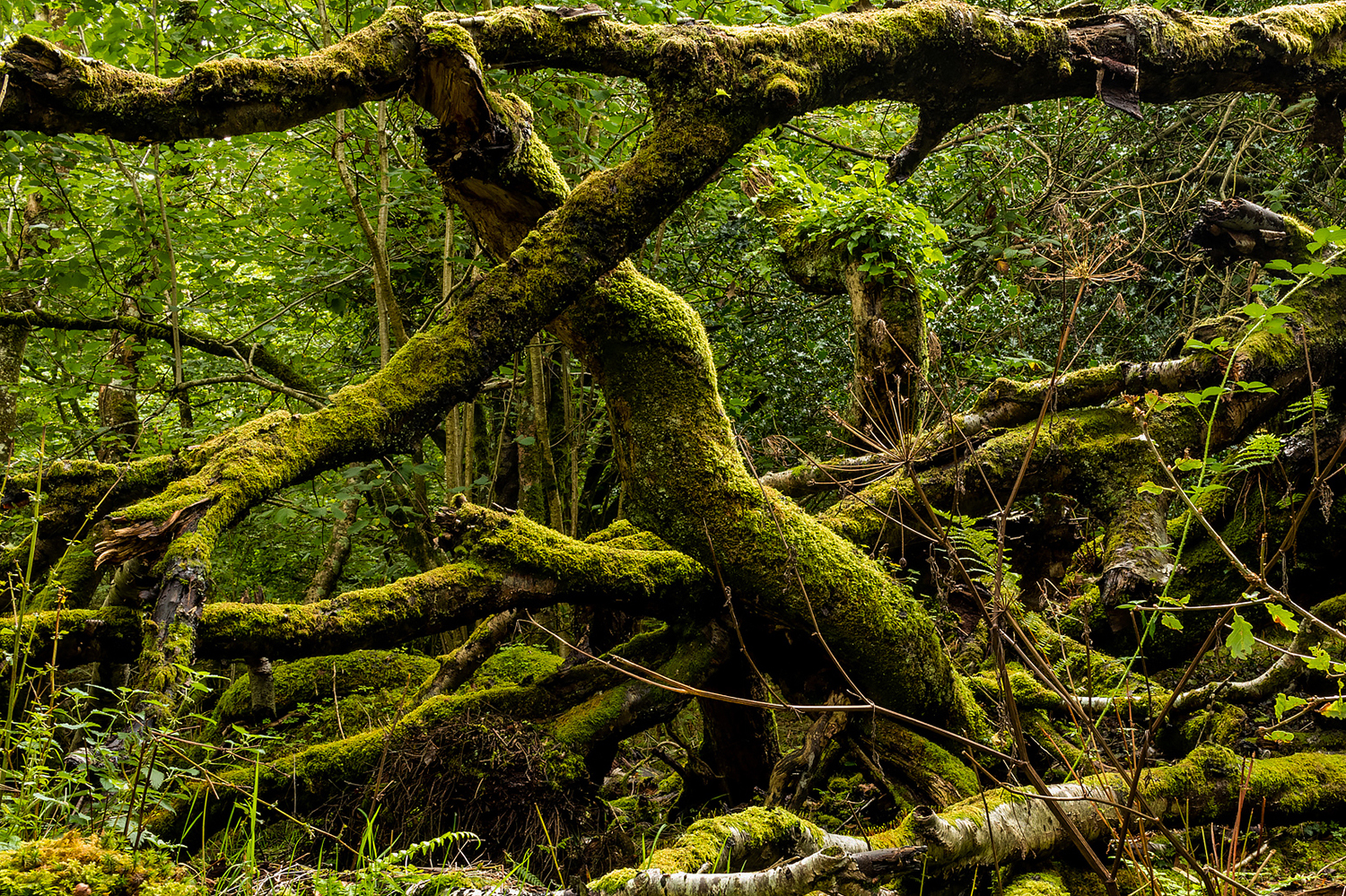
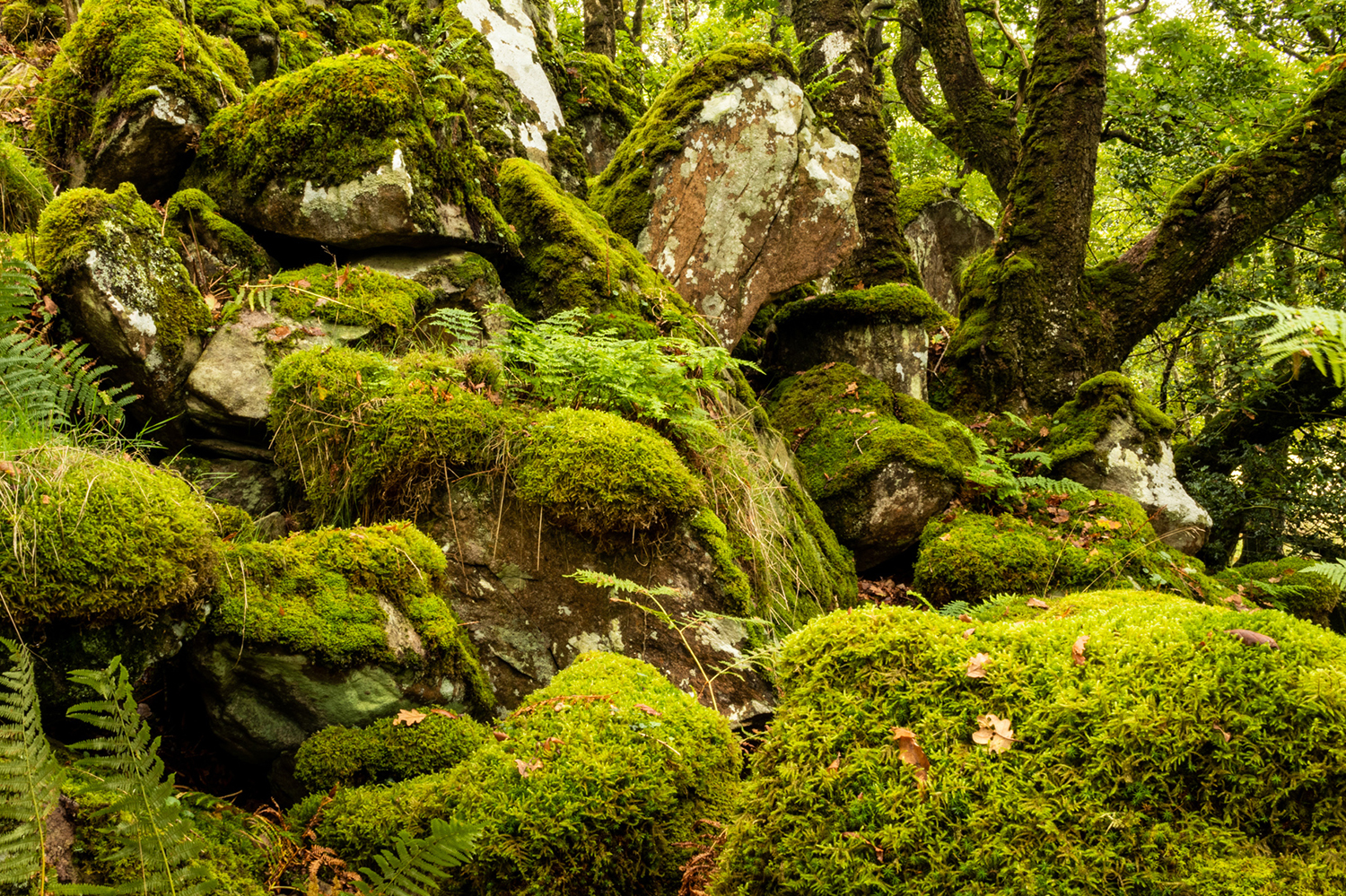
My body of work is about internal and external passage. When I “go out” to the ancient woodlands, I am really “going in”. My visual representation explores my feelings of discomfort about the tension in my local community, this as a contrast to the successful assimilation of diversity in the woodlands.

This series is an exploration of whether diversity necessarily results in tension and chaos, or whether these differences can be harmonious.

IMAGES

Harmony or Chaos?

_________

#Chaos… or Adaptation

_________

#Discord… or Diversity

_________

#Mayhem… or Cooperation

_________

#Partnerships… or Anarchy

_________

#Peace… or Disorder

_________

#Muddle… or Balance

_________

#Collaboration… or Disarray

_________

#Confusion… or Harmony

_________

Reflective commentary  

This series develops my previous work which positions the ancient woodlands as a visual metaphor for a harmonious community. The motivation for the concept are my observations of the local community who are often disharmonious, driven by difference. The concept is stimulated by humans, though they are not evident in my work.

This approach runs parallel to my contextual studies work on affect (expressing what is in a photographer’s mind) and effect (the reality) in landscape photography. In essence this is the difference between photographing a subject for itself and photographing a subject to give a message about something else. Photographers such as Minor White present images as metaphors for something beyond the subject being photographed.

In this assignment, I want to explore further my ability to transform the abstract ideas in my head, my subconscious, into something concrete, via a physical representation of another subject. Many landscape photographers I have researched talk of combining the world within us and the world outside us, some say that that going out is really going in. Radonjič, (Metascapes,2016) calls this transforming our subconscious into “metascapes”, our personal landscapes, as the real landscape is inside your head. Tom Wilkinson (Wilkinson, 2022) suggests that photography is as much about the photographer as the landscape. I am aware through my previous practice that combining the world within my head with the one in front of me can be cathartic as well as produce intriguing photographs. My concept fits well with the theme of part 3 course work “Showing not telling”, Golding calls this using photography “to transform objective reality” (Golding 2022).

Prior to producing this particular series of images, disharmony in the local community had increased; partly due to the influx of summer tourists. Walking in the woodlands I was struck that there are many different species and great diversity, yet they coexist successfully, adapting to accommodate each other’s needs. Moreover, when I observed closely I saw that although this diversity first appears chaotic, messy, muddled, and disorderly, it is an organised chaos that works successfully. I resolved to to express my discomfort with the discord caused by the differences within the local community, by contrasting this with the harmony that exists in the diverse woodland community, where various elements accommodate each other to mutual benefit.

My intention when photographing was to seek out the visually chaotic, muddled and disordered to focus viewers on this aspect of the woodland community. Radonjic describes this as “visually intertwined living space” (Wesche, 2022). Viewers will need to observe hard just to make sense of what is present in such images, without any distortion by the photographer, and this fits well with another of my intentions that viewers should look closely to find meaning in the images.

I then edited to form a series of images that would communicate my message. My intention is to invite viewers thoughts as to whether what is presented is in fact harmony, or chaos. The images I chose demonstrate disorder and some randomness, but I believe they also have a quality of tranquility. I have signposted the work simply with its title “Harmony or Chaos?” and by each image having a caption denoting antonyms of these. In a way I am asking viewers to consider if chaos and differences are necessarily inharmonious. For myself, the first author of this work I am suggesting that differences and diversity can lead to adaptation, balance, and harmony.

I challenged myself in my last assignment to put something of myself in the landscape without intervening in it, and believe that my voice, my subconscious, is in these images. The viewers must decide for themselves what meaning they take from the images.

To create a vision of the harmony of the unequal, balance the infinite variety, the chaotic, the contradictions in a unity”. (Hans Richter, German Dada painter, and modern art historian cited at: The painters keys, 2022)

References:

Golding, J.M. (2022) At: https://www.jmgolding.com/before-there-were-words/wigdebnrfagnyp1cf1wr96rfxg7jll (Accessed 09/09/2022).

Radonjič, G. (2016) Metascapes. At: https://gregorradonjic.wordpress.com/metascapes/ (Accessed 30/08/2022).

The painters’ keys (2022) Hans Richter quotes – Art Quotes. At: http://www.art-quotes.com/auth_search.php?authid=3048 (Accessed 25/09/2022).

Wesche, A. (2022) ‘An Interview with Gregor Radonjič’ In: On Landscape (250). Ed. Tim Parkin. pp.97–118. Found at: https://www.onlandscape.co.uk/2022/02/interview-with-gregor-radonjic/ [accessed 30.7.22)

Wilkinson, T. (2022) Tom Wilkinson Art Photography. At: http://www.i-m.mx/tomwilkinson/ArtPhotography/about (Accessed 09/09/2022).

Next post: https://nkssite6.photo.blog/category/body-of-work/bow-submissions/bow-a3-reflections-on-formative-feedback/

BODY OF WORK ASSIGNMENT THREE: REFLECTIONS AGAINST LEARNING OUTCOMES

Nicola South        Student number:514516

LO1 produce convincing visual products that communicate your intentions, using accomplished techniques in complex and unfamiliar environments, with minimal supervision from your tutor.

  • I believe I have communicated my intentions both in the images and in the accompanying reflection, that this is about place and self.
  • My images support these intentions to use the woodlands as a metaphor for a harmonious community, the transformation of subject and object. However, there is ambiguity and room for the viewer to interpret.
  • The subjects chosen for this series I believe give the overriding presentation of harmony and yet there is a twist, as on first look they may appear chaotic. Chaos in the woodlands caused by diversity is a complex situation as the place remains highly successful
  • The techniques used may appear simple, it is through the straightforward use of a digital camera, with little postproduction work; the colours are as shot and I have rarely cropped, I prefer to create in camera.
  • The environment is becoming very familiar to me and yet it changes daily with the ever-changing weather and seasons.

LO2 demonstrate comprehensive knowledge of your area of specialisation and be able to situate your own work within a larger context of practice in your field.

  • My study for Contextual Studies is deepening my understanding of “affect” and expression in landscape photography both conscious and sub-conscious. This detailed CS reading is not literally evident in my BOW as the research I present is that for my BOW, but I hope that my photographic and reflective progress demonstrates that there is increasing understanding of Semiotics, indexical relationships (sharing the idea of an object/subject) without a physical likeness, transient meaning, and the existence of both affect and effect in photographs.
  • The background reading and research into photographers both in the field of landscape and using landscape to share internal and external passage is feeding a belief in what I am trying tom achieve and offering me new ideas to try. Their ideas on personal landscapes, and literal appearances as metaphors for internal experience are central to my work.
  • I have increasing knowledge in these areas which is explicit in my Contextual Studies, however do I need to make it more explicit in my Body of Work commentaries?

LO3 transform abstract concepts and ideas into rich narratives and integrate them in your images.

  • I have demonstrated that I can transform abstract concepts into a narrative, that diversity can be harmonious, and I think that narrative is in each image and reinforced by the images as a series. However, it is subjective expressionism.
  • I believe working in a series has strengthened the message I am sharing as I was very careful during editing to ask myself the question of each image: does the image detract or contradict from the rest of the series? or even better does it emphasise and add impact to my message?  
  • I have signposted meaning for the viewers with my title and captions but hope that it is sufficiently open for them to interpret my and their own meaning also.

LO4 critically review your own work and evaluate it against desired outcomes.

  • I have reviewed this work against the course learning objectives as well as against my personal intentions.

Next post: https://nkssite6.photo.blog/2022/11/16/bow-assignment-three-submission/

BODY OF WORK ASSIGNMENT THREE DRAFT

Nicola South Student number: 514516

BODY OF WORK ASSIGNMENT THREE : SHOW AND TELL

Brief: As you work through Part Three, carry on developing your major body of work. Continue to shoot and reflect on your work so far and build a set of images to submit to your tutor.

Remember that the point of these assignments is to get tutor feedback on the project as a whole so come with your questions on how to move forward and ask for your tutor’s opinion on how the project is working so far.

Submit your work in progress together with a reflective commentary. Your reflection may consider some of the material in Part Three if it has been relevant to your practice. You may also wish to consider how genres are continuing to influence you and how you’re relating what you’re doing in Contextual Studies to your practice on this course.

ARTIST STATEMENT:

My body of work is about internal and external passage. When I “go out” to the ancient woodlands, I am really “going in”. My visual representation explores my feelings of discomfort about the tension in my local community, this as a contrast to the successful assimilation of diversity in the woodlands.

This series is an exploration of whether diversity necessarily results in tension and chaos, or whether these differences can be harmonious.

IMAGES

Harmony or Chaos?

_________

#Chaos… or Adaptation

_________

#Discord… or Diversity

_________

#Mayhem… or Cooperation

_________

#Partnerships… or Anarchy

_________

#Peace… or Disorder

_________

#Muddle… or Balance

_________

#Collaboration… or Disarray

_________

#Confusion… or Harmony

_________

Reflective commentary  

This series develops my previous work which positions the ancient woodlands as a visual metaphor for a harmonious community. The motivation for the concept are my observations of the local community who are often disharmonious, driven by difference. The concept is stimulated by humans, though they are not evident in my work.

This approach runs parallel to my contextual studies work on affect (expressing what is in a photographer’s mind) and effect (the reality) in landscape photography. In essence this is the difference between photographing a subject for itself and photographing a subject to give a message about something else. Photographers such as Minor White present images as metaphors for something beyond the subject being photographed.

In this assignment, I want to explore further my ability to transform the abstract ideas in my head, my subconscious, into something concrete, via a physical representation of another subject. Many landscape photographers I have researched talk of combining the world within us and the world outside us, some say that that going out is really going in. Radonjič, (Metascapes,2016) calls this transforming our subconscious into “metascapes”, our personal landscapes, as the real landscape is inside your head. Tom Wilkinson (Wilkinson, 2022) suggests that photography is as much about the photographer as the landscape. I am aware through my previous practice that combining the world within my head with the one in front of me can be cathartic as well as produce intriguing photographs. My concept fits well with the theme of part 3 course work “Showing not telling”, Golding calls this using photography “to transform objective reality” (Golding 2022).

Prior to producing this particular series of images, disharmony in the local community had increased; partly due to the influx of summer tourists. Walking in the woodlands I was struck that there are many different species and great diversity, yet they coexist successfully, adapting to accommodate each other’s needs. Moreover, when I observed closely I saw that although this diversity first appears chaotic, messy, muddled, and disorderly, it is an organised chaos that works successfully. I resolved to to express my discomfort with the discord caused by the differences within the local community, by contrasting this with the harmony that exists in the diverse woodland community, where various elements accommodate each other to mutual benefit.

My intention when photographing was to seek out the visually chaotic, muddled and disordered to focus viewers on this aspect of the woodland community. Radonjic describes this as “visually intertwined living space” (Wesche, 2022). Viewers will need to observe hard just to make sense of what is present in such images, without any distortion by the photographer, and this fits well with another of my intentions that viewers should look closely to find meaning in the images.

I then edited to form a series of images that would communicate my message. My intention is to invite viewers thoughts as to whether what is presented is in fact harmony, or chaos. The images I chose demonstrate disorder and some randomness, but I believe they also have a quality of tranquility. I have signposted the work simply with its title “Harmony or Chaos?” and by each image having a caption denoting antonyms of these. In a way I am asking viewers to consider if chaos and differences are necessarily inharmonious. For myself, the first author of this work I am suggesting that differences and diversity can lead to adaptation, balance, and harmony.

I challenged myself in my last assignment to put something of myself in the landscape without intervening in it, and believe that my voice, my subconscious, is in these images. The viewers must decide for themselves what meaning they take from the images.

To create a vision of the harmony of the unequal, balance the infinite variety, the chaotic, the contradictions in a unity”. (Hans Richter, German Dada painter, and modern art historian cited at: The painters keys, 2022)

References:

Golding, J.M. (2022) At: https://www.jmgolding.com/before-there-were-words/wigdebnrfagnyp1cf1wr96rfxg7jll (Accessed 09/09/2022).

Radonjič, G. (2016) Metascapes. At: https://gregorradonjic.wordpress.com/metascapes/ (Accessed 30/08/2022).

The painters’ keys (2022) Hans Richter quotes – Art Quotes. At: http://www.art-quotes.com/auth_search.php?authid=3048 (Accessed 25/09/2022).

Wesche, A. (2022) ‘An Interview with Gregor Radonjič’ In: On Landscape (250). Ed. Tim Parkin. pp.97–118. Found at: https://www.onlandscape.co.uk/2022/02/interview-with-gregor-radonjic/ [accessed 30.7.22)

Wilkinson, T. (2022) Tom Wilkinson Art Photography. At: http://www.i-m.mx/tomwilkinson/ArtPhotography/about (Accessed 09/09/2022).

Next post: https://nkssite6.photo.blog/category/body-of-work/bow-assignments/bow-assignment-3/bow-a3-reflections-against-learning-outcomes/

BODY OF WORK ASSIGNMENT THREE: SHOWING NOT TELLING

LEARNING LOG BOW ASSIGNMENT 3

CONTEMPLATION AT THE OUTSET ON MY SUBJECT

My intention to use the Ancient woodland as visual metaphor for harmonious community is currently subverted in my mind. At the moment feel that the community that I live in is more disharmonious than ever as a consequence of summer tourists as well as political and economic threats; it seems to have brought out the worst in some of the local community. I know that this is the opposite to that found in the woodlands. Could my next assignment be a contrast between harmony in the woodlands and dissonance elsewhere?

As I reflected I realised that what I see in the woodlands may not at first appearance seem harmonious and yet in reality it is, as all the different elements work together to achieve a workable balance…unlike my local community.

Walking the woodlands I recognised that much first appears chaotic and yet when you look deeper it’s organised chaos, and it can have an underlying order.

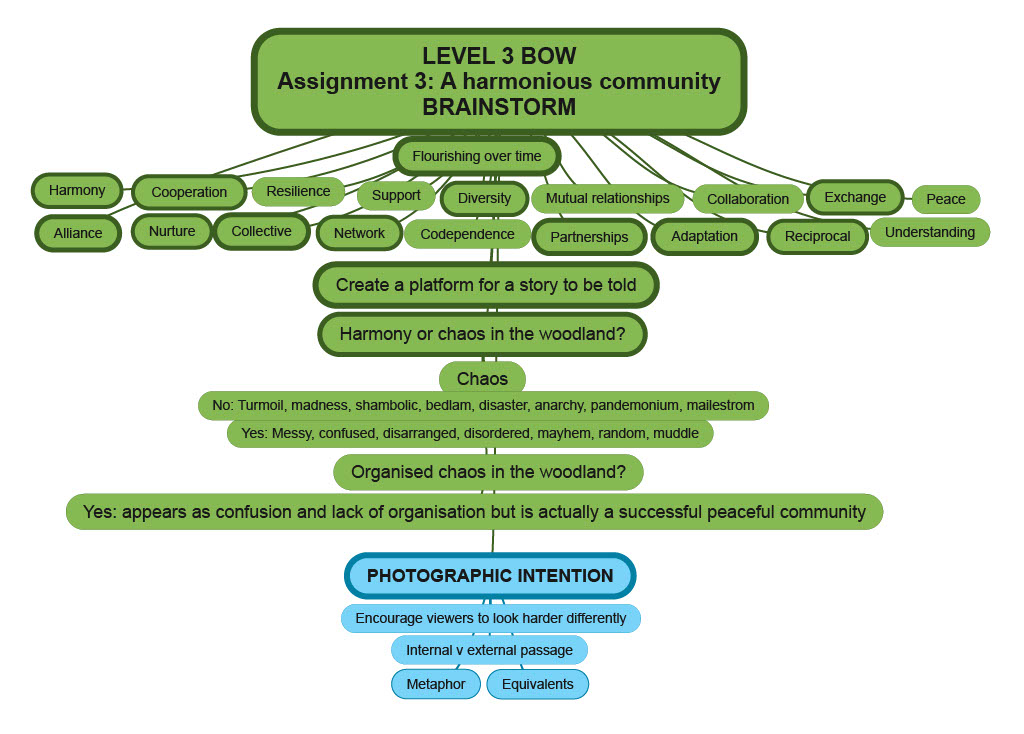
Definitions and synonyms of concepts

Harmony:

Definition: the situation in which people live or work happily together without and big problems…

a situation in which people are peaceful and agree with each other, or when things seem right or suitable together…Harmony is the combination of separate but related parts in a way that uses their similarities to bring unity (Cambridge Dictionary, 2022).

Synonyms: Collaboration, teamwork, consensus, cooperation, peace, tranquillity, understanding, unity, accord, amicability, compatibility, concord, empathy, sympathy, corporation, nurture, support, mutuality, alliance, co-dependency, partnerships, reciprocal.

Chaos:

Definition:a state of total confusion with no order…a state of disorder and confusion ” (Cambridge Dictionary, 2022).

Synonyms: Messy, confused, madness, turmoil, disarranged, disordered, shambolic, bedlam, disarray, mayhem, turmoil, destruction, disaster, random, anarchy, discord, disorder, pandemonium

Turmoil, bedlam, muddle, topsy-turviness, bedlam, disturbed, havoc, maelstrom.

Organised chaos:

Definitions:a situation in which there seems to be a lot of confusion and no organisation, which makes you surprised that the results are good”. (Cambridge dictionary).

a complex situation or process that appears chaotic while having enough order to achieve progress or goals” (Burnell, 2022)

REFLECTION: I return to my earlier thought that harmony doesn’t depend on homogenous components, and there is scope for a variety of beings to coexist harmoniously. The many elements of woodlands may at first appear chaotic, but in reality it is a peaceful community.

I will continue with my theme as the woods as a visual metaphor for a harmonious community. However in my photography reflect my current feelings about disharmony in my local community by showing that a community of many varied parts can coexist in harmony.

INFLUENCES FROM RESEARCH

These confirmed maintaining my original approach for my BOW “internal and external passage:

  • Gregor Radonjic: Metascapes Transforming and representing what in our subconscious – personal landscapes – distorted reality – artworks between fiction a and reality- the real landscape is in your head
  • Inside the Outside landscape collective: Going out was really going in- narrative, metaphor, investigation
  • Stephen Seagasby: Physical mental and emotional level using metaphor
  • Rob Hudson: making abstract thoughts more concrete through rep of the world around us (ITO 2016), Landscape dependant on how our intellect views them (Hudson, 2016), Photography can transform objective reality
  • J.M. Golding: Lived and unconscious v learned and conscious Wilkinson: a photograph says as much about the photographer as the landscape, Literal appearances of subjects to metaphors for internal experience (G 2022)

Mindmap BOW Assignment 3 Brainstorm:

SHOOTING

Whilst walking forefront of my mind was the disharmony in my local community and the contrasting harmony in the woodlands. When shooting in the woodlands I was open to scenes that would share visually what a chaotic and complex community it is, and yet illustrate that this “organised chaos” is actually successful and peaceful- diversity is absolutely fine.

My first day of shooting was an unusually sunny day and as the woodlands are shady it seemed visually pleasing, however on  reviewing the images I returned on an cloudy day and obtained better results. I returned several times until I had plenty of images that I was happy with.

Mindmap BOW Assignment 3 Shooting:

EDITING

When editing foremost in my mind was my intention to share the chaotic but peaceful harmony in the woodland community. Backstory – Harmony or chaos?

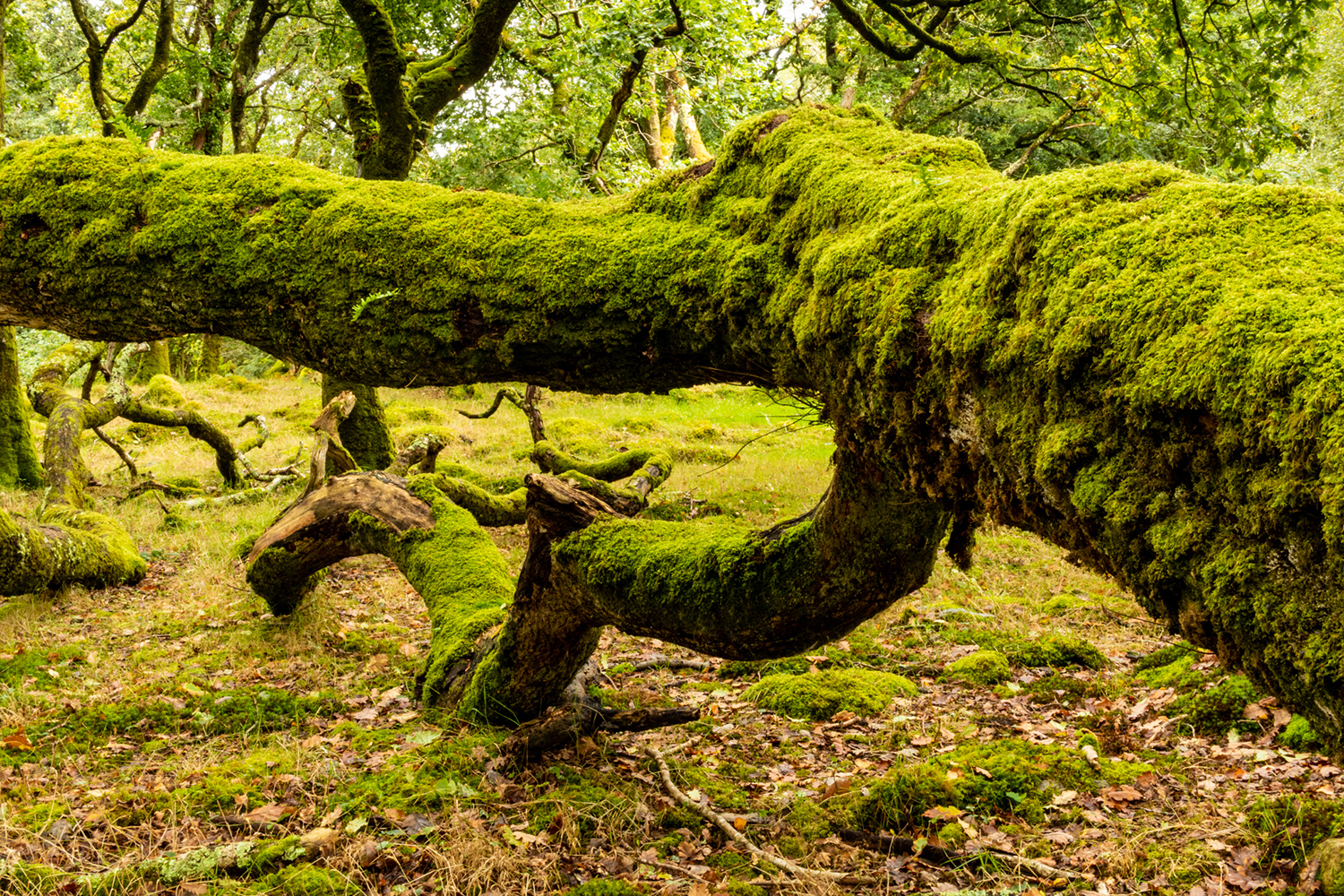
I chose images that shouted: mess, muddle, random, confusion, disorder, but that also looked tranquil. I sought images that were complex and would cause viewers to look closely to find the meaning.

I also considered my use of colour in the light of my research, should I keep the colour true or use it to express my intention? It was obvious to me that the true rich greenness of the woodlands expresses my intention perfectly, so I simply retained the true colour as seen and captured.

I gave time to the editing and once I’d narrowed down to possible images, I started working on which would fit in a series.

I dropped some weaker images such as:

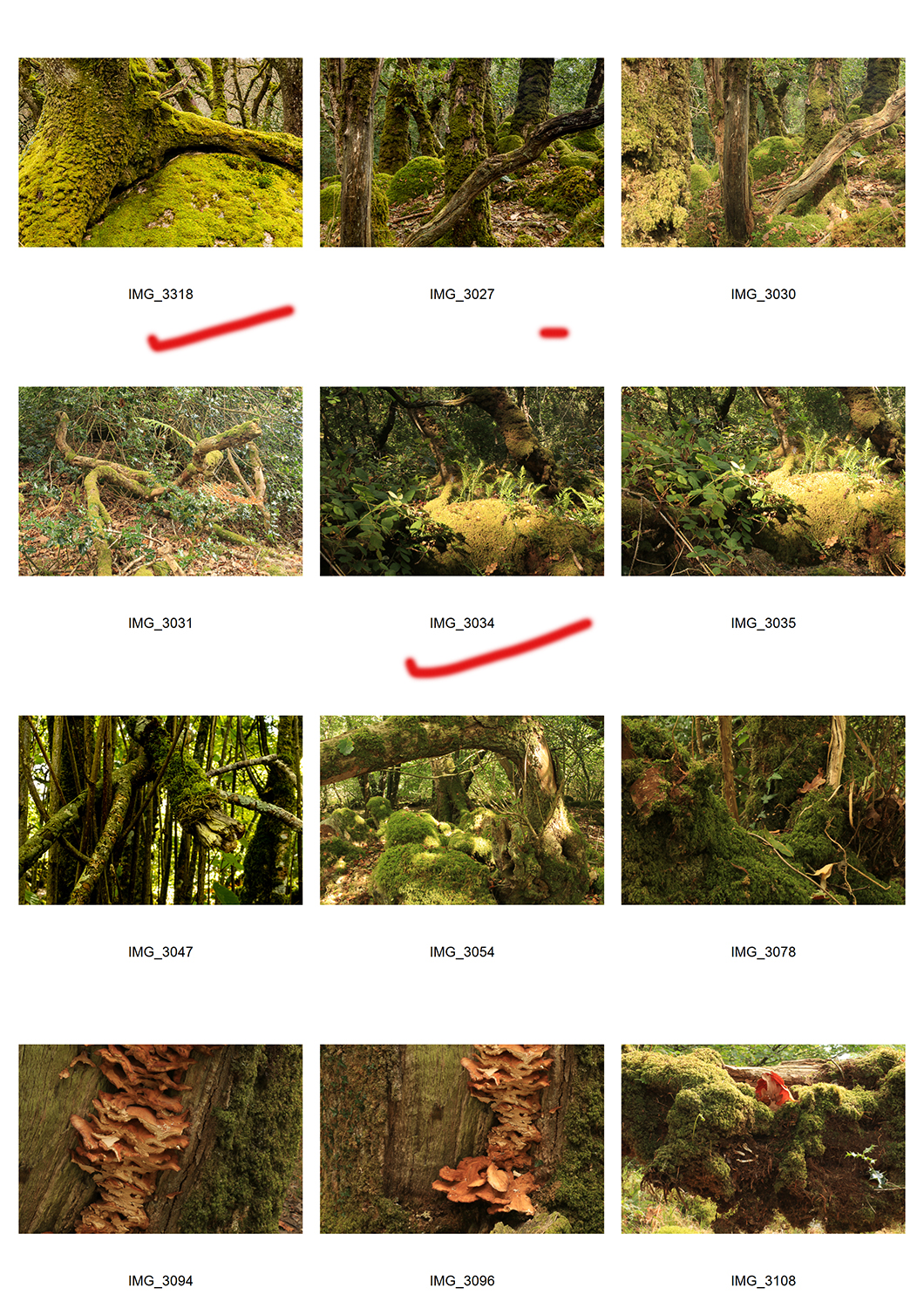
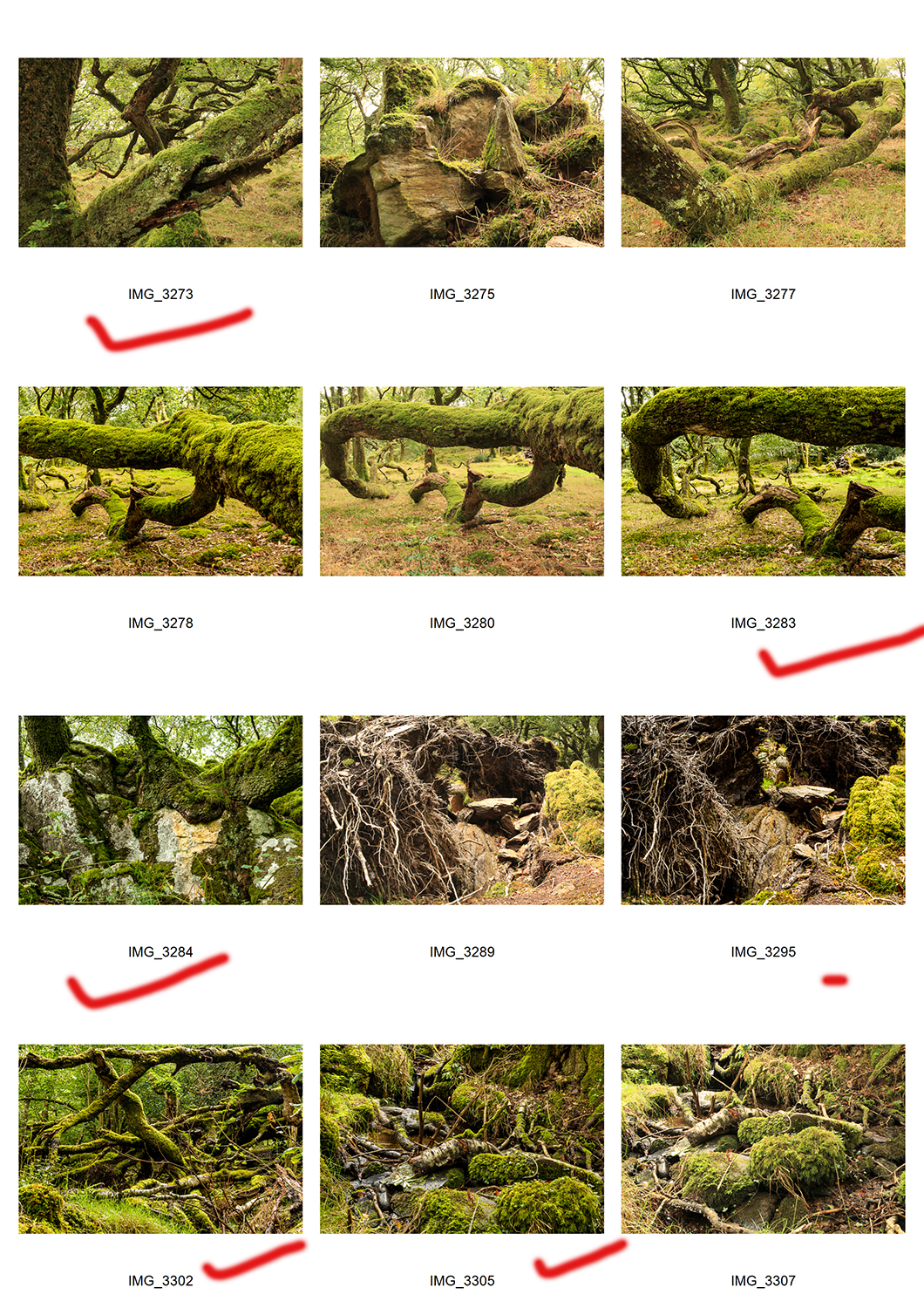
Image: 3278

I asked which images fitted in a series? The form of these didn’t:

Images : 3047 3254 3295

I asked which images strengthen my ideas or voice and which images slowed the narrative down or weakened my narrative? I dropped:

Image 3027

I looked closely at those I was left with. For instance I vacillated between:

And dropped the 3247 as although it gave more context this diluted the message

I reluctantly dropped one of my “babies” which Id spent much time on as though it clear to me it was a tree lying on its side when I shouldn’t naturally be, it might not be obvious to others and it didn’t fit in the series as well

Image 3162

Then this image was dropped to get the series to a cohesive flowing set of 8

Image 3256

Finally I checked myself by answering as suggested in the coursework:

•    Will the image stand as a visual piece on its own?

•    Is the image adding anything new or emphasising the point I want it to?

•    Is it detracting or contradicting from the rest of the series?

•    Am I overlooking any less striking work because of aesthetic concerns that may be secondary to the impact the piece will have on final reading?

I am satisfied with my choice of images in the light of these challenges.

Mindmap BOW Assignment 3 Editing:

Presenting

When sequencing I tried to provide for a flowing narrative from one image to another and increasing the viewers response.

Aware that I need to signpost the work for my viewers I decided for this work to do so simple with captions. Each image to be captioned with a harmonious and chaotic synonym. I matched the words with the images as I best thought.

Next post: https://nkssite6.photo.blog/category/body-of-work/bow-assignments/bow-assignment-3/bow-a3-contact-sheets/