I have already written much about Minor White, so here is a synopsis of the areas of his practice which influence my Body of Work.
Minor White research revisited:
- He had an amazing eye for observation of the natural landscape and used seeing and feeling in his work “to register a sense of things beyond the visible world” (Green, 1972).
- He opens up the act of seeing, “Although their meaning seems to at first to be wrapped in metaphor, we see finally that they are frank and open records of discovery” (Szarkowski, 1970:174).
- His final form was less important that the meaning it evoked, photography had the ability to be metaphorical and photographic representation must be symbolic (Grunberg, 1989).
- “Great pictures cannot be just about particular landscapes; they have to direct us to more, even eventually to the whole of life” (Adams, 2009:92).
References:
Green, J. (1972) ‘Back cover’ In: Hayden Gallery (ed.) Octave of Prayer: an exhibition on a theme at M.I.T. 27th Oct-26th Nov. 1972,. New York: Aperture.
Grundberg, A. (1989) ‘PHOTOGRAPHY VIEW; Minor White’s Quest for Symbolic Significance’ In: The New York Times 30/04/1989 At: https://www.nytimes.com/1989/04/30/arts/photography-view-minor-white-s-quest-for-symbolic-significance.html (Accessed 25/08/2019).
Szarkowski, B. J. (1970) ‘Mirrors Messages Manifestations’ In: The New York Times 08/03/1970 At: https://www.nytimes.com/1970/03/08/archives/mirrors-messages-manifestations-mirrors-american-manhattan.html (Accessed 21/08/2019).
Adams, R. (1989) Beauty in Photography: Essays in Defense of Traditional Values. New York: Aperture.
John Blakemore – A summary of my reading for CS that I have taken into my body of work
Like Minor White, John Blakemore’s (1936-2022) landscape photography also signifies the “felt and the unseen as well as the seen” (Badger, 1977:7), he uses subjects for metaphor as well as for the literal. He often explores a theme over time, using series and motifs, working with intimacy with one subject (Parkin, 2021), returning to the same subject over time. He shows intense awareness of his subject and his photography is “a process of exploring and defining ones relationship to the world”. (The Photographer’s Gallery, 1980).
He sometimes uses hid landscape photography as a metaphor for his own emotions. His work ‘Wounds of trees (1971) is seen as a metaphor for his precarious emotional state, following the breakup of his marriage.
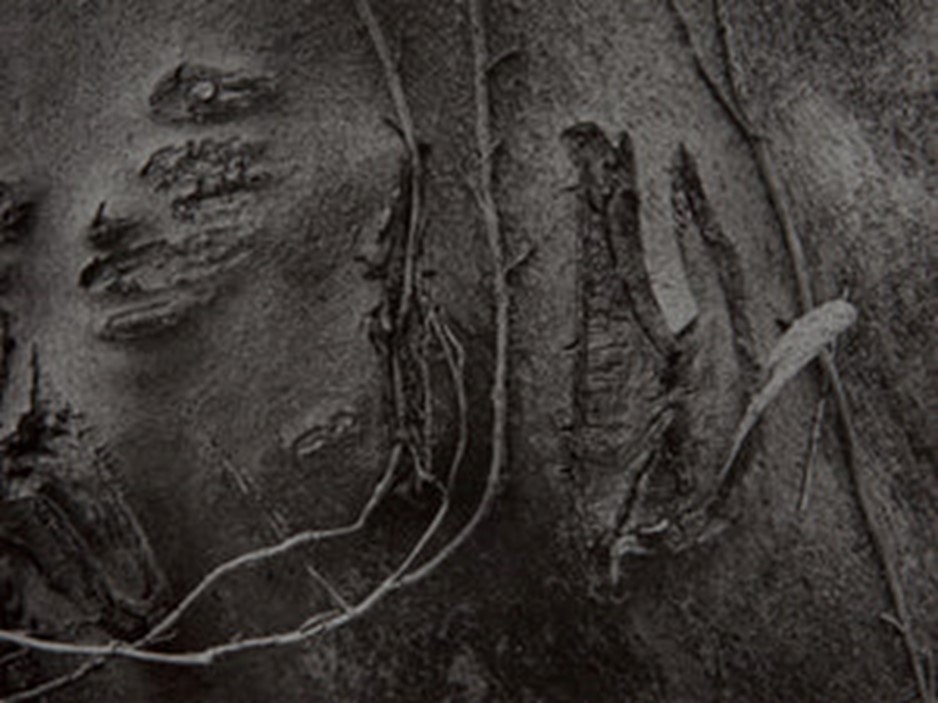
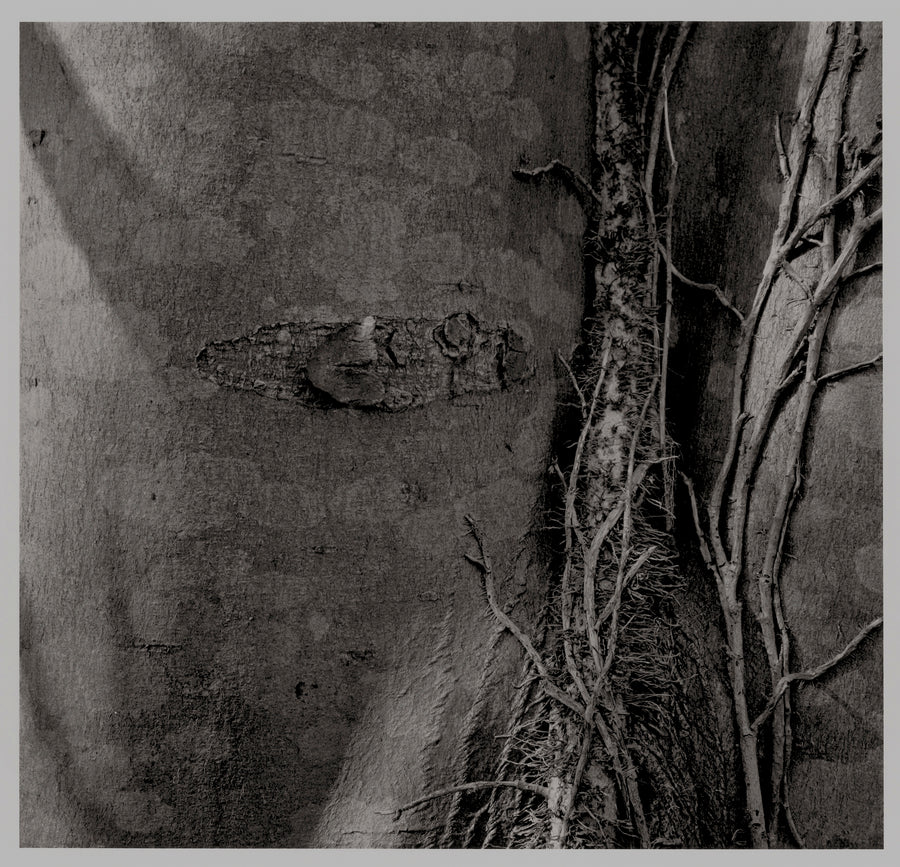
(Blakemore, 2023)
In this work Badger suggests that Blakemore tries to quantify and communicate experience through photographic meaning, saying that his images are “the result of a long process of coming to terms with himself and the places he choose to photograph” (Badger, 1977:8).
Blakemore’s equivalence operates at the factual level of a subject, on the formal and spatial level, as well as the personal, spiritual and emotional level (Badger, 1977). Describing his photography Blakemore says it represents aspects of the real “The photograph is the result of an interaction between the photographer and an aspect of the real” (Blakemore, 2005:12). He also uses White’s term ‘previsualisation’ when discussing his techniques for photographing (Blakemore, 2005:12). The Lila and Wind series is more akin to Edward Weston’s work, than White’s – abstract framing of realism.
In my work in the ancient woodlands, I can identify with Blakemore when he says:
“My work in the landscape was based upon a ritual of intimacy, the intense exploration of small areas of the landscape, an are of woodland, a length of river, a confined stretch of beach. Areas which in some way spoke to me, which I could visit again and again, to learn to see, to allow the possibility of communion, of understanding”. (Blakemore, 2005:14).
References
Blakemore, J. (2005) John Blakemore’s Black and White Photography Workshop. (Newton Abbot): David & Charles.
Blakemore (2023) Early landscape – Fragments At: https://www.johnblakemore.co.uk/collections/early-landscape-fragments (Accessed 28/05/2023).
Badger, G. (1977) ‘Introduction’ In: British Image 3: JOHN BLAKEMORE : EXHIBITION. London: Arts Council. pp.7–10.
Parkin, T. (2011) John Blakemore. At: https://www.onlandscape.co.uk/2011/03/master-photographer-john-blakemore/ (Accessed 25/04/2022).
Parkin, T. (2023) Black and White Photographers Workshop – John Blakemore. At: https://www.onlandscape.co.uk/2011/03/book-review-black-and-white-photographers-workshop-john-blakemore/ (Accessed 28/05/2023).
The Photographers Gallery (1980) John Blakemore At: https://thephotographersgallery.org.uk/whats-on/john-blakemore (Accessed 28/05/2023).
Bibliography
John Blakemore (1980) At: https://thephotographersgallery.org.uk/whats-on/john-blakemore (Accessed 28/05/2023).
Blakemore, J. (2017) Meeting of Minds Conference 2016 – John Blakemore. At: https://www.onlandscape.co.uk/2017/05/john-blakemore-conference-video/ (Accessed 25/04/2022).
Blakemore, J. (2023) John Blakemore. At: https://peoplepill.com/people/john-blakemore (Accessed 28/05/2023).
Blakemore, J. and LensCulture (2023) The Stilled Gaze – Photographs by John Blakemore. At: https://www.lensculture.com/articles/john-blakemore-the-stilled-gaze (Accessed 28/05/2023).
Parkin, T. (2011) John Blakemore. At: https://www.onlandscape.co.uk/2011/03/master-photographer-john-blakemore/ (Accessed 25/04/2022).
ON LANDSCAPE – ONLINE LANDSCAPE PHOTOGRAPHY MAGAZINE
I have gained a wider range of knowledge, especially from contemporary landscape practitioners, who write in the online photography magazine On Landscape. Below are some examples of those who influenced my photography during BOW A5.
ON FLOW STATE VS LEAKY ATTENTION (GUY TAL: ON LANDSCAPE ISSUE 268)
He asks the question, does creativity require de-focused attention, allowing new ideas to emerge and new associations to be made, or does creativity require intensely focused attention on specific tasks? He concludes both, at different times. The most successful creators are those who excel in maintaining both types of attention and switching between them at will to facilitate both the generation of new ideas and the discipline to reclaim attention and to focus it intensely on the detail-oriented tasks needed to carry a chosen idea to fruition (Tal,2022).
He explains that ‘consciously assigned attention’ is known as “top-down attention.” This is where attention may be hijacked and diverted without conscious choice by external events: loud noises, flashes of light or colour, chatter, the chirping or vibration of gadgets. Attention assigned by the brain without conscious choice in response to external stimuli is known as “bottom-up attention.”
Tal notes that Edward Weston described what we now refer to as the process of visualization, where he previsualized before shooting. Tal explains that by visualizing our photographs in advance, before being inspired by actual experiences, we bypass the “leaky attention”. divergent thinking and focus attention on the specifics and technical considerations of achieving a preconceived idea—convergent thinking. This he says prevents us from being open to novel, creative ideas (Tal, 2022).

(Tal, 2022)
Mindfulness he says is when we are able to quickly see when interfering thoughts and emotions intercept our consciousness; If these are detected, with conscious control
We can set them aside and stay focused on the task at hand.
Reference
Tal, G. (2022) Attention and Creativity. At: https://www.onlandscape.co.uk/2022/11/attention-and-creativity/ (Accessed 06/04/2023).
DO YOU REALLY NEED A PHILOSOPHY FOR YOUR PHOTOGRAPHY? THE QUEST FOR A PRAGMATIC REALISM (KEITH BEVEN ON LANDSCAPE ISSUE 268)
Bevan says that the problem of realism is that what we see may not be what is the actuality. When we view a rock in the landscape, we can experience that rock through our senses, but these feelings may show the true nature of the rock, and how we see the rock will be subjective. He suggests there are two philosophical aspects of realism, ontological and aesthetic. The first is the deeper levels of understanding that might be associated with that rock, these he calls ontological mysteries (or potential possibility). We should be open to these possibilities and allow that there could be some deeper levels of understanding about the nature of a rock for instance.
The 2nd mystery is the aesthetic impact of an image, the mystery is that the responses to an image aesthetics and emotional can be personal and can be different for the photographer and the viewer. This he calls this pragmatic realism, where it is accepted that the experience of a landscape is that the impression conveyed cannot be completely real. It is dependent on our experience and personal understanding of the landscape and the technical choices we choose.
Currently I can align with this idea of pragmatic realism- personal expression with little manipulation, just perspective and scale.

Hyper-reality Abstract 7, Hauterive, Switzerland (Bevan, 2021)
Reference
Bevan, K. (2022) Do you really need a philosophy for your photography?. At: https://www.onlandscape.co.uk/2022/11/need-philosophy-for-your-photography/ (Accessed 06/04/2023).
PORTRAIT OF A PHOTOGRAPHER EQUIVALENCE IN NATURE PHOTOGRAPHY JASON PETTIT (ON LANDSCAPE ISSUE 270)
Pettit shares his thoughts that Nature and landscape photography can be an outlet for personal expression, and an outlet from everyday tensions. He uses photography as metaphors and mirrors himself. He notes that this meaning beyond literal representation in our photographs, was first conceived of by Alfred Stieglitz in the 1920s through the concept of “Equivalence”, which he says has become the backbone of photography as a medium for personal expression.
He describes equivalence in a simple way, saying that any photograph might function as an Equivalent to someone, sometime, someplace, “When a photographer presents us with what to them is an Equivalent, they are telling us, “I had a feeling about something and here is my metaphor of that feeling.”” (Payne, 2022). Equivalence opens opportunities for conveying/evoking feelings, which could otherwise not be photographed. Payne suggests that Pettit uses shapes, colors, forms, and patterns for expression to arouse specific ideas and emotions.


(Pettit, 2022)
Reference:
Payne, M. (2022) Jason Pettit – Portrait of a Photographer. At: https://www.onlandscape.co.uk/2022/12/jason-pettit/ (Accessed 06/04/2023).
END FRAME GILLY WALKER COMMENTS (ON LANDSCAPE ISSUE 269)
When photography becomes art, it works as a conversation between the viewer and the artist. The artist creates the work and shares it to the viewer; the viewer responds, completes the dialogue when he responds, “They will fill in the blanks in their own way, and for this to happen there need to be blanks to fill” (Walker, 2022).
Reference
Walker, G. (2022) End frame: Skyfall by Valda Bailey. At: https://www.onlandscape.co.uk/2022/12/end-frame-skyfall-valda-bailey/ (Accessed 07/03/2023).
RICHARD MARTIN FEATURED PHOTOGRAPHER (ON LANDSCAPE ISSUE 270)
Richard Martin’s work “is a celebration of the visual world. It originates straight from the heart, honest and direct. Inspired by colour, texture and light, I take photographs to express feelings surrounding my experiences, searching for visual equivalents to those feelings.” (Martin, 2022). He says that there is always a subjective aspect to a photograph, that tells us as much about who is behind the camera as about what is in front of it, “Our perceptions and biases, which are determined by our background, character, self-awareness, and sensitivity, will determine both what we will choose to photograph and how we will photograph it” (Martin, 2022).
I should explore these photographers who he says have inspired him:
Ernst Hass, Paul Strand, Edward Weston, René Burri, Franco Fontana, Aaron Siskind, Freeman Patterson, Jay Maisel, Saul Leiter, Peter Turner, Shinzo Maeda, William Neill, and Stephen Patterson. Harry Callahan, and Joel Meyerowitz I am already aware of their work.
Martin says to always choose your emotions over intellect. Trust your inner voice and your intuitive eye.

(Martin, 2022)
Of his image above he describes how he discovered this image and explored the bog’s surface from the edge of the path. It was made with a moderately wide-angle lens, and excluded any reference of scale, to allows the viewer to interpret it on their own terms. He mentions that retaining a child’s view of the world is something he holds on to. Similarly, he says that he undertakes the process of discovery and selection in a meditative and contemplative fashion. He likes to approach subject matter without preconceived ideas, and to keep free from all formulas and rules, which are in no way part of the creative process. Martin considers himself a ‘gatherer’ photographer, with a receptive mood, gazing aimlessly, paying attention to their feelings and moods, who prefers to be surprised than aiming to surprise.
“The greatest breakthroughs in my photography have been achieved during times of playfulness. It is the perfect tool for allowing experimentation and change. Play is fundamental to creativity and an excellent means to stimulate our minds” (Martin, 2022). Asked how he keeps an open mind he says to believe in your work, regardless of what others may think, and be honest and realistic in your assessment.
When asked about his practice often of including some writing, or a quote with his images he comments that an image should stand alone in terms of its poetry, visual fluency, or expressiveness, without a caption or quote to make it better. However, that text may reinforce the photographer’s feelings or philosophy surrounding the image.
Interestingly he mentions that research suggests that being around trees is good for our mental and social well-being, as they help us feel less stressed and more restored; I must keep up my wanderings with a camera in the woods after my major project. He like myself also enjoys quiet time spent exploring a small area. He uses a quote from Freelance journalist Jill Suttie, Staff Writer and Contributing Editor at the Greater Good Science Center:
“While being in nature leads to better health, creativity, and even kindness, there may be something special about being among trees. Probably the most well-researched benefit of nature exposure is that it seems to help decrease our stress, rumination, and anxiety. And much of that research has been conducted in forests.”
Martin’s methods and photographic attitude espouses mindfulness, with creativity as an attitude, a habit of mind, and creativity as fun.

(Martin, 2022)
Reference
Martin, M. Griffith, M. (2022) Richard Martin. At: https://www.onlandscape.co.uk/2022/12/richard-martin-featured-photographer/ (Accessed 07/04/2023).
CAMELS, LIONS, AND CHILDREN THE PURSUIT OF FREEDOM GUY TAL (ON LANDSCAPE ISSUE 270)
Tal, explains Nietzsche’s three described “metamorphoses of the spirit”, these being stages of personal development that people may take. Nietzsche described the three stages as analogous to adopting the attitudes of a camel, a lion, or a child.
One stage is as a lion who must fight to gain the freedom to live according to its own values. Its attitude is confrontational, subversive, aggressive, defiant, and sometimes offensive to others.
Another stage is as a Camel, who does conform for the sake of public approval and avoids conflict or rebels at the risk of antagonising others.
He also describes how a lion may, after asserting himself over to many established norms and living by its own values, a lion may by transforming itself into a child. The child stage is innocence, forgiving, forgetting, as a new beginning. Nietzsche meant is that a child by nature doesn’t feel itself laden by traditions and norms and is free to pursue whatever feels “right.” A child may also invent new values for itself, whilst a lion resists values imposed on it by others.
Tal suggest that the best testament he knows of such transformation from lion to the child in photography is this passage by Minor White:
“Most adults have to regain the ability to experience pictures directly and deeply. Contrary to their convictions that they understand everything, most people have to reestablish the ability to let a photograph speak for itself. And paradoxes abound, one has to earn the innocence of vision—by hard effort, by serious and deliberate search for meanings in photographs.” (Minor White cited in Tal, 2022).
Reference
Tal, G. (2021) Camels, Lions, and Children The PURSUIT OF FREEDOM. At: https://www.onlandscape.co.uk/2022/04/colour-as-form/ (Accessed 27/03/2022).
Rene Algesheimer featured photographer (On Landscape issue 271 2023
Talks about top down conceptual, or bottom up, intuitive photography that develop ‘on the ground’. The later are usually stimulated from a specific in the landscape. The more she thinks about it, the more it develops into a project.
I’m interested in her statement “I am interested in interconnections and the importance of social grouping for the well being of the individual”. In her work Togetherness, she conveys how togetherness between the individual and a group can have enriching, positive, as well as negative aspects that need to be balanced. In her project ‘Together’ she noticed a series of trees in the Swiss Jura that only grow in groups, and form families, probably to protect themselves together from the harsh climate. She connected this with her scientific studies on social structures. Here, the trees became metaphors for us humans. With this series, she created mirrored diptychs of trees, resented so that each diptych represents different dimensions of Togetherness, e.g. belongingness, attachment, support or conflict, and pressure.

Togetherness (Algesheimer, 2019-20)
Algesheimer explains that she no longer photographs objects, but I uses heart as an expression of what she feels and wants to say. Going back to the top down and bottom-up methods, she tries to give space to both these. The analytical side flows into her conceptual projects, where she has pre thought about the intention, stories, and emotions of the story. Whilst she gives space to her emotional side by immersion in nature, engaging with what she sees.
References
Algesheimer, R. Griffith, M. (2023) Rene Algesheimer. At: https://www.onlandscape.co.uk/2023/01/rene-algesheimer/ (Accessed 08/03/2023).
Together (2019-2020) At: https://www.rene-algesheimer.com/project/together/ (Accessed 08/03/2023).
BEARING WITNESS: EXPERIENCING MOMENTS WITHOUT THE CAMERA. CHRIS MURRAY (ON LANDSCAPE ISSUE 271)
Murray suggests that seeing and feeling something fully is when we really experience something, only then can we feel intensely enough that we can fully express it. He says, “The best photos are the perfect confluence of eyes, mind, and heart” (Murray, 2023), if he’s not moved by something, or it has nothing to say he won’t photograph it. He believes that a camera can be an obstacle that compromises our experiences. He warns to be aware ‘shooting’ too much for as Sontag described souvenirs. Murray Argues that if we want more meaningful and rewarding experiences to make photos that are creative and self-expressive, there are times when the camera should not come out of the bag.- he calls this liberating.
Murray says that through photography, he has discovered that everything is already present in us, that we do not need anything, we don’t need to follow others, and we don’t need to learn techniques – it is most important to take our time:
“Time to get to know ourselves. Time to deal with our feelings and thoughts and to express them in pictures. And ultimately, the courage and authenticity to make ourselves vulnerable and share those thoughts and feelings with others”.
This seems an excellent mantra to me.
His blog: https://chrismurrayphotography.wordpress.com/
His website: https://www.chrismurrayphotography.com/
Reference
Murray, C. (2023) Bearing witness- experiencing moments without the camera. At: https://www.onlandscape.co.uk/2023/01/bearing-witness/ (Accessed 09/04/2023).
This reading has also led me to the book https://voiceoftheeyes.com/ Rene Algesheimer -this is a collection of interviews with exceptional landscape photographers collected and edited by René Algesheimer.
Book : The Mindful Photographer Sophie Howarth (2022)
This book focuses on slowing down, paying attention, and becoming attuned to your world when photographing working through various concepts such as, playfulness, compassion, and gratitude.
Howarth says “mindful photography is about prising open the tiny gap between what is happening and how we understand or respond to it, allowing ourselves to linger for a few brief moments in the fullness and freeness of direct perception.”(Howarth, 2022:9). She likens this to a simple curiosity known in Zen Buddhism as beginners mind.
Stephen Batchelor Buddhist teacher describes how the practices of photography are intertwined for him. He says photography is concerned with making images of reality, whilst meditation is about seeing reality as it is. The mindful photographer mixes curiosity and an open heart and mind, known in Zen Buddhism as ‘shoshin’. This “keeps all creative possibilities open” (Howarth, 2022:21).
On ‘devotion’ Thomas Merton a 20th century trappiest monk suggested that
“If one reaches the point where understanding fails, this is not a tragedy; it is simply a reminder to stop thinking and start looking. Perhaps there is nothing to figure out after all: perhaps we only need to wake up” (Howarth, 2022,:29).
Howarth suggests that a mindful photographer should connect with the world with confidence, and switch from an acquisitive to a receptive mindset; Minor White epitomised receptive mindset, sort of blank but active. Howarth also advises that ambiguity is essential for breaking away from learned perception. She quotes Uta Barth who says ”The question for me is how can I make you aware of your own looking, instead of losing your attention to thoughts about what it is that you are looking at” (Howarth, 2022:72). This is an action that I could experiment with.
The book also features the works and quotations from various photographers, these ones I find particularly inspiring:
Robert Adams: “A photographer can describe a better world only by better seeing the world as it is in front of him” (Adams, 1989).
Minor White: “When gifts are given to me through my camera, I accept them graciously” (White, 1977)
Marc Riboud: “Taking pictures is savouring life intensely, every hundredth of a second” (Riboud, nd).
Lee Friedlander: “You don’t have to go looking for pictures. The material is generous. You go out and the pictures are staring at you” (Friedlander 1975).p63
Henri Cartier-Bresson: “ You can’t go looking for it; you can’t want it or you won’t get it, first you must lose yourself. Then it happens” (Cartier-Bresson, 2010).
Susan Derges “There are things that live through us, or want to express themselves through us and if we could just get out of the way, we would do exactly what we are meant to be doing” (Derges, 2016).
The ideas presented in this book, around achieving free flowing photography, sit well with my recent personally expressive ‘bottom up photography’.
References
Adams, R. (1989) Beauty in Photography: Essays in Defense of Traditional Values. New York: Aperture.
Cartier-Bresson, H (2010) Display quote in the decisive moment. Simon and Schuster, New York, 1952).
Derges, S (2016) Display quote “Tide and pools”, Photomonitor, March 2016. Susan Derges and Purdy Hicks Gallery London.
Friedlander, L (1975) Display quote in documentary photography -LIFE library of photography (Time-life books, New York, 1975).
Howarth, S. (2022) The Mindful Photographer. London: Thames and Hudson.
Riboud, M. (nd) Cited in Howarth, 2022:55)
White, M. (1977) In Interviews Master Photographers. Cited in Howarth, 2022:65.


 NIKI SOUTH
