Brief background on lichen, ferns and mosses
Lichen
Are composite organisms made up of fungus and algae living together in the lichen body. The algal partner produces by photosynthesis nutrients (simple sugars) for the fungus and the fungus the body for the algae to live in protected from extreme conditions of heat or drought– a symbiotic partnership.
Lichens are extremely sensitive to environmental changes and are natural indicators of the health of our environment. They are affected by pollutants such as sulphur dioxide from coal burning and industry, as well as nitrogen compounds from intensive farming activities.
They form numerous shapes, sizes and structures ranging from tiny ‘pinheads’ to porridge-like crusts, to large leafy structures. They colonise most habitats on earth, even your car, but are very evident in ancient woodlands, where the levels of sunlight and moisture are ideal for lichens.
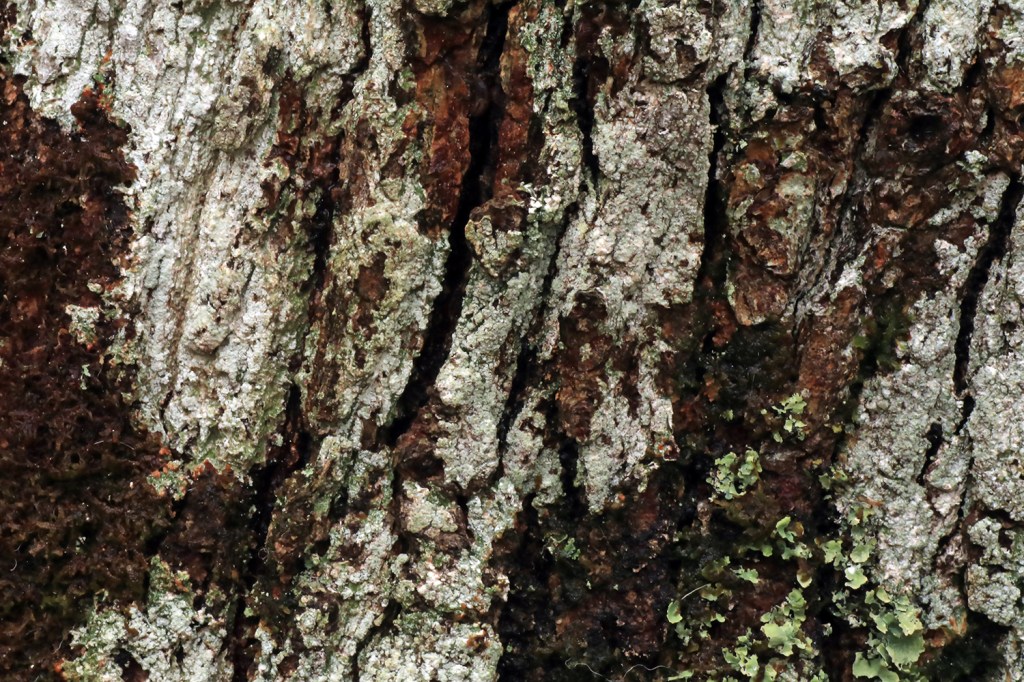
On twigs epiphytic lichens will quickly colonise new growth on branches but must compete with mosses and algae. There are three types of lichen, Crustose which looks like a crust on a bark, such as this one on a deciduous tree:
Foliose which attaches like a leaf and Fruticose that attaches to twigs with a sucker like stem and grows like a mini shrub, both can be seen here:

Merlin Sheldrake, author of “Entangled Life: How Fungi Make Our Worlds, Change Our Minds and Shape Our Futures”, gives a good description of lichens saying:
“They flicker between “wholes” and “collections of parts.” Shuttling between the two perspectives can feel strange. The word individual comes from the Latin meaning “undividable.” Is the whole lichen the individual? Or are its constituent members, the parts, the individuals? This confusion is healthy.” (Look at a lichen, 2021).
References:
Burt, E. (2018) Haloing, lichens and our ancients. At: https://naturebftb.co.uk/2018/03/14/haloing-lichens-and-our-ancients/ (Accessed 07/03/2022).
Woodland Trusts (2021) Look at a lichen At: https://www.wildlifetrusts.org/blog/guest/look-lichen (Accessed 07/03/2022).
Mosses
Also known as Bryophytes, there are 20,000 species around the world which may be microscopic or over a metre in size. They grow in many climates and environments. Tiny, non-flowering mosses are one of the oldest land plants known to Earth, believed to have first appeared around 350 million years ago, long before dinosaurs, and even though they grow slowly, about ¼ inch per century, they are virtually unchanged. In ancient woodlands they grow as green carpet-like mats across forest floors or covering tree trunks. Instead of seeds, mosses have evolved spores to give rise to new plants. They have no vascular system to move substances up through their roots, or move liquid around the plant, and depend on obtaining their water and nutrients by directly absorbing the resources into their leaves while using threadlike rhizoids instead of roots to anchor themselves into the ground. This means that in they need to be almost completely saturated with water. Moss leaves are only one cell thick so have complex leaf structures to maximize photosynthesis.
When in unfavourable, hot conditions: they can almost completely halt their metabolism when stressed. By slowing their biological processes, they just wait until water is available again. As mossy mats can help to prevent soil erosion and increase soil enrichment.


Uses of moss
Moss has been used for drinking water, decoration, food, fuel, and shelter over the years. In World War I, Sphagnum mosses (the most widespread moss) were used to dress wounds and stem bleeding from injuries. It is the major constituent in peat, a slowly renewable fossil fuel, though emitting more carbon dioxide than coal or natural gas.
References:
Evans, C. (2018) Mighty moss: how these ancient plants have survived for millenia. At: https://www.howitworksdaily.com/mighty-moss-how-these-ancient-plants-have-thrived-for-millenia/ (Accessed 07/03/2022).
Moss: The 350-million-year-old plants that turn the unsightly ‘into things radiant of beauty’ (2019) At: https://www.countrylife.co.uk/nature/moss-350-million-year-old-plants-turn-unsightly-things-radiant-beauty-203327 (Accessed 07/03/2022).
Ferns
Ferns are common in woodlands as most are shade tolerant and can grow all year round.
Hard fern is common in the wet conditions of west and north of Britain, preferring acidic rocks and walls, and are found growing amongst other plant species in ancient woodlands.

The epiphyte fern grows on trees and are very common in ancient woodlands. This fern lives half its life cycle on another plant such as a tree, usually the bark and the other rooted in the soil. These ferns start as epiphytes, low on the trunk of a tree, and later grow a single root down to the soil. Though rooted in the soil the fern continues to grow up the tree. Interestingly these ferns cannot live on the bark or on the soil alone and are an exception to the general rule that plants are adapted to live in just one habitat. In this case the fern must cope with living with both water poverty, on the bark, and water excess in the soil. Also, there are less nutrients that the fern needs to survive on the bark, so it must be very efficient at nutrient uptake before its root reaches the soil. What an amazing plant!

Reference:
Salt, A. and Salt, V. A. P. by (2019) A fern thought to grow on trees still keeps a root on the ground. At: https://www.botany.one/2019/10/a-fern-thought-to-grow-on-trees-still-keeps-a-root-on-the-ground/ (Accessed 10/03/2022).
Next post: https://nkssite6.photo.blog/category/research/bow-research/other-photographers-same-material/
 NIKI SOUTH