FUNGI RESEARCH
Mushrooms: The Art, Design and Future of Fungi (2020) Exhibition Somerset House
I visited this exhibition in 2020. In just a small couple of rooms the works of over 40 artists, musicians and designers inspired by fungi were brought together, collages, watercolours, recipes, illustrations as well as new ways of using mushroom materials especially mycelium.
According to the exhibition catalogue fungi having been objects of witchcraft and decay, became prevalent in art and design in the 1960s, especially after their appearance in children’s literature and botany and recently even more so
Background:
Fungi are closer to animals than plants. There are 2 types, those that carry water and those that break down organic matter. The mushroom that we see are the fruiting bodies of mycelium. Mycelium is the thread like underground root network of fungi, sometimes called the wood wide web. It passes nutrients and messages between plants. Chemically the substance that mycelium uses is similar to the neurotransmitters in our brain.
Plants, animals, humans, bacteria, and mushrooms live symbiotically, and such an “entanglement” are necessary for life. Fungi are needed also for creating products such as cheese, bread, penicillin, and vaccines. Mushrooms are also known for their psychedelic qualities and ritualistic and medicinal uses. Fungi are even used for cleaning oil spills and rehabilitating radioactive sites.
Mycelium can also be nurtured in laboratories by mycelium engineering as a biodegradable alternative to plastic and can be used to make shoes, clothing furniture and so on.
Notable mushroom artists:
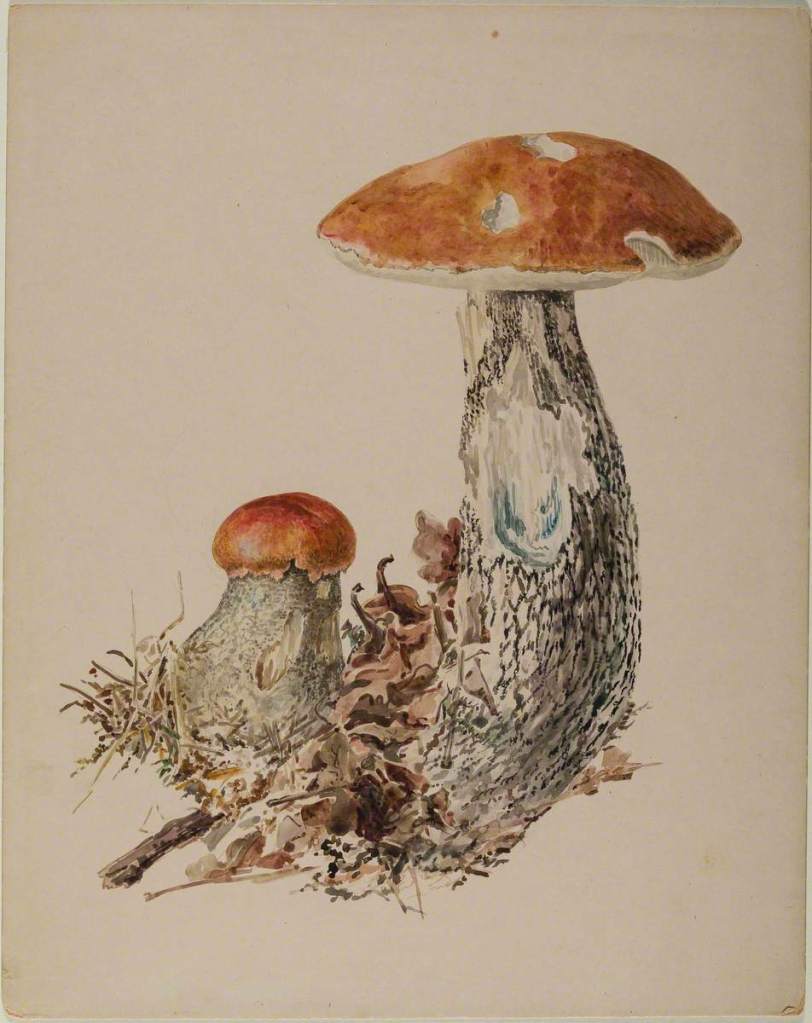
Beatrix Potter had a fascination with mushrooms and painted over 300 water colours of them; her detailed analysis of them was a starting point for her illustrations of nature and landscape in her books. It is suggested that interest in them is partly due to out of interest in the fragility of the natural world and wanting to connect ourselves to nature.
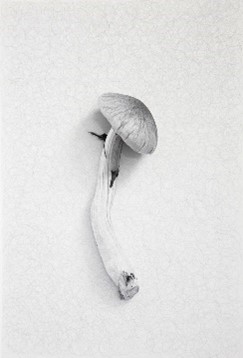
Annie Ratti’s series of overdrawn photographs are part of a larger body of work on psilocybe mushrooms, where she uses photography, drawing, installation, and text to explore their significance and how they grow in a rhizomatic way.
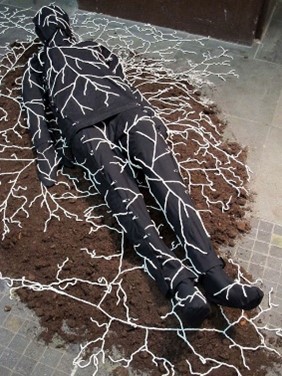
Jae Rhim Lee a Korean American artist, has designed an organic cotton, wood, and biomaterial burial suit, where she has sewn in mushroom spores to help a body decompose and deliver nutrients but not toxins to the environment.
The exhibition made me look at mushrooms in different ways as well as rethink their potential in areas from art to industry. It illustrates that the mushroom has become a figure of resilience, and points to new ways of living as humans become more disconnected from the natural world.
References:
Catterall, C. and Gavin, F. (2019) Mushrooms: The Art, Design and Future of Funghi. (s.l.): Somerset House Trust.
Hintz, C. (2016) Mushroom Death Suit: Funerals Go Fungal. At: https://www.cultofweird.com/death/mushroom-burial-suit/ (Accessed 04/03/2022).
Leccinum versipelle (2022) At: https://artuk.org/discover/artworks/leccinum-versipelle-312447 (Accessed 04/03/2022).
Mushrooms: The Art, Design and Future of Fungi (2019) At: https://www.somersethouse.org.uk/whats-on/mushrooms-art-design-and-future-fungi (Accessed 06/02/2022).
The Shroom Project (2022.) At: https://www.slashseconds.co.uk/annie-ratti/14/210/submission/the-shroom-project/ (Accessed 04/03/2022).
Further reading/research on mushrooms I’m yet to complete:
ECOLOGY WITHOUT NATURE (2022) At: http://ecologywithoutnature.blogspot.com/2011/04/david-reids-mushrooms.html (Accessed 10/03/2022).
Hall, S. et al. (2006) ‘Dr Derek Reid’ In: The Daily Telegraph 28/01/2006 At: https://www.telegraph.co.uk/news/obituaries/1508984/Dr-Derek-Reid.html (Accessed 10/03/2022).
Netflix (2020) Fantastic fungi. Director: Louie Schwartzberg Writer: Mark Munroe 2019.
Sheldrake, M. (2021) Entangled Life: How Fungi Make Our Worlds, Change Our Minds and Shape Our Futures. (s.l.): Vintage Penguin Random House.
Tsing, A. L. (2021) The Mushroom at the End of the World: On the Possibility of Life in Capitalist Ruins. (s.l.): Princeton University Press.
Weston, P. et al. (2021) ‘Why is it hard to get our head around fungi? (Part one) – podcast’ In: The Guardian 30/03/2021 At: http://www.theguardian.com/science/audio/2021/mar/30/why-is-it-hard-to-get-our-head-around-fungi-part-one-podcast (Accessed 26/10/2021).
Next post: https://nkssite6.photo.blog/category/research/reading/woodland-reading/lichen-ferns-and-moss/
 NIKI SOUTH