BODY OF WORK STARTING POINTS:
SUBJECT: Community
VISUAL REPRESENTATION: Ancient woodlands
WORKING TITLE: What ancient woodland communities can teach local human communities.
THEMES: Visual language & representation- seeing- metaphors- equivalents- symbols-abstraction
GENRES: Psychogeography/landscape/conceptual
SHOOTING METHODS: Abstract/macro/landscape/construction
CONCEPT: Ancient woodlands as a visual representation of community
My interest is in community. I have been part of the local community here both as an insider and outsider, observed it keenly and photographed aspects of it before in my work. My perspective is that there are positives and negatives and many wounds and divisions that it would be good to heal.
CONTEXT:
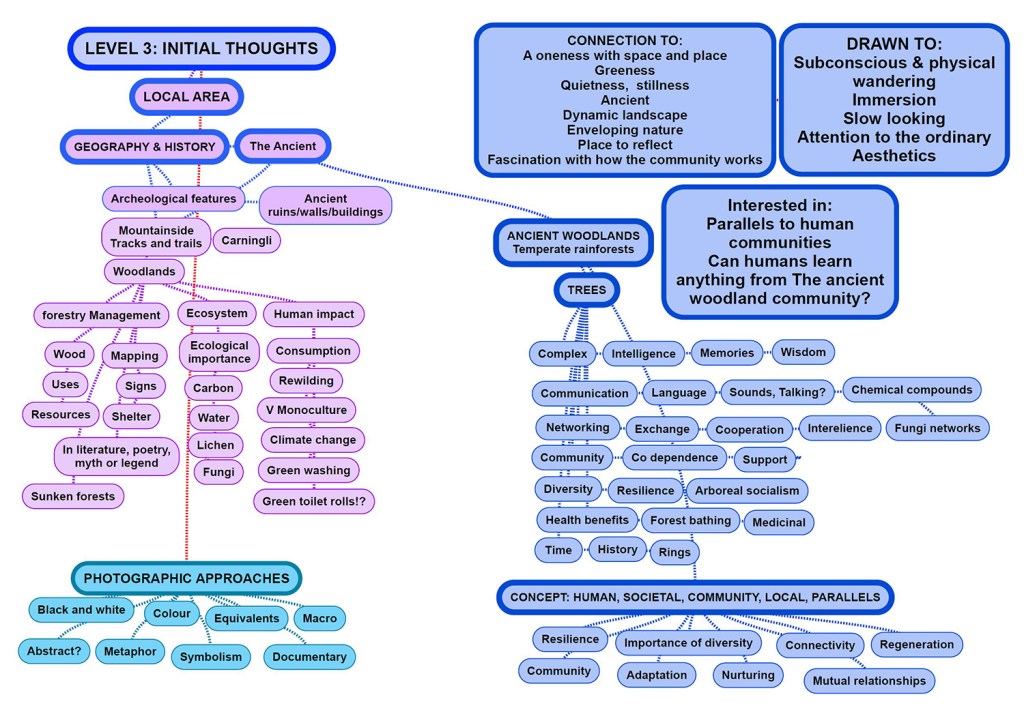
As a walker and photographer, I appreciate the ancient woodlands local to here, not only for their aesthetic appeal but for their example of thriving communities. As a terrain these small temperate rainforests envelop your senses, encourage you to slowly absorb what you see and feel, wake your subconscious, and inspire reflection. Ancient woodlands are complex communities, with trees at their heart. I am most interested in aspects of their community where parallels can be drawn to human communities; features such as communication, language, cooperation, support, diversity, resilience, networking, adaptation, mutual exchange and adaptation.
APPROACH:
I intend to use the ancient woodland community as a visual metaphor for local community, using a personal, expressive, reflective, visual approach as a visual metaphor for visual community.
RESEARCH
I completed the coursework part one Genres before shooting and did some research on landscape photographers that haven’t looked at before that might inspire my work. My starting point for new research were some of the inside outside landscape photography collective who negotiate the liminal space between the world before us and within. This was an initial scan, below are the main inspirations to me I took away:
- Rob Hudson: is a conceptual landscape photographer using metaphor and narrative. In his work the Secret language of trees, he gives clues to community, connectivity, and nurturing. He uses “Landscape as representation in photographic form” where he inhabits “two worlds, the one before us and the one within us” (Hudson, 2018). He believes we should illustrate the land by telling stories that interest us not just aesthetic presentations.
- Stephen Segasby: Uses space and place as a human response to environment and culture, and a metaphoric base for personal narrative, and “making sense” (Seagaby, 2021).
- Guy Dickenson: He explores place as internal and external passage. He describes how he shifts his eyes from foreground to background with “the passage of thoughts and of the body” (Dickinson,and Griffith, 2018); in the process, losing the horizon, using depth of field and perspective for texture tone and surface.
- Tom Wilkinson: In his narrative about his workNothing Remains, he says “landscape is composed not only of what lies before our eyes but what lies within our heads” (Wilkinson,,2021) and talks of place and self?
- JM Golding: “explores the transition from outer landscapes into inner through the experience of the soft fascination of place”, (Hudson,2018).
References:
Dickenson, G (2021) At: https://www.tracingsilence.com/about.html (Accessed 30/10/2021).
Inside the outside Collective (2018) Out of the woods of thought. An exhibition of photography. JW editions. limited edition of 200.
{Inside the outside Collective (2018) Out of the woods of thought. At: https://www.inside-the-outside.com/publications/2018-exhibition-book/ (Accessed 30/10/2021).
Brydon, A. et al. (2016) A DAY’S JOURNEY INWARD. At: https://www.inside-the-outside.com/jm-golding-days-journey-inward/ (Accessed 30/10/2021).
Dickinson, G. and Griffith, M. (2018) Guy Dickinson. At: https://www.onlandscape.co.uk/2018/05/guy-dickinson-featured-photographer/ (Accessed 30/10/2021).
Hudson, R (2018) Introduction in: Inside the outside Collective (2018) Out of the woods of thought. An exhibition of photography. JosephWright.co.uk. limited edition of 200.
Seagaby (2021) Stephen Segasby At: https://www.stephensegasby.com/index (Accessed 30/10/2021).
Wilkinson, (2021)Tom Wilkinson Art Photography (s.d.) At: http://www.i-m.mx/tomwilkinson/ArtPhotography/nothing-remains (Accessed 30/10/2021).
Wright, J. (2019) STATIONS. At: https://www.inside-the-outside.com/stations-guy-dickinson/ (Accessed 30/10/2021).
Previous research on Stieglitz: revisited:
- Photographs can illuminate personal philosophies (Szarkowski, 1970)
- landscape photography expressing his ideas and emotions rather than presenting pure visual facts.
Minor White research revisited:
- He had an amazing eye for observation of the natural landscape and used seeing and feeling in his work “to register a sense of things beyond the visible world” (Green, 1972).
- He opens up the act of seeing, “Although their meaning seems to at first to be wrapped in metaphor, we see finally that they are frank and open records of discovery” (Szarkowski, 1970:174).
- His final form was less important that the meaning it evoked, photography had the ability to be metaphorical and photographic representation must be symbolic (Grunberg, 1989).
- White’s 1963 paper on the concept of Equivalence (1963), described it operating at three levels, the graphic, the mental processes of the viewer and the memories and feelings that remain afterwards (White, 1963).
- “Great pictures cannot be just about particular landscapes; they have to direct us to more, even eventually to the whole of life” (Adams, 2009:92).
References:
Adams, R. (2009). Beauty in photography. New York, NY: Aperture.
Green, J (1972) in White, M. (1972). Octave of Prayer. New York, NY. p. Back cover.
Grundberg, A. (1989) ‘PHOTOGRAPHY VIEW; Minor White’s Quest for Symbolic Significance’ In: The New York Times 30 April 1989 [online] At: https://www.nytimes.com/1989/04/30/arts/photography-view-minor-white-s-quest-for-symbolic-significance.html (Accessed on 25 August 2019)
Pultz, J. (1980) ‘Equivalence, symbolism, and Minor White’s way into the language of photography’ In: John Pultz Record of the Art Museum, Princeton University Vol. 39, No. 1/2 (1980), pp.28–39 [Online] At: https://www.jstor.org/stable/3774627?seq=1#page_scan_tab_contents (Accessed on 22nd August 2019)
Szarkowski, B.J. (1970) ‘Mirrors Messages Manifestations’ In: The New York Times 8 March 1970 [online] At: https://www.nytimes.com/1970/03/08/archives/mirrors-messages-manifestations-mirrors-american-manhattan.html (Accessed on 21st August 2019)
White, M. (1963) ‘Equivalence the Perennial Trend: PSA Journal, 29 (7) pp.17–21.{Online] At: http://aransomephoto.com/wp-content/uploads/2016/10/Minor-White-Equivalence.pdf
Equivalence: the perennial trend (2016) At: https://theawakenedeye.com/pages/equivalence-the-perennial-trend/ (Accessed on 23 August 2019)
I have also been reading about woodland communities
See my bibliography under research: https://nkssite6.photo.blog/2021/11/07/research-trees-background-reading/
THE RESEARCH AND COURSEWORK GAVE ME SOME IDEAS HOW I COULD REPRESENT MY CONCEPT THROUGH THE LANDSCAPE:
- Represent the world within me with the world around me
- Search for my narrative within the landscape
- As a flaneur I can’t be objective
- Using a combination of blurred distant views with clarity in close up views.
- Disregard the horizon and play with perspective.
- Take viewers into my field of vision
- Show relationships within the woodlands
- Infuse images with the feelings I absorb in a place
- Create a platform for a story to be told
SHOOTING:
I began with Psychogeography as a genre is a good starting point .
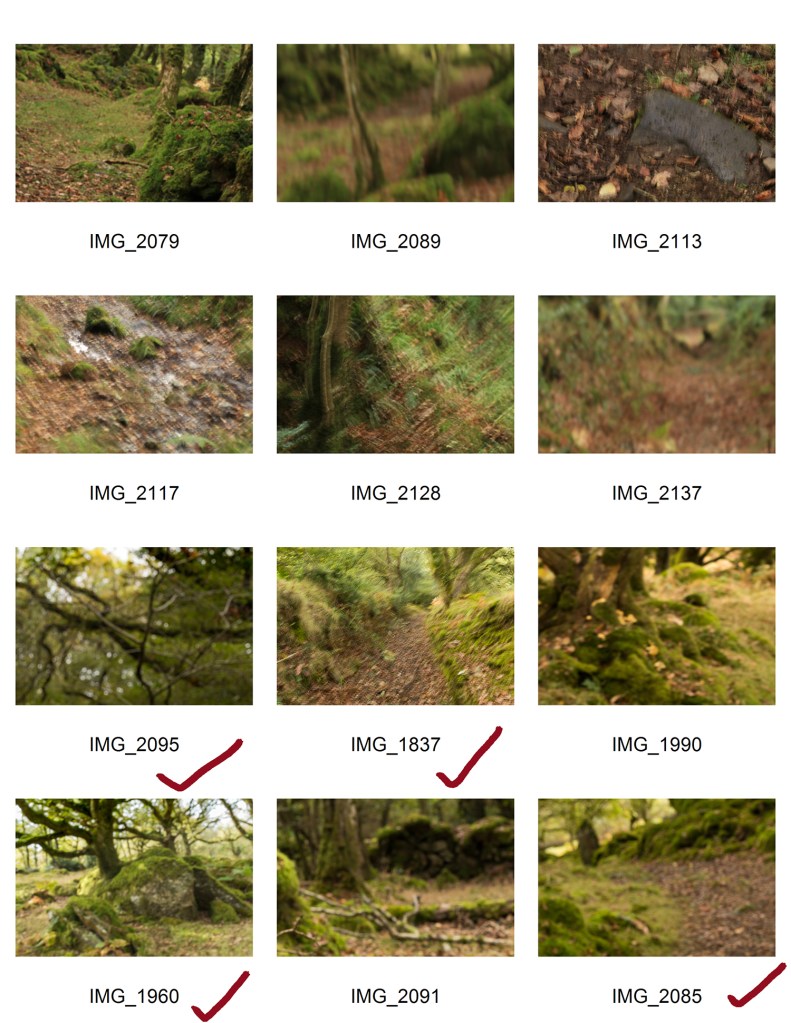
I set out to shoot using a combination of drifting and responding emotionally through place but with my theme of community on my mind. As walked, I recorded where my eyes rested. Then as I worked into the project I decided to replicate the scanning ahead that I did as I walked, by just capturing where my gaze went quickly – this resulted in lop sided views, blurred or out of focus images.
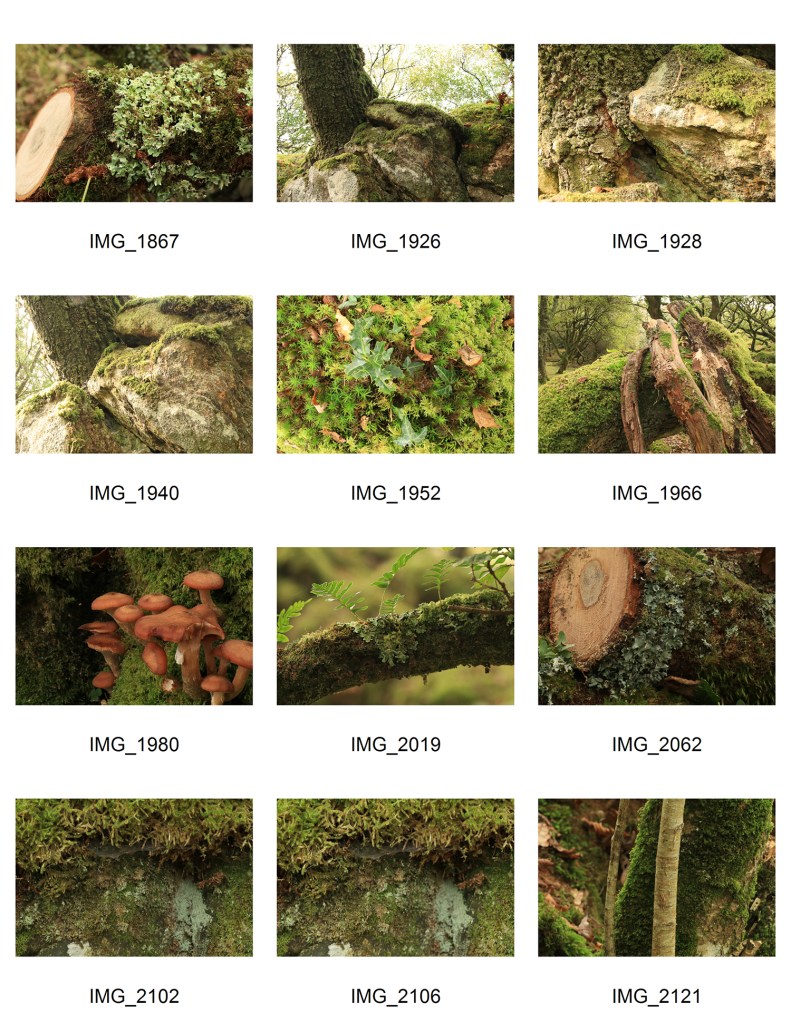
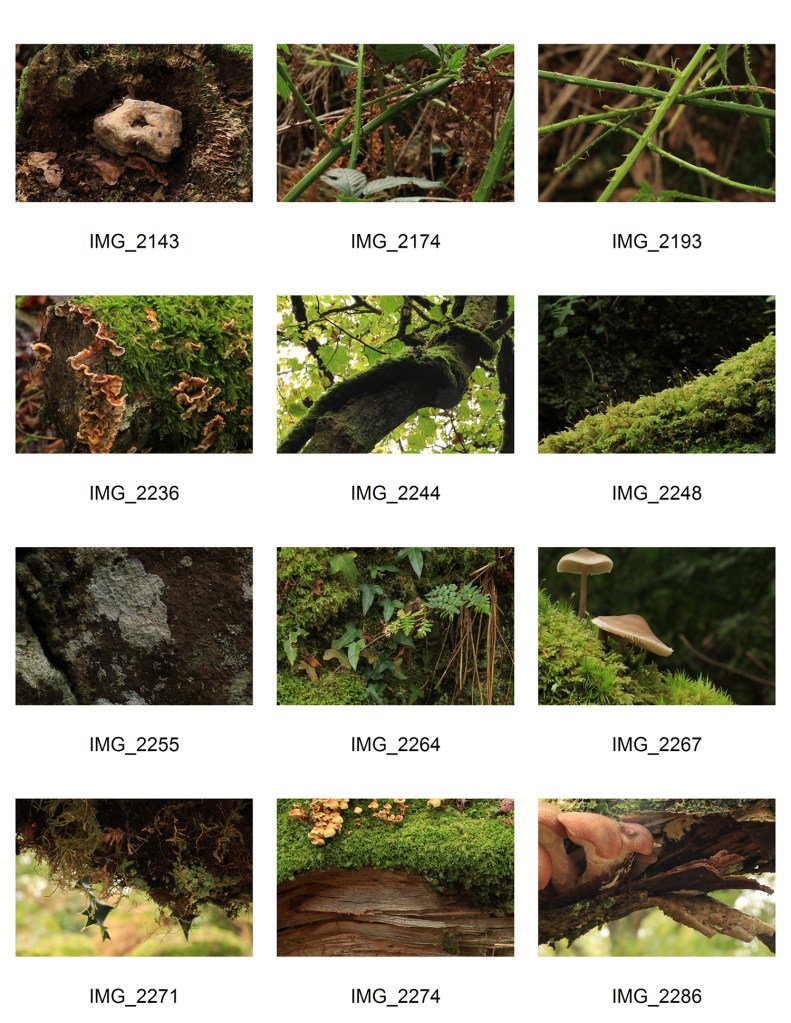
When I saw a detail that interested me, at first I shot with good depth of field for good clarity, as that’s what happens when I stop and closely observe something. My first shoot I predominantly used my prime lens, but on subsequent shoots I primarily used my 1:1 macro lens, for both the close up and scanning shots, which gave me the results I wanted. I also experimented with a shallow depth of field.
Once I had settled on my methodology, scanning versus detailed vision represented by uncontrolled photographing versus detailed close ups, I spent more time immersing myself in the place, just photographing whilst walking.
I didn’t set out to photograph in either colour or black and white, I felt that I had to see what transpired and then choose; I knew that this might make either less strong than if I deliberately sought subjects and compositions for one or other reasons, but that it was more important to go with the flow if I were to adopt the activity of drifting.
I did find it difficult to take completely ordinary shots of detail and subjects close up – I felt the need for there to be some aesthetics in my image, but in composing them I increasingly sought to enhance the aspect of the subject that spoke to me of community, through using different ways of seeing.

EDITING:
The images were taken over 2 shoots. After reviewing the images from the first shoot I returned to use only my 1:1 Macro lens which brought the results I wanted so that I could concentrate on immersing myself. I then had the blurred distant images that I wanted to represent my journey through the wood and plenty of detailed images. Whilst editing I tried to choose images that spoke the most to me about community. I thought about presenting different subjects to represent different aspects of community such as diversity, networking support and how I might present this, but then decided this might be something for the future. I returned for a final shoot to feel and capture the essence of community and relationship in the woodlands in different detailed ways, rather than to seek images to form a series.
I have chosen images that offer me different ways to continue this work:
General landscape representation, abstract representation and close up representation which could become abstract representations. Of course it maybe that I mix these styles in my work going forwards.

CONTACT SHEETS

Next post: https://nkssite6.photo.blog/category/research/woodland-bibliography/
 NIKI SOUTH